Russia sent spies to Ireland to check undersea fiber-optic cables: report

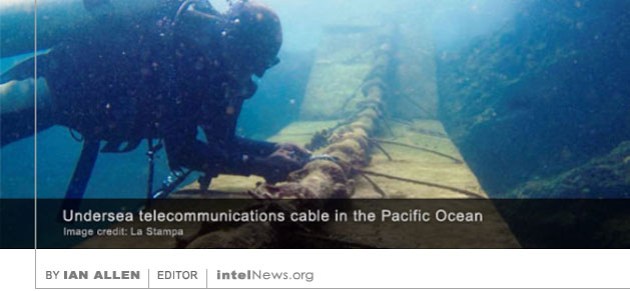
Undersea cableThe Russian government sent a team of spies to Ireland to monitor undersea fiber-optic cables, which enable communications traffic between North America and Western Europe, according to a new report. The spies were allegedly sent to Ireland by the Main Directorate of the General Staff of the Russian Armed Forces, which is known in Russia as GU, and formerly as GRU.
Due to its geographical proximity to both North America and Europe, Ireland constitutes a major hub for several of the more than 300 undersea cables that currently cross the world’s oceans. Totaling over 500,000 miles, these cables deliver Internet and telephone traffic across every continent. Nearly all transcontinental communications traffic is facilitated through these cables.

According to the London-based Sunday Times newspaper, the Irish security services believe that the GU spies were sent to Ireland to check the cables for weak points, in case Moscow decides to sabotage them in the future. Others claim that the Russian spies sought physical access to the cables in order to install wiretaps. The Times article also claims that Russian spies were detected by Irish security personnel monitoring the Dublin Port, which is Ireland’s primary seaport. This, said The Times, prompted a security alert in government facilities along the Irish coastline.

The same report claimed that the GU has been using Ireland as a base for operations in northwestern Europe, from where Russian spies can gather intelligence on European targets such as Belgium, the United Kingdom, Holland and France.

Author: Ian Allen | Date: 18 February 2020 | Permalink

Swiss neutrality ‘shattered’ as leading cryptologic firm revealed to be CIA front

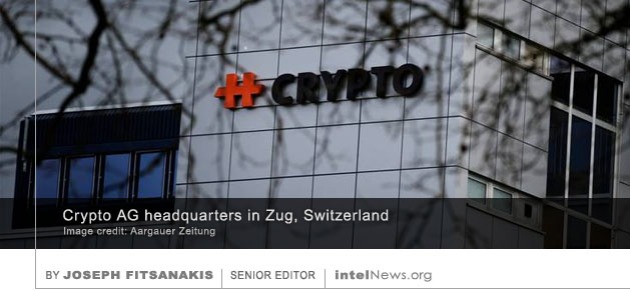
Crypto AGSwitzerland is reeling from the shock caused by revelations last week that Crypto AG, the world’s leading manufacturer or cryptologic equipment during the Cold War, whose clients included over 120 governments around the world, was a front company owned by the United States Central Intelligence Agency.
The revelation, published last Tuesday by The Washington Post and the German public broadcaster ZDF, confirmed rumors that had been circulating since the early 1980s, that Crypto AG had made a secret deal with the US government. It was believed that the Swiss-based company had allowed the US National Security Agency to read the classified messages of dozens of nations that purchased Crypto AG’s encoding equipment. These rumors were further-substantiated in 2015, when a BBC investigation unearthed evidence of a “gentleman’s agreement”, dating to 1955, between a leading NSA official and Boris Hagelin, the Norwegian-born founder and owner of Crypto AG.

But the reality of this alleged secret pact appears to have been even more controversial. According to last week’s revelations, the CIA and West Germany’s Federal Intelligence Service (BND) secretly purchased the Swiss company and paid off most of its senior executives in order to buy their silence. The secret deal allegedly allowed the US and West Germany to spy on the classified government communications of several of their adversaries —and even allies, including Italy, Spain and Greece, as well as Austria, Jordan, Saudi Arabia and the United Arab Emirates.

What is more, the secret CIA/BND partnership with Crypto AG was known to senior British and Israeli officials, and information derived from it was routinely shared with them. Government officials in Switzerland and even Sweden were aware that Crypto AG had been compromised, but remained silent.

American and German authorities have not commented on the revelations. But the story has monopolized Swiss media headlines for several days. Some news outlets have opined that the traditional Swiss concept of political neutrality has been “shattered”. Meanwhile, a Swiss federal judge has opened an investigation into the revelations, as the Swiss parliament is preparing to launch an official inquiry. Switzerland’s Prime Minister, Simonetta Sommaruga, said on Sunday that the government would discuss the issue “when we have the facts”.

Author: Joseph Fitsanakis | Date: 17 February 2020 | Permalink

Pakistani Taliban leaders found dead in Kabul hotel, culprits unknown

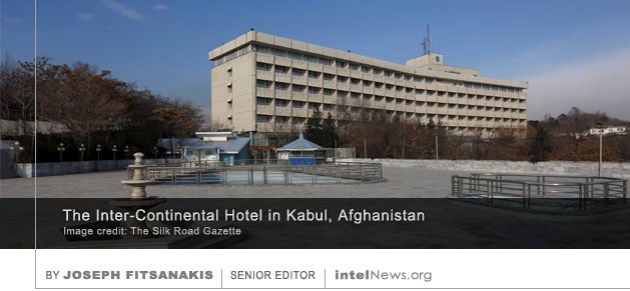
Inter-Continental Hotel KabulTwo senior members of the Pakistani Taliban, who were carrying fake identification documents, were reportedly assassinated earlier this month in the vicinity of a luxury hotel in the Afghan capital Kabul. The culprits remain unknown, although the leadership of the Pakistani Taliban has blamed the United States for their death.

According to the BBC, which reported on the incident on Friday, the bodies of the two men were found in or near the Inter-Continental, a five-star hotel located in western Kabul. According to Afghan government sources, the two men were carrying forged identification papers. In a statement issued on Thursday, the Pakistani Taliban identified the dead men as Sheikh Khalid Haqqani and Qari Saif Younis. Sheikh Haqqani had served as the group’s deputy leader, and was a member of its leadership council. Younis was among the group’s most powerful military commanders.

The Pakistani Taliban said that the two men had secretly traveled to Kabul from Paktika, a Taliban stronghold in the east-central region of Afghanistan, in order to attend a high-level meeting. The group did not say who the two men were meeting and why. But it is rare for leading figures of the Pakistani Taliban to leave the areas that the group controls, and even rarer for them to travel to Kabul or any other big city in the region.

The statement from the Pakistani Taliban claimed that the two men were killed “in a clash with American forces”. But the BBC quoted an unnamed “source within the group” who said that they could also have been targeted by militant groups linked to the Pakistani government, which is a sworn enemy of the Pakistani Taliban. United States officials have yet to comment on this developing story.

Author: Joseph Fitsanakis | Date: 10 February 2020 | Permalink

US threatens to de-fund Africa disease control program over Chinese influence

African UnionThe United States has threatened to pull its funding for an Africa-wide disease control program if the African Union decides to accept an offer from China to build the program’s new headquarters. The dispute accentuates a growing competition between Washington and Beijing to exert political control in Africa and places the African Union at the center of a difficult dilemma.
The quarrel concerns the Africa Centers for Disease Control and Prevention, or Africa CDC, a network of five biomedical research hubs that are located in Zambia, Kenya, Gabon, Nigeria and Egypt. The network was established in 2017 in response to the outbreak of the Ebola epidemic in western Africa. Its mission is to gather data that can help monitor and contain disease outbreaks and other health crises throughout the continent. The network’s central hub is located at the headquarters of the African Union in Addis Ababa, Ethiopia.

Africa CDC is an initiative of the African Union, but it is partly funded by outside countries and bodies, including China, the United States, and the World Bank. Washington supported the establishment of Africa CDC with a donation of $14 million, and an offer to pay the project director’s salary, as well as assign scientists to work there from the US CDC. But the United States has expressed concerns about a recent offer by China to double its funding of Africa CDC and to build a the organization’s new headquarters, at the cost of $80 million. Foreign affairs ministers from the African Union’s 55 states began discussing Beijing’s offer on Thursday during a meeting in Ethiopia.

There are some among them who question China’s intentions. They refer to news reports that surfaced in the French press in 2018, according to which the Chinese-built headquarters of the African Union was comprehensively ‘bugged’ by Beijing. According to the reports, the $200 million, 19-storey skyscraper in the Ethiopian capital was hardwired with computer servers that secretly communicate with Chinese government computers, without the consent of African Union network managers.

On Thursday The Wall Street Journal quoted an anonymous United States government official, who said that “if the Chinese build the headquarters [of Africa CDC], the US will have nothing to do with” the organization. The African Union has not commented on The Journal’s article.

Author: Joseph Fitsanakis | Date: 07 February 2020 | Permalink


United States quietly scraps joint anti-terrorist intelligence project with Turkey

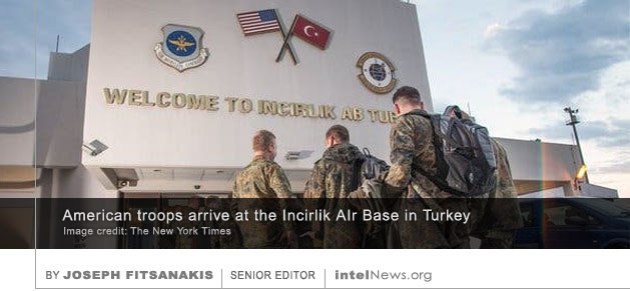
Incirlik TurkeyThe United States has indefinitely suspended a longstanding military intelligence-sharing program with its North Atlantic Treaty Organization ally Turkey. The program, which targets a Kurdish separatist group, is believed to have been in place since 2007. According to the Reuters news agency, which published the story on Wednesday, it has never before been reported on by news media.


The joint intelligence-sharing program targets the Kurdistan Workers Party (PKK), a militant organization that campaigns for a separate homeland for Turkey’s Kurdish minority. Washington and Ankara have both designated the group a terrorist organization, and have been working jointly to combat it since at least 1997. According to Reuters, the United States military has been carrying out surveillance on the PKK using unmanned surveillance drones that fly out of Turkey’s Incirlik air base. Much of the surveillance focuses on the regions of Turkey that border with Iraq and Syria, where the PKK has a strong grassroots presence.

But Washington decided to suspend the program indefinitely last October, said Reuters. The decision was allegedly taken after Turkish troops invaded Syria in order to push back Kurdish rebels and establish a Kurdish-free buffer zone along the Turkish-Syrian border. The news agency cited four American officials, who did not wish to identify themselves, “due to the sensitivity of the matter”. It also cited an unnamed Turkish official, who confirmed that the intelligence-collection program had been terminated.

The American officials told Reuters that the suspension of the program would place strains on the ability of the Turkish military to respond to the challenges of its ongoing guerrilla war against Kurdish militants in northern Syria, as well as within Turkey. It will also make “the anti-PKK campaign more […] costly for Turkey”, one of the officials told the news agency.

Reuters said it contacted the United States Department of Defense, but was told by a spokeswoman that the Pentagon would “not provide details on operational matters”. A spokesperson from the United States Department of State told Reuters that its representatives could “not comment on intelligence matters”. The Turkish Ministry of Defense did not return requests for comment.

Author: Joseph Fitsanakis | Date: 06 February 2020 | Permalink

Denmark arrests three Iranian separatists for spying for Saudi Arabia

Finn Borch AndersenAuthorities in Denmark have announced the arrests of three Iranian Arab separatists, who are charged with carrying out espionage on behalf of the intelligence services of Saudi Arabia. The arrests were announced on Monday by the Danish Security and Intelligence Service, known as PET.

According to the PET, the three Iranians are members of a group calling itself the Arab Struggle Movement for the Liberation of Ahvaz (ASMLA). Known also as Al-Ahwaziya, the group was established in 1980. It calls for a separate state for ethnic Arabs who live the oil-rich province of Khuzestan, in Iran’s southwest.

PET director Finn Borch Andersen told reporters on Monday that the three Iranians were recruited in 2012 by the General Intelligence Presidency (GIP), Saudi Arabia’s primary intelligence agency. They allegedly spied on pro-Iranian groups and individuals in Denmark and other countries northern Europe on behalf of the GID. They reported regularly to their handler, who was an undercover intelligence officer at the Saudi embassy in Copenhagen, according to the PET.

In October 2018, one of the three Iranian men was targeted for assassination by Iranian intelligence, but Danish authorities managed to prevent it with an elaborate security operation. A Norwegian man of Iranian background was arrested during the operation and remains in detention in Denmark. Throughout that time, the PET continued to monitor the three Iranian separatists, and proceeded to arrest them this week.

Late on Monday, the Danish Ministry of Foreign Affairs summoned the Saudi ambassador to Copenhagen in order to file an official complaint about Saudi espionage activities on Danish soil. According to the Danish media, the ambassador of Denmark to Saudi Arabia contacted the oil kingdom’s government to protest about the incident.

Author: Joseph Fitsanakis | Date: 05 February 2020 | Permalink

ISIS is tenacious, well-funded and quickly reasserting itself, new UN report warns

Islamic State ISISThe Islamic State remains committed to its goals and continues to utilize ample funding sources, according to a new report by the United Nations. The report warns that the militant Sunni group, which was previously known as the Islamic State of Iraq and Syria (ISIS), is quickly reasserting itself in the Middle East.

The report (.pdf) was authored by a committee of the UN’s Security Council that monitors the impact of UN-imposed international sanctions designed to weaken the Islamic State, al-Qaeda, and groups aligned with them. It was completed on January 20 and submitted to the UN Security Council last week. Its authors state that the information used to compile it came from intelligence shared with the UN by its member states.

The report recognizes that the Islamic State has suffered significant defeats in the field of battle, which have shattered its once formidable military and logistical power. Despite these setbacks, however, the militant group remains “tenacious and well-funded”, with much of its financial income stemming from sound investing practices in business opportunities throughout the Middle East, says the report. Meanwhile, its armed units in Syria continue to sell protection and carry out extortion, now even during daylight hours, it adds. The group’s steady funding even allows it to continue to provide monthly pensions to close family members of its dead fighters.

Additionally, says the report, the Islamic State has learned to take advantage of the deficiencies of Syrian and Iraqi security forces, and is now carrying out progressively brazen armed attacks against a variety of military and civilian targets. Although it is operationally weak, it continues to aspire to launch attacks in Europe in the future. Additionally, its leaders continue to seek ways of freeing thousands of the group’s supporters from detention camps in Syria and Iraq.

The report concludes that the death of the group’s leader, Abu Bark al-Baghdadi, and his replacement by Amir al-Salbi (also known as Abdullah Qardash) is not expected to signal drastic changes in the Islamic State’s strategic direction. However, Qardash is not an Arab and may not stay at the group’s helm for long, as an Arab Emir would be more likely to be met with acceptance by the group’s wilayats, or provinces, the report adds.

Author: Joseph Fitsanakis | Date: 03 February 2020 | Permalink

Czech intelligence foiled North Korean plan to smuggle arms through Africa

Czech Security Information ServiceThe Czech intelligence services foiled a secret plan by North Korea to smuggle weapons parts and surveillance drones, leading to the expulsion of a North Korean diplomat from the country, according to a report. The report, published this week by the Czech daily Deník N, claims that the alleged plot was foiled by the Czech Security Information Service, known as BIS.

According to Deník N, the alleged plot took place in 2012 and 2013. It was initiated by a North Korean diplomat who was serving at the DPRK’s embassy in Berlin as an economic attaché. However, claims Deník N, the diplomat was in fact operating on behalf of the North Korean intelligence services. The unnamed diplomat allegedly traveled to Prague and contacted a local businessman, seeking to purchase spare parts for use in Soviet-built T-54 and T-55 tanks, as well as spare parts for armored vehicles and jet airplanes. The diplomat also sought to purchase surveillance drones, according to the newspaper.

The buyers reportedly planned to smuggle the acquired weapons parts and drones to North Korea through ports in Africa and China, said Deník N. Such an act would have violated the international embargo that has been in place against the DPRK since 2006. However, the plot was foiled by the BIS, which informed the Czech Ministry of Foreign Affairs. The Czech government eventually detained the diplomat and expelled him from the country, said Deník N.

Following the newspaper article, BIS spokesperson Ladislav Šticha said that he “could not comment on the details” of the case, but could confirm that “in the past BIS has indeed managed to prevent trade in weapons from the Czech Republic to the DPRK”. Hours later, the BIS posted on its Twitter account that it could not comment “on the details of this case”, but added that “its outcome was very successful”.

IntelNews regulars will remember a similar report in the German media in 2018, according to which North Korea used its embassy in Berlin to acquire technologies that were almost certainly used to advance its missile and nuclear weapons programs.

Author: Joseph Fitsanakis | Date: 31 January 2020 | Permalink

United Nations targeted in sophisticated cyber-espionage operation

United Nations headquartersOne of the United Nations’ most sensitive computer systems was targeted in a highly sophisticated cyber-espionage operation that appears to have been sponsored by a state, according to a leaked study. The study was leaked to the media earlier this week, and was reported by the Associated Press on Wednesday.

According to the Associated Press report, hackers used IP addresses in Romania to stage a meticulously organized infiltration of dozens of United Nations computer servers. The servers that were compromised included those used by the Office of the United Nations High Commissioner for Human Rights (OHCHR), which collects sensitive personal data regarding human rights abuses by governments around the world. The OHCHR has regularly been the subject of verbal attacks by authoritarian governments around the world in recent years.

The identity of the hackers remains unclear, said the report. However, their degree of technical sophistication was so substantial that forensic investigators suspect that a state actor was behind the espionage operation, according to the Associated Press. The news agency relayed an email message it received from United Nations spokesman Rupert Colville, which claimed that the hackers did penetrate the OHCHR system but “did not get very far, [as] nothing confidential was compromised”.

But the above statement appears to contradict the leaked study, which suggests that the cyber-espionage operation against the United Nations resulted in a compromise of “core infrastructure components” that were “determined to be serious”. Among the accounts that were compromised by the hackers were those of some domain administrators, who have access to large segments of the United Nations’ computer networks. The Associated Press spoke to an anonymous United Nations official, who said that the attack was “sophisticated”, and that the organization’s computer systems were “reinforced” in the months following the incident.

Author: Joseph Fitsanakis | Date: 30 January 2020 | Permalink

Russian spy agency reveals identities of undercover officers in rare move

Sergei NaryshkinIn an extremely rare move, the head of Russia’s spy agency has disclosed the identities of several undercover officers during an event marking the centenary of the KGB and its modern-day successor, the Russian Foreign Intelligence Service, or SVR.

The identities of the officers —most of whom are now retired or dead— were disclosed on Tuesday by Sergei Naryshkin, head of the SVR. Speaking at a press conference in Moscow, Naryshkin revealed the names and read the brief biographical notes of seven non-official-cover officers, referred to in Russian as “pазведчики-нелегалы”, or ‘illegals’. The term refers to undercover intelligence officers who are secretly posted abroad without diplomatic cover. Accordingly, they have no official connection to a Russian diplomatic facility, while some even pose as citizens of third countries.

Since 1922, illegals have operated out of the KGB’s and (after 1991) the SVR’s “S” Directorate, whose formal title is First Main Directorate or First Chief Directorate. It is customary to keep the identities of illegals secret following their retirement and even after death. However, in December of last year Naryshkin surprised many by announcing that he would soon disclose the identities of a number of former members of what he described as the “special reserve staff”, at an event to mark the centenary of the KGB and SVR.

He did so on Tuesday, when he disclosed the names of seven individuals and described their work in broad terms. The names disclosed by Naryshkin were: Yury Anatolievich Shevchenko (born 1939), Yevgeny Ivanovich Kim (1932-1998), Mikhail Anatolyevich Vasenkov (born 1942), Vitaly Viacheslavovich Netyksa (1946-2011) and his spouse Tamara Ivanovna Netyksa (born 1949), Vladimir Iosifovich Lokhov (1924-2002) and Vitaly Alekseyevich Nuykin (1939-1998).

The accompanying biographies released by the SVR disclose no specifics about the countries in which these illegals operated, the type of work they carried out, and the specific dates in which they were active. Most of them operated between the late 1960s and the early 1990s.

Author: Ian Allen | Date: 29 January 2020 | Permalink

Russia expelled Japanese reporter accusing him of espionage, say sources

VladivostokRussian authorities detained a Japanese journalist last month, and eventually expelled him after accusing him of espionage, according to sources. Even though it occurred last month, the incident was reported only on Monday by Russia’s RIA Novosty news agency.

According to the news agency the Japanese journalist was detained by the Russian Federal Security Service (FSB) on December 25, 2019. At the time of his detention, the journalist was working in Vladivostok for Kyodo, Japan’s largest news agency. Vladivostok, a city of 600,000, features the largest Russian port on the Pacific coast and hosts the main base of Russia’s Pacific Fleet.

The Russian Ministry of Foreign Affairs told RIA Novosty that the Japanese journalist was detained because he was “trying to acquire secret materials about Russia’s military capabilities in the Far East”. He was eventually released following an interrogation session that lasted for over five hours. Upon his release he was given 72 hours to leave the country. Later that day, the Russian Ministry of Foreign Affairs summoned an official from the embassy of Japan in Moscow to file an “official diplomatic protest” about the incident, according to RIA Novosty.

The Reuters news agency said on Monday that officials from Japan’s Kyodo News confirmed that one of their reporters —which it did not name— had been detained in Russia. The Japanese news agency also confirmed that the reporter had been expelled from Russia, but denied that he had been involved in espionage, saying instead that he was “engaged in standard reporting activities”. Kyodo News officials added that the reporter had left Russia as instructed, “for safety reasons”.

The Japanese Ministry of Foreign Affairs told Reuters that it “could not comment” on the matter.

Author: Joseph Fitsanakis | Date: 28 January 2020 | Permalink

Leader of American far-right paramilitary group is based in Russia

The BaseThe mysterious leader of an American far-right paramilitary group, which authorities say is seeking to overthrow the United States government, runs the organization from Russia, according to a probe conducted by the BBC. The group, which calls itself The Base, is thought to have been formed in the summer of 2018. Since then, it is believed to have recruited dozens of members using encrypted messaging applications.

The Base urges its members to undergo paramilitary training and learn how to evade surveillance by government agencies. It also instructs them to create and use ciphers for communication and trains them to use encrypted applications to exchange messages so that government agencies cannot access their content. The Federal Bureau of Investigation describes The Base as a “racially motivated violent extremist group” that “seeks to accelerate the downfall of the United States government, incite a race war, and establish a white ethno-state”. Earlier this month, authorities arrested three alleged members of the organization, which are accused of engaging in a conspiracy to commit murder.

Despite the attention that The Base has received from American authorities, almost no information is available about the group’s leader and founder. This individual goes by the aliases “Norman Spear” and “Roman Wolf”. But a recent investigation alleged that his name is Rinaldo Nazzaro and that he is a 46-year-old American man from New York. Prior to founding The Base, Nazzaro is believed to have purchased land in a remote area of America’s Pacific Northwest region with the goal of creating a white-only enclave.

Now the BBC has said that Nazzaro is living in Russia, from where he is allegedly running The Base. He is thought to have married a Russian woman in 2012 in the New York borough of Manhattan. The couple probably relocated to the Russian city of St. Petersburg “less than two years ago”, according to the BBC. In an article published on Friday, the BBC said that its researchers had been able to identify Nazzaro from his online activity and from photographs and videos he had posted online in the past year.

Author: Ian Allen | Date: 27 January 2020 | Permalink

Intelligence officer who forged credentials did not betray secrets, says Sweden

Sweden militaryA man who rose through the ranks of the Swedish Armed Forces by using forged credentials, and worked as an intelligence officer in NATO while liaising with the Russian security services, did not betray national secrets, according to Swedish officials.

The man, who has not been named by the Swedish government, served in the Försvars- makten —the Swedish Armed Forces— for 18 years. He used forged certificates to claim that he had a university degree in political science. He also claimed that he had successfully completed the Swedish Army’s officer training program, a claim that he supported with a forged certificate of completion.

During his military career, he participated in Sweden’s international peacekeeping missions in Kosovo, as well as in Afghanistan, where he served with the rank of major. Between 2007 and 2010, and then again in 2013, the unnamed man was an employee of the Swedish Military Intelligence and Security Service (MUST), where he worked as a liaison between MUST and Russia’s Federal Security Service.

In 2012 he rose to the rank of lieutenant colonel and was dispatched to the Supreme Headquarters Allied Powers Europe, which is the headquarters of the North Atlantic Treaty Organization’s Allied Command Operations. Sweden is not a member of NATO but has close ties with the alliance. While in Belgium, the unnamed man joined the Afghanistan Mission Network, an intelligence-sharing platform for nations that participated in military and peacekeeping missions in Afghanistan. He then joined Sweden’s United Nations peacekeeping mission in Mali as its chief of staff, with the rank of major.

The forgeries that he used to join the military were reportedly detected in 2019, but the case did not become public until earlier this month, when the Stockholm-based newspaper Dagens Nyheter published an claimed about it. On Thursday, the chief of staff of the Försvarsmakten, General Micael Byden, told the Defense Committee of the Swedish Parliament that the unnamed man did not harm Sweden’s national security. General Byden briefed the committee on the results of an internal investigation into the case by the armed forces. He claimed that the investigation had found “nothing that indicates that classified information had been disseminated” to Russia or any other foreign power by the unnamed man. NATO has not commented on the case.

Author: Ian Allen | Date: 24 January 2020 | Permalink

French counterterrorism officer charged with selling forged documents online

DGSI FranceAn officer in France’s elite counterterrorism agency is to be tried along with four accomplices for selling forged identity documents and private data on the darknet. The case first emerged in 2018, after officers with France’s Central Office for the Prevention of Illegal Immigration (OCRIEST) detected a seller of high quality forged copies of official documents on the darknet.

The seller, who went by the nickname Haurus, offered French identification cards, drivers’ licenses, birth certificates and even bank documents, in exchange for between €100 and €300 ($110 and $330). The quality of the documents on sale was substantially higher than most forgeries sold on the darknet. According to French government investigators, the fake docments qualified as what anti-forgery experts call “the gold standard”. Haurus also sold private phone records and other information to track the whereabouts of individuals.

Government investigators eventually received an anonymous tip that helped identify Haurus. According to prosecutors, Haurus was an officer in the General Directorate for Internal Security (DGSI), which serves as France’s main counterterrorism agency. In accordance with France’s strict privacy laws, he has been identified only as “Cédric D.”, 33. According to Le Parisien newspaper, Cédric D. worked as a counterterrorism investigator specializing on jihadist terrorist networks.

Upon his arrest, Cédric D. led prosecutors to four more people, including a private investigator, all of whom were eventually apprehended. Cédric D. was kept in pre-trial detention for several months. He was released five months ago and remains under judicial supervision. The investigation into his activities has now concluded, and a trial is expected to commence soon in the Paris suburb of Nanterre.

Author: Ian Allen | Date: 23 January 2020 | Permalink

Britain warns its citizens following detention of alleged Russian spies in Switzerland

Davos SwitzerlandA Swiss newspaper has revealed a previously unreported detention of two Russian diplomats in the luxury Swiss Alpine resort of Davos, which is currently hosting the annual meeting of the World Economic Forum (WEF). The development prompted British authorities to warn some British citizens participating in the WEF meeting that they may be in physical danger.

The brief detention of the two Russians allegedly occurred in August of last year in Davos, a mountain resort in the canton of Graubünden, which is located in Switzerland’s eastern Alps region. According to the Swiss newspaper Tages-Anzeiger, local police detained two Russians during the period between August 8 and 28 of last year. Citing anonymous sources from the police and security services, the paper said that the authorities were alerted about the two Russians by employees at a local resort. The employees reportedly found it strange that the Russians had booked hotel rooms for over three weeks, which is unusually long for Davos’ ultra-luxury resort setting.

When police officers approached the two men and inquired about their background, one of them said he worked as a plumber. However, when asked to provide identification papers, both men reportedly produced Russian diplomatic passports. However, none had received accreditation by the Swiss government, which means they had not been formally registered as diplomats in the Alpine nation. When Swiss police officials contacted the Russian embassy in Bern to inquire about the two men, Russian officials “threatened diplomatic consequences if the men were arrested” said Tages-Anzeiger.

The two Russians were eventually released, as Swiss police “could not ascertain any reason to detain them”, said the paper. However, Swiss officials said that the two Russians “obviously […] had their sights on the WEF” and were probably planning to install surveillance equipment around the Swiss resort town. Soon after the Tages-Anzeiger report was published, British counterterrorism police reportedly warned a number of British citizens attending the WEF meeting that they might be in physical danger.

But the Russian embassy in Switzerland dismissed the Tages-Anzeiger report as “one more attempt to undermine Swiss-Russian relations”. Russian officials at the embassy accused Western countries of trying to “whip out a scandal out of nothing”, adding that Russian authorities had not been officially notified of the incident and that there was “no evidence of espionage” by the two men.

Author: Joseph Fitsanakis | Date: 22 January 2020 | Permalink