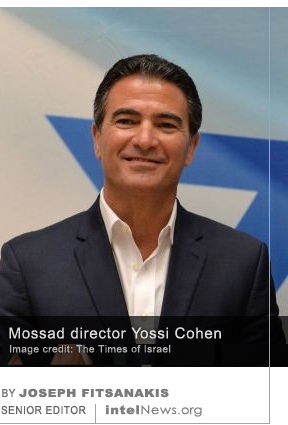
Mossad chief comments on policy of assassinations in rare interview

Yossi CohenYossi Cohen, the chief of the Mossad —Israel’s main external intelligence agency— said he has authorized “more than a few” assassinations during his tenure and warned that more may be on the way. Cohen, 57, who took command of the Mossad in 2016, spoke last week to Mishpacha, a magazine aimed at ultra-orthodox Jews. His comments were covered widely by Israeli media over the weekend.
Cohen was asked to respond to recent allegations made by the Iranian government that Israel worked with “Arab countries” to assassinate General Qassem Suleimani, the head of the Quds Force, an elite paramilitary unit in Iran’s Islamic Revolutionary Guard Corps (IRGC). Suleimani claimed that several individuals were arrested last month in connection with the alleged plot. He also said that Israel tried to kill him and Hassan Nasrallah, leader of the Lebanese Hezbollah group, in 2006.

The head of the Mossad told Mishpacha that Suleimani had not “necessarily committed the mistake yet that would place him on the prestigious list of Mossad’s assassination targets”. However, “he knows very well that his assassination is not impossible” because “the infrastructure he built presents a serious challenge for Israel”, said Cohen. Regarding Nasrallah, Cohen said that the Hezbollah strongman “knows we have the option of eliminating him”. When asked why the Mossad had not exercised that option, Cohen said he preferred not to answer.

In regards to Hamas, the Palestinian militant group that controls the Gaza Strip, Cohen admitted that the Mossad has been behind a string of assassinations of Hamas officials around the world in recent years. “If there is one target that we eliminate without hesitation, it is Hamas officials abroad. [These range] from local agents to those who manage acquisitions of weapons pointed towards Israel”, said Cohen. He added that there had been “more than a few assassinations” in recent years, but not all were admitted to by Hamas. “The enemy has changed tactics. It is not quick to attribute assassination to us, for its own reasons”, said the Mossad chief.

Author: Joseph Fitsanakis | Date: 14 October 2019 | Permalink

US and Saudi Arabia ‘suffered intelligence blackout’ during Iran drone strikes: sources

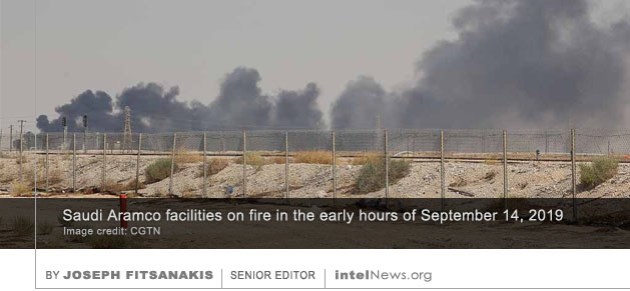
Saudi AramcoSaudi Arabia and the United States suffered “a total and embarrassing [intelligence] failure” in the lead-up to the drone strikes that shut down half of the kingdom’s oil production last month, according to Israeli sources. In the early hours of September 14, missiles struck two refineries belonging to the world’s largest crude oil processing facility in eastern Saudi Arabia. The facilities, which belong to Aramco, Saudi Arabia’s government-owned oil conglomerate, were forced to cease operation so that repairs could be carried out. This drastically reduced Saudi Arabia’s oil production by close to 50 percent, which amounted to a 5 percent drop in global oil production. By Monday morning, global oil prices had seen their most significant one-day surge since the 1991 Gulf War.
Soon after the attacks, Saudi and American officials accused Iran of having launched the missile strikes. But according to Breaking Defense, Riyadh and Washington suffered “a total and embarrassing [intelligence] failure” in the hours prior to and following the attacks. The US-based website cited a number of anonymous Israeli sources, who said that officials in Tel Aviv were surprised by the lack of intelligence in the US and Saudi Arabia about the missile strikes. The Israelis told Breaking Defense that Saudi intelligence agencies “had no idea Iran was planning to attack the kingdom’s oil facilities […]. It seems that the Americans were also in the dark [or that possibly] Washington […] did not share the data in time with the Saudis”, they added.

The above information was allegedly discussed at an emergency meeting of the Israeli defense cabinet on October 6, which included a briefing on the attacks by the Mossad, Israel’s main external intelligence agency. According to the Israeli sources, Mossad officials were quickly able state with high confidence that the missiles had been launched from military bases in southeast Iran or by Iranian militias in Iraq. It was only following an examination of missile fragments that Saudi and American intelligence officers were able to point the finger at Iran, according to Aahron Ze’evi Farkash, former director of the Israeli Military Intelligence Directorate.

Breaking Defense also said that Israeli intelligence analysts were impressed by the precision of the weapons systems used in the Iranian strikes. Additionally, the specific targets of the attacks were selected with the help of “very accurate intelligence”, said the Israeli sources.

Author: Joseph Fitsanakis | Date: 11 October 2019 | Permalink

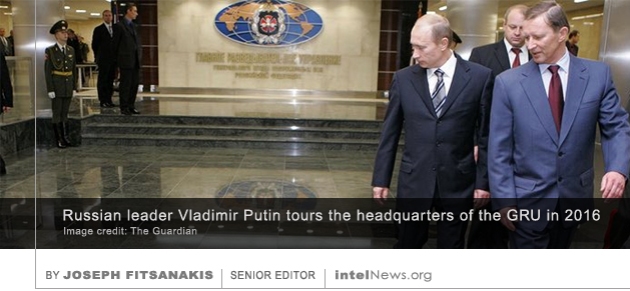
Russia has a dedicated spy unit to destabilize Europe, Western officials claim

GRU

Russian intelligence maintains an elite spy unit whose sole goal is to run operations that have the potential to subvert European political and economic systems, according to a new report by The New York Times. The unit is behind a string of intelligence operations in recent years, which range from espionage to disinformation campaigns and even assassinations.

The Times cited “four Western officials” who said that the group is known as Unit 29155 and operates within the Main Directorate of the General Staff of the Russian Armed Forces, commonly known as GRU. It has allegedly been in existence for at least 10 years, but it only recently appeared on the radar of Western intelligence agencies. The latter began to take note of Unit 29155 in 2016, after it was alleged that an elite unit of Russian spies tried to stage a coup in the tiny Balkan country of Montenegro. The former Yugoslav Republic was seeking to join the North Atlantic Treaty Organization at the time. It was claimed that the Russian intelligence operatives carried out a failed attempt to kill its prime minister and instigate a pro-Russian coup.

According to the paper, Western intelligence officials do not have a clear picture of the structure of Unit 29155, nor are they able to predict where it will strike next. But they believe that it consists of a very tightly knit group of no more than 200 intelligence officers and 20 operations officers, led by Major General Andrey V. Averyanov (alias Andrey Overyanov), a hardened veteran of Russia’s Chechen wars. The existence of the unit is so secret that even other GRU operatives are unlikely to have heard of it, said The Times. Members of the unit frequently travel to Europe to carry out sabotage and disinformation campaigns, kill targets, or conduct other forms of what some experts describe as the Kremlin’s hybrid war. They tend to travel on the cheap, in order to economize and avoid attention, said the paper.

The Times said it reached out to the Kremlin with a number of questions about Unit 29155. It received a response from Kremlin spokesman Dmitri S. Peskov, who suggested that the questions be directed instead to Russia’s Defense Ministry. But the ministry did not return any messages.

Author: Joseph Fitsanakis | Date: 09 October 2019 | Permalink

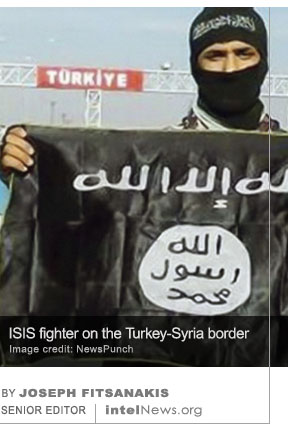
Concerns about mass breakouts of jailed ISIS fighters if Turkey invades northern Syria

Turkey ISISOfficials in the United States, Europe and the Middle East have warned that thousands of jailed members of the Islamic State could escape from Kurdish-controlled prisons in northern Syria if Turkey invades the region. For more than two years, the area has been controlled by American-supported Kurdish militias, who were instrumental in helping Washington defeat the Islamic State —also known as Islamic State of Iraq and Syria, or ISIS. But the growing strength of the Kurdish forces has alarmed Turkey, which views Kurdish nationalism in the region as a bigger threat than Salafi jihadism. Ankara has repeatedly threatened to invade northern Syria and disarm the Kurdish groups, which it sees as terrorist.
The continuous presence of American troops in northern Syria has served to dissuade Turkey from invading. Yesterday, however, the White House surprised observers by announcing its sudden decision to pull its troops from northern Syria. Washington’s unexpected move drew criticism from Kurdish commanders who spoke of betrayal, as well as by members of both political parties in Congress. Security officials also expressed fears that Turkey’s focus on the Kurds could allow ISIS to regroup in northern Syria. A statement issued by the White House on Monday said that Turkey would assume control of over 10,000 captured ISIS fighters who are currently being held in Kurdish-administered prison camps in northern Syria. But experts said that the wider Kurdish-controlled region of northern Syria, which Turkey intends to capture, is home to dozens of prisons with over 60,000 captured ISIS supporters in them. What will be the fate of these prisoners under Turkish control?

Security observers have repeatedly accused Turkey in the past of turning a blind eye to ISIS, whose members fought a prolonged and bloody war against Iraqi and Syrian Kurds from 2016 to 2018. There are no guarantees that the Turks will not utilize a resurgent ISIS to suppress Kurdish nationalism in the region. In fact, some experts, including retired American generals, warned on Monday that a Turkish invasion of northern Syria would give ISIS “a golden chance to regroup”. There are concerns of mass breakouts of ISIS members from Kurdish-controlled prisons in Syria, amidst the widespread chaos caused by a Turkish military onslaught. Such breakouts have been encouraged by ISIS leaders, including Abu Bakr al-Baghdadi himself. Escaped prisoners would most likely join the nearly 20,000 estimated ISIS fighters who are still at large in Iraq and Syria, thus contributing to a potentially catastrophic regeneration of the militant Sunni group, according to experts.

Author: Joseph Fitsanakis | Date: 08 October 2019 | Permalink

Iran arrests Russian journalist for espionage in rare spat with key ally Moscow

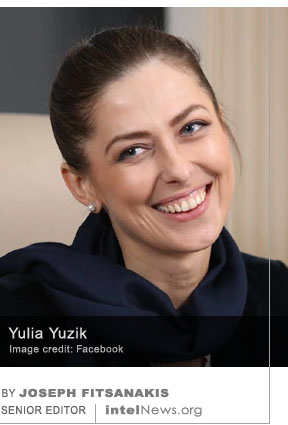
Yulia YuzikIn a surprising move last week, Iranian authorities arrested a Russian journalist and expert on the Caucasus region, whom they accused of spying for Israel. They later agreed to release her following significant diplomatic pressure from Russia. But the move surprised observers, because Iran rarely acts in ways that have the potential to damage its close relations with Moscow.


The journalist in question is Yulia Yuzik, a 38-year-old reporter with considerable expertise on Russia’s Caucasus region. Her articles on the security situation in the Caucasus have been published in several Russian and Western outlets, including Foreign Policy and GQ. She has also authored a number of books on Islamist militancy in the Russian Caucasus, which have been translated into several foreign languages, such as German, Italian and French.

In 2017, Yuzik spent several months in Iran while working on a number of stories. She returned to Russia before returning to Iran on September 29 of this year, reportedly “on a private trip”. Media reports stated that Yuzik intending to meet a number of Iranian journalists that she worked with back in 2017. However, upon landing at Iran’s Imam Khomeini International Airport, Yuzik had her passport confiscated without explanation, and was forced to enter the country without identity and travel documents. Then, last Thursday she was arrested at her hotel in downtown Tehran by members of the Iranian Revolutionary Guard Corps (IRGC), who apparently broke down the door of her hotel room before arresting her.

There were no news of Yuzik’s whereabouts until the following day, when staff at the Russian embassy in the Iranian capital were contacted by her family. Yuzik’s family said that the IRGC had charged her with collecting intelligence for the Mossad, Israel’s spy service. Russian media reports said that the accusations against Yuzik took Russian diplomats by the surprise, given that Yuzik has no apparent connection to Israel, nor does she have a travel visa to enter that country. She reportedly spent a few days there in 2004 while writing a story about the Israel Defense Forces for Russian newspaper Komsomolskaya Pravda.

Yuzik’s family told the Russian embassy that she had been scheduled to appear in a Tehran court on Saturday. The Russian embassy gave a press briefing to reporters on Friday, saying that the Russian Foreign Ministry had summoned the Iranian ambassador to Moscow to complain about Yuzik’s arrest. Then early on Saturday, Maria Zakharova, a spokeswoman for the Russian Foreign Ministry in Moscow, announced that Yuzik would be released soon and would be allowed to return home to Russia.

The incident has surprised observers, because Russia is one of Iran’s closest international allies. It is therefore highly unusual for Tehran to take any action that might potentially provoke Moscow or otherwise damage its diplomatic relations with the Kremlin.

Author: Joseph Fitsanakis | Date: 07 October 2019 | Permalink

Colombian spy chief resigns over fake dossier that linked militants to Venezuela

Comando Conjunto de InteligenciaColombia’s military spy chief has resigned, after the Colombian president was found to have misused intelligence at a United Nations speech to blame Venezuela for allegedly aiding paramilitary groups. For many years, authorities in Bogotá have accused Venezuela of aiding armed groups such as the National Liberation Army (ELN) and the Revolutionary Armed Forces of Colombia (FARC). These groups have been engaged in a decades-long guerrilla war against the Colombian state. In 2017, the largest of these groups, the FARC, laid down its weapons and signed a peace treaty with the Colombian government. But the ELN has refused to follow suit, while a number of hardline FARC leaders recently announced that they would be resuming their armed struggle against the Colombian authorities.

In recent months, the rise of Venezuela’s Western-supported opposition leader Juan Guaidó has further-fueled tensions between Colombia and Venezuela. Bogotá has come out in support of Guaidó, while many anti-government Venezuelans, some of them armed, have sought refuge in Colombia. Colombia rejects Venezuela’s claims that it is giving shelter to terrorists and argues instead that it is providing humanitarian aid to Venezuelan refugees. In turn, it accuses Caracas of sheltering ELN and FARC guerrillas, a claim that the Venezuelan government strongly denies.

Last week, during the United Nations General Assembly in New York, Colombian President Iván Duque unveiled a dossier of evidence that purportedly proved beyond doubt Venezuela’s collusion with Colombian paramilitaries. Duque told the United Nations gathering that the collusion was supervised by no other than the President of Venezuela, Nicolás Maduro. But within hours of Duque’s speech, reporters who scrutinized the dossier found that much of the photographic evidence in it had been downloaded from the Internet. Moreover, the photographs were not taken in Venezuela, as Duque claimed in his speech, but in Colombia.

The revelations have dominated the news headlines in Colombia and Venezuela in the past week, with the Colombian government engaging in damage control. On Monday, General Oswaldo Peña, Colombia’s military intelligence chief, resigned over the fake dossier. General Peña directed the Comando Conjunto de Inteligencia (Joint Intelligene Command) of the Colombian Armed Forces, which was seen as the primary spy agency behind the information contained in the dossier. In his resignation letter, General Peña wrote that “as a general of the [Colombian] Republic” he was fully aware that he needed to take responsibility for his activities and the activities of his subordinates. President Duque has not commented on the general’s resignation.

Author: Joseph Fitsanakis | Date: 03 October 2019 | Permalink

Espionage scandal prompts resignations of top Swiss banking executives

Credit SuisseTwo senior executives of Credit Suisse, one of the world’s most powerful banking firms, have resigned amidst a high-stakes espionage scandal that may have prompted a suicide and has shocked Switzerland. The alleged target of the espionage is Iqbal Khan, the former Chief Executive Officer (CEO) of Credit Suisse’s wealth-management division. The 43-year-old Khan moved to Switzerland from his native Pakistan at the age of 12. In 2013, after working for more than a decade as an auditor at Ernst & Young, he joined Credit Suisse. He quickly rose to head the institution’s wealth-management division and was credited with having nearly doubled its profits between 2016 and 2018.

Khan’s meteoric success brought him immense financial wealth. He soon bought a piece of property that is adjacent to the home of Tidjane Thiam, the 57-year-old CEO of Credit Suisse. Khan and his wife had the house on their property demolished and began a two-year project to build a new house. But the disruption caused by the large-scale construction project gave rise to a dispute between Thiam and Khan. Their rivalry escalated quickly and prompted the intervention of Credit Suisse board chairman Urs Rohner. However, the dispute between the two men was not resolved, and on July 1 of this year Khan left Credit Suisse. On August 29, Credit Suisse’s rival UBS announced that Khan would co-lead its global wealth management division.

It appears that some Credit Suisse executives were concerned that Khan might try to attract their firm’s customers to his new UBS portfolio. These concerns allegedly prompted Credit Suisse’s Chief Operating Officer (COO), Pierre-Olivier Bouee, to instruct the bank’s security department to keep tabs on Khan. The bank reportedly hired a private investigation firm, Investigo, to monitor Khan’s movements. There was an unexpected turn on September 17, when Khan noticed that he was being followed and promptly confronted an Investigo employee in downtown Zurich. On the same day, the former Credit Suisse star manager filed a complaint with the Zurich office of the Swiss Public Prosecutor.

On September 18, Credit Suisse gave orders to Investigo to stop keeping tabs on Khan. It also launched an internal investigation to evaluate the merits of the decision to spy on Khan. Meanwhile, the Swiss Public Prosecutor’s office announced that it had opened a criminal case on Investigo and had arrested three individuals in connection with the case. On September 24, a private investigator, who is believed to have been involved in Khan’s case, committed suicide. Media reports said the unidentified man was “an external security expert” who mediated between Credit Suisse and Investigo.

On Tuesday, Credit Suisse COO Bouee announced his resignation. Swiss media said the head of the bank’s global security division also resigned. Also on Tuesday, Credit Suisse’s internal investigation found that CEO Thiam had not been involved in the decision to spy on Khan.

Author: Joseph Fitsanakis | Date: 02 October 2019 | Permalink

FBI files espionage charges against California man who allegedly spied for China

Xuehua Edward PengThe United States has pressed espionage charges against a naturalized American citizen who operated as a courier for Chinese intelligence while working as a tour operator in California. On Monday federal prosecutors in San Francisco filed espionage charges against Xuehua “Edward” Peng, a 56-year-old Chinese-born American citizen. Peng, a trained mechanical engineer, reportedly entered the United States in June 2001 on a temporary visa. In 2012 he became a naturalized American citizen. By that time he was working for US Tour and Travel, an independent tour operator in California.

On Friday, officers with the Federal Bureau of Investigation arrested Peng at his home in Hayward, California, and charged him with spying on behalf of the Ministry of State Security (MSS), which is China’s primary external intelligence agency. At a press conference held on Monday, David Anderson, US Attorney for the Northern District of California, said that Peng began working for the MSS in June 2015 and continued to do so until June of 2018. Throughout that time, Peng participated in at least six dead drops on behalf of the MSS, said the FBI. But he was unaware that the agent on the other end of the dead drop was in fact an FBI informant, who had lured Peng and the MSS into an elaborate sting operation. The informant is referred to in the indictment as “the source”. The FBI said it paid the informant nearly $200,000 to facilitate the sting operation.

Most of the dead drops took place at a hotel in Newark, California. Peng would book a room in the hotel using a popular online booking service. He would check in and go to his hotel room, where he would hide envelopes containing as much as $20,000 in cash. He would then leave the room key at the front desk for his contact to pick up. The contact (the FBI informant) would pick up the key and the cash, and leave memory sticks with classified US government information for Peng to pick up. Peng would then travel to China to deliver the classified information to the MSS.

Unbeknownst to Peng, the FBI was monitoring him all along, and managed to secretly tape his alleged espionage activities. The surveillance footage is now part of the federal affidavit that was unsealed on Monday. Moreover, the FBI appears to have given Peng classified information that was approved for the purposes of the counterespionage operation against him. It is not known whether the classified information was real, deceptive, or a mixture of the two. It is worth noting that Peng is not a foreign diplomat and is therefore not subject to the rules of diplomatic immunity. He now faces a maximum of 10 years in prison and a fine of up to $250,000 if convicted.

Author: Joseph Fitsanakis | Date: 01 October 2019 | Permalink

Head of Saudi king’s security detail shot dead in mysterious circumstances

Abdulaziz al-FaghamThe head of the security detail of Saudi Arabia’s king Salman bin Abdulaziz al-Saud has been shot dead in mysterious circumstances. Abdulaziz al-Fagham was a Major General in Saudi Arabia’s Royal Guard Corps, whose mission is to protect the senior members of the oil kingdom’s royal family. Al-Fagham served two kings, king Salman and his predecessor, king Abdullah bin Abdulaziz Al Saud, and was constantly seen alongside the in official functions. Since much current-affairs coverage in Saudi Arabia’s state-owned media revolves around the activities of the royal family, al-Fagham’s figure was familiar to most Saudis. They were reportedly shocked by the murder of such a familiar figure who was very close to the Saudi royal family.

But details of al-Fagham’s killing remain sparse. Saudi officials began posting social-media messages of condolence about al-Fagham and his family late on Saturday evening. It wasn’t until late on Sunday evening that the kingdom’s official media began to publish official reports of al-Fagham’s demise. State-run Saudi television said that al-Fagham, whom it described as a “bodyguard of the custodian of the two holy mosques”, had been killed following a “dispute of a personal nature”. A subsequent television report stated that al-Fagham had died on Saturday evening at a house belonging to a close friend of his in Jeddah, Saudi Arabia’s second-largest city, which is located on the shores of the Red Sea.

It has since emerged that while visiting his friend’s house, al-Fagham had a prolonged argument with another visitor named Mamdouh bin Meshaal al-Ali. The latter left the house in anger and later returned with a rifle, which he used to kill al-Fagham and injure two others, according to reports. Al-Fagham was taken to a nearby hospital, where he died of gunshot wounds. Meanwhile, police surrounded the house where the shootout took place and tried to arrest al-Ali. But the alleged culprit refused to surrender to police and was subsequently shot dead by security officers, following a firefight that injured several people.

The New York Times said on Sunday that around al-Fagham’s murder the Saudi intelligence services contacted their American counterparts seeking information on a number o Saudi citizens with alleged connections to terrorism. But it is not known whether the request for intelligence was in any way connected to al-Fagham’s killing.

Author: Joseph Fitsanakis | Date: 30 September 2019 | Permalink

White House whistleblower is a CIA officer, report claims

Donald TrumpThe individual who filed a report claiming that United States President Donald Trump sought help from a foreign country to win the 2020 election is believed to be a male employee of the Central Intelligence Agency. The man, who is legally classified as a whistleblower, filed the report on August 12. It was released for publication on Thursday and is now available [.pdf] online. It claims that Trump tried to “solicit interference from a foreign country” in the 2020 US presidential election. The basis of this claim refers to a telephone exchange between the US president and his Ukrainian counterpart, Volodymyr Zelensky, which took place on July 25.

The whistleblower’s report states that Trump asked Zelensky to investigate the business dealings of Democratic presidential hopeful Joe Biden and his son Hunter Biden in Ukraine. The implication of the whistleblower’s allegation is that Trump sought to subvert the election effort of one of his main rivals for the US presidency. The whistleblower report, along with transcripts and memoranda that describe the July 25 telephone conversation between the two heads of state, form the basis of an impeachment inquiry that has been launched by Trump’s political rivals in Congress.

On Thursday, The New York Times cited what it said were three people who knew the identity of the whistleblower. The paper said that the whistleblower is a male employee of the CIA. In the past, the man had been assigned to work in the White House, said The Times. The secondment of CIA personnel to the White House is a regular occurrence. CIA personnel are temporarily assigned to perform duties relating to National Security Council meetings, or manage the White House Situation Room. They also monitor and help manage the White House secure communications system. The paper said that the CIA officer’s White House secondment had ended and that he had returned to the CIA headquarters by the time the July 25 telephone call between Trump and Zelensky took place. In his report [.pdf], the whistleblower states that he was “not a direct witness to most of the events described”. However, he cites accounts of these events by “multiple officials” who shared the information with him “in the course of official interagency business”.

Some have criticized The Times for leaking information about the whistleblower’s place of employment and past assignments. They argue that the information could allow the White House to identify the source of the complaint. By law, whistleblowers in the US have the right to remain anonymous, and thus be protected from possible retaliation from those whom they accuse of abusing their power. But the paper claims that the American public has a right to information about the whistleblower’s “place in government”, so as to assess his credibility and evaluate the significance of his allegations.

Author: Joseph Fitsanakis | Date: 27 September 2019 | Permalink

Executive of Danish bank implicated in massive money laundering found dead

Danske BankThe former chief executive of Danske Bank’s subsidiary in Estonia, which is implicated in a massive money laundering scheme, has been found dead in an apparent suicide in Tallinn. Aivar Rehe, 56, headed the Estonian subsidiary of the Copenhagen-based Danske Bank, one of Northern Europe’s largest retail banks, which was founded in 1871. He belonged to a group of dynamic young entrepreneurs who spearheaded the privatization of the Estonian economy in the post-Soviet era.

But the reputation of the Estonian banking sector was tarnished last year, when a criminal investigation was launched into an alleged money laundering scandal. The investigation focused on customers from Russia and other Eastern European countries who allegedly used Danske Bank’s subsidiary in Estonia to launder billions of dollars in illicit funds. The probe prompted Danske Bank to pull out of the Baltic countries. Meanwhile, the probe extended to Sweden, Germany and the United States. Deutsche Bank, one of the world’s largest financial institutions, is currently being investigated for allegedly helping facilitate Danske Bank’s customers launder money by converting it into United States dollars. The criminal probe has damaged the previously spotless reputation of the Scandinavian banking sector and has made Central European banks hesitant to do business in the Baltics. Some financial observers have even warned that the Danske Bank scandal could drag the Baltic economies into a prolonged recession.

Rehe was not involved in the money laundering scandal. However, much of the money laundering took place between 2007 and 2015, when he was in charge of the Estonian subsidiary of Danske Bank. Under his leadership the bank’s operations were allegedly marred by “deficiencies in controls and governance”, which allowed for criminal activity to occur unnoticed, according to an internal Danske Bank investigation into the money laundering affair. Rehe had been missing from his home since Monday, having apparently left without taking his wallet and cellphone. His body was discovered on Wednesday in the garden of his home in the Estonian capital. Police have ruled his death an apparent suicide and believe that no foul play was involved.

Author: Ian Allen | Date: 26 September 2019 | Permalink

Opinion: Saudi Arabia will not go to war with Iran, but it may pay others to do so

Saudi AramcoEver since a barrage of drone and missile attacks struck Saudi Arabia on September 14, many have wondered whether the oil kingdom will go to war with Iran. Riyadh has directly accused the Islamic Republic of being behind the attacks. But the speculation about a possible war is baffling, argues Nesrine Malik in a well-argued article published last Sunday in Britain’s Guardian newspaper. Saudi Arabia does not “go to war”, she says —it pays others to do so on its behalf.

The war in Yemen is a perfect example, argues Malik. Even though the Saudi monarchy is leading the foreign military involvement in that war, Saudi Arabia is supplying almost no ground troops in that war. There are only Saudi commanders who are managing groups of mercenaries from Morocco, Jordan and Egypt. A large portion of the Saudi-led force consists of Sudanese child soldiers, whose families are paid handsomely for supplying the oil kingdom’s force in Yemen with what Malik describes as “cannon fodder”. The Saudi commanders communicate their battle orders to their hired troops via satellite phones and use unmanned drones and high-flying planes to attack the predominantly Shiite Houthi rebels. That largely explains the high civilian toll in that war.

Meanwhile, the United States government announced last week that it will be sending several hundred troops to the oil kingdom and will be beefing up its air defense systems. But Malik wonders why it is that Saudi Arabia, which has been the world’s largest weapons importer since 2014, and whose 2018 arms purchases accounted for 12 percent of global defense spending last year, requires the presence of American troops on its soil for its protection. The answer is simple, she says: the Saudi regime purchases weapons, not to use them, but to make Wester defense industries dependent on its purchasing power. In other words, the Saudi monarchy buys Western weapons for political reasons. These purchases enable it to get away with its abysmal human-rights record at home, as well as its kidnappings and assassinations abroad.

In the meantime, says Malik, if Saudi Arabia goes to war against Iran, it will do so the way it always does: it will hire proxies —including the United States— to fight on its behalf.

Author: Joseph Fitsanakis | Date: 25 September 2019 | Permalink

Extracts from Kim Philby’s espionage confession published today for the first time

Kim PhilbyExtensive extracts from the confession of Kim Philby, one of the Cold War’s most prolific double spies, are scheduled to be released today for the first time by Britain’s National Archives. While working as a senior member of British intelligence, Harold Adrian Russell Philby, known as ‘Kim’ to his friends, spied on behalf of the Soviet OGPU and NKVD, the intelligence services that later became known as the KGB. His espionage activities lasted from 1933 until 1963, when he secretly defected to the USSR from his home in Beirut, Lebanon. Philby’s defection sent ripples of shock across Western intelligence and is often seen as one of the most dramatic incidents of the Cold War. He was part of a spy ring of upper-class British communists who were known collectively as ‘the Cambridge spies’ because they were recruited by Soviet intelligence during their student days at the University of Cambridge in England.

Britain’s intelligence establishment has never released Philby’s confession, which he made to his friend Nicholas Elliott, an intelligence officer in the Secret Intelligence Service (MI6) in January 1963. The MI6 had sent Elliott to Beirut, where Philby was working as a journalist, to inform him that his espionage role for the Soviets had been established beyond doubt. The MI6 officer had been authorized to offer Philby immunity from prosecution in return for a full confession. Philby accepted the offer and began his confession while in Beirut. But a few days later he vanished and reemerged in Moscow in July of that year. He died there in 1988.

The file that is scheduled to be released today by the National Archives is marked “Secret” and comes from the Security Service (MI5), Britain’s primary counterintelligence agency. It contains details about Philby’s first assignments for Soviet intelligence, which included identifying other communist students at Cambridge who would be susceptible to recruitment. Philby’s list included the names of Donald Maclean and Guy Burgess, who later became members of the Cambridge spy ring. Philby states in his confession that he cautioned his Soviet handlers about recruiting Burgess due to “his unreliability and indiscretion”, but his objections were “overruled”, he says.

When asked by Elliott how he could have sided with Soviet intelligence at a time when the Soviet leader, Joseph Stalin, was slaughtering millions, Philby responds by comparing his service for the KGB to joining the armed forces. Following orders, he says, does not imply that a soldier unquestionably agrees to every action of the government he serves. He goes on to reveal that his Soviet handlers never attempted to win his “total acceptance on the technical level. In short”, Philby continues, “I joined [Soviet intelligence] as one joined the army [… I often] obeyed orders although convinced they were wrongly conceived”.

Author: Joseph Fitsanakis | Date: 24 September 2019 | Permalink

Far-right terrorism a transnational threat backed by state actors, says US official

Slavic UnionThreats posed by white supremacist and other far-right groups are now global in nature and are increasingly backed by state actors, according to a Congressional testimony by an American former counterterrorism official. The testimony was delivered by Joshua Geltzer, former senior director for counterterrorism at the United States National Security Council. Geltzer, who now directs the Institute for Constitutional Advocacy and Protection at Georgetown University in Washington, DC, testified on Friday before two subcommittees of the US House of Representatives. The Subcommittee on National Security and the Subcommittee on Civil Rights and Civil Liberties held a joint hearing entitled “Confronting Violent White Supremacy”.

Geltzer said in his testimony [.pdf] that the type of violence perpetrated by white supremacist groups in America cannot any more be characterized as “domestic”, because it is quickly becoming transnational in character. White supremacist violence in America is part of a “global surge” that is “increasingly interlinked and internationalized”. In fact, the attackers themselves internationalize their role in this global movement by referencing white supremacist violence in other parts of the world to justify the use of violence in the US, said Geltzer. He added that the emerging center of this global surge of white supremacist violence appears to be located in Ukraine and Russia. It is there that funds provided by the Russian government are being used to train and educate white supremacist leaders in guerrilla warfare, social media propaganda and various forms of ideological training.

It is therefore imperative, said Geltzer, that the US Intelligence Community begins to examine white supremacist violence within this new transnational context. For instance, it would be helpful if the mission of the National Counterterrorism Center (NCTC) of the Office of the Director of National Intelligence was changed to include a concentration in so-called “domestic terrorism”, including white supremacist violence, he argued.

Also on Friday, the US Department of Homeland Security (DHS) unveiled its new strategy report. The report views “domestic terrorism and mass attacks” as a growing threat to the United States that is equal in magnitude to the threat posed by Islamist terrorists. The report identifies what it describes as “a disturbing rise in attacks motivated by domestic terrorist ideologies”. One of the most powerful drivers of this new wave of domestic violence is “white supremacy”, according to the DHS.

Author: Ian Allen | Date: 23 September 2019 | Permalink

Spanish court rejects US request to extradite Venezuelan ex-spy chief

Hugo CarvajalSpain has refused to extradite Venezuela’s former spy chief to the United States, where he is wanted for drug-running. The decision is also an intelligence setback for Washington, as the former spy, Hugo Carvajal, is reputed to possess a “treasure trove” of inside information on the Venezuelan government. Carvajal is a retired general, a former diplomat, and a member of the late Venezuelan President Hugo Chávez’s inner circle. From 2004 to 2011, under Chávez’s tutelage, Carvajal headed the Directorate General of Military Counterintelligence (DGCIM). In 2008 the US named Carvajal as a major facilitator of international drugs trafficking and imposed financial sanctions on his assets around the world. Washington accused Carvajal of assisting the paramilitary group known as the Revolutionary Armed Forces of Colombia (FARC) transport drugs from Latin America to Mexico and from there to the US.

In 2014, the US government officially charged Carvajal with orchestrating a shipment of 1,200lbs of cocaine from Venezuela to Mexico. Washington also charged Carvajal with supplying FARC drug traffickers with Venezuelan passports bearing fake names, which they used to travel internationally to avoid detection. In February of this year, Carvajal publicly unexpectedly denounced Maduro and sided with his arch-nemesis, Juan Guaido, the President of the National Assembly of Venezuela. Carvajal urged the Venezuelan armed forces to stop siding with Maduro and support the US-backed Guaido as Venezuela’s acting president. In April of this year, Carvajal was arrested in Spain. Soon afterwards, the US Department of Justice filed a formal request for the former spy chief’s extradition to the US. An anonymous US official hinted at the time that Carvajal may have willingly given himself up to Spanish police to express his desire to cooperate with the US.

On Monday, however, Spain’s National Court (the country’s top criminal court) announced that Carvajal would not be extradited to the US. The former spy chief was released minutes after the court made its decision known. A court spokesman told reporters that a formal ruling and justification would be released “later”, but an official document has yet to be published. Carvajal’s lawyers told the court that the US request to have him extradited was politically motivated by the administration of US President Donald Trump. It is possible that the court may have sided with that view. There are also rumors that Carvajal may have agreed to cooperate with Spanish intelligence in return for receiving political asylum in Spain. The US Department of Justice has not commented on the case.

Author: Joseph Fitsanakis | Date: 19 September 2019 | Permalink