Russian hackers behind US election attacks also targeted hundreds of journalists
December 26, 2017 Leave a comment
 The Russian hacker group that targeted the United States presidential election in 2016 also attacked hundreds of reporters around the world, most of them Americans, an Associated Press investigation shows. The group is often referred to in cyber security circles as Fancy Bear, but is also known as Pawn Storm, Sednit, APT28, Sofacy, and STRONTIUM. It has been linked to a long-lasting series or coordinated attacks against at least 150 senior figures in the US Democratic Party. The attacks occurred in the run-up to last year’s presidential elections in the US, which resulted in a victory for Donald Trump. The hacker group’s targets included Democratic Party presidential candidate Hillary Clinton and her campaign chairman John Podesta. But its hackers also went after senior US diplomatic and intelligence officials, as well as foreign officials in countries like Canada and the Ukraine.
Now a new investigation by the Associated Press news agency, based on data collected over a period of two years by the cyber security firm Secureworks, appears to show that Fancy Bear also attacked journalists. In a leading article published last week, the Associated Press said that journalists appeared to be the third largest professional group targeted by Fancy Bear, after politicians and diplomats. The investigation shows that nearly half of all journalists that were systematically targeted by the hacker group worked for a single newspaper, The New York Times. At least fifty Times reporters feature on the hacker group’s target list. The latter includes another 50 reporters working for Russian outlets that known to be critical of the Kremlin, and dozens of Eastern European reporters based in the Baltics, Moldova, Armenia, Georgia and Ukraine.
The Associated Press said that prominent names on the Fancy Bear target list include The Washington Post’s Josh Rogin, The Daily Beast’s intelligence correspondent Shane Harris, CNN’s security correspondent Michael Weiss, and Ellen Barry, the former Moscow bureau chief for The New York Times. The report also said that some American journalists were not only targeted online, but also physically. One of them, The New Yorker’s Masha Gessen, claims that she was routinely followed by Russian-speaking men in the period leading up to the 2016 presidential election. In April of this year, a study by the Tokyo-based cybersecurity firm Trend Micro showed that Fancy Bear was behind systematic efforts to subvert recent national elections in France and Germany. And a few weeks ago, Russian media reported that Konstantin Kozlovsky, a member of the prolific Russian hacker group Lurk, alleged that he had been hired by the Kremlin to help target the US Democratic Party.
► Author: Ian Allen | Date: 26 December 2017 | Permalink
 Dozens of Western former spies, most of them Americans, are being hired by the United Arab Emirates, whose ruling family is trying to create a new spy service modeled after the United States Central Intelligence Agency.
 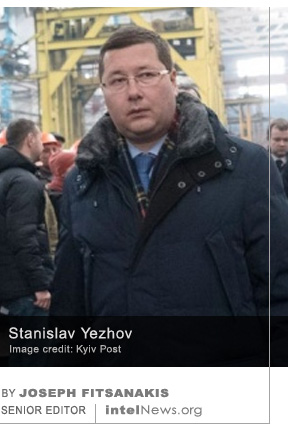 Ukraine’s counterintelligence agency has arrested the principal translator of the country’s prime minister, accusing him of spying for Russia. The translator has been identified as Stanislav Yezhov, who has served as a translator for two consecutive Ukrainian prime ministers. As part of his job, Yezhov has been present at nearly all high-level meetings between Ukraine’s Prime Minister, Volodymyr Groysman, and foreign leaders since 2016, when Groysman assumed his executive post. In the last year alone, Yezhov accompanied the Ukrainian prime minister during official trips to Washington, London and Berlin. Before translating for Groysman, Yezhov is thought to have served as an interpreter for Viktor Yanukovych, Ukraine’s former President. Yanukovych, a pro-Russian politician, occupied that office from 2010 until his ousting from power in 2014, as a result of the 2014 Ukrainian revolution.
 Current and former employees of the United States’ primary military intelligence agency have publicly accused the agency’s senior watchdog of not doing her job and sabotaging the careers of her subordinates.
  Authorities in Russia have announced the arrest of a Norwegian citizen, whom they accuse of receiving classified information relating to Russia’s Armed Forces. The detainee has been named as Frode Berg, 62, from Kirkenes, a small town in Norway’s far north, located 100 miles from the Russian city of Murmansk. According to articles in the Russian press, Berg is a 24-year veteran of the Office of the Norwegian Border Commissioner, an obscure government agency that operates under Norway’s Ministry of Justice and Public Security. Among other tasks, the Office of the Norwegian Border Commissioner is responsible for enforcing and monitoring bilateral compliance with the Soviet (now Russian)-Norwegian Border Agreement of 1949. Berg, who worked closely with Norway’s National Police Directorate as part of his job, retired from the Office in 2014.
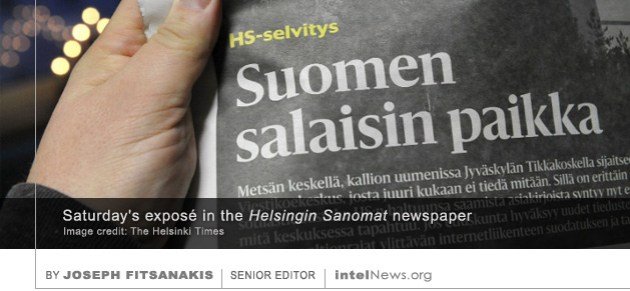 An investigative journalist in Finland, who recently co-authored an exposé of a Finnish intelligence program targeting Russia, destroyed her computer with a hammer, prompting police to enter her house on Sunday. The journalist, Laura Halminen, co-wrote the exposé with her colleague, Tuomo Pietiläinen. Titled “The Secret Behind the Cliff”, the article
  Authorities in Poland have charged three high-level military intelligence officials with acting in the interests of Russia. The three include two former directors of Polish military intelligence and are facing sentences of up to 10 years in prison. The news broke on December 6, when Polish authorities announced the arrest of Piotr Pytel, who was director of Poland’s Military Counterintelligence Service (SKW) from 2014 to 2015. It soon emerged that two more arrests had taken place, that of Pytel’s predecessor, Janusz Nosek, and Krzysztof Dusza, Pytel’s chief of staff during his tenure as SKW director.
 A member of a prolific Russian hacker group reportedly stated in court that he was hired by the Russian government to break into the computer systems of the Democratic Party in the United States. The hacker, Konstantin Kozlovsky, operated online as a member of Lurk, a notorious hacker group whose members are believed to have stolen in excess of $45 million from hundreds of companies since 2011. Most of the group’s members were apprehended in a
 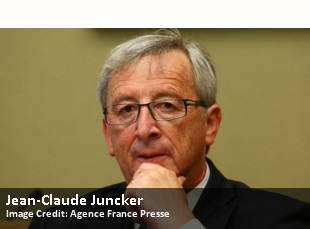 A judge in Luxembourg has launched a criminal investigation into whether officials working for the country’s former Prime Minister and current European Commission President, Jean-Claude Juncker, tried to conceal his role in a spy scandal. Until he stepped down from his post in 2013, Juncker, a member of Luxembourg’s Christian Social People’s Party, was Europe’s longest-serving elected leader, having served as Prime Minister since 1995. His resignation from his post came after a parliamentary inquiry found that the country’s State Intelligence Service (SREL) had engaged in serious criminal activity.
 A Russian court has sentenced an Estonian aircraft business executive to 12 years at a maximum security prison, allegedly for having spied on Russia a decade ago. Little is known about the case of Raivo Susi, who co-owns two companies that are involved in the sale and maintenance of non-commercial aircraft. The Estonian businessman’s activities include the partial ownership of Aerohooldus OU, which provides training jet aircraft for use by the Air Force of Estonia –a member state of the North Atlantic Treaty Organization (NATO).
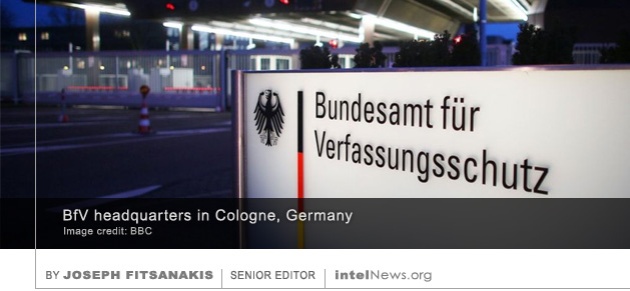 In an unusual step, German intelligence officials have issued a public warning about what they said are thousands of fake LinkedIn profiles created by Chinese spies to gather information about Western targets. On Sunday, Germany’s Federal Office for the Protection of the Constitution (BfV) held a press conference in which it said that it had discovered a wide-ranging effort by spy agencies in China to establish links with Westerners. The agency said that it undertook a 9-month investigation, during which it identified 10,000 German citizens who were contacted by Chinese spy-run fake profiles on LinkedIn. Across Europe, the number of targets could be in the hundreds of thousands,
  A senior former commander of one of Syria’s largest Kurdish rebel groups, who recently defected to Turkey, has accused the United States of agreeing to let thousands of heavily armed Islamic State fighters escape from Raqqa in exchange for conquering the city without a fight. The Syrian city served as the de facto capital of the Islamic State from early 2014 until October of this year, when it was captured by a coalition of forces supported by the United States and other Western powers. The Syrian Democratic Forces (SDF), a predominantly Kurdish militia, was among the groups that captured Raqqa. One of its spokesmen, Talal Silo, told Western media correspondents back in October that the Western-backed coalition had allowed fewer than 300 hardline fighters of the Islamic State to leave the war-ravaged city during the final stages of the battle.
 The former director of Poland’s military counterintelligence agency has been questioned by the country’s military police, over allegedly illegal cooperation with Russian intelligence. From 2006 to 2012, General Piotr Pytel was head of Poland’s Military Counterintelligence Service (MCS), which is responsible for domestic security and for ensuring the war-readiness of Poland’s armed forces. According to government prosecutors, General Pytel struck an illegal agreement with the Russian Federal Security Service, the FSB, in 2010. The alleged agreement concerned the return to Poland of troops who had been sent to serve in Afghanistan with the International Security Assistance Force (ISAF). Several hundred Polish troops participated in ISAF, a NATO-led security mission in Afghanistan, established by the United Nations Security Council in 2001.
 The Turkish government has issued a warrant for the arrest of a former officer in the United States Central Intelligence Agency, which Ankara claims was instrumental in the failed July 2016 attempt to topple the government of Turkish President Recep Tayyip Erdoğan. The move comes amidst heightened tensions in relations between Ankara and Washington. The two NATO allies have








Analysis: Egyptian Islamist group is emerging as ISIS’ most powerful branch
December 27, 2017 by Joseph Fitsanakis Leave a comment
According to leading Israeli defense and security expert Amos Harel, Wilayat Sinai’s most recent strike demonstrates that, aside from operational expertise, the group also possesses formidable intelligence collection capabilities. In an article published on Tuesday in the Israeli daily Ha’aretz, Harel focuses on the group’s assassination attempt against Egyptian Defense Minister Sedki Sobhy and Interior Minister Magdy Abdel-Ghaffar. The attack took place on December 19 at the Al-Arish military airport in north Sinai. Wilayat Sinai guerrillas fired an antitank missile at a parked Egyptian Air Force helicopter, which had just transported the two ministers to the area. Footage of the attack, released last week by ISIS, shows the helicopter exploding after being hit by the missile. Three people died in the attack, a security guard, a helicopter pilot, and a senior aide to Defense Minister Sobhy. Although neither minister was harmed in the attack, that is not the point, says Harel, and points to the fact that the officials’ trip to northern Sinai was part of a surprise visit, which had not been announced in advance. It seems, therefore, says Harel, “that Wilayat Sinai obtained intelligence information that exposed the minister[s] to attack”.
Interestingly, the group’s membership is not large. American and other Western intelligence sources estimate that its armed nucleus consists of no more than a thousand fighters. However, Wilayat Sinai members have access to advanced weaponry, which is routinely smuggled into Egypt from Libya and the Sudan. It is thus the weaponry, coupled with advanced organization and intelligence capabilities, that makes Wilayat Sinai so dangerous, says Harel. In the past three years, the militant group has killed in excess of 1,500 people in Egypt. But as its attacks become increasingly surgical and sophisticated, Egypt may be forced to respond with increasing firepower, which could further-destabilize the volatile Sinai region. Meanwhile, Israeli security forces are preparing for the possibility of cross-border raids by Wilayat Sinai, warns Harel. The Egyptian-Israeli border region could become the next front in the war against ISIS.
► Author: Joseph Fitsanakis | Date: 27 December 2017 | Permalink
Filed under Expert news and commentary on intelligence, espionage, spies and spying Tagged with Al-Arish (Egypt), Amos Harel, Analysis, Islamic State, Magdy Abdel-Ghaffar, Sedki Sobhy, Sinai (Egypt), Wilayat Sinai