Analysis: Without fanfare, FBI places Putin’s right-hand man on most wanted list
March 1, 2021 3 Comments
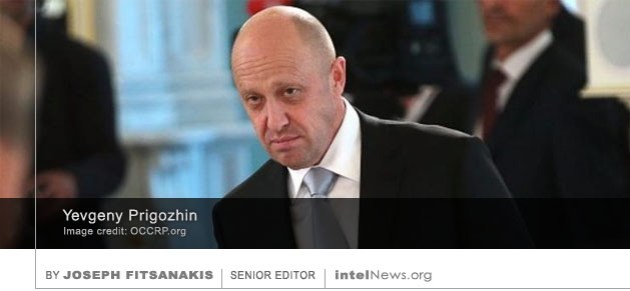 WITHOUT MUCH FANFARE LAST week, the Federal Bureau of Investigation placed on its most wanted list Yevgeny Prigozhin, who is one of Russian President Vladimir Putin’s closest collaborators. Known as “Putin’s chef”, for providing catering services to the Kremlin, Prigozhin was indicted in February 2018 by United States prosecutors for his alleged role in Russia’s meddling in the 2016 presidential elections. According to the Special Counsel investigation, led by Robert Mueller, Prigozhin bankrolled the Internet Research Agency (IRA), which in turn played a central coordinating role in the effort to influence the outcome of the elections.
But it is one thing to be indicted by the US government, and quite another to be placed on the FBI’s most wanted list. What does this mean? And why did the FBI wait three years to place Prigozhin on its list of infamy?
With characteristic flamboyance, Prigozhin boasted victory against the FBI back in March of 2020, when US federal prosecutors requested that the Mueller-era criminal case against Concord Management and Consulting (CMC) be dismissed. Founded in 1995, CMC is Prigozhin’s flagship company. According to the US government, CMC was used to fund the IRA’s activities in the run-up to the 2016 US elections. Although some were surprised by that decision, it made sense from an intelligence point of view. US federal prosecutors said at the time that it would not be possible to prove the allegations against CMC due to a “classification determination”. The term basically meant that the US government could not prove the claims made against CMC without revealing “methods and sources”. The term refers to witnesses that have probably been recruited as US government assets, as well as to methods of surveillance that the government wishes to keep secret.
Even though the individual indictment against Prigozhin was never dropped, the flamboyant Russian boasted at the time that the dismissal of the case against CMC proved that he was not implicated in the US election meddling affair. He became even more boastful after September of last year, when Interpol removed his name from its international alert list. He reportedly began traveling outside Russia again, something that he had stopped doing after his 2018 indictment, out of an abundance of caution. At that time, everyone assumed that US prosecutors would eventually drop the case against Prigozhin too, for the same reason they had dropped the CMC case —namely a “classification determination”. Read more of this post
 • Analysis: The outstanding issue of the Libyan intelligence services. The post of Chief of the Libyan Intelligence Service of Tripoli’s Government of National Accord (GNA) is still vacant. Therefore, this is an optimal situation for the Head of Tripoli’s government, who is currently pro tempore Director of the GNA agencies, while the struggle for the next Intelligence Service director is
  Four men have been arrested by Turkish authorities in Istanbul, allegedly for being members of a spy ring operated by an agent who collected information on extremist groups for France’s external spy agency. The arrests were reported on Tuesday by a newspaper with close links to the Turkish government. It is worth noting, however, that the reports have not been confirmed by Turkish officials. If true, the incident points to further deterioration in the relations between the two nations, which are members of the North Atlantic Treaty Organization.
 The United States has alleged that the Russian military flew over a dozen unmarked aircraft to Libya, in an attempt to provide air support for Russian mercenaries who are fighting in Tripoli. If true, this development marks a major escalation of Russia’s military intervention in the Libyan civil war.
 The United Arab Emirates is behind a “covert air bridge” to supply weapons to Libyan warlord Khalifa Haftar, according to a leaked report by a United Nations investigative panel. A war has been raging in Libya since 2011, when a popular uprising backed by the West and its allies led to the demise of the country’s dictator, Muammar Gaddafi. Much of the east of the country is controlled by the United States-backed Tobruk-led Government, which is affiliated with the Libyan National Army (LNA) and its commander, Field Marshal Khalifa Haftar (pictured). The LNA is fighting against the UN-recognized Libyan Government of National Accord.
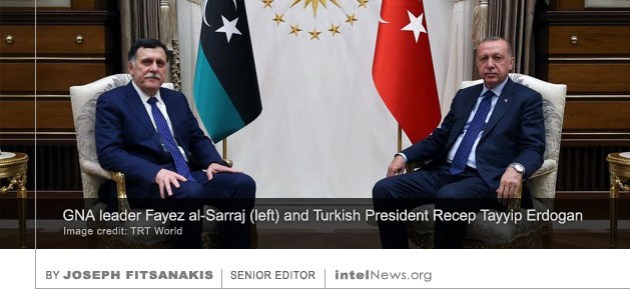 Turkish President Recep Tayyip Erdoğan has said his country is prepared to deploy troops to Libya, just days after Ankara surprised analysts by announcing an agreement with the embattled Libyan government in Tripoli. The Turkish-Libyan agreement has spurred angry reactions from Israel, Greece and Egypt, all of which are
 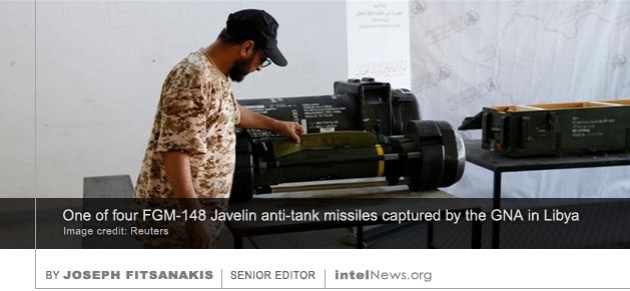 The French government has admitted that four anti-tank missiles found in a Libyan rebel camp belonged to its Special Forces units, but denied accusations that it deliberately breached the United Nations-imposed weapons embargo on Libya. Libya’s UN-recognized government, the Government of National Accord (GNA), which is headed by Fayez al-Sarraj, announced in June that it discovered a cache of FGM-148 Javelin portable anti-tank missiles during a raid on a rebel camp. The camp belonged to forces loyal to Khalifa Haftar, a rogue Libyan warlord who is supported by a group of Western-led nations that includes the United States, France, Israel, Egypt and the United Arab Emirates.
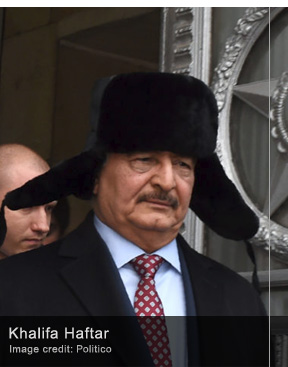 Several European Union member states, led by Italy, have criticized France for blocking a joint resolution calling on all warring factions in Libya to cease all hostilities and return to the negotiations table. The latest round of hostilities was sparked by an all-out attack by a group calling itself the Libyan National Army (LNA). The commander of the LNA is Field Marshal Khalifa Haftar, an old adversary of the Libyan leader Muammar al-Gaddafi, who lived in the United States under Washington’s protection for several decades. In 2011, following an uprising that toppled Gaddafi, Haftar returned to Libya and launch a military campaign from the eastern city of Tobruk. Since that time, he has led the LNA in a war of attrition against the United Nations-backed Government of National Accord (GNA), which is based in the Libyan capital Tripoli.
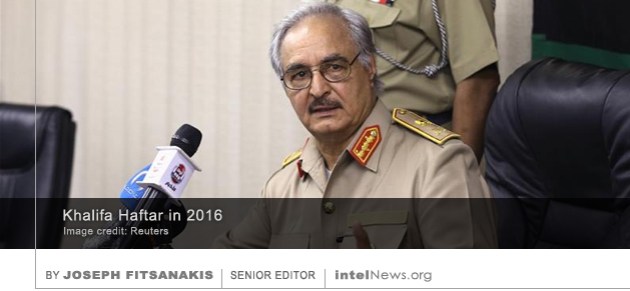 Libya’s most powerful warlord, who was an asset of the United States Central Intelligence Agency before entering the Libyan Civil War, ordered his troops to commit war crimes, according to two American legal experts. Libya has remained in a state of war since 2011, when a popular uprising backed by the West and its allies led to the demise of the country’s dictator, Colonel Muammar Gaddafi. Currently the strongest faction in the ongoing Libyan Civil War is the eastern-based Tobruk-led Government, which is affiliated with the Libyan National Army (LNA). The commander of the LNA is Field Marshal Khalifa Haftar, an old adversary of Colonel Gaddafi, who lived in the United States under Washington’s protection for several decades before returning to Libya in 2011 to launch his military campaign.
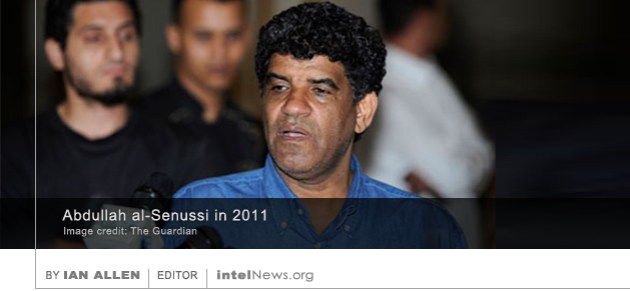 A group of American, British and Irish citizens are pressuring their respective governments to prevent the impending execution of Libya’s former intelligence strongman. Abdullah al-Senussi, 65, led Libya’s intelligence services during the regime of the country’s late dictator Muammar al-Gaddafi. Last week, however, he was sentenced to death by a court in Tripoli for his role in “inciting genocide” during the 2011 civil war that toppled Gaddafi’s regime. American, British and Irish officials are being urged to intervene to stop Senussi’s execution, so that he can help shed light on Libya’s role in international terrorist plots in the 1980s and 1990s.







 intelNews.org
Turkey and United States co-examine Russian missile system captured in Libya
March 3, 2021 by Joseph Fitsanakis 1 Comment
Last year, General Haftar led the LNA in a major offensive aimed at capturing Tripoli and ending the conflict between the two sides, which has raged for nearly a decade. He was supported by Emirati advisors and Russian troops, which are ostensibly in Libya as private security contractors, but are commonly thought to receive directions from the Kremlin. In a surprise move, Turkey sent troops to assist in the defense of Tripoli. These troops were instrumental in beating back the LNA, and effectively terminating General Haftar’s ambitions.
In the process of beating back General Haftar’s’s offensive, GNA fighters took over the LNA’s airbase in Al-Watiya, 100 miles southwest of Tripoli, which LNA forces abandoned in haste. Among the looting was a Russian-built Pantsir missile defense system —reportedly captured in pristine condition. This is the Russian armed forces’ state-of-the-art self-propelled anti-aircraft system, which fires medium-range surface-to-air missiles. It had reportedly been given to the LNA by the Emiratis.
The captured Pantsir system disappeared for a few weeks, and eventually reappeared in the hands of a local militia in the town of Zawiya. The militia is commanded by Mohamed Bahroun, a Libyan warlord with links to the Islamic State. Turkish troops struck a deal with Bahroun, whose forces agreed to deliver the Pantsir to the Turkish-controlled Mitiga International Airport on the outskirts of Tripoli. Shortly afterwards, the United States warned Turkey that it was prepared to forcibly take control of the missile system, fearing that it could fall in the hands of the Islamic State. Washington also wanted to get its hands on Russia’s state-of-the-art anti-aircraft system.
According to reports, the two countries reached a deal in recent weeks. The United States sent a C-17 Globemaster cargo plane to Mitiga airport from its AFRICOM base in Germany, and collected the Pantsir. It then delivered it to Ankara, where it is now being examined by a joint team of Turkish and American weapons experts. Some weapons specialists suggest that this development could significantly affect Russia’s ability to counter NATO military systems, given that the Pantsir’s technology will now be compromised.
► Author: Joseph Fitsanakis | Date: 03 March 2021 | Permalink
Filed under Expert news and commentary on intelligence, espionage, spies and spying Tagged with 2011 Libyan civil war, News, Pantsir missile defense system, Russia, Turkey, United States