Dutch crime investigator charged with spying for organized criminals
October 20, 2015 Leave a comment
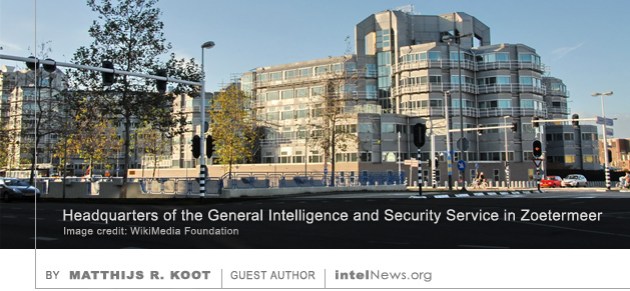 A 28-year-old criminal investigator of the Dutch National Crime Squad was arrested by Dutch police on September 29 over allegations of corruption, neglect of duty, and money laundering. The man, named as Mark M., applied for a job at the Dutch police in 2009. According to an online résumé, M. dropped out of professional college in journalism after several years of being self-employed as a freelance reporter covering crime issues.
According to Dutch media, M. did not pass the security screening carried out by the General Intelligence and Security Service (AIVD) as part of the job application. But he was hired nonetheless as trainee in a less sensitive position that is not subject to security screening by the AIVD. The reported reason for M.’s failure to pass the screening process is that he is married to a Ukrainian woman. The AIVD has no intelligence-sharing relationship with its Ukrainian counterpart agency concerning security screenings.
M. is reported to have access to the files “of all large national criminal investigations”, and allegedly sold information on a large scale to drug organizations and criminal biker gangs. He is reported to have close ties with leaders of the biker gangs Satudarah and No Surrender.
Newspaper NRC Handelsblad, which first reported about M., states that the screening involved an investigation into M.’s social environment and personal finances. Television news service RTL Nieuws, which was the first to publicly name the man, reports that M. stood out for his luxurious lifestyle: driving a Porsche Cayenne, frequenting Curaçao and the Dominican Republic for holidays, and wearing expensive watches. During a search of his residence, the police found €235.000 ($266,266), as well as confidential police information that M. allegedly intended to sell.
The police is investigating the extent of the damage caused by M., as well as the precise investigations that he may have compromised. The question of why M. was hired despite not having passed the security screening is part of the investigation. It is, so far, believed that M. acted alone.
Addendum, Nov. 4, 2015: Pending a security clearance from the AIVD, M. was granted access to BlueView, a confidential police data search engine. When the AIVD refused to issue a security clearance, M. was transferred to the traffic department, but superiors failed to revoke his access to BlueView. In 2007, BlueView contained 55 million documents containing data about suspects, transcripts of interrogations and police reports. M.’s authorization level included access to information from the Criminal Intelligence Unit (CIE), that works with informants. M. was able to access BlueView for close to four years.
► Author: Matthijs Koot | Date: 20 October 2015 | Permalink













Dutch spies identified Russian hackers who meddled in 2016 US election
January 29, 2018 by Joseph Fitsanakis 1 Comment
Last Thursday, the Dutch current affairs program Nieuwsuur, which airs daily on Holland’s NPO 2 television, said that the initial tipoff originated from the AIVD, Holland’s General Intelligence and Security Service. On the same day, the Dutch newspaper De Volkskrant published a detailed account of what it described as AIVD’s successful penetration of Cozy Bear. According to these reports, AIVD was able to penetrate Cozy Bear in mid-2014, before the hacker group intensified its campaign against political targets in the US. Citing “six American and Dutch sources who are familiar with the material, but wish to remain anonymous”, De Volkskrant said that the AIVD was able to detect the physical base of the Cozy Bear hackers. The latter appeared to be working out of an academic facility that was adjacent to Moscow’s Red Square. The AIVD team was then able to remotely take control of security camera networks located around the facility. Eventually, the Dutch team hacked into another security camera network located inside the buildings in which the hackers worked. They soon began to collect pictures and footage of Cozy Bear members, which they then compared with photos of “known Russian spies”, according to De Volkskrant.
The paper said that the AIVD team continued to monitor Cozy Bear’s activities until at least 2017, while sharing intelligence with the Central Intelligence Agency and the National Security Agency in the US. The intelligence was allegedly instrumental in alerting US spy agencies about Russian government-sponsored efforts to meddle in the 2016 presidential election. Several newspapers, including The Washington Post in the US and The Independent in Britain, contacted the AIVD and the MIVD —Holland’s military intelligence agency— over the weekend. But the two agencies said they would not comment on reports concerning Cozy Bear.
► Author: Joseph Fitsanakis | Date: 29 January 2018 | Research credit: E.J. & E.K. | Permalink
Filed under Expert news and commentary on intelligence, espionage, spies and spying Tagged with 2016 US presidential election, AIVD (Netherlands), APT29, computer hacking, Cozy Bear, cybersecurity, Netherlands, News, Russia, United States