News you may have missed #830 (Boston bombings analysis)
April 18, 2013 10 Comments
 By IAN ALLEN | intelNews.org |
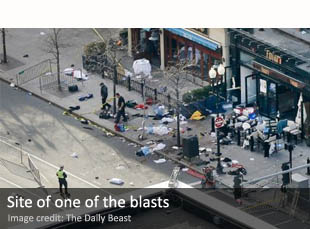
►►Despite WMD fears, terrorists still focused on conventional attacks. The United States has spent billions of dollars to prevent terrorists from obtaining a weapon of mass destruction even as the bombings in Boston further show that a nuclear weapon or lethal bioagent is not necessary for causing significant harm. However, experts warn that, even though there is a considerably lower probability of a WMD attack versus a conventional strike, the much higher consequences necessitate continued US investment in prevention and preparation.
►►Why isn’t terrorism in the US a whole lot more frequent? While the horrific bombing at the Boston Marathon has brought concerns about terrorism back to the forefront of national attention, it is worth remembering that terrorism inside the United States is exceedingly rare. Over the past 40 years, just over 3 people on average have been killed by acts of terrorism per year (remove 9/11, and the average is 1.4 deaths per year). After 9/11 or an event like the Boston attack, we often think “it would be so easy to [fill in the blank] and cause massive damage.” And it’s true. Then why doesn’t it happen more often?
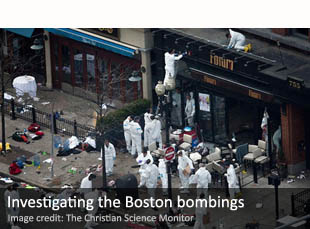
►►Boston bomb investigators can’t decide: foreign or domestic? Even the most experienced investigators are still trying to decide whether the Boston marathon bombs were carried out at the hands of domestic or foreign attackers. The inability to settle that question is proving frustrating to investigators. Former FBI assistant director Tom Fuentes told CNN: “I’ve run bomb scenes in Iraq and also in the US”, adding that the attack in Boston “has the hallmarks of both domestic and international, and you can see either side of that”.
►►Smoke color is key clue to analyzing Boston Marathon bombs. As a team of investigators led by the FBI begins deciphering the bombs that killed three people and wounded 150 more in Boston this week, a key clue is already in plain sight on countless videos taken during the blasts: the color of the smoke. Analyzing the color of the smoke can provide information about the explosive that powered the bombs, which in turn provides clues about its sophistication —and, possibly, that of the people who made it.


 This morning I














Is Ana Montes ‘the most important spy you’ve never heard of’?
April 19, 2013 by Ian Allen 7 Comments
An extensive article published today in The Washington Post Magazine revisits the largely forgotten case of Ana Belen Montes, a senior United States military intelligence analyst who was convicted in 2002 of spying for Cuba. Montes, who was arrested by the Federal Bureau of Investigation in Washington, DC, on September 20, 2001, underwent trial and sentencing in the shadow of 9/11, which might help explain the relative obscurity of her case. Still, as The Post article by Jim Popkin states, many intelligence observers view her as one of the most damaging double spies in recent American history. She entered government work as a clerk typist at the Department of Justice, and quickly received top-security clearance. It was from there that she moved to the Defense Intelligence Agency, America’s premier military intelligence organization, in September 1985. She rose meteorically through the ranks of the DIA, eventually becoming the Agency’s top Cuba analyst. Montes’ former colleagues report that she was known as “the Queen of Cuba”, a witty label that rested on her indisputable reputation as one of America’s most capable intelligence analysts on Cuba. She also came from a family with strong conservative credentials and strong connections with the US counterintelligence community. Her brother and sister were both FBI agents, and her former long-term boyfriend was a Cuban intelligence specialist for the Department of Defense. Read more of this post
Filed under Expert news and commentary on intelligence, espionage, spies and spying Tagged with Ana Belen Montes, Analysis, communism, Cuba, DIA, espionage, history