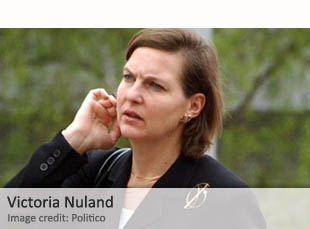
Comment: Nuland’s leaked phone call is ‘populist intelligence’
February 10, 2014 4 Comments
 By JOSEPH FITSANAKIS | intelNews.org
My phone started ringing off the hook on Thursday evening, when a video appeared on YouTube containing a frank conversation between Victoria Nuland and Geoffrey Pyatt. Nuland, Assistant Secretary at the United States Department of State, and Pyatt, US Ambassador to Ukraine, were discussing US diplomatic moves on the political standoff in Ukraine. In the conversation, which was clearly meant to be private, Nuland expresses frustration with efforts by the European Union, which she deems weak and inadequate. In a shocking display of candor, Nuland tells Pyatt that the US should “help glue this thing and […] have the UN help glue it and, you know, f**k the EU”.
On Thursday night I spoke at the main news program of BBC television, where I agreed with most observers —some of the US government officials— that Russia was the obvious culprit behind the leaked conversation. The geopolitical interests of Washington and Brussels coincide almost completely when it comes to Ukraine, as both wish to detach the former Soviet republic from the Russian sphere of influence. So driving a wedge between the two allied sides is clearly to the benefit of Moscow. I added that the two American officials should have known better than to speak so frankly on the phone, given the constant monitoring of diplomatic communications by both adversary and friendly intelligence services, which is common knowledge in diplomatic circles. Read more of this post


 By J. FITSANAKIS and I. ALLEN | intelNews.org |









News you may have missed #869 (Ukraine edition)
February 24, 2014 by Ian Allen 1 Comment
►►US and UK warn Russia not to deploy troops in Ukraine. US National security adviser Susan E. Rice said Sunday that Russian troop intervention in Ukraine would be a “grave mistake”, arguing that a return to a Cold War posture would not reflect modern realities. Earlier on the same day, British foreign secretary William Hague cautioned Moscow “not to intervene” in Ukraine. “If there is an economic package” from Russia, said Hague, “it will be important that Russia doesn’t do anything to undermine that economic package and is working in cooperation and support of it”.
►►Analysts touting Ukraine’s East-West division are just plain wrong. “The image of two competing blocs is just dead wrong. Ukraine’s diversity is pretty much on par with that found in just about any country of the world. The real divide in Ukraine is not between East and West, but between the democratic forces on the one hand and the Party of Regions on the other. The latter is strongest in the southeast, mostly because its cadres (who are mostly former communists) have controlled the region’s information networks and economic resources since Soviet times and continue to do so to this day”.
►►The global implications of the Ukraine conflict. Thus far, the Kremlin hasn’t sought to encourage separatist sentiment in eastern and southern Ukraine. And it doesn’t appear that Vladimir Putin and his system of power is interested in the prospect of a civil war in his backyard. But it still has the potential to break out even if Moscow doesn’t want it. Those familiar with Ukraine’s history know that the militant nationalists in the west of the country have gone time and time again into battles they can’t win. Whatever the case, romanticizing revolution can only end in a “big bang”, the fallout from which would extend far beyond Ukraine.
Filed under Expert news and commentary on intelligence, espionage, spies and spying Tagged with 0 Analysts touting Ukraine's East-West division are just plain wrong, 0 The global implications of the Ukraine conflict, 0 US and UK warn Russia not to deploy troops in Ukraine, Analysis, News, news you may have missed, UK, Ukraine, United States