Analysis: Should government spies target foreign firms?
June 12, 2014 3 Comments
 By JOSEPH FITSANAKIS | intelNews.org
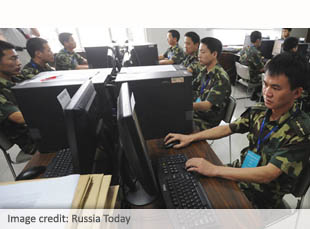
Last month, the government of the United States indicted five officers of the Chinese People’s Liberation Army with conspiracy to commit computer fraud, economic espionage, and theft of trade secrets, among other charges. In indicting the five PLA officers, the US Department of Justice went to great pains to ensure that it did not accuse the suspects of engaging in cyberespionage in defense of China’s national security. What sparked the indictments was that the accused hackers allegedly employed intelligence resources belonging to the Chinese state in order to give a competitive advantage to Chinese companies vying for international contracts against American firms. In the words of US Attorney General Eric Holder, the operational difference between American and Chinese cyberespionage, as revealed in the case against the five PLA officers, is that “we do not collect intelligence to provide a competitive advantage to US companies, or US commercial sectors”, whereas China engages in the practice “for no reason other than to advantage state-owned companies and other interests in China”. I recently authored a working paper that was published by the Cyberdefense and Cybersecurity Chair of France’s Ecole Spéciale Militaire de Saint-Cyr, in which I argued that the American distinction between public and private spheres of economic activity is not shared by PLA. The Chinese see both state and corporate cyberespionage targets as fair game and as an essential means of competing globally with the United States and other adversaries. In the paper, I argue that Beijing sees the demarcation between state and private economic activity as a conceptual model deliberately devised by the US to disadvantage China’s intelligence-collection ability. Read more of this post














Analysis: Did Russian spy services secretly bug Polish officials?
June 25, 2014 by intelNews 3 Comments
Poland’s relations with the United States were strained this week after Poland’s foreign minister allegedly described Warsaw’s alliance with Washington as “worthless” and “complete bullshit” in a private conversation. Radosław Sikorski has not denied the authenticity of a bugged conversation, in which he appears to argue that Poland is wrong to anger Germany and Russia by always siding with America on foreign policy issues. Using highly undiplomatic language, Sikorski denounced Poland’s foreign policy planners as “complete losers” and accused them of having a “slave mentality” in their dealings with American diplomats. He also described British Prime Minister David Cameron as an “incompetent” politician who “believes in his stupid propaganda” about the European Union. Transcripts of the conversation, which allegedly took place between Sikorski and Poland’s former Finance Minister Jacek Rostowski, were published last week in several increments by Polish newsmagazine Wprost.
How did the bugging occur? It appears that Sikorski was among a number of Polish politicians surreptitiously recorded for over a year while dining with colleagues at elite restaurants in Polish capital Warsaw. Polish authorities reportedly believe that managers and waiters at the restaurants placed concealed recording devices near the guests’ tables. Some believe the culprits’ goal was to blackmail the politicians in return for cash payments; others believe that powerful business interests or opposition politicians were behind the recordings. A few observers have even suggested that Rostowski, who is heard talking with Sikorski in the bugged conversation, may have been the source of the leak to Wprost. The magazine’s editors said they received an encrypted email from a business executive, going by the name “Patriot”, with links to four recorded conversations between senior Polish government officials. But it insisted that it was not aware of the identity of the leaker. Read more of this post
Filed under Expert news and commentary on intelligence, espionage, spies and spying Tagged with Analysis, communications interception, diplomacy, Jacek Rostowski, Joseph Fitsanakis, Poland, Radosław Sikorski, Russia, United States