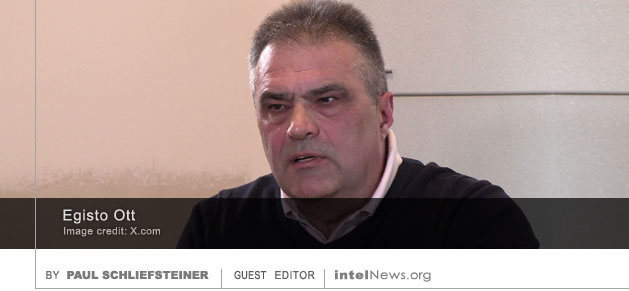
Austrian prosecutors charge ex-intelligence officer accused of spying for Russia

Landesgericht für Strafsachen Wien Vienna Regional Court for Criminal MattersPROSECUTORS IN VIENNA HAVE charged a former intelligence officer with spying for Russia in a high-profile case that has had broad political ramifications in Austria and abroad. The criminal case centers on Egisto Ott, a former employee of Austria’s Federal Office for the Protection of the Constitution and Counterterrorism (BVT). The BVT operated as Austria’s primary domestic intelligence agency from 2002 until its dissolution in 2021.

Ott was first arrested in March 2021, but was soon released after Vienna’s state court ruled that the accused no longer had access to classified information, and was thus not a persistent threat to the state. Ott was arrested again in March 2024 on suspicion of having maintained contact with Russian intelligence officers even following his 2021 arrest and release, and of trying to sell classified information after his release. As intelNews reported a year ago, Ott was released again from pre-trial detention in June 2024, in a decision that raised eyebrows.

Now Ott is facing charges of colluding with an unidentified police officer to “support an intelligence agency” of a foreign country “to the detriment of Austria”, according to the public prosecutor. Ott is also accused of having engaged in bribery, misuse of his office, and of having broken Austria’s Official Secrets Act. Among several instances of engaging in espionage, Ott is accused of having given Russian intelligence an encrypted SINA-workstation laptop of the type used by government employees to access classified information remotely.

Ott and his lawyers have denied he was involved in espionage and have vowed to confront all charges against him in court.

Author: Joseph Fitsanakis | Date: 02 September 2025 | Permalink

Austria’s revamped security leadership team tackles challenges

DSN AustriaTHE CONTROVERSIES THAT CONTINUE to be associated with the Austrian intelligence agencies today took place before December 2021, when the current Directorate of State Security and Intelligence (Direktion Staatsschutz und Nachrichtendienst, or DSN) was founded. Despite this, the DSN under the leadership of its director Omar Haijawi-Pirchner is still regarded as stable and predictable.

The DSN’s Western partner agencies were more than happy that the new governing coalition in Vienna was able to prevent the rightwing populist and generally Putin-friendly Freedom Party of Austria (FPÖ) from providing the minister of the interior. The fact that the current Interior Minister Gerhard Karner has been joined by an experienced state secretary is a major plus: Jörg Leichtfried, a Social Democrat born in 1967, has been regarded as a liberal European for many years, including eleven years as a member of the European Parliament. He will be responsible for state security and intelligence agencies.

One of Leichtfried’s stated goals has been particularly well received: he has vowed to improve the country’s national infrastructure and intensify its international cooperation. Various other details, such as the future framework conditions for military intelligence agencies, are also on his list. It is certain that the operational work of the DSN will continue to be led by Haijawi-Pirchner. This is reportedly to be improved, with better monitoring of terrorist threats, made possible by the planned extended access to messenger services.

The Austrian intelligence agencies have always been characterized by the personalities of their individua leaders. It is therefore all the more important who the leadership surrounds itself with—especially as the expectations are high, not least due to the threats from Russia and China. The uncertainty regarding Europe’s partners in the United States also means that the European intelligence agencies are urgently dependent on reliable Austrian partners.

As the political-strategic organization will be the responsibility of Leichtfried, two people who work in his immediate environment, and were previously only known to insiders, have come to the fore: the head of the Cabinet, Christian Strnad, and the head of Strategy and Security Policy, Rastislav Bachora. Both previously worked on the security-policy concept of the Social Democratic Party of Austria (SPÖ), the Social Democratic Strategy for Freedom, Protection and Security. Read more of this post

Austrian intelligence service report draws international attention over Iran nuke claims

Direktion Staatsschutz und NachrichtendienstON MAY 26, THE Austrian domestic intelligence service, Direktion Staatsschutz und Nachrichtendienst (DSN) in Vienna officially presented its annual report: the Verfassungschutzbericht (VSB) [Constitution Protection Report].  The document can be downloaded [PDF] via the official homepage of the DSN.

First published in 1997 by the predecessor of the DSN and then titled Staatsschutzbericht [State Protection Report], these reports offer rare official insights into the work of Austria’s domestic intelligence service. While their form and scope have varied over the nearly 30 years of the service’s existence, their aim and structure have roughly stayed the same: the VSB informs the public about the duties of the service, and about recent developments in the fields it is tasked with, monitoring and policing, during the calendar year prior to its publication.

Featured chapters nearly always include political extremism, terrorism, espionage, proliferation of weapons of mass destruction, protection of critical infrastructure and, since their emergence, sometimes also cyber threats. Often—thought not always—the reports feature anonymized cases from the year before and specialized essays about certain relevant topics. Traditionally the media and public give most attention to those parts of the report that deal with extremism and terrorism of all kinds inside Austria.
VSB 2024 Receives International Attention

This year, however, several paragraphs in the chapter titled “International Illicit Arms Trade and Proliferation” [“Internationaler Illegaler Waffenhandel und Proliferation”] have drawn international attention. The proliferation section—starting on page 154 of the report—deals with a number of states that can be described as partly or fully antagonistic to “the West”. In addition to Russia, China, Pakistan and North Korea, the Islamic Republic of Iran and its activities are described in the chapter. Regarding the Shia theocracy and its nuclear program, the report states (translated by the author with assistance by DeepL):

In order to assert and enforce its political claims to regional power, the Islamic Republic of Iran is striving for comprehensive armament. Nuclear weapons are intended to make the regime untouchable and to expand and consolidate its dominance in the Middle East and beyond. The Iranian program to develop nuclear weapons is well advanced. An arsenal of ballistic missiles is ready to carry nuclear warheads over long distances. [Emphasis added]

All efforts to prevent Iran’s armament with sanctions and agreements have so far proved ineffective. On the contrary: the Islamic Republic of Iran is producing weapons and weapons delivery systems on a large scale—and not just for its own use. [p.158]

Iranian intelligence services are entrusted with the development and implementation of circumvention structures for the procurement of armaments, proliferation-relevant technologies, and materials for weapons of mass destruction. They use front companies and networks inside and outside the Islamic Republic of Iran for this purpose. In particular, the [Islamic] Revolutionary Guards Corps’ widely ramified and difficult to oversee company empire serves proliferation purposes. [p.159]

The report clearly describes a program by Iran to develop nuclear weapons as a fact. It does not only suggest that it might be well advanced, but states this as a given. The report furthermore establishes that transport systems to deploy nuclear weapons—once finalized—are in place and could reach long-distance targets.

Fox News Picks Up VSB 2024

The VSB was picked up by the American media giant Fox News. The network reported on it under the title “Explosive new intelligence report reveals Iran’s nuclear weapons program still active” on May 28. The Fox News report begins by pointing out that “[t]he startling intelligence gathering of Austrian officials contradicts the assessment of the US Office of the Director of National Intelligence (ODNI)”. It goes on to note that “[t]he Austrian intelligence findings could be an unwanted wrench in President [Donald] Trump’s negotiation process to resolve the atomic crisis with Iran’s rulers because the data outlined in the report suggests the regime will not abandon its drive to secure a nuclear weapon.”
Fox News quotes David Albright, a physicist and founder/president of the Institute for Science and International Security in Washington, DC, as saying: “[t]he ODNI report is stuck in the past, a remnant of the fallacious unclassified 2007 NIE [National Intelligence Estimate]. The Austrian report in general is similar to German and British assessments. Both governments, by the way, made clear to [the] US IC [Intelligence Community] in 2007 that they thought the US assessment was wrong that the Iranian nuclear weapons program ended in 2003.”

The Fox News report also states that “[t]he danger of the Islamic Republic of Iran as a state sponsor of terrorism [and its illegal atomic weapons program] was cited 99 times in the 211-page report that covers pressing threats to Austria’s democracy.” All in all, Fox News’ reporting paints a picture that the small European state’s intelligence service has information that contradicts the assessment of the much larger American IC and insinuates that the American assessment—and by implication the political approach to dealing with Iran—is wrong. Read more of this post

Spy’s release by higher court shows Austria is unable to find its intelligence footing

Egisto OttON JUNE 26, THE longwinded case of Austria’s counter intelligence failure regarding a possible inside threat took yet another —quite surprising— turn: the state court of Vienna (Landesgericht Wien) released from pre-trial detention (Untersuchungshaft) Egisto Ott, a former member of the Federal Office for the Protection of the Constitution and Counterterrorism (BVT) —Austria’s now-dissolved domestic intelligence agency. Ott, who was accused of spying against Austria, had been arrested (again) at the end of March on suspicion of obtaining classified information for which he could provide no reason, as well as for presumably selling it. Among the suspected recipients of the classified information were Russian assets and —more or less directly— Russian intelligence.
However, the three-judge panel called to decide on the detention complaint came to the conclusion that, while there remains a strong suspicion (dringender Tatverdacht) against Ott, the reasons for his further detention were not sufficiently given. In the judges’ view, all activities that could carry a pre-trial detention were committed before Ott was arrested and released for the first time in 2021. Back then, Ott had also been released after a short detention, following a decision by the same court. Briefly summarized, in 2021 the Landesgericht concluded that Ott could no longer spy against Austria as he did not have access to classified information, having been removed from the domestic intelligence agency years earlier. Additionally, since the BVT was in the process of reorganization and reformation at that point, the judges deemed the possibility of further criminal behavior by Ott to be unrealistic.
The recent assessment that Ott did not conduct additional punishable offences following his first release is surprising, since the prosecutor alleged —with a certain undertone directed against the initial decision to release Ott, which can be noted in the arrest warrant— that Ott had resumed his information-gathering and handling activities immediately upon being set free in 2021. Specifically, Ott is accused of having unlawfully retrieved data from the Central Register of Residents (Zentrales Melderegister) on March 24 of that year and then passing it on. The information accessed by Ott concerned the Bulgarian investigative journalist Christo Grozev, who was living in Austria at the time. Consequently, Grozev had to leave Vienna, since his life was deemed to be in severe danger. Today, whenever Grozev returns to Austria to visit members of his family who remain there, he has to do so under heavy protection by the Austrian authorities.

Between June and November 2022, when Ott had been released from his first pre-trial detention, there was also an alleged transfer to Russia of three mobile phones, or their data, as well as a highly-encrypted SINA-workstation laptop. However, the judges of the Landesgericht concluded that, while information or intelligence provided to foreign services does not have to be secret to constitute criminal espionage against Austria, “concrete and vital interests of Austria” have to be violated by such a transfer. The judges did not deem that the evidence furnished by the prosecutor met their criteria. Die Presse, Austria’s ‘newspaper of record’, published a detailed explanation of the court decision. Read more of this post

Austria: Arrest raises broader questions about counterintelligence capabilities

BVT AustriaON GOOD FRIDAY, MARCH 29, Egisto Ott, a former member of Austria’s now-dissolved domestic intelligence agency, the Federal Office for the Protection of the Constitution and Counterterrorism (BVT), was arrested in his house in Carinthia, Austria’s southernmost state. Ott had frequently been at the center of media attention in the past year, in connection with the network surrounding the fugitive financier and alleged spy Jan Maršálek, as well as alleged misconduct relating to carrying out illegal investigations of persons. Ott also seems to have been involved in an alleged attempt to create an intelligence unit, or even an entire shadow intelligence service, embedded inside Austria’s foreign ministry. Now the veteran police and intelligence officer stands accused by the state attorney of abusing his authority and of being part of an “intelligence activity to the disadvantage of Austria” —the only form of spying that is illegal under § 256 of the Austrian criminal code.
Ott’s arrest came several years after intelligence was first shared with Austria by Western partner services —allegedly the Central Intelligence Agency— that reportedly date from as early as November 2017. Back then, Ott allegedly received classified material from his service’s email address to his personal Gmail account. However, Peter Gridling, director of the BVT from 2008 until its dissolution in 2021, stated in a recent interview that the ensuing investigations did not yield actionable results that could be used in criminal proceedings. This statement is highly interesting, as Gridling filed accusations about Ott with the State Prosecutor’s Office himself, and would hardly have done unless he had access to hard evidence. Ott was consequently removed from the BVT and placed in Police Academy Austria (SIAK), which is responsible for training police officers and conducts research related to police and domestic security.

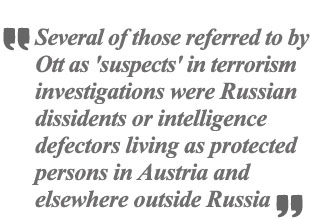
Nevertheless, according to media reporting, Ott seems to have kept and illegally used certain forms of identification that presented him as a police officer. He is also alleged to have maintained access to several police databases and to have retained his network of trusted informants that provided him with intelligence. These included contacts in friendly foreign police services, whom Ott knew from his time as a liaison officer in Italy and Turkey. According to Gridling, these contacts were unaware that Ott had been removed from the BVT under suspicion of being unreliable and potentially even working for Russia. They therefore continued to help him when asked. Ott allegedly deceived his contacts by claiming that he needed information on cases relating to different kinds of extremism. As it turned out, according to the leaked arrest warrant, several of the individuals referred to by Ott as “suspects” in terrorism investigations were in fact Russian dissidents or intelligence defectors who were living as protected persons in Austria and elsewhere outside Russia.
It appears highly probable that Ott also had people inside the Austrian bureaucracy, including former colleagues in the BVT, who continued to provide him with information and assistance, even after the first allegations against him arose in 2017. As of now, at least one other officer from LVT Vienna (the state unit of the BVT) has been found to have illegally provided Ott with Information. It is likely, given the publicly available descriptions of Ott’s activities, that other individuals may be implicated. It also remains to be seen whether individuals involved in this case were able to join the BVT’s successor agency, the new Directorate of State Protection and Intelligence (DSN). Read more of this post

Austria expels four more Russian diplomats for espionage, sources say

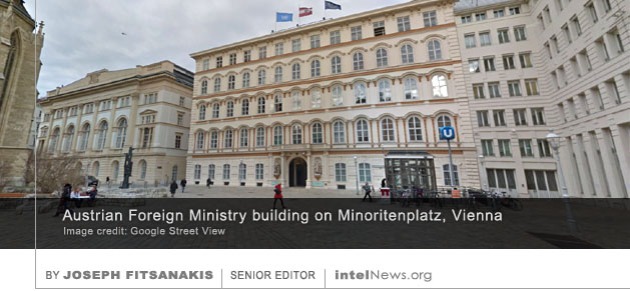
Austria Foreign Affairs MinistryTHE MINISTRY OF FOREIGN Affairs of Austria announced Thursday that it has ordered the expulsions of four Russian diplomats from its territory. It is highly unusual for Austria, which is traditionally reluctant to take sides in international political disputes, to expel Russian diplomats.

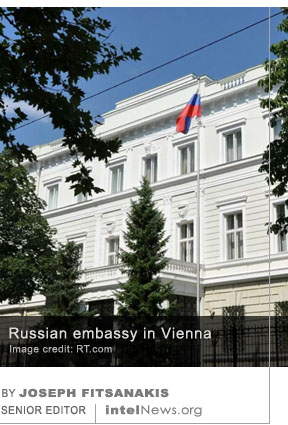
According to the ministry, two of the diplomats are stationed at the Embassy of Russia in the Austrian capital, Vienna. The other two diplomats are members of the Permanent Mission of Russia to the United Nations office in the same city. All four have been declared personae non gratae (unwelcome persons) in accordance with Article 9 of the Vienna Convention on Diplomatic Relations. They are being expelled for allegedly “committing actions incompatible with their diplomatic status”.

Although Austrian authorities have refused to provide details about the expulsions, the phrase “actions incompatible with [one’s] diplomatic status” is often used in diplomatic lingo to refer to activities relating to espionage or other clandestine operations. The Reuters news agency cited “officials speaking on condition of anonymity” in claiming the four Russian diplomats were indeed involved in espionage. However, the Russian embassy in Vienna declined media requests for comment.

The Russian diplomats have been ordered to leave Austria by the end of Wednesday, February 8. The last time Austria expelled Russian diplomats was 2020, prompting Russia to expel an Austrian diplomat in response. Since that time, and including this week’s expulsions, Austria has expelled a total of nine Russian spies from its territory. According to media reports, over 140 diplomats are currently based at the Embassy of Russia in Vienna.

Author: Joseph Fitsanakis | Date: 03 February 2023 | Permalink

Austrian pro-Kremlin officials planned to launch shadow spy agency, report claims

Austria Foreign Affairs MinistryTHE AUSTRIAN STATE HAS launched a probe into an attempt by alleged pro-Russian government officials in Vienna to create a brand new intelligence service in 2018, according to news reports. The effort did not succeed. Some claim, however, that, had it become operational, the new spy service in this European Union state would have been under Russian influence. There are also questions about whether Austria’s foreign minister at the time, Karin Kneissl, was aware of this effort, which appears to have emerged from within her ministry.

The alleged effort to create a new intelligence agency in Austria occurred during the government of Chancellor Sebastian Kurz, a conservative politician belonging to the center-right Austrian People’s Party (ÖVP). Having failed to secure a majority in parliament in the 2017 national election, Kurz’s ÖVP formed a government through an uneasy coalition with the Freedom Party of Austria (FPÖ), a rightwing populist alliance of euro-skeptics, anti-immigration campaigners and strong critics of Islam. In joining Kurz’s governing coalition, the FPÖ was successful in installing Kneissl as Austria’s Minister for Europe, Integration and Foreign Affairs.

Although previously a supporter of the ÖVP, Kneissl had worked closely with the FPÖ —though never officially joined it— in the run-up to the 2017 national election. Prior to that, she had spent nearly a decade with Austria’s Foreign Office, where she had been able to utilize her near-fluent command of English, French, Spanish, and Arabic (she had spent much of her childhood in Jordan, where her father worked as a pilot). Even prior to heading the Foreign Affairs Ministry, Kneissl —and the FPÖ as a whole— was seen by her critics as being too close to the Kremlin. At her wedding in 2018, the list of guests included Russian President Vladimir Putin. Kneissl stepped down from her ministerial post in the summer of 2019. She has since blogged for the Kremlin-funded Russia Today television channel, while also serving —until earlier this year— on the board of the Moscow-headquartered energy company Rosneft. Read more of this post

Two dozen US diplomats in Vienna show signs of ‘Havana syndrome’, report claims

Vienna Austria

ABOUT TWO DOZEN PERSONNEL of the United States embassy in the Austrian capital Vienna have been experiencing unexplained neurological symptoms that are similar to the so-called “Havana syndrome”, a mysterious medical condition that continues to puzzle brain scientists. The condition is believed to have afflicted at least 130 American and Canadian diplomats around the world in recent years.

The matter first came to light in 2017, when Washington recalled the majority of its personnel from its embassy in Havana, Cuba, and at least two more diplomats from its consulate in the Chinese city of Guangzhou. The evacuees reported experiencing “unusual acute auditory or sensory phenomena” and hearing “unusual sounds or piercing noises”. Subsequent tests showed that the diplomats suffered from sudden and unexplained loss of hearing, and possibly from various forms of brain injury.

Now a new report by The New Yorker’s Adam Entous claims that “about two dozen” personnel at the US embassy in Vienna have shown Havana syndrome symptoms “since Joe Biden took office” in January of this year. If accurate, this number of incidents would mean that the Austrian capital is now the largest Havana syndrome location in the world after Cuba. In his report, Entous cited a spokesman for the US Department of State, who said that department was “vigorously investigating” reports of “possible unexplained health incidents” among US diplomats and other embassy personnel in Vienna. The expression “unexplained health incidents” is the official term that the US government uses to refer to what is informally known as the Havana syndrome.

Meanwhile, the Reuters news agency reported a statement issued on Saturday by the Austrian Federal Ministry for European and International Affairs. It said the ministry was “working with the US authorities on jointly getting to the bottom of this”, adding that the Austrian government took “these reports very seriously”, as they potentially affected “the safety of the diplomats sent to Austria and their families”, which was a “top priority” for the Austrian government.

Author: Joseph Fitsanakis | Date: 19 July 2021 | Permalink

Austria expels alleged assassin accused of working for Turkish government

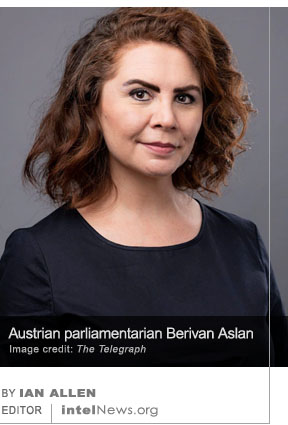
Berivan AslanAUSTRIAN AUTHORITIES HAVE REPORTEDLY expelled from the country an Italian citizen of Turkish origin, who was allegedly hired by the Turkish government as an assassin. The man, Feyyaz Öztürk, 53, reportedly turned himself in to Austrian intelligence last year. According to the British press, Öztürk claimed he had been hired by the Turkish government to assassinate Berivan Aslan (pictured). Aslan, who is of Kurdish heritage, is a Viennese parliamentarian and a leading critic of Turkey’s treatment of its minority Kurdish population.

News reports claimed Öztürk’s mission was to terrorize members of the Kurdish expatriate community in Austria and elsewhere in Europe, who tend to be vocal critics of the Turkish government’s human rights record. British newspaper The Telegraph claimed that Öztürk had been tasked by Ankara to “ensure [Aslan] was hurt or died”, so that “other politicians get the message”. Öztürk also claimed that Turkish intelligence officials had blackmailed him in order to force him to carry out Alsan’s assassination. Moreover, he had been asked to kill two more Austrian public figures who are of Kurdish origin.

However, Öztürk reportedly aborted the assassination operation in March of last year, after he broke his leg in an accident during a trip to the northern Italian city of Rimini. Austrian prosecutors confirmed that an official investigation on Öztürk had concluded. It found that he had carried out “military espionage on behalf of a foreign state”, but did it not identify the state. Turkey has strongly denied that its intelligence agencies have any connection with Öztürk.

Öztürk’s espionage trial has been scheduled for February 4. However, according to Austrian law, he cannot be held in pre-trial detention and must be freed prior to his day in court. Rather than allow him freedom of movement inside Austria, the authorities decided to expel him to Italy. Öztürk’s lawyer said yesterday that her client had been designated “an imminent danger to public security” and taken to the Italian border shortly before Christmas.

The lawyer added that Öztürk wishes to return to Austria to attend his trial in February. There are suspicions among intelligence observers that the Austrian state would prefer Öztürk not to return to Austria, so as to avoid exposing espionage methods and sources in court. Meanwhile, Aslan said she remains under police protection, which was initially extended to her last year, when the alleged assassination plot against her became known.

Author: Ian Allen | Date: 13 January 2021 | Permalink

Mossad helped Syrian intelligence official flee to Austria, despite alleged crimes

BVT AustriaA SYRIAN INTELLIGENCE OFFICIAL, who was denied political asylum in France due to claims he committed serious war crimes, received protection from Austria with assistance from Israel, according to a report. This was revealed on Sunday by British newspaper The Telegraph, which said it had been given the information by “a judicial source”.

The Syrian official in question is Khaled al-Halabi, a former Brigadier General in the Syrian Military Intelligence Directorate (MID). He served as head of the MID in the northern Syrian city of Raqqa amidst the Syrian Civil War, which began in 2011. But in 2013, as the civil war became fiercer, al-Halabi defected from Syria and took his family to France, where applied for political asylum.

Two years later, al-Halabi was notified by the French authorities that his application for political asylum had been denied, due to serious concerns that he had been involved in criminal acts against opponents of the regime of Syrian President Bashar al-Assad. However, soon after being notified that his application for asylum had been rejected, al-Halabi mysteriously disappeared from France, and was never seen there again.

According to The Telegraph, while waiting for a decision from the French authorities in regards to his application for asylum, al-Halabi was negotiating with the Israeli external intelligence agency, the Mossad. The Israeli spy agency allegedly whisked al-Halabi away from France and took him to nearby Austria. Once there, al-Halabi went into the custody of the Office for the Protection of the Constitution and Counterterrorism (BVT), Austria’s primary intelligence agency.

In December of 2015, al-Halabi was granted asylum in Austria, and today he is believed to live in Vienna, in a four-bedroom apartment provided to him by the Austrian government. The decision by the Austrian government to give the former Syrian spy official asylum made headlines in Austria in October, causing significant controversy. This is because at least one lawsuit has been filed against al-Halabi for his alleged participation in war crimes and crimes against humanity during the Syrian Civil War, according to The Telegraph.

But the alleged involvement of the Mossad in al-Halabi’s case was not known until last Sunday. If true, the Mossad’s role in this case could signify that al-Halabi had established a relationship with the Israeli spy agency prior to his defection from Syria in 2013. According to the Austrian press, al-Halabi denies that he was involved in war crimes and crimes against humanity.

Author: Joseph Fitsanakis | Date: 02 December 2020 | Permalink

Austrian government signals major overhaul of spy service, following Vienna attack

BVT AustriaAUSTRIAN GOVERNMENT OFFICIALS SIGNALED on Thursday the beginning of a major overhaul of the country’s intelligence community, in response to this week’s terrorist attack in Vienna, which killed four people. Another 20 people were wounded by a lone gunman, who used an automatic weapon to spread panic in the Austrian capital before he was shot dead by Austrian police.
The gunman was later identified as Kujtim Fejzulai, an Austrian citizen of Albanian extraction, who was born in North Macedonia and held citizenship there too. The shooter was known to Austrian authorities, as he had been previously convicted of trying to travel to Syria to join the Islamic State. He had been imprisoned as an Islamic radical, but had been released after allegedly duping Austrian judges, who believed he had reformed.

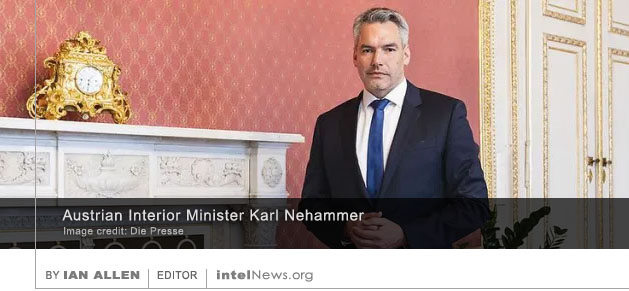
In the days following the attack, it emerged that Slovakian authorities had notified Austrian security agencies in July that Fejzulai had tried to purchase ammunition in Slovakia. On Wednesday, Austria’s Director General for Public Security, Franz Ruf, said that Austrian intelligence authorities “sent questions back to Bratislava”, but then there had been a “breakdown” in the system. Austrian Minister of the Interior Karl Nehammer added that “something apparently went wrong with the communication in the next steps”.

Nehammer and others, including Austrian Vice Chancellor Werner Kogler, called for the establishment of an independent commission to examine the Fejzulai case and “clarify whether the process went optimally and in line with the law”. The Austrian Chancellor, Sebastian Kurz, said on Thursday that the country did not have “all the legal means necessary to monitor and sanction extremists”, adding that he would initiate the creation of a panel that would supervise a “realignment” of the intelligence agencies. He was referring to the Office for the Protection of the Constitution and Counterterrorism, known by the initials BVT. He did not provide details.

Author: Joseph Fitsanakis | Date: 06 November 2020 | Permalink

Austrian financier dubbed ‘world’s most wanted man’ worked for several agencies

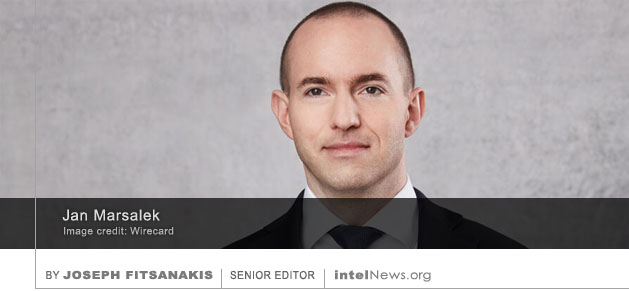
Jan Marsalek

AN AUSTRIAN FINANCIER, WHO disappeared and is wanted by Western spy agencies in connection with a massive financial scandal in Germany, may have worked for several spy agencies simultaneously, according to reports. Jan Marsalek, dubbed by some as “the world’s most wanted man”, is connected with the sudden collapse of Wirecard AG in Germany last month.

Wirecard (est. 1999) was a German provider of financial services, such as mobile phone payment processing and other electronic payment transaction systems. The company also issued physical and virtual credit and pre-paid cards. But on June 25 of this year the company declared insolvency, after an audit revealed that nearly €2 billion ($2.3 billion) in cash deposits were missing from its accounts. Soon afterwards the company’s shares lost over 70 percent of their value and its management team, including its chief executive officer, Markus Braun, stepped down. Braun was eventually arrested. But Marsalek, who had worked as Wirecard’s chief operating officer since 2010, was nowhere to be found.

Marsalek, 40, was also in charge of Winecard’s operations in Asia and specifically the Philippines, where the fictitious €2 billion had reportedly been deposited. On June 18, after getting fired from his job, Marsalek told colleagues that he was leaving immediately for Manilla, in order to track down the missing funds and clear his name. However, he never arrived there, as he seemed to disappear into thin air on the way. An investigative report by The Financial Times revealed that Marsalek never made use of his airline ticket to the Philippine capital, and that the immigration records that showed him entering the country and then flying from there to China had been forged. This was later confirmed by the Philippines government.

Last Thursday, the German newspaper Süddeutsche Zeitung reported that, according to some German lawmakers, Marsalek may have operated as an informant for the Austrian Office for the Protection of the Constitution and Counterterrorism (BVT). The paper cited a number of German lawmakers, who said they were told during a briefing of the German Parliament’s Committee on Intelligence Oversight that Marsalek probably worked “for several intelligence agencies at the same time” prior to his disappearance. The lawmakers did not provide details of these allegations. Meanwhile, Marsalek’s whereabouts remain unknown.

Author: Joseph Fitsanakis | Date: 02 November 2020 | Permalink

Austria to press charges on man caught spying for Turkish intelligence service

Karl NehammerThere were angry exchanges between Austrian and Turkish officials on Tuesday, after the Austrian government announced it would press charges against an individual allegedly caught spying for Turkish intelligence. The charges were announced on Tuesday morning local time by Austria’s Interior Minister Karl Nehammer (pictured), during a press conference in the Austrian capital Vienna.
During the press conference, Nehammer said the Austrian government wished to send “a clear message to the Turkish Republic: Turkish espionage and interference by Turkey in the civil liberties [of Austrian citizens] have no place in Austria”. Additionally, the Austrian official said his government would “work at the European level to make sure that Turkey does not interfere in the internal affairs of European Union states”. Vienna had already notified Horst Seehofer, president of the European Council, of the espionage case, said Nehammer.

It is believed that the alleged Turkish spy was uncovered by Austrian authorities after a large political protest that took place in Vienna last June, which resulted in violent clashes between pro-Kurdish and pro-Turkish demonstrators. The protesters were members of pro-Kurdish organizations in Vienna, but were confronted by pro-Turkish demonstrators, which resulted in the whole rally descending into violent street clashes. An investigation by Austrian police determined that many of the pro-Turkish demonstrators were affiliated with a far-right Turkish group known as the Grey Wolves.

According to the Austrian Interior Ministry, however, it was also found that Turkey’s National Intelligence Organization, known as MİT, helped organize the Grey Wolves group that confronted the pro-Kurdish rally. Among the Grey Wolves rioters, say Austrian officials, was a man who had been “recruited” by the MİT to spy on pro-Kurdish activists or critics of Turkish President Recep Tayyip Erdoğan. Nehammer said the alleged spy already confessed to working for Turkish intelligence.

In response to Nehammer’s statements, the Turkish government accused Austria’s national leadership of harboring an “anti-Turkey obsession”. Turkish Foreign Ministry spokesman Hami Aksoy told reporters in Ankara that the Austrian government should “top chasing artificial agenda with shallow and domestic political calculations over Turkey, and act with […] seriousness, common sense, and sincere cooperation”.

Author: Ian Allen | Date: 02 September 2020 | Permalink

Russia expels Austrian diplomat in tit-for-tat move involving espionage claims

Russian embassy in AustriaRussia has expelled a diplomat stationed at the Austrian embassy in Moscow, just hours after the Austrian Ministry of Foreign Affairs expelled a Russian diplomat from Austria, allegedly for engaging in espionage. Austrian officials reportedly gave the unnamed Russian diplomat until Tuesday, September 1, to leave Austrian soil, in a move that surprised observers, given the close relations between Austria and Russia in recent years.


The Russian diplomat is accused by the Austrian authorities of engaging in “behavior that violated the Vienna Convention on Diplomatic Relations”. The Austrian Ministry of Foreign Affairs did not elaborate on the accusations against the diplomat, and refused to name him. However, the Vienna-based Kronen Zeitung newspaper, said on Monday that the Russian diplomat had carried out “industrial espionage” for several years. According to the paper, the Russian had recruited an Austrian citizen who worked for a technology firm to spy for Moscow. Austrian authorities arrested the man, who promptly identified the Russian diplomat as handler. The paper also said that, according to some sources, the man turned himself in to the authorities.

Later on Monday, the Russian Foreign Ministry summoned Johannes Aigner, Austria’s ambassador to Russia, and “strongly protested the unjustified course of action to cancel the accreditation of a Russian diplomat and order him to leave Austrian soil”. Moscow said in a statement its decision to expel an Austrian diplomat was “guided by the principle of reciprocity”. It is not known at this time how this incident will affect bilateral relations between Russia and Austria, which have been among Moscow’s warmest with a Western country in recent years.

Author: Joseph Fitsanakis | Date: 25 August 2020 | Permalink

Austrian court finds unnamed retired Army colonel guilty of spying for Russia

Igor Egorovich ZaytsevA court in Austria has found a retired Army colonel guilty of providing classified military information to Russia, following a closed-door trial. Interestingly, the alleged spy’s name has not been made public. Some Austrian media have been referring to him as “Martin M.”.

The retired colonel was arrested in November of 2018, reportedly after having recently retired following a long military career. Austria’s Defense Ministry said at the time that the arrest came after a tip given to the Austrian government by an unnamed European intelligence agency from a “friendly country”. Martin M. reportedly served in peacekeeping missions in the Golan Heights and Cyprus before being posted at one of the Austrian Armed Forces’ two headquarters, located in the western city of Salzburg. It was around that time, say prosecutors, that the unnamed man began spying for Russia. Starting in 1992, he was in regular contact with his Russian handler, who was known to him only as “Yuri”.

“Yuri” was later identified by Austrian authorities as Igor Egorovich Zaytsev, who is allegedly an intelligence officer for the Main Directorate of the General Staff of the Russian Armed Forces. Known as GRU, the organization is Russia’s primary military-intelligence agency. The Austrian government has issued an international arrest warrant for a Zaytsev.

Zaytsev reportedly trained Martin M. in the use of “sophisticated equipment”, according to the Austrian prosecutor, which he used to communicate classified information to Moscow. He is thought to have given Russia information on a range of weapons systems used by the Austrian Army and Air Force, as well as the personal details of high-ranking officers in the Austrian Armed Forces. Austrian media initially reported that the alleged spy was paid nearly $350,000 for his services to Moscow.

During his trial, Martin M. reportedly admitted that he had received payments form the Russians to provide information. But he claimed that the information he gave them was already publicly available. His legal team compared his role to that of a “foreign correspondent” for a news service. The court, however, did not accept that argument and on Tuesday sentenced Martin M. to three years in prison.

Soon after his sentencing, the defendant was released on parole, after the court counted the 18 months he has served behind bars since his arrest as part of his prison sentence. His legal team said they plan to appeal the sentence.

Author: Joseph Fitsanakis | Date: 11 May 2020 | Permalink