Germany arrests Tunisian man for producing biological weapon in his apartment
June 18, 2018 Leave a comment
 German authorities have charged a Tunisian citizen with building a biological weapon, after finding significant quantities of the highly toxic substance ricin in his apartment. The 29-year-old man is referred to in public reports only as “Sief Allah H.”, in compliance with German law that forbids the naming of suspects until they are found guilty in court. German officials said last Thursday that the man remains in custody and has been charged with violating Germany’s War Weapons Control Act (known as Kriegswaffenkontrollgesetz) and “preparing a serious act of violence against the state”.
According to reports, German intelligence services received a tip-off last month that the man had made online purchases of a coffee grinder and 1,000 castor seeds. Processing castor seeds creates a ricin byproduct, which can then be weaponized in the form of a powder, a fine mist, or solid pellets of various sizes. The end product is more powerful than many other toxic substances, such as cyanide. Upon entering the human body, ricin can cause multiple organ failure in less than two days. It has no known antidote.
After receiving the tip-off, German authorities began monitoring the suspect’s movements in the western German city of Cologne, near the Belgian and Dutch borders. By June, German police discovered that he had produced enough ricin to dispense as many as 1,000 lethal doses.
German media reported that “Sief Allah H.” is a sympathizer of the Islamic State. However, investigators have found no direct link between him and any militant organizations in Germany or abroad. Additionally, no evidence has yet been presented that he had planned an actual attack —in Germany or elsewhere— at a specific time. However, officials from Germany’s Federal Office for the Protection of the Constitution said it was “very likely” that the arrest of “Sief Allah H.” had averted a terrorist attack. Late last week, German newsmagazine Der Spiegel said that the suspect had made ricin by following instructions posted online by the Islamic State.
Throughout the weekend, several other apartments in Cologne were searched by German authorities. Search parties consisted of members of the local police, intelligence officers and scientists from the Robert Koch Institute, the German government agency tasked with monitoring hazards to public health.
► Author: Joseph Fitsanakis | Date: 18 June 2018 | Research Credit: S.F. | Permalink
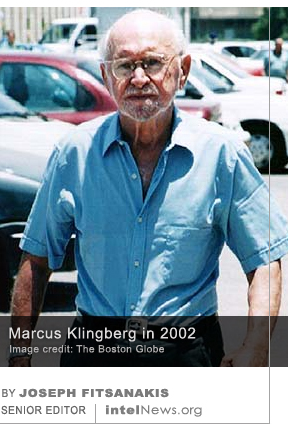 Marcus Klingberg, who is believed to be the highest-ranking Soviet spy ever caught in Israel, and whose arrest in 1983 prompted one of the largest espionage scandals in the Jewish state’s history, has died in Paris. Born Avraham Marek Klingberg in 1918, Klingberg left his native Poland following the joint German-Soviet invasion of 1939. Fearing persecution by the Germans due to his Jewish background, and being a committed communist, he joined the Soviet Red Army and served in the eastern front until 1941, when he was injured. He then received a degree in epidemiology from the Belarusian State University in Minsk, before returning to Poland at the end of World War II, where he met and married Adjia Eisman, a survivor of the Warsaw Ghetto uprising. Together they moved to Sweden, from where they emigrated to Israeli in 1948. It is believed that Klingberg was recruited by the Soviet KGB while in Sweden, and that he moved to Israel after being asked to do so by his Soviet handlers –though he himself always denied it.









 intelNews.org
Analysis: No, the coronavirus was not bioengineered. The rumors are false
March 24, 2020 by intelNews 5 Comments
Coronaviruses are not new in nature or to humans. SARS-CoV-2 (SARS-associated coronavirus 2) is only the latest coronavirus we have identified that infects humans and causes disease (COVID-19). Because other corona viruses have also been isolated, it is possible to sequence the genome of these viruses. This provides detailed information about their origins. This is particularly important in light of the rumors that this virus has been manipulated by various governments.
Similar to the SARS-CoV strain, the one responsible for severe acute respiratory syndrome (SARS), this novel virus also binds to a protein, the receptor for angiotensin-converting enzyme 2 (ACE2), which is found on cells in humans, in the lungs, kidneys, GI tract, heart, and bladder. The virus uses a “spike protein” to attach to the receptor protein on cells in these regions, and then punctures the cell to inject the viral nucleic acids (genetic material). Once inside the cell, the virus nucleic acids are reproduced by the cell, and new viruses are manufactured.
When scientists analyzed the nucleic acids sequence responsible for attaching to cells, they found that the sequence was optimal, but not ideal. This means that the virus can recognize and bind tightly to the ACE2 receptor protein, but it is not perfect. This is analogous to having an old key (spike protein) that will fit into a lock (ARE2 receptor), but does not always work properly (open the door). In bioengineering, the goal is to have the perfect key so that all of the virus can enter cells and reproduce rapidly. This perfect fit is not found in SARS-CoV-2. This provides evidence of natural selection, and not of bioengineering.
Additionally, the SARS-CoV-2 genome has a unique amino acid in an important region of the spike protein. This amino acid, a proline, has an unusual structural characteristic that causes a protein to make a sharp change in direction (a turn). This is not seen in the SARS-CoV, the closest genetic relative to SARS-CoV-2. Furthermore, when the sequence for the SARS-CoV-2 is compared to other coronaviruses, the SARS-CoV-2 sequence does not appear to be derived from previously sequenced viruses. This fact also points to natural selection, since a bioengineered virus would be based on a known template that could be easily manufactured in a laboratory.
Rather it appears, from genetic and biochemical analysis, that SARS-CoV-2 started in bats, moved to pangolins, and then to humans. It is unclear whether the evolutionary changes that gave rise to the SARS-CoV-2 variant changed once it entered pangolins from bats, or whether it entered humans and continued evolving into the strain we see today. While the evidence indicates that it is highly unlikely that the virus was bioengineered, it is impossible to determine whether it entered humans in its present form, or evolved once it crossed the species barrier.
► Author: Dr. A.T. | Date: 24 March 2020 | Permalink
Filed under Expert news and commentary on intelligence, espionage, spies and spying Tagged with Analysis, biological weapons, biosecurity, Coronavirus, COVID-19, guest articles, scientific intelligence