Revealed: British prime minister was not told about fourth Cambridge spy ring member
July 24, 2018 Leave a comment
 The Prime Minister of Britain, Sir Alec Douglas-Home, was kept in the dark by his own home secretary about the discovery of a fourth member of the infamous Cambridge Spy Ring in 1964, according to newly released files. The Cambridge Spies were a group of British diplomats and intelligence officials who worked secretly for the Soviet Union from their student days in the 1930s until the 1960s. They included Guy Burgess, Donald Maclean and H.A.R. “Kim” Philby, all of whom eventually defected to the Soviet Union. In 1964, Sir Anthony Blunt, an art history professor who in 1945 became Surveyor of the King’s Pictures and was knighted in 1954, admitted under interrogation by the British Security Service (MI5) that he had operated as the fourth member of the spy ring.
Despite his allegedly full confession, Blunt was never seriously disciplined for his espionage activities against Britain. In return for revealing his spy activities and naming others who had assisted him, he was granted immunity from prosecution. He was also allowed to remain in his academic post and retained his title of Surveyor of the Queen’s Pictures –effectively the curator of Queen Elizabeth II’s art collection. It wasn’t until 1979 when British Prime Minister Margaret Thatcher revealed in a statement to the British House of Commons that Blunt had been the fourth member of the Cambridge Spy Ring. Minutes after the prime minister’s statement entered the public record, Buckingham Palace (which had been made aware of Blunt’s espionage role back in 1964, but had been asked by Britain’s Interior Ministry to not draw attention to the scandal) stripped him of his 1954 knighthood.
It has now been revealed known that, in the days following her House of Commons statement about Blunt, Prime Minister Thatcher received several letters by Henry Brooke, who was serving as home secretary in 1964, when Blunt’s treachery was discovered. In his letters, Brooke (by then Lord Brooke of Cumnoor) expressed his support for the prime minister’s revelation. But the letters, which were previously classified but were published on Tuesday by Britain’s National Archives, also reveal that Brooke kept Blunt’s 1964 confession hidden from the then Prime Minister Sir Alec Douglas-Home. In his 1979 letter to Thatcher, Brooke states that he did not inform the prime minister in 1964 in his “well-meant effort not to add to [Douglas-Home’s] burdens”. But he adds that “I may, with hindsight, have expressed my discretion wrongly”. By that time, Blunt had voluntarily withdrawn from public life and was rarely heard of. Upon his death in 1984, his unfinished memoir was given to the British Library by the executor of his will, under the stipulation that it be kept sealed for 25 years. It was released to the public in 2009.
► Author: Joseph Fitsanakis | Date: 24 July 2018 | Permalink
 A document that allegedly contains the name of a man who could be connected to one of the most sensational spy rings of the Cold War is to remain secret after a judge rejected a request to have it released. The man is believed by some to have been associated with the so-called ‘Cambridge spy ring’, a group of upper-class British graduates of Cambridge University, who spied for the USSR from the 1930s until the 1960s. Among them was Guy Burgess, Donald Maclean and H.A.R. “Kim” Philby, all of whom eventually defected to the Soviet Union. In 1979, it was revealed that Anthony Blunt, an art history professor who in 1945 became Surveyor of the King’s Pictures and was knighted in 1954, was also a member of the group. A fifth member, career civil servant and former intelligence officer John Cairncross, was publicly outed as a Soviet in 1990, shortly before his death.
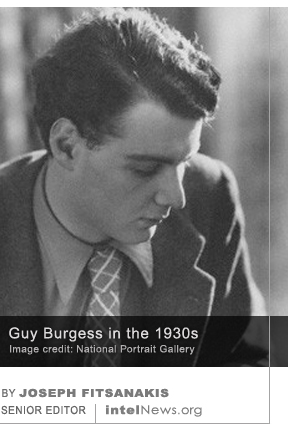 The life of Guy Burgess, one of the so-called ‘Cambridge Five’ double agents, who spied on Britain for the Soviet Union before defecting to Moscow in 1951, is








 intelNews.org
Russian security services honor members of the Cambridge spy ring with plaque
December 23, 2019 by Joseph Fitsanakis Leave a comment
In 1951, shortly before they were detained by British authorities on suspicion of espionage, Burgess and Maclean defected to the Soviet Union. They both lived there under new identities and, according to official histories, as staunch supporters of Soviet communism. Some biographers, however, have suggested that the two Englishmen grew disillusioned with communism while living in the Soviet Union, and were never truly trusted by the authorities Moscow. When they died, however, in 1963 (Burgess) and 1983 (Maclean), the Soviet intelligence services celebrated them as heroes.
On Friday, the Soviet state recognized the two defectors in an official ceremony in the Siberian city of Samara, where they lived for a number of years, until the authorities relocated them to Moscow. Kuibyshev, as the city was known during Soviet times, was technically a vast classified facility where much of the research for the country’s space program took place. While in Kuibyshev, Burgess and Maclean stayed at a Soviet intelligence ‘safe house’, where they were debriefed and frequently interrogated, until their handlers were convinced that they were indeed genuine defectors.
At Friday’s ceremony, officials unveiled a memorial plaque at the entrance to the building where Burgess and Maclean lived. According to the Reuters news agency, the plaque reads: “In this building, from 1952-1955, lived Soviet intelligence officers, members of the ‘Cambridge Five’, Guy Francis Burgess and Donald Maclean”. On the same day, a letter written by Sergei Naryshkin, head of Russia’s Foreign Intelligence Service (SVR), one of the institutional descendants of the Soviet-era KGB, appeared online. In the letter, Naryshkin said that Burgess and Maclean had made “a significant contribution to the victory over fascism [during World War II], the protection of [the USSR’s] strategic interests, and ensuring the safety” of the Soviet Union and Russia.
Last year, Russian officials named a busy intersection in Moscow after Harold Adrian Russell Philby. Known as ‘Kim’ to his friends, Philby was a leading member of the Cambridge spies. He followed Burgess and Maclean to the USSR in 1963, where he defected after a long career with the British Secret Intelligence Service (MI6).
► Author: Joseph Fitsanakis | Date: 22 December 2019 | Permalink
Filed under Expert news and commentary on intelligence, espionage, spies and spying Tagged with Cambridge Five, Cold War, defectors, Donald Maclean, espionage, Guy Burgess, history, News, SVR (Russia), UK, USSR