As Australia launches probe, skeptics cast doubts on Chinese defector’s spy claims
November 27, 2019 1 Comment
 As the Australian government has launched an official investigation into the claims made by a self-styled Chinese intelligence defector, some skeptics have begun to cast doubts about his revelations. The claims of Wang “William” Liqiang have dominated news headlines in Australia for over a week. The 26-year-old from China’s eastern Fujian province reportedly defected to Australia in October, while visiting his wife and newborn son in Sydney. He is currently reported to be in a safe house belonging to the Australian Security Intelligence Organization (ASIO).
The Australian spy agency confirmed last week that Mr. Wang had provided a 17-page sworn statement, in which he detailed his work as an undercover intelligence officer for Chinese military intelligence. He is also said to have shared the identities of senior Chinese intelligence officers in Taiwan and Hong Kong, and to have explained how they plan to carry out espionage operations on behalf of Bejing. Some media reports claimed that Mr. Wang had shared details about deep-cover Chinese intelligence networks in Australia. The Australian government said on Tuesday that an official investigation had been launched into Mr. Wang’s claims.
But some skeptics in Australia and elsewhere have begun to raise doubts about the Chinese defector’s claims, suggesting that he has given little —if any information— that is genuinely new. Some argue that Mr. Wang is much too young to have been entrusted with senior-level responsibilities in the intelligence agency of a country that rarely promotes twenty-somethings in high-ranking positions. Additionally, Mr. Wang appears to have no military background —he claims to have been recruited while studying fine art— which is not typical of a Chinese military intelligence operative.
Furthermore, Mr. Wang episode interviewers from Australian television’s 60 Minutes program that he began feeling tormented by moral dilemmas when his staff officers supplied him with a fake passport bearing a different name, in preparation for an operation in Taiwan. However, by his own admission, Mr. Wang had been supplied with fake passports for previous operations, so it is not clear why he lost his nerve at the time he did. In fact, case officers usually covet the opportunity to go undercover and feel a sense of exhilaration when they receive fake identification documents for an undercover mission.
Is Mr. Wang not sharing the entire background to his decision to defect to Australia? Or could he be deliberately amplifying his role in Chinese intelligence, in an effort to appear useful to the Australian government and thus secure political protection by Canberra? In the words of Alex Joske, an analyst at the International Cyber Policy Centre of the Australian Strategic Policy Institute, the details in some of Mr. Wang’s claims mean that “government investigations should uncover the facts eventually. But we don’t know the full story and we probably never will”.
► Author: Joseph Fitsanakis | Date: 26 September 2019 | Permalink
 A Chinese intelligence defector has reportedly given the Australian government information about entire networks of Chinese undercover spies in Hong Kong, Taiwan and Australia, according to reports. The story of Wang “William” Liqiang, made headlines all over Australia during the weekend, culminating in an entire
 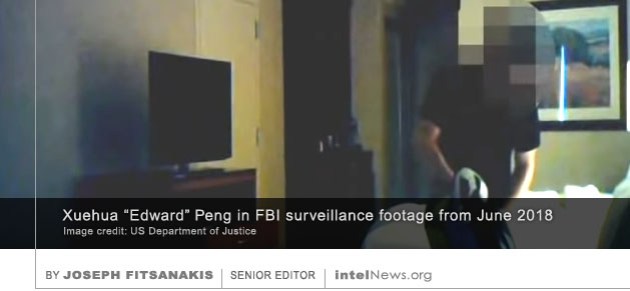 The United States has pressed espionage charges against a naturalized American citizen who operated as a courier for Chinese intelligence while working as a tour operator in California. On Monday federal prosecutors in San Francisco filed espionage charges against Xuehua “Edward” Peng, a 56-year-old Chinese-born American citizen. Peng, a trained mechanical engineer, reportedly entered the United States in June 2001 on a temporary visa. In 2012 he became a naturalized American citizen. By that time he was working for US Tour and Travel, an independent tour operator in California.
 In a move observers describe as unprecedented, a United States government regulator is preparing to recommend blocking the construction of an 8,000-mile long undersea cable linking America with China, allegedly due to national security concerns. Washington has never before halted the construction of undersea cables, which form the global backbone of the Internet by facilitating nearly 100% of Internet traffic. Much of the undersea cable network is in the process of being replaced by modern optical cables that can facilitate faster Internet-based communications than ever before.
 A Swiss court has ordered the extradition to the United States of the brother of one of the world’s leading biochemists, who spied on a British pharmaceutical firm to help a Chinese startup. The extradition is part of a large corporate espionage case centered on Yu Xue, a Chinese scientist described by US federal prosecutors as “one of the world’s top protein biochemists”. Yu specializes in drug research for cancer and other serious terminal illnesses. From 2006 until 2016 he worked in the US for GlaxoSmithKline (GSK), a leading British pharmaceutical group.
 The Polish government has authorized the release on bail of a former counterintelligence officer who was charged in January of this year with spying for China. The man has been identified in media reports as Piotr Durbajlo and is believed to have served as deputy director of the Internal Security Agency, Poland’s domestic counterintelligence service. A cyber security expert, Durbajlo also served in Poland’s Office of Electronic Communications with a top security clearance and unrestricted access to classified systems of Poland and the North Atlantic Treaty Organization, of which Poland is a member.
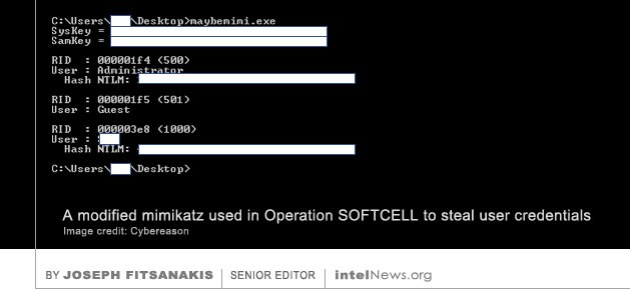 A hacker attack of impressive magnitude targeted specific individuals of interest to the Chinese government as they moved around the world, in what appears to be the first such operation in the history of cyberespionage. The attack was revealed late last month by Cybereason, an American cybersecurity firm based in Boston, Massachusetts. Company experts
  Despite allegations in the French press that China has been spying for years on the internal communications of the African Union, the organization appears to be deepening its ties with a leading Chinese telecommunications firm. The allegations
  German intelligence officials appear to be dismissing Washington’s warning that it will limit security cooperation with Berlin if China’s Huawei Telecommunications is allowed to build Germany’s 5G network. The company, Huawei Technologies, is a private Chinese venture and one of the world’s leading telecommunications hardware manufacturers. In recent years, however, it has come under scrutiny by some Western intelligence agencies, who view it as being too close to the Communist Party of China. More recently, Washington has intensified an international campaign to limit Huawei’s ability to build the infrastructure for 5G, the world’s next-generation wireless network. Along with Britain, Australia and Canada, the US is concerned that the Chinese telecommunications giant may facilitate global wiretapping on behalf of Beijing’s spy agencies.
 The United States has warned Germany that intelligence sharing between the two countries will be threatened if the Chinese telecommunications giant Huawei is awarded a contract to build Germany’s 5G network. The company, Huawei Technologies, is a private Chinese venture and one of the world’s leading telecommunications hardware manufacturers. In recent years, however, it has come
 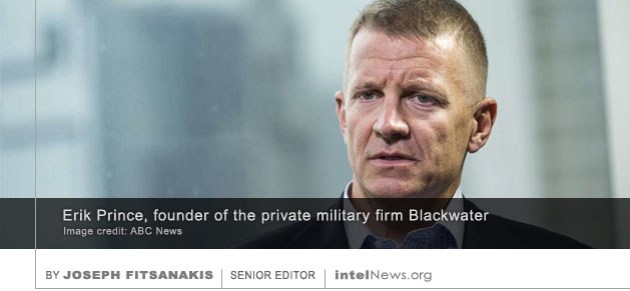 A security firm founded by Erik Prince, the former boss of the private military company Blackwater, has announced a deal with the Chinese state to operate a training facility in China’s largely Muslim Xinjiang province. In the months following the United States invasion of Iraq, Blackwater was hired by the Department of State to provide diplomatic security at several locations throughout the Middle Eastern country. By 2010, when the company was abruptly sold to a group of private investors, its tactics in Iraq had prompted international controversy. Prince went on to help found Frontier Services Group (FSG), another private security firm registered in Hong Kong. The company provides security training to personnel working for Chinese companies. Its specialization is training personnel of Chinese firms based abroad, mainly in regions of Africa.
 The Chinese telecommunications giant Huawei has fired one of its employees who was arrested last week in Poland on charges of spying for China,






 intelNews.org
Belgian university shuts down Chinese-funded institute due to espionage claims
December 12, 2019 by Ian Allen Leave a comment
The Confucius Institute at VUB is one of more than 500 such research bodies that the government of China has funded around the world since 2004. Their mission is to promote the language and culture of China to the world. However, numerous academic institutions in Japan, Canada, and a number of European countries, have recently shut down Confucius Institute branches, following allegations that their staff members carried out espionage tasks, or tried to stifle academic research critical of China. In Europe alone, the University of Lyon in France, Stockholm University in Sweden, and Holland’s University of Leiden have all recently terminated their cooperation with the Confucius Institute.
In October of this year, Belgium’s State Security Service (VSSE) concluded that the VUB Confucius Institute director, Dr. Song Xinning, carried out espionage tasks on behalf of the Chinese government. As a result, the Belgian government refused to renew the work visa of Dr. Song, who had lived in Belgium for over a decade. Additionally, the Chinese academic was barred from entering the European Union’s Schengen Area —which comprises 26 European countries— for eight years.
Dr. Song alleges that his work visa was revoked after he refused to cooperate with an American diplomat stationed in Brussels. He also denies that he was ever in the service of Chinese intelligence or the Chinese state. But the VUB appears to have sided with the Belgian government in this dispute. The university annulled its contract with Dr. Song and, as of January, will be terminating its relationship with the Confucius Institute. In a press statement published online, VUB Rector Caroline Pauwels said that the work of the Confucius Institute did not meet the “current policy objectives” of the university.
► Author: Ian Allen | Date: 12 December 2019 | Permalink
Filed under Expert news and commentary on intelligence, espionage, spies and spying Tagged with Belgium, China, Confucius Institute, espionage, News, Song Xinning, Vrije Universiteit Brussel, VSSE (Belgium)