News you may have missed #315

  • Nuclear bunker spy comes out of hiding. A British retiree named Mike Lesser has revealed he was one of the so-called “spies for peace”, a group of peace activists who in the 1960s helped uncover Britain’s secret network of underground bunkers built to protect the government in case of nuclear war.
  • Aussie spy agency spied on little girls. Secret files kept by the Australian Security Intelligence Organisation reveal spooks tailed the teenage children of suspected socialists and communist sympathizers during the late 1960s, and anyone with whom they associated, including school friends and boyfriends.
  • Analysis: Under Panetta, a more aggressive CIA. Expectations among CIA hardliners were low when Leon Panetta arrived at the Agency’s headquarters in February 2009. But almost from the first week, Panetta positioned himself as a strong advocate for the CIA, to the extent that critics worry that Panetta has become a captive of the agency he leads.

Bookmark and Share

News you may have missed #302 (NSA edition)

Bookmark and Share

FBI wiretaps broke the law thousands of times from 2002 to 2006

FBI memos

FBI memos

By JOSEPH FITSANAKIS | intelNews.org |
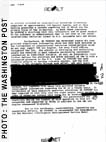
Considering the extent of illegal domestic telephone surveillance practiced by US intelligence agencies after 9/11, the disclosure of yet another wiretap scandal can hardly surprise anyone. But the latest revelation by The Washington Post points to an alarming collusion between FBI agents, their supervisors, as well as telephone industry employees, all of whom consciously disregarded even the severely lax standards of the USA PATRIOT Act. The paper says it acquired several internal FBI memos (.pdf), through “a government employee outside the FBI, who gained access to them”. These memos appear to show widespread abuse of more than 2,000 US telephone call records (but not content, it appears), which FBI agents obtained between 2002 and 2006, by presenting telephone companies with fake National Security Letters (NSLs). The NSLs claimed the records were required for emergency counterterrorism investigations. But in reality these investigations bore no connection to terrorism, and the NSLs were never followed up with actual subpoenas, as they were supposed to. Read more of this post

News you may have missed #0254 (activism edition)

  • US activists file lawsuit over domestic spying. Anti-war activists in Washington State are suing military analyst John Towery and police officials for allegedly infiltrating and spying on two antiwar groups in Olympia. The suit also names the City of Olympia and a US Coast Guard employee.
  • Antiwar activist to stage sit-in at CIA HQ. American political activist Cindy Sheehan says she intends to stage a sit-in in front of the CIA headquarters in Langley, Virginia, on January 16, to protest the Agency’s unmanned drone attacks in Pakistan. Sheehan, whose son was killed in the Iraq War in 2004, attracted international attention for her extended protest at a makeshift camp outside President George Bush’s Texas ranch.
  • Is there legal basis for CIA drone strikes in Pakistan? We at intelNews have asked this question before. Now the American Civil Liberties Union is asking it also, and has requested to see the US government’s estimates of civilian casualties caused by the strikes.

Bookmark and Share

Comment: Is There a ‘DNA Problem’ in US Spying?

Sam Tanenhaus

Sam Tanenhaus

By IAN ALLEN* | intelNews.org |
The controversy of the apparent ineffectiveness of US intelligence agencies to uncover the so-called Christmas Day bomb plot has reignited the discussion about the operational shortcomings of the US intelligence community. Sam Tanenhaus, editor of of The New York Times Book Review, has authored an interesting commentary, in which he delves into some of what he sees as the design deficiencies in American intelligence.

Read more of this post

US court upholds NSA’s refusal to admit or deny wiretap data

Glomar Challenger

The Glomar

By IAN ALLEN | intelNews.org |
A US federal appeals court has concluded that the National Security Agency can refuse to admit or deny it possesses information about the US government spying on lawyers representing Guantánamo prison detainees. The decision by the 2nd US Circuit Court of Appeals in New York relates to a Freedom of Information Act (FOIA) request under a civil liberties lawsuit challenging post-9/11 warrantless surveillance operations by US agencies. The latter typically respond to most FOIA requests by confirming or denying possession of information relating to particular requests, and then by proceeding to either deny release, or release selected segments of the requested data. It is rare for an agency to refuse even to acknowledge the existence of information sought through FOIA. Read more of this post

US to stop funding scandal-prone Colombian spy agency

By IAN ALLEN| intelNews.org |
The US Congress has voted to stop subsidizing Colombia’s soon-to-be dismantled Administrative Department of Security (DAS) intelligence agency. The Colombian government recently decided to disband DAS, after it was found to have illegally wiretapped the phones of several public figures, including the chief of the Colombian National Police, the minister of defense, as well as those of former Presidents, Supreme Court judges, prominent journalists, union leaders and human rights campaigners. The activities of the scandal-prone agency had not, until now, affected US-Colombian relations, nor had they dampened US-Colombian intelligence cooperation. Read more of this post

News you may have missed #0231

  • Chinese honey trap methods net another victim. This time it was M.M. Sharma, an Indian diplomat posted with India’s mission in China, who reportedly had an affair with “a Chinese female spy”. She managed to gain access to his personal computer and “peruse [classified] documents without any restraint”. London’s ex-deputy mayor, Ian Clement, must feel better knowing he is not alone.
  • NSA’s $1.9 billion cyber spy center a power grab. Extensive –if a little ‘light’– analysis of the US National Security Agency’s planned new data storage center in Utah, by Chuck Gates of Deseret News.
  • Connecticut police spying on Democratic Party activists? Kenneth Krayeske, a political activist and free-lance journalist is suing the Connecticut State Police, claiming that officers engaged in “political spying [by using] cloaked Connecticut State Police addresses [to] subscribe to e-mail bulletin boards and lists […] that contain political information relating to the Green Party, the Democratic Party” and independent political activists.

Bookmark and Share

Canadian police spying on anti-Olympics groups sparks debate

Jamie Graham

Jamie Graham

By IAN ALLEN | intelNews.org |
Intense debate has been sparked in Canada by the revelation that local police departments are actively spying on peaceful citizen groups opposing the 2010 Winter Olympic Games, due to be held in Vancouver in February. The surprise disclosure was made by Victoria Police chief Jamie Graham, during his keynote speech at the Vancouver International Security Conference, a closed-door event held earlier this month to discuss emergency management and public safety arrangements for the Games. Speaking at the Conference, Graham, who formerly was Chief of Vancouver Police, revealed that law enforcement operatives planted among an anti-Olympics protest group an undercover officer, who posed as the driver of a leased bus and drove the group to an anti-Olympics demonstration. Read more of this post

News you may have missed #0203

  • N. Koreans arrested for revealing Kim Jong-Il’s whereabouts. A number of North Koreans have been arrested and could face execution for leaking to a South Korean Internet newspaper information on the movements of Kim Jong-Il’s February 24 trip to the city of Hoeryong.
  • Authority to spy on Americans unclear as PATRIOT Act expires. Controversial provisions in the Act, which grant US the government far-reaching domestic surveillance and seizure powers, are due to expire on December 31. These provisions will have to be discussed in Congress, “but only when the Senate isn’t backlogged by health care” according to insiders.

Bookmark and Share

News you may have missed #0168

  • 1,600 suggested daily for FBI’s terrorist watch list. Newly released data show that, during a 12-month period ending in March this year, the US intelligence community suggested 1,600 names daily for entry on the FBI’s terrorist-watch list. The ever-churning list is said to contain over a million entries and more than 400,000 unique names, of which around 5 percent are US citizens or legal residents.
  • German spies keep files on leftist politicians. Germany’s Federal Office for the Protection of the Constitution, a domestic intelligence service, has kept tabs on 27 elected German lawmakers since 2005. All of those targeted are members of Germany’s Left Party. The news, disclosed during an internal German parliament investigation, is certain to upset members and supporters of the Left Party, which holds 76 seats in the country’s 662-seat federal parliament.

Bookmark and Share

New Zealand union says intelligence services spying on academics

Dr. Jane Kelsey

Dr. Jane Kelsey

By IAN ALLEN | intelNews.org |
Back in February, intelNews reported on allegations, subsequently confirmed through declassification, that the New Zealand Security Intelligence Service (NZSIS) has been keeping files on several members of the country’s Parliament, some of them since they were children. Now the Wellington-based Tertiary Education Union (TEU) has alleged that NZSIS also spies on academics. The allegations follow a request by Dr. Jane Kelsey for the release of her NZSIS files. Professor Kelsey, a prominent scholarly critic of free trade policies, made the request after NZSIS agreed to release the files of several parliamentarians it had been monitoring for a many decades. Interestingly, NZSIS refused to confirm whether it possessed information on Dr. Kelsey. Read more of this post

British report reveals over 500,000 domestic spying requests in 2008

ICC report

ICC report

By JOSEPH FITSANAKIS | intelNews.org |
An annual report published Monday by Britain’s Interception of Communications Commissioner has revealed that UK government agencies made 504,073 official requests for communications data of citizens in 2008. The report by Sir Paul Kennedy shows that UK authorities authorized every single one of the half a million requests for access to telephone and email traffic data, such as phone numbers dialed and the dates and times of email exchanges. The authorizations did not cover the content of communications. The total number of requests for 2008 amount to more than 1,400 a day and nearly 10,000 a week. Overall, around 1,2 million official government requests for access to communications data have been made in Britain from 2006 to 2008 –the equivalent of one request for every 21 adults living in Britain.

Bookmark and Share

News you may have missed #0062

  • Hacking, Lock-Picking, Booze and Bacon. Excellent illustrated review of some of the highlights of DefCon 17, the world’s largest hacking convention, which took place in Las Vegas, Nevada.
  • Were NC terror suspect’s stories an exaggeration? There are more doubts over the genuineness of the Afghan exploits of Daniel Boyd, who was recently arrested along with seven others in North Carolina on domestic terrorism charges.
  • Ex-DHS boss comes out in support of controversial NSA project. Michael Chertoff, who directed the US Department of Homeland Security under the Bush Administration, has come out in support of EINSTEIN 3, a rumored joint project between the NSA and US telecommunication service providers, which requires the latter to route government data carried through their networks to the NSA, via secret rooms installed in exchange sites. Critics have condemned the project as “antithetical to basic civil liberties and privacy protections” in the United States.

Bookmark and Share

News you may have missed #0029

  • Iranians revolting against Nokia for alleged spying complicity. Consumer sales of Nokia handsets in Iran have allegedly fallen by up to 50%, reportedly because of the company’s membership in the Nokia Siemens Networks (NSN) partnership. As intelNews has been pointing out since last month, NSN allegedly helped supply the Iranian government with some of the world’s most sophisticated communications surveillance systems.
  • Analysis: Why NSA’s Einstein 3 project is dangerous. This editorial argues that US President Barack Obama’s decision to proceed with a Bush administration plan to task the National Security Agency with protecting government computer traffic on private-sector networks is “antithetical to basic civil liberties and privacy protections” in the United States.
  • New US government report says Bush secrecy hampered intelligence effectiveness. A new report from the Offices of Inspectors General of the Department of Defense, Department of Justice, CIA, NSA, and Office of the Director of National Intelligence, says that the Bush administration’s decision to keep NSA’s domestic wiretap program secret seriously hampered the broader intelligence community’s ability to use the program’s output.

Bookmark and Share