US spies confirm Qatar’s claims that its media were hacked by Emirates to spark crisis
July 18, 2017 Leave a comment
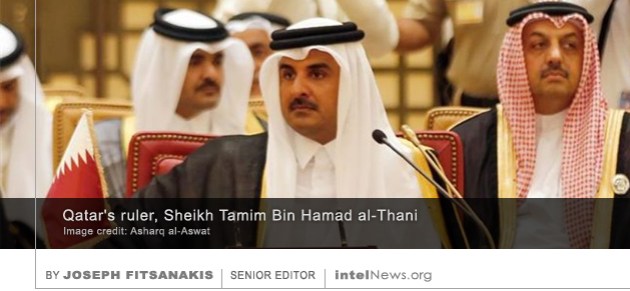 American officials appear to confirm Qatar’s allegations that its news media were hacked by its Gulf adversaries, who then used the fake news posted by hackers to launch a massive campaign against it. Tensions between Qatar and other Muslim countries have risen since late May, when the country’s state-controlled news agency appeared to publish an incendiary interview with Qatar’s Emir, Sheikh Tamim Bin Hamad al-Thani. In the interview, which appeared on May 24, the sheikh appeared to praise Saudi regional rival Iran as a “great Islamic power” and to express support for the militant Palestinian group Hamas. On the following day, Saudi Arabia, the United Arab Emirates, Egypt and Bahrain immediately banned all Qatari media —primarily Al Jazeera— from broadcasting in their territories and broke diplomatic relations with Doha. Later on, they declared a large-scale commercial embargo against the small oil kingdom. They have since threatened war unless Qatar changes its alleged support for Iran and for a number of militant groups in the region.
The Qatari government has dismissed the embargo as unjust and has claimed that Sheikh al-Thani’s controversial interview was fake, and was placed on the country’s state-owned news agency and social media as a result of a computer hack. It has also claimed to have evidence of a number of iPhones that were used from locations in Saudi Arabia and the Emirates to launch the hacks on its networks. Qatari officials have also said that an investigation into the incident is underway, but their claims have been criticized as outlandish by Qatar’s regional rivals.
Now, however, a report by The Washington Post claims that American officials have uncovered evidence that Qatar’s allegations of a computer hack are true. The paper cited “US intelligence and other officials” who spoke “on the condition of anonymity”. The officials said that US intelligence agencies recently became aware of a meeting of senior UAE state administrators that took place on May 23 in Abu Dhabi. At the meeting, the officials discussed a plan to hack Qatari news websites and social media, in order to post incendiary messages that could be used to spark a row between Qatar, the Saudi government and its allies. The alleged computer hacks is reported to have taken place on the following day. According to The Post, the only thing that US intelligence is unsure about is “whether the UAE carried out the hacks itself or contracted to have them done” by a third party.
The Post said that several US intelligence agencies, including the Central Intelligence Agency and the Federal Bureau of Investigation, refused to comment on its report. The paper received a response from the UAE embassy in Washington, DC, which said that the Emirates had “no role whatsoever in the alleged hacking described in the article”.
► Author: Joseph Fitsanakis | Date: 18 July 2017 | Permalink
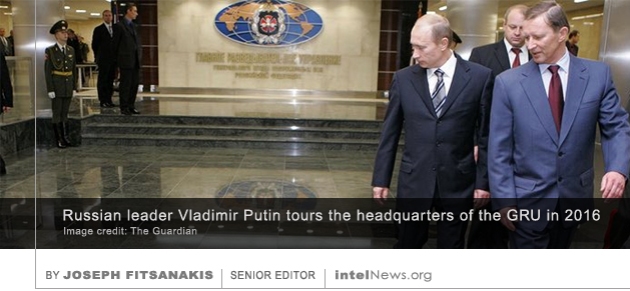 New information about carefully targeted attempts by Russian operatives to compromise the November 2016 presidential elections in the United States have emerged in a newly published intelligence document. The document, which dates from May of this year, was produced by the US National Security Agency and
  The same group cyber-spies that attacked the campaign of French presidential candidate Emmanuel Macron is now attacking German institutions that are connected to the country’s ruling coalition parties, according to a report by a leading cyber-security firm. The Tokyo-based security software company Trend Micro published a 41-page report on Tuesday, in which it tracks and traces the attacks against French and German political targets over the past two years. The report, entitled
  A new report authored by a consortium of government and private organizations in Britain has revealed the existence of a computer hacking operation, allegedly based in China, that is said to be “one of the largest ever” such campaigns globally. The operation is believed to have compromised sensitive information from an inestimable number of private companies in Southeast Asia, Europe and the United States. The
 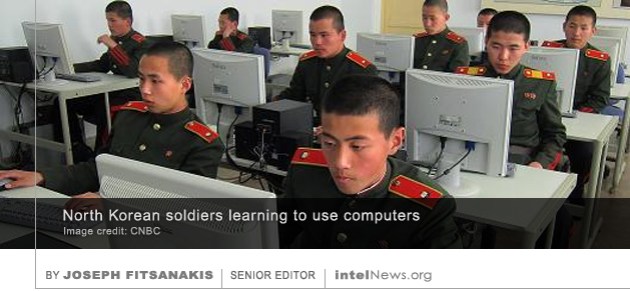 Comments made by a senior American intelligence official on Tuesday appeared to suggest that the North Korean government was behind an attempt to steal nearly $1 billion from a Bangladeshi bank last year. The heist took place in February of 2016, when a computer malware was used to issue several requests to transfer funds from Bangladesh Bank —the state-owned central bank of Bangladesh— using the SWIFT network. The hackers were able to transfer five separate sums of $101 million each to a linked Bangladesh Bank account at New York’s Federal Reserve Bank. However, when further requests were issued, Federal Reserve Bank employees contacted Bangladesh Bank and blocked further transactions. Eventually, most of the transferred funds, which neared $1 billion, were recovered; but the hackers managed to get away with approximately $81 million worth of funds.
 The United States federal government has launched a criminal investigation into the public disclosure of thousands of documents that purportedly belong to the Central Intelligence Agency. The documents were
 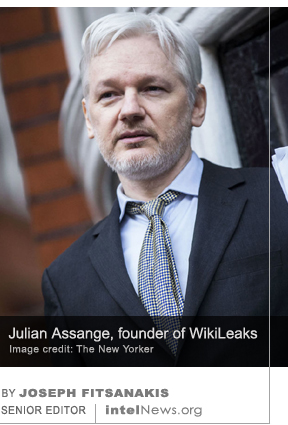 Thousands of documents belonging to the United States Central Intelligence Agency, which were released on Tuesday by the international anti-secrecy website WikiLeaks, are almost certainly genuine. They reveal an entire universe of technical intelligence collection methods used by the CIA to extract information from digital applications and electronic devices, ranging from flash drives to smart screen televisions. WikiLeaks named the collection
 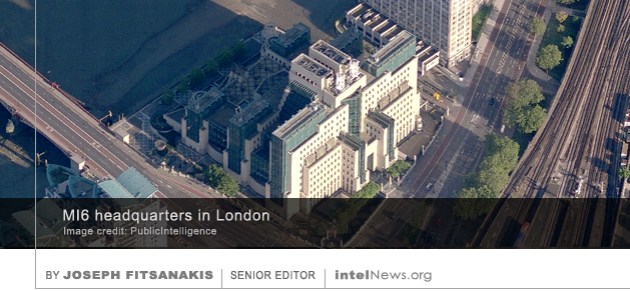 British intelligence agencies gave their United States counterparts an early warning about Russian attempts to influence the outcome of the American presidential election, according to The New York Times. The American newspaper
  There had been rumors for some time about a possible expulsion of Russian diplomats from the United States, in response to alleged Russian interference in the 2016 US Presidential election. The White House confirmed the rumors on Thursday morning, by
 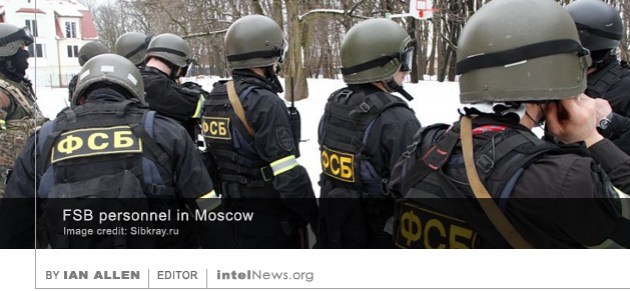 Russian authorities say they prevented a large-scale cyber attack by “a foreign intelligence service”, which had been designed to destabilize the country’s financial system and subvert its economy. In an official
  Coordinated efforts by Anglo-American military and intelligence agencies have resulted in the killing or capturing of nearly every senior commander of the Islamic State’s online force. The close-knit group of Islamic State hackers and online propagandists, which are informally known as “the Legion”, is responsible for hacking and online recruitment incidents that led to several lone-wolf attacks in the West. In one incident in March of 2015, the Legion claimed responsibility for the unauthorized release of personal details of over 1,300 American government employees, with orders to Islamic State volunteers to kill them. In other instances, Legion operatives reached out to impressionable young men and women in Western Europe and the United States and convinced them to move to Syria or conduct attacks at home.
 The former director of France’s cyber spy agency has spoken candidly about the recent activities and current state of French cyber espionage, admitting for the first time that France engages in offensive cyber operations. Between 2006 and 2013, Bernard Barbier was director of the technical division of the General Directorate for External Security, France’s external intelligence agency, which is commonly known as DGSE. During his tenure at DGSE, the organization’s technical division witnessed unprecedented financial and administrative growth. Today it is said to employ over 2500 people, nearly half of DGSE’s total personnel.








North Korean state now uses cyber attacks to steal cash, says report
July 31, 2017 by Joseph Fitsanakis Leave a comment
The report, published last week, analyzed patterns of cyber attacks against South Korean state-owned and private financial institutions that took place between 2015 and 2017. It identified two separate computer hacking groups, which it named Lazarus and Andariel. According to the report, both groups’ activities, which are complementary, appear to be directed by the government of North Korea. An analysis of the groups’ targets suggests that Pyongyang has been directing its computer spies to find ways to secure hard currency for use by the government. Foreign currency has been increasingly hard to come by in North Korea in recent years, due to a host of international sanctions that were imposed on the country as a form of pressure against its nuclear weapons program.
Several cyber security experts and firms have claimed in recent months that North Korea has been behind recent cyber attacks against international banking institutions. The DPRK has also been blamed for a 2014 attack against the Hollywood studios of the Japanese multinational conglomerate Sony. Regular readers of intelNews will recall our story in March of this year about comments made on the subject of North Korea by Rick Ledgett, a 30-year veteran of the United States National Security Agency. Speaking at a public event hosted by the Aspen Institute in Washington, Ledgett expressed certainty that the government of North Korea was behind an attempt to steal nearly $1 billion from Bangladesh Bank —the state-owned central bank of Bangladesh—in 2016. Eventually the bank recovered most of the money, which were made through transactions using the SWIFT network. But the hackers managed to get away with approximately $81 million.
More recently, cyber security experts have claimed that the government of North Korea has been behind attempts to hack into automated teller machines, as well as behind efforts to steal cash from online gambling sites. In April of this year, the Russian-based cyber security firm Kaspersky Lab identified a third North Korean hacker group, which it named Bluenoroff. The Russian experts said Bluenoroff directed the majority of its attacks against foreign financial firms. There are rumors that Pyongyang was behind the wave of WannaCry ransomware attacks that infected hundreds of thousands of computers in over 150 countries in May. But no concrete evidence of North Korean complicity in the attacks has been presented.
► Author: Joseph Fitsanakis | Date: 31 July 2017 | Permalink
Filed under Expert news and commentary on intelligence, espionage, spies and spying Tagged with computer hacking, cyber crime, cybersecurity, Financial Security Institute of South Korea, News, North Korea, South Korea