MI6 chiefs used secret slush fund to finance operations, document shows
November 22, 2017 1 Comment
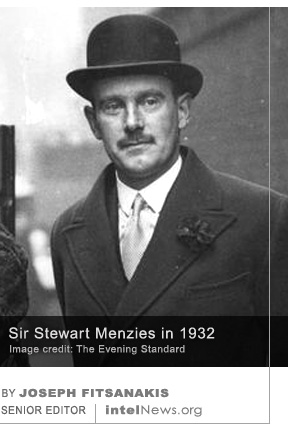 Successive directors of the Secret Intelligence Service used a secret slush fund to finance spy operations without British government oversight after World War II, according to a top-secret document unearthed in London. The document was found in a collection belonging to the personal archive of the secretary of the British cabinet, which was released by the United Kingdom’s National Archives. It was discovered earlier this year by Dr Rory Cormac, Associate Professor of International Relations in the Faculty of Social Sciences of the University of Nottingham in England. It forms the basis of an episode of BBC Radio 4’s investigative history program, Document, which was aired last weekend. In the program, the BBC’s security correspondent Gordon Corera explains that the discovery of the secret slush fund reveals new information about the activities of the Secret Intelligence Service. It also raises questions about the underground activities of British spies in the Middle East following the British Empire’s postwar retreat.
Historically, the activities of the Secret Intelligence Service —known commonly as MI6— have been indirectly supervised by the British Parliament and its committees, which fund the agency through a secret vote. The use of the agency’s funds to carry out operations is also monitored by the Secretary of State for Foreign Affairs, the head of the Foreign and Commonwealth Office, who exercises political control over MI6. However, the document uncovered by Dr Cormac shows that, for many years, successive directors of the secretive spy agency financed operations using a sizeable personal fund, the existence of which was not disclosed to the government. The document describes a meeting held in 1952 between Sir Stewart Menzies, who was then the outgoing director of MI, and the permanent secretaries —essentially the top-ranking civil servants— to the Foreign Office and the Treasury. The meeting was held to prepare the ground for Sir Stewart’s retirement and to facilitate the smooth handover of power to his successor, Major-General Sir John Sinclair, who became director of MI6 in 1953. Read more of this post
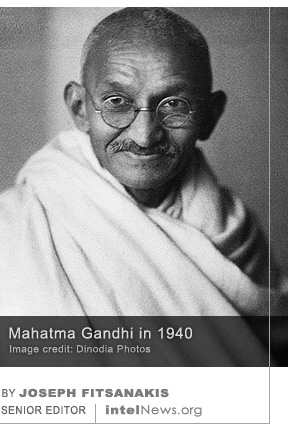 A researcher is seeking access to a potentially revealing classified telegram sent by a United States diplomat who witnessed the assassination of Indian leader Mahatma Gandhi in 1948. Gandhi, the leader of the Indian movement for independence, and a towering civil rights figure of the 20th century, was assassinated on January 30, 1948, as he was about to hold a prayer meeting in downtown New Delhi. His assassin, Nathuram Vinayak Godse, was a member of a Hindu nationalist paramilitary group, who blamed Gandhi for the bloody partition of India. He and a co-conspirator, Narayan Apte, were arrested for Gandhi’s murder and put to death in 1949.
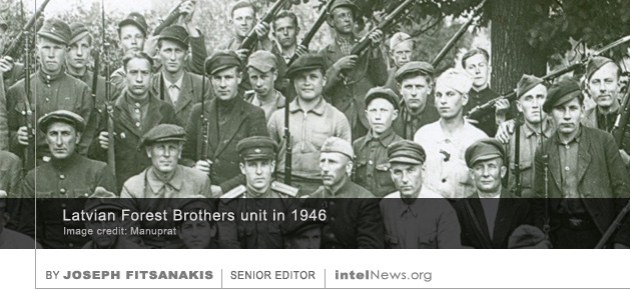 The role of the CIA in funding and helping to organize anti-Soviet groups inside the USSR has been known for decades. But, as intelNews explained in
 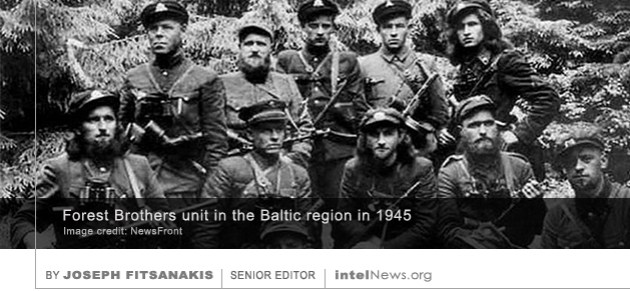 Recently declassified documents from the archive of the Central Intelligence Agency detail financial and material support given by the United States to groups of armed guerrillas in Soviet Latvia in the 1950s. The documents, initially marked ‘Top Secret’ but now declassified, show that the CIA was aware and supported the activities of an anti-Soviet guerrilla army known as ‘the Forest Brothers’. Known also as ‘the Forest Brethren’, the group was formed in the Baltic States in 1944, as the Soviet Red Army established Soviet control over the previously German-occupied states of Estonia, Latvia and Lithuania. The Soviet Union had previously occupied and annexed the three Baltic countries, in a failed attempt to pre-empt Germany’s eastward military expansion. Groups like the Forest Brothers consisted of the most militant members of anti-Soviet groups in the Baltic States, many of whom were ideologically opposed to Soviet Communism.
 A document that allegedly contains the name of a man who could be connected to one of the most sensational spy rings of the Cold War is to remain secret after a judge rejected a request to have it released. The man is believed by some to have been associated with the so-called ‘Cambridge spy ring’, a group of upper-class British graduates of Cambridge University, who spied for the USSR from the 1930s until the 1960s. Among them was Guy Burgess, Donald Maclean and H.A.R. “Kim” Philby, all of whom eventually defected to the Soviet Union. In 1979, it was revealed that Anthony Blunt, an art history professor who in 1945 became Surveyor of the King’s Pictures and was knighted in 1954, was also a member of the group. A fifth member, career civil servant and former intelligence officer John Cairncross, was publicly outed as a Soviet in 1990, shortly before his death.
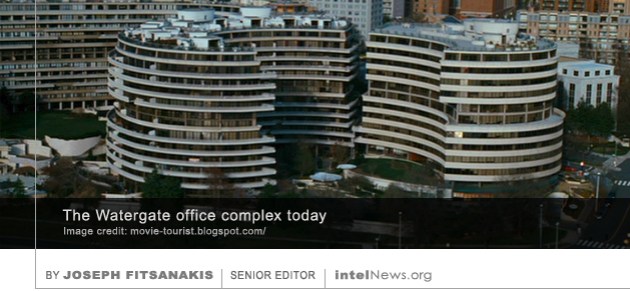 One of the men caught burglarizing the offices of the United States Democratic Party in 1972, a ploy that led to the resignation of President Richard Nixon, was an agent of the Central Intelligence Agency, according to a newly declassified document. The revelation is included in a narrative history of the Watergate scandal, produced over 40 years ago by the CIA to assess its own role in the affair. It recounts the events of the early morning hours of June 17, 1972, when a security guard saw five men dressed in black breaking into the headquarters of the Democratic National Committee at the Watergate office complex in Washington, DC. When the five men were arrested by police, it was discovered that one of them was connected with the Committee for the Re-Election of the President, a fundraising organization set up by US President Richard Nixon. The remaining four burglars had CIA contacts. They included E. Howard Hunt, a retired CIA operations officer who in 1961 had played a leading role in the failed Bay of Pigs invasion. It was eventually discovered that the burglary had been authorized by President Nixon himself, as part of a broader program to sabotage his political opponents.
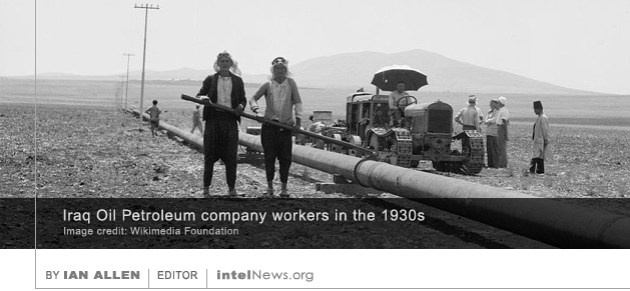 Recently uncovered documents shed further light on an ultra-secret plan, devised by the British and American governments, to destroy oil facilities in the Middle East in the event the region was invaded by Soviet troops. The
 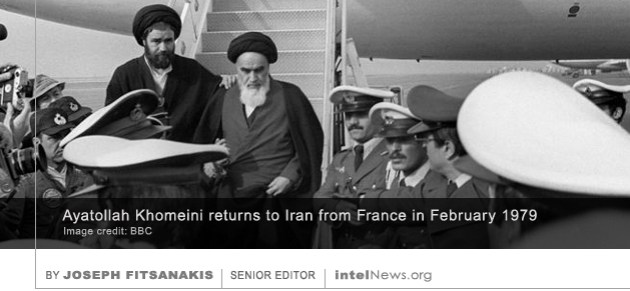 Newly declassified files show that Ayatollah Khomeini, who led Iran after the 1979 Islamic Revolution, had a secret channel of communication with the United States, and even sent a personal letter to US President Jimmy Carter. On January 16, 1979, after nearly a year of street clashes and protests against his leadership, the king of Iran, Mohammad Reza Shah Pahlavi, fled the country for the US. His decision to leave was strongly influenced by his American advisors, who feared that Iran was heading toward a catastrophic civil war. The Shah’s departure did little to calm tensions in the country. Protesters —many of them armed— engaged in daily street battles with members of the police and the military, who remained loyal to Pahlavi. Meanwhile, a national strike had brought the Iranian oil sector to a standstill, thereby threatening to bring about a global energy crisis. Moreover, the country was home to thousands of American military advisors and the Iranian military was almost exclusively funded and supplied by Washington. The Carter administration worried that the weaponry and technical knowledge might fall into the hands of a new, pro-Soviet government in Tehran.
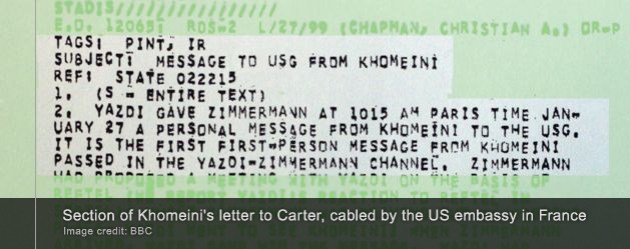 Nine days later, on January 27, Dr. Yazdi gave Zimmerman a letter written by Khomeini and addressed to President Carter. The letter, which addressed Carter in the first person, was cabled to the Department of State from the US embassy in Paris and, according to the BBC, reached the US president. In the letter, Khomeini promises to protect “America’s interests and citizens in Iran” if Washington pressured the Iranian military to stand aside and allow him and his advisers to return to Iran. Khomeini’s fear was that the royalist Iranian military would not allow a new government to take hold in Tehran. But the exiled cleric was aware of America’s influence in Iranian military circles, which at the time were effectively under the command of General Robert Huyser, Deputy Commander of US Forces in Europe, who had been dispatched to Tehran by President Carter. Before answering Khomeini’s letter, the White House sent a draft response to the embassy in Tehran for input and advice. But Khomeini did not wait for Washington’s response. On February 1, he returned to Iran, where he was greeted by millions of people in the streets and welcomed as the next leader of the country. Meanwhile, Washington had already instructed General Huyser to rule out the so-called “option C”, namely a military coup carried out by the Iranian armed forces.
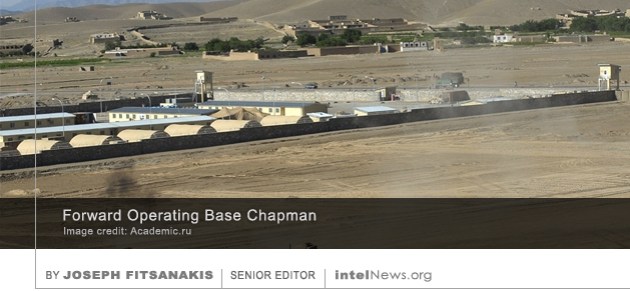 Two recently declassified United States government documents suggest that Pakistani intelligence officers may have been behind a suicide attack that killed seven employees of the Central Intelligence Agency in Afghanistan. The
 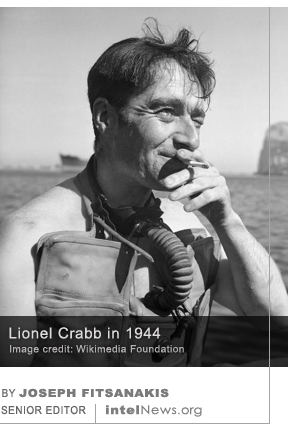 A set of newly released files from the archives of the British Cabinet Office shed light on the mysterious case of a highly decorated combat swimmer, who vanished while carrying out a secret operation against a Soviet ship. The disappearance happened during a historic Soviet high-level visit to Britain in 1956. In April of that year, First Secretary of the Communist Party of the USSR, Nikita Khrushchev, and Nikolai Bulganin, Chairman of the Council of People’s Commissars, arrived in Britain aboard Russian warship Ordzhonikidze, which docked at Portsmouth harbor. Their eight-day tour of Britain marked the first-ever official visit by Soviet leadership to a Western country. But the tour was marred by a botched undersea operation led by Britain’s Secret Intelligence Service, known commonly as MI6. The operation, which aimed to explore the then state-of-the-art Ordzhonikidze, ended in the
 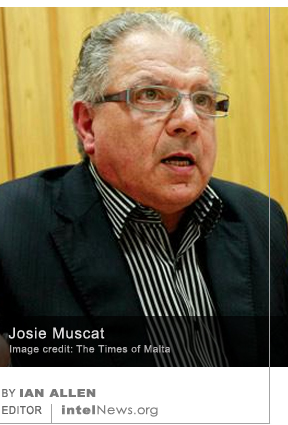 A Maltese ultra-nationalist group believed to be behind a string of bombings in the 1980s was believed by British intelligence to have links to the United States Central Intelligence Agency (CIA), according to recently declassified documents. The Front Freedom Fighters (FFF) was a staunchly anticommunist group whose members violently objected to what they saw as Malta’s overly close contacts with the Communist Bloc. During the 16-year rule of the Maltese Labour Party, which began in 1971, the Mediterranean island maintained close relations with countries during such as Libya and North Korea. The Maltese Nationalist Party, which formed the main opposition to Labour, was highly critical of these contacts, but failed to win three consecutive electoral contests and was thus unable to influence the country’s foreign policy in any significant way.
 In 2007 I wrote in my “
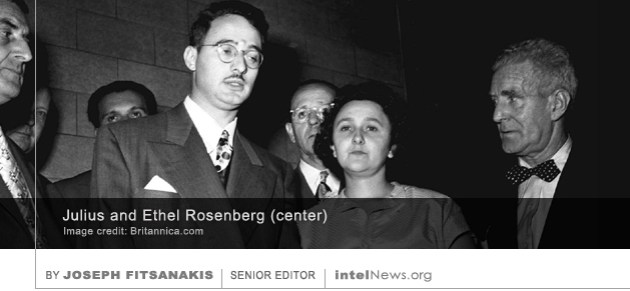 The final piece of sealed testimony in one of the most important espionage cases of the Cold War has been released, 64 years after it was given. The case led to the execution in 1953 of Julius and Ethel Rosenberg, an American couple who were convicted of spying for the Soviet Union. The Rosenbergs were arrested in 1950 for being members of a larger Soviet-handled spy ring, which included Ethel’s brother, David Greenglass. Greenglass agreed to testify for the US government in order to save his life, as well as the life of his wife, Ruth, who was also involved in the spy ring. He subsequently fingered Julius Rosenberg as a courier and recruiter for the Soviets, and Ethel as the person who retyped the content of classified documents before they were surrendered to their handlers. That piece of testimony from Greenglass the primary evidence used to convict and execute the Rosenbergs.
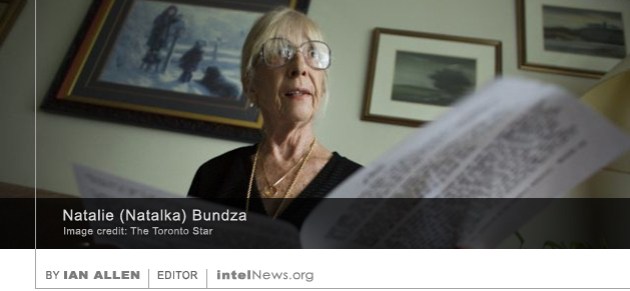 A set of declassified intelligence documents from the 1950s and 1960s offer a glimpse into the secret war fought in Canada between American and Soviet spy agencies at the height of the Cold War. The documents were authored by the United States Central Intelligence Agency and declassified following a Freedom of Information Act request filed on behalf of the Canadian newspaper The Toronto Star.






 intelNews.org
CIA believed Yugoslavia was on the brink of going nuclear in 1975
November 23, 2017 by Joseph Fitsanakis 1 Comment
The documents show that the CIA placed the beginning of the Yugoslav nuclear program at the end of World War II. At that time, the multi-ethnic Balkan country became the focus of an intense campaign for influence by the two emerging superpowers, the United States and the Soviet Union. But Yugoslavia’s communist leader, Josip Broz Tito, opted for a policy of nonalignment, refusing to side with Washington or Moscow. It was at that time that Tito began to explore the creation of a nuclear arsenal, which he hoped would enable Yugoslavia to remain independent amidst the pressures of the Cold War. Interestingly, his plans were quietly supported by the US, which invited Yugoslav physicists and engineers to study and conduct research at American universities. Washington also sent teams of geologists to conduct surveys across Yugoslavia in 1952. These and subsequent surveys detected substantial uranium deposits in northern and southern Yugoslavia, which were deemed sufficient to fuel several nuclear bombs. Two decades later, an American manufacturing company, Westinghouse Nuclear, was contracted by Belgrade to build Yugoslavia’s first nuclear power plant in Slovenia.
The papers unearthed by Dr Kovacevic suggest that in 1975 the CIA was convinced that Yugoslavia was technically and financially capable of building an atomic weapon within four years. In a study entitled “Prospects for Further Proliferation of Nuclear Weapons”, the spy agency said that Belgrade had made remarkable technical strides in the area of nuclear research and production in 15 years, partly with America’s support. The only question was whether the Yugoslav leadership would decide to go nuclear, something that the CIA’s analysts warned that it would be difficult to ascertain, as President Tito was unpredictable in his decision-making. Eventually, the Yugoslav leader opted to beef up his country’s conventional forces instead of going nuclear. As Tito’s health worsened in the latter half of the 1970s, ethnic rivalries between competing officials took center stage, and the nuclear weapons question lost its immediacy. Tito died in 1980, and almost immediately the country began to sink under the weight of deepening ethnic tensions.
According to Dr Kovacevic, the CIA documents show that the agency kept close tabs on Yugoslavia’s nuclear ambitions throughout the Cold War. Moreover, CIA analysts appeared to have detailed, accurate and up-to-date information about the Yugoslav nuclear program, on which they based their —broadly accurate— estimates. Crucial pieces of information came from the CIA’s “well-organized network of informants” who were placed “across the country’s institutions” and provided the US with highly dependable intelligence on Tito’s nuclear plans, said Dr Kovacevic.
► Author: Joseph Fitsanakis | Date: 23 November 2017 | Permalink
Filed under Expert news and commentary on intelligence, espionage, spies and spying Tagged with CIA, Cold War, declassification, history, News, nuclear proliferation, Yugoslavia