News you may have missed #675

Eugene ForseyBy IAN ALLEN | intelNews.org |
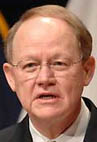
►►US ‘has engaged in cyberwarfare’. Former National Security Agency Director Mike McConnell said in an interview with Reuters that the United States has already used cyber attacks against an adversary. Most believe he was referring to Stuxnet, the computer virus unleashed against Iran in 2010.
►►Philippines studying US offer to deploy spy planes. The Philippines is considering a US proposal to deploy surveillance aircraft on a temporary, rotating basis to enhance its ability to guard disputed areas in the South China Sea, the Philippine defense minister said last week. The effort to expand military ties between the United States and the Philippines, which voted to remove huge American naval and air bases 20 years ago, occurs as both countries grapple with the growing assertiveness of China.
►►Canadian intelligence spied on constitutional expert. Canadian security forces kept close tabs on renowned constitutional scholar Eugene Forsey from his early days as a left-wing academic to his stint as a senator, according to newly declassified documents. The collection of more than 400 pages, which has been obtained by Canadian newspaper The Toronto Star, reveals the RCMP Security Service (the predecessor to the Canadian Security Intelligence Service), followed Forsey for four decades throughout his career as an economics professor, research director for the Canadian Congress of Labour (now called the Canadian Labour Congress), a two-time Ottawa-area candidate for the Cooperative Commonwealth Federation and then his 1970 appointment as a Liberal senator. No surprises here.

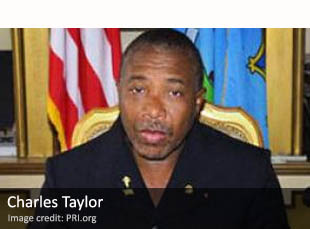
US admits African war crimes suspect Charles Taylor was CIA agent

Charles TaylorBy JOSEPH FITSANAKIS | intelNews.org |

Editor’s note: Since publishing this story, The Boston Globe issued a correction, which includes the following: “This story drew unsupported conclusions and significantly overstepped available evidence when it described former Liberian President Charles Taylor as having worked with US spy agencies as a “sought-after source’’ […]. The Globe had no adequate basis for asserting otherwise and the story should not have run in this form”.

Ever since his 2006 arrest for war crimes, Liberia’s former President, Charles Taylor, has consistently claimed that he was an agent of the United States Central Intelligence Agency. Now declassified US government documents have officially confirmed that Taylor was indeed an agent of the CIA and the US Defense Intelligence Agency for several decades. The 63-year-old, who ruled his West African homeland from 1997 to 2003, is currently being tried at the United Nations Court in The Hague on multiple counts of civilian murders, rapes, and deploying underage soldiers during a brutal civil war in neighboring Sierra Leone. Rumors that Taylor was being protected by Washington started surfacing in 2003, after he left Liberia and was given protection in US-allied Nigeria, despite his indictment by the UN Special Court for Sierra Leone. In July 2009, intelNews reported Taylor’s claim that his 1985 “escape” from the Plymouth County maximum security Correctional Facility in Massachusetts, which allowed him to return to Liberia and take over the country through a military coup, took place with US government assistance. His persistent claims led The Boston Globe newspaper to file a Freedom of Information Act (FOIA) request, which has resulted in the declassification of nearly 50 separate documents covering “several decades” of Taylor’s work for the CIA and the DIA. The documents confirm that both agencies employed Taylor as an agent beginning in the early 1980s, long before he became Liberia’s ruler. But the FOIA release does not contain details of Taylor’s work for US intelligence, in an alleged effort to “protect intelligence sources and methods” and so as not to “harm national security”, according to The Boston Globe. Read more of this post
US gave N. Ireland police weapons, spy equipment, despite Congress ban

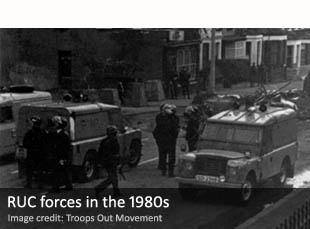
Royal Ulster Constabulary forces in the 1980sBy JOSEPH FITSANAKIS | intelNews.org |
Declassified documents show that thousands of American-made weapons, as well as spy equipment, ended up in the hands of Northern Ireland’s police force in the 1980s, despite a strict ban enacted by Congress. The ban was passed in 1979, following strong pressure by organized groups in the Irish-American community. The latter accused Northern Ireland’s police, known as the Royal Ulster Constabulary (RUC), of severe human rights violations and systematically excluding Catholic recruits. But internal government documents released in Northern Ireland this week, reveal that thousands of pieces of American-made weaponry, as well as surveillance equipment, continued to get into the hands of the RUC, despite the official ban. According to the documents, which were released under the UK’s 30-year declassification rule, the RUC eventually managed to collect all 6,000 Ruger revolvers it had ordered from American manufacturers before 1979, when the Congressional ban was enacted. The weapons continued to be shipped to Northern Ireland by way of “third-party suppliers”, who sent them secretly and in small quantities, so as not to arouse suspicion. The documents also state that the RUC was able to “receive [from the United States] some US equipment for surveillance work which is arguably more sensitive than guns”. The documents do not specify if the White House was aware that the Congressional ban against selling weapons to the RUC was being broken, or if the weapons were being surreptitiously smuggled by the British government, which hid the shipments from Washington. But The Belfast News Letter, which accessed the declassified documents, said it spoke to “one former senior RUC officer” who said that “the Reagan Administration was aware of the shipments” and had “turned a blind eye to the issue”. Read more of this post

Australian government feared KGB spy scandal, documents show

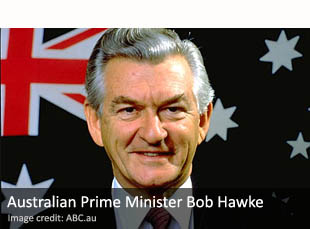
Bob HawkeBy JOSEPH FITSANAKIS | intelNews.org |
Declassified papers from a 1983 Australian Cabinet meeting reveal that the Labor government of the day feared it could be brought down by revelations of spying by a Soviet diplomat in Canberra. The spy was Valeriy Nikolayevich Ivanov, First Secretary at the Soviet embassy in the Australian capital. Suspecting the Soviet diplomat of espionage activities, the Australian Security Intelligence Organisation (ASIO) had bugged his home, and by 1982 had concluded that he was “a professional KGB intelligence officer”. Moreover, ASIO counterintelligence officials believed that Ivanov had been actively cultivating a relationship with an Australian citizen with a possible view to recruitment. Their concern apparently intensified after the Australian citizen began meeting Ivanov at his diplomatic residence, at the Soviet official’s request. On April 20, 1983, ASIO Director General Harvey Barnett met newly installed Australian Prime Minister Bob Hawke, and informed him that the Australian citizen in question was no other than David Combe. A former National Secretary of the Australian Labor Party (ALP) from 1973 to 1981, Combe was also the Prime Minster’s personal friend and close associate. A member of the Australia-USSR Friendship Society, Combe had come to know Ivanov in 1982, when he asked the Soviet embassy in Canberra for assistance in preparing for a business trip to the Soviet Union. Combe had exited politics before the 1983 national election, which had resulted in a landslide victory for the ALP, and he had entered a career as a business consultant and lobbyist. But his close relationship with Hawke alerted senior ALP officials. Meeting minutes of the government’s National and International Security Committee, released last week by the National Archives of Australia, show that Hawke chose to take Director General Barnett and other ASIO officers with him to brief senior cabinet members on April 21, the day after he himself had been briefed about the Ivanov affair. Read more of this post

CIA installed nuclear surveillance device atop Himalayas mountains

Nanda DeviBy JOSEPH FITSANAKIS | intelNews.org |
The United States Central Intelligence Agency tried at least twice to install a nuclear-powered surveillance device atop the Indian Himalayas, in an effort to spy on China. The decision to plant the device was taken in 1964, soon after communist China detonated its first nuclear bomb. In 1965, a team of CIA operatives attempted to climb Nanda Devi in the Garhwal Himalayas, which, at 25,645 feet (7,816 meters), is the highest mountain peak located entirely within Indian territory. But the top-secret mission failed miserably after adverse weather forced the CIA team to give up its effort approximately 2,000 feet below the summit. Battling against a heavy snowstorm, the CIA officers abandoned the 125-pound device, which was eventually swept away (.pdf document) by an avalanche. Incredibly, the team members deserted the surveillance device even though they knew it contained plutonium 238, which can emit radioactivity for over 500 years. In 1966, the same CIA team returned to Nanda Devi, in an effort to recover the complex surveillance instrument, but failed to locate it. In response to the second failed mission, the Agency decided to close the book on Nanda Devi, and instead constructed an identical surveillance device, which was transported and installed on Nanda Kot, a mountain peak located about nine miles (15 km) southeast of Nanda Devi. At 6,861 meters, Nanda Kot is about 3,000 feet shorter and far less steep than Nanda Devi. In 1967, a successful CIA attempt was made to reach the peak of Nakda Kot, where the radioactive surveillance device was installed. It is believed that it served its purpose before being abandoned there in 1968. Ten years later, in 1978, both operations were revealed in an article published in US-based Outside magazine. The revelation caused a major political uproar in India, as many Indians consider the Himalayas ‘sacred’ ground. Now the National Archives of India has released a batch of previously classified internal documents from India’s Ministry of External Affairs. Read more of this post

British Nazi was in fact MI5 double spy, new book reveals

Arthur OwensBy JOSEPH FITSANAKIS | intelNews.org |
A Welsh nationalist, whose aversion to British rule led him to spy for Nazi Germany during World War II, was in fact a double spy for Britain, and was instrumental in helping he Allies win the war, a new book reveals. The book, Snow: The Double Life of a World War II Spy, by Madoc Roberts and Nigel West (At Her Majesty’s Secret Service, A Matter of Trust, etc), centers on the life of Arthur Owens, who was recruited by the Abwehr, Germany’s military intelligence, in 1935, during a business trip to the Continent. Given the operational codename JOHNNY O’BRIEN by the Germans, he quickly began providing Berlin with inside information on Britain’s military buildup in the run-up to the War. But, according to Roberts and West, who base their account on declassified government documents, British counterintelligence agency MI5 became aware of Owens’ espionage activities and eventually recruited him as a double agent for the Crown. According to the book, Owens, who was given the codename SNOW by his British masters, became one of the human intelligence cornerstones of MI5’s XX (Double-Cross) System. Consisting of a close-knit group of deception specialists, XX is known for a series of outrageous —and often highly successful— covert operations during World War II, including Operation FORTITUDE, a plan to deceive the Germans about the location of the invasion of Europe by the Western Allies. The authors claim that agent SNOW’s activities successfully lured a large number of Nazi agents into the arms of MI5, thus eventually paving the way for some of MI5’s greatest wartime counterintelligence successes. In fact, it is believed that Owens’ pro-Nazi activities were so convincing, and his operational cover so deeply buried within the XX System, that in 1941 his MI5 handlers recommended that he be interned in a British prison. But the book alleges that, while in prison in Dartmoor, England, SNOW continued his intelligence collection for the Crown and kept feeding his handlers with information extracted from the prison’s German inmates. Read more of this post

News you may have missed #651

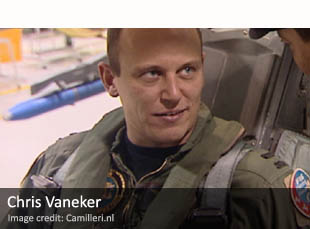
Chris VanekerBy IAN ALLEN | intelNews.org |
►►Israel defense minister forbids spy official’s lecture. Israel’s Defense Minister Ehud Barak has refused to allow the head of research for Military Intelligence, Brigadier General Itai Baron, to lecture at the annual conference of Israel’s ambassadors unless the lecture is deemed ‘unclassified’. The conference deals with diplomatic and security issues and public affairs, and the lectures are given by senior Israeli government and military officials.
►►CIA agrees to look into OSINT FOIA request. Open Source Works, which is the CIA’s in-house open source analysis component, is devoted to intelligence analysis of unclassified, open source information. Oddly enough, the directive that established Open Source Works is classified. But in an abrupt reversal, the CIA said that it will process a Freedom of Information Act request by intelligence historian Jeffrey Richelson for documents pertaining to Open Source Works.
►►Dutch former pilot convicted of espionage. A court in The Hague has sentenced former F-16 pilot Chris Vaneker to five years in jail after finding him guilty of selling state secrets to a Russian diplomat. Vaneker wanted half-a-million euros for the information he was trying to sell to the military attaché at the Russian embassy in The Hague. The pilot and the Russian diplomat were arrested in March.

News you may have missed #624

Viktor Bout

Viktor Bout

►►Russia angry at Viktor Bout’s US guilty verdict. Moscow has reacted angrily to the guilty verdict handed down to Russian arms dealer Viktor Bout by a court in the United States. Bout, a former Soviet military intelligence (GRU) officer, was arrested in a sting operation in Bangkok, Thailand, in March of 2008. At the time of his arrest, he and his two collaborators were negotiating a complex weapons deal with two informants posing as representatives of the Revolutionary Armed Forces of Colombia (FARC), Latin America’s largest leftist paramilitary group.
►►Symposium examined Reagan’s use of intelligence. The CIA released more than 200 declassified documents it prepared for US President Ronald Reagan during a symposium last week at the Ronald Reagan Presidential Library in Simi Valley, California. The CIA conference, entitled “Ronald Reagan, Intelligence, and the End of the Cold War“, included a discussion by American and Soviet former spies.
►►Suspected Chinese spy loses bid to rejoin Canada civil service. Haiyan Zhang, worked as a senior communications analyst with the Privy Council Office in Ottawa. She was fired when Canada’s spy agency questioned her “loyalty to Canada” over suspicion she was spying for China. Now she has lost her fight to return to the civil service.

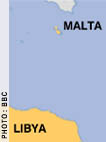
Declassified documents reveal US-Libyan spy war in Malta

Libya and Malta

Libya and Malta

By JOSEPH FITSANAKIS | intelNews.org |
A batch of declassified CIA reports from the late 1980s point to the Mediterranean island-nation of Malta as a major battlefield between American and Libyan intelligence operatives. According to the reports, which date from between 1988 and 1991, Malta served as a “primary launching point” for Libyan intelligence and paramilitary units on their way to Germany, Britain, and other countries in Western Europe. Most of the reports, which number over 250 pages in total, contain intelligence from a CIA informant named Abdul Majid Giaka. Referred to as “P/1” in the CIA documents, Giaka was a Libyan employee of Libyan Arab Airlines stationed in Malta. In 1988, however, he walked in the American embassy in the Maltese capital Valetta, and offered to work as an agent-in-place for the CIA. In exchange for his services, he requested regular financial compensation, as well as a promise of eventual relocation to the United States for him and his Maltese wife. Eventually, the intelligence collected by Giaka formed a major component of the prosecution’s case in the Lockerbie bombing court hearings. Giaka’s testimony directly led to the conviction of Abdelbaset al-Megrahi, a Libyan intelligence officer, who was released from a British prison in August of 2009 on compassionate grounds and is now in Tripoli. The declassified documents show that, in return for Giaka’s services, the CIA arranged a fake surgery for him in 1989, in order to help him secure an exemption from serving in the Libyan armed forces. The CIA’s initial assessment of Giaka was that he was dependable “intelligent, serious and fairly well composed”. Later, however, Giaka’s CIA handlers began questioning his commitment after he started appearing with new information only when in need of money. Read more of this post

Documents reveal MI5 role in Guyana coup

Cheddi and Janet Jagan

The Jagans

By JOSEPH FITSANAKIS | intelNews.org |
Secret intelligence documents declassified last week reveal that Britain’s Security Service, known as MI5, played a significant role in the lead-up to the 1953 coup that toppled the democratically elected government of British Guiana. The Latin American territory, which borders Suriname, Venezuela and Brazil, was once one of the British Empire’s most lucrative sugar-producing colonies. In 1963, after gaining its independence from Britain, it was officially renamed the Co-Operative Republic of Guyana. Instrumental in the fight for independence was Cheddi Jagan —an ethnic Indian former dentist who is today considered the father of the nation— and his American-born wife Janet (née Rosenberg). In 1950, the couple founded the People’s Progressive Party (PPP), which became the primary pro-independence political vehicle in the British colony. But dozens of folders of classified documents that were released last Friday by Britain’s National Archives show that MI5 was suspicious of the Jagans, and believed that Janet had been a member of the Communist Party of the United States in the 1940s. Several MI5 reports from the 1950s express concern that the PPP intended to establish close proximity between a newly independent Guyana and the Soviet Union. The declassified MI5 archives contain countless transcribed telephone conversations between the Jagans and their political allies, as well as copies of intercepted correspondence and reports of physical surveillance by MI5 informants. They reveal that British intelligence closely monitored the Jagans for at least a decade. Even though MI5 concluded that the PPP had no close contacts with Soviet agents or agencies, and that the party was “not receiving any financial support from any Communist organization outside the country”, it continued to describe Janet Jagan as “a committed communist” and remained apprehensive of the couple’s “disruptive antics”. The British government of Winston Churchill decided to take aggressive action in 1953, after a landslide election victory for the PPP in British Guiana elections. Read more of this post

News you may have missed #574

CIA documents

CIA documents

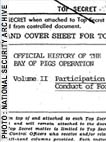
►►CIA told Kennedy Cuba invasion was ‘unachievable’. [Never mind. It turns out that the original article on Foreign Policy has been corrected to state that the meeting was not with Kennedy after all — see reader’s comment below]. More revelations from the newly declassified CIA Official History of the Bay of Pigs Invasion. According to the multi-volume history (pictured), a CIA team told President-Elect John F. Kennedy during a meeting in 1960 that toppling the Cuban government of Fidel Castro would not be feasible, considering the small invasion force that Kennedy insisted upon for the Bay of Pigs operation, in order to maintain plausible deniability.
►►NATO bombs home of Libyan intel chief. A compound in Tripoli destroyed overnight by NATO air strikes was the home of Abdullah Al-Senussi, former head of Libyan intelligence. This information allegedly comes from al-Senussi’s neighbor, oil engineer Omar Masood, who said he has lived across the street for 35 years. Meanwhile, several news outlets report that Abdel Salam Ahmed Jalloud, prime minister of Libya between 1972 and 1977, has defected to Italy.
►►Palestinian attacks took Israeli intel by surprise. The triple attacks, attributed by Israel to a Palestinian splinter group from the Gaza Strip, took Israel’s intelligence and security services by surprise, judging by the ensuing confusion and inaccuracy of initial reports. Between 15 and 20 Arab gunmen, some wearing Egyptian army fatigues, are believed to have taken part in the operation.

Former Finnish diplomat reveals she worked for the CIA

Marja-Liisa Linkoaho

Linkoaho

By JOSEPH FITSANAKIS | intelNews.org |
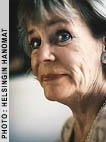
A Finnish diplomat in Cold-War East Germany has revealed how she was recruited by the US Central Intelligence Agency in the 1960s, shortly after the construction of the Berlin Wall. Marja-Liisa Linkoaho spoke to the Sunday edition of Finland’s Helsingin Sanomat newspaper, and admitted that she worked for American intelligence. She did so despite representing Finland, which was notably pro-Soviet during the presidency of ‘neutralist’ Finnish statesman Urho Kekkonen. She told the paper that, in 1961, at age 27, she became an assistant at the Finnish trade mission in East Germany, which at the time served as Finland’s de facto embassy in the communist country. The trade mission was headed by Consul General Olavi Wanne, and was centrally located on Mauerstrasse, within walking distance from the border between East and West Berlin. In August of 1961, less than three months after Linkoaho moved to East Germany, the country’s government, under Walter Ulbricht, took the decision to begin the construction of the Berlin Wall. However, as a foreign diplomat, Linkoaho was able to travel freely between East and West Germany despite the construction in Berlin of the heavily policed partition barrier. Several months later, Linkoaho borrowed a sum of money by one of her Finnish co-workers at the trade commission, which she used to purchase a German-made Volkswagen Beetle, from an American car dealership in West Berlin. However, shortly after she returned to East Berlin with her new car, it was stolen. Interestingly, Linkoaho said that, soon after the theft of her car, she was contacted by the CIA and asked to work for them as an agent, in return for money and a new car. The Finnish former diplomat told the Helsingin Sanomat that she had been contacted by the CIA “a few times before”, but had politely declined the Agency’s offers for work. This time, however, she needed the money, and the car, so she took up the offer. Read more of this post

CIA shot own planes, used napalm in Bay of Pigs, documents show

CIA documents

CIA documents

By JOSEPH FITSANAKIS | intelNews.org |
Newly declassified documents show that the CIA mistakenly fired at its own assault planes and resorted to using napalm to stave off successive Cuban counterattacks during the Bay of Pigs invasion. The revelations are included in a multi-volume Official History of the covert operation, which the CIA was forced to declassify after a lawsuit by George Washington University’s National Security Archive. On April 17, 1961, a brigade of 1,300 CIA-funded and -trained anticommunist Cubans mounted a surprise assault on the Caribbean island. But prior intelligence collected by spies working for Havana, and stiff resistance by pro-Castro troops, resulted in the CIA’s biggest known covert action failure. Approximately 1,200 surviving members of the CIA’s army were captured by pro-Castro forces, many of whom were severely interrogated or executed in subsequent years. According to the declassified documents, CIA forces eventually resorted to bombing Cuban government troops with napalm. Initially, operation planners were hesitant about using napalm, because of fears that doing so “would cause concern and public outcry”. But all hesitation had dissolved by the early hours of April 18, as American military commanders faced the possibility of seeing invading troops completely annihilated by successive waves of counterattacks. The documents also reveal that at least one CIA paramilitary officer opened fire on the Agency’s B-26 planes, which had been disguised to resemble those used by the Cuban Revolutionary Air Defense Force. Read more of this post

News you may have missed #563 [updated]

Mike McConnell

Mike McConnell

►►Colombia spy official imprisoned for illegal wiretapping. Gustavo Sierra Prieto, the former analysis chief of Colombia’s soon-to-be-dismantled DAS intelligence agency, has been sentenced to eight years and four months in jail for his role in the illegal wiretapping of government opponents, judges and journalists. But the main culprit in the wiretapping scandal, former DAS Director Maria Pilar Hurtado, is still hiding in Panama.
►►Cold War documents detail CIA interest of Canada. The CIA has declassified some of its Cold-War-era reports on Canada. The documents show that the Agency’s interest in America’s northern neighbor was mostly related to the its satellite R&D, as well as its economic sector, with a particular focus on Canada’s energy and minerals sector. There is also discussion in some documents of how to best utilize Canada’s energy resources in a possible war with the Soviet Union.
►►Ex-intel official says US must engage in cyberspying. Is it just me, or is there a calculated echo chamber developing by former senior US spy officials? Read more of this post

News you may have missed #548 (China edition)

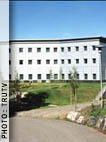
NIS HQ

By IAN ALLEN | intelNews.org |
►►China detains Korean spy officers. It emerged last week that Chinese authorities have kept in detention for nearly a year two South Korean NIS intelligence officers, who were caught collecting information about North Korea on Chinese soil. It appears that the Chinese did share the information with the North Koreans, because usually the North Korean news agency would have announced this when the officers were first arrested. Of course, NIS denied the Chinese report. ►►US intelligence on China declassified. George Washington University’s National Security Archive has published a series of declassified US intelligence reports on China, spanning the period from 1955 until 2010. In one report authored in 2005, US intelligence analysts speculate that Beijing might be trying to develop a capability to incapacitate Taiwan through high-power microwave and electromagnetic radiation, so as not to trigger a nuclear retaliation from the US. ►►IMF investigators see China behind computer hacking. Back in June, intelNews reported on a massive and sophisticated cyberattack on the computer systems of the International Monetary Fund, which experts claimed was “linked to a foreign government”. Read more of this post