Swiss officials defend alleged spying on German tax-fraud investigators

SwitzerlandSenior Swiss government officials, including the defense minister and the director of the country’s intelligence agency, have defended Switzerland’s right to spy on European tax-fraud investigators who meddle in Swiss affairs. Earlier this week, German authorities announced the arrest of a Swiss national who was allegedly spying on the activities of German tax-fraud investigators in Frankfurt. According to German officials and media reports, the man, identified only as Daniel M., is an employee of the Swiss Federal Intelligence Service. The agency, known by its German-language initials, NDB, is Switzerland’s main intelligence organization.

As intelNews reported on Monday, Daniel M. was said to be monitoring the activities of German tax-fraud investigators who have been trying for years to stop German citizens from having secret bank accounts abroad. In the past decade, German authorities have paid nearly $100 million to employees of Swiss banks in return for information about the identities of German bank account holders in the small alpine country. The Swiss government has strongly criticized Berlin for encouraging Swiss banking sector employees to steal internal corporate information, a practice that goes against Switzerland’s stringent privacy laws. On Tuesday, Germany’s Foreign Minister, Sigmar Gabriel, summoned Switzerland’s ambassador to Germany, Christine Schraner Burgener, to the Foreign Ministry, in order discuss Daniel M.’s arrest. A press statement that the Foreign Ministry sent on Tuesday to the German media said that the meeting had been called “in the interest of German-Swiss friendship”.

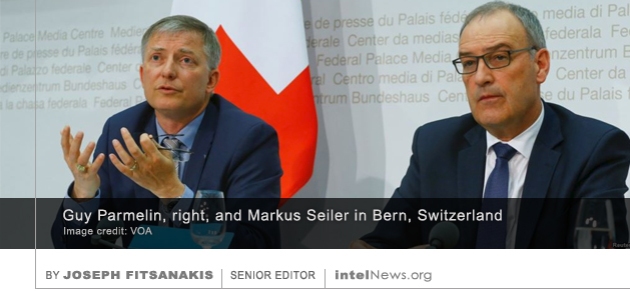
But the Swiss do not appear to be interested in discussing. On Tuesday, Markus Seiler, Director of the NDB, defended his agency’s right to spy on anyone who “uses illegal methods in Switzerland to steal state or business secrets”. Seiler, who was speaking in Bern, classified all such practices as espionage targeting the the Swiss economy. Asked by reporters whether Daniel M. was an NDB employee, Seiler said he could not comment. But he defended the NDB’s right to “fight the theft of business secrets” and “uphold Swiss laws”. He also refused to specify whether the NDB is active in Germany, stating instead that the agency is “active at home and abroad”. Switzerland’s Minister of Defense, Guy Parmelin, who supervises the NDB’s activities, was equally general when asked to discuss the arrest of Daniel M. He said simply that he and other Swiss government officials had to “protect [the NDB’s] methods and sources”.

Author: Joseph Fitsanakis | Date: 04 April 2017 | Permalink

Germany arrests Swiss spy who was monitoring tax-fraud investigators

Frankfurt AirportAuthorities in Germany have announced the arrest of a Swiss national who was allegedly spying on the activities of German tax-fraud investigators in Frankfurt. According to prosecutors in the German state of Hesse, of which Frankfurt is the largest city, the Swiss man was arrested on Friday and is currently in custody. He has been identified only as Daniel M., and is believed to be in his mid-50s. According to news reports, German counterintelligence officers had been monitoring the suspect for over a year. They were issued a warrant for his arrest in December of last year, but waited until he was on German soil to arrest him. He was arrested at Frankfurt Airport.
German federal prosecutors said simply that Daniel M. was employed in the financial and banking sectors of Germany until early 2012. However after that time, he is believed to have been employed by “the intelligence service of a foreign power”. German officials refused to identify the “foreign power”. However, the Berlin-based German newspaper Die Welt said on Sunday that the Swiss man arrested on Friday is an employee of the Swiss Federal Intelligence Service. The agency, known by its German-language initials, NDB, is Switzerland’s main intelligence agency, tasked with safeguarding the security of the small alpine nation by collecting and analyzing information.

The question is, what was a Swiss spy doing in Germany, and why was he arrested? According to Die Welt, Daniel M. was monitoring the activities of German tax-fraud investigators who have been trying for years to stop German citizens from having secret bank accounts abroad. The German government believes that billions of euros are deposited by its citizens in banking institutions in European tax-havens like Liechtenstein, Switzerland or Monaco. For the past decade, German authorities have resorted to bribing whistleblowers in offshore banks in order to acquire internal documents that reveal the identities of German citizens who are hiding their money in foreign bank accounts. It is estimated that over a hundred million dollars have been paid to whistleblowers by German authorities since 2006. The latter argue that the proceeds collected from unpaid taxes and fines more than justify the payments made out to whistleblowers. But the Swiss government has strongly criticized Berlin for encouraging Swiss banking sector employees to steal internal corporate information that often breaks Switzerland’s stringent privacy laws.

It is believed that Daniel M. was arrested while monitoring efforts by German tax-fraud investigators to approach potential whistleblowers working in the Swiss banking sector. Soon after the Swiss man’s arrest, officers from Germany’s Federal Criminal Police Office (BKA) searched a hotel room, several apartments and a number of business premises in Frankfurt and nearby cities. It is worth noting that Frankfurt is a major global financial center, which also hosts the headquarters of the European Central Bank. If found guilty, Daniel M. could face up to 10 years in prison for espionage.

Author: Joseph Fitsanakis | Date: 01 May 2017 | Permalink

Crisis looms over Pakistan’s impending execution of alleged Indian spy

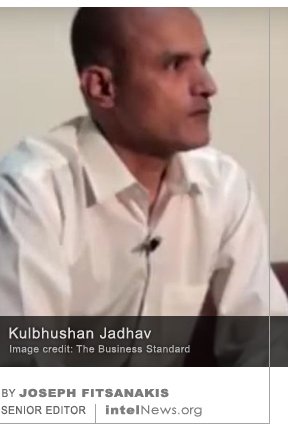
Kulbhushan JadhavAnalysts warn that South Asia may witness its worst crisis since the 2008 Mumbai attacks if Pakistan carries out its threat to execute an Indian former naval officer whom it accuses of espionage. Authorities in Islamabad say Kulbhushan Jadhav (pictured) worked for the Indian Navy until 2003, when he was recruited by India’s Research and Analysis Wing (RAW), a government intelligence agency that conducts operations abroad. The Pakistanis claim that Jadhav was arrested in southwest Pakistan in 2016, where he was engaged in funding and training secessionist militants from Pakistan’s Baluch minority. The Baluch are an Iranic people, most of whom live in a region known as Baluchistan, which is split between Iran and Pakistan. There are populous Baluch communities in the southern city of Karachi, one of Pakistan’s most populous ports. Some members of the Baluch community have secessionist aspirations and are accused of terrorism by Iranian and Pakistani authorities.
Soon after Jadhav’s arrest in March 2016, the Pakistani military released excerpts of an alleged videotaped confession by the Indian former naval officer. In it, Jadhav can be seen confessing to having worked on instructions by the Indian government to inflame ethnic divisions in Pakistan, from 2013 until his arrest. Last month, a secret military court in Pakistan sentenced Jadhav to death on charges of espionage. India, however, has rejected Pakistan’s allegations, saying that Jadhav’s confession was extracted through torture. The Indians claim that Jadhav was kidnapped by Pakistani operatives in Iran and brought to Pakistan by force. Indian officials dismissed Islamabad’s claim Jadhav was carrying his Indian passport when the Pakistanis captured him, saying that no undercover intelligence officer operating abroad would be carrying an Indian passport. New Delhi has warned of “serious consequences” if Pakistan engages in “premeditated murder” by executing Jadhav.

Some observers have noted that Jadhav was tried by a secret court martial, which signifies a radical break from standard practice. Moreover, the public announcements about his fate were made by the Pakistani military, rather than the civilian government, which is unprecedented. This leads some analysts to the conclusion that the Jadhav case is being handled solely by the military, which is trying to use Jadhav’s case to dissuade the government in Islamabad from reaching out to India with an offer for negotiations. There are also suggestions that the timing of Jadhav’s sentence might indicate that Islamabad hopes to exchange him for one or more of its intelligence officers that are being held by India.

Author: Joseph Fitsanakis | Date: 17 April 2017 | Permalink

FBI accuses US State Department official of contacts with Chinese spies

US Department of StateAn employee of the United States Department of State has been charged with lying to authorities about her contacts with Chinese intelligence operatives, who gave her money and gifts in return for information. Candace Claiborne, 60, joined the Department of State in 1999 as an office management specialist. She lives in Washington, DC, but has served overseas in American diplomatic facilities in Baghdad, Iraq, Khartoum, Sudan, and China, where she was stationed in Beijing and Shanghai. According to information provided by the Federal Bureau of Investigation, Claiborne had a top security clearance, which required her to report contacts with foreign nationals.
However, federal prosecutors said earlier this week that Claiborne interacted on a regular basis with Chinese intelligence personnel without informing her employer. According to court documents, her contacts with the Chinese were extensive and occurred from 2011 until earlier this year. The Chinese gave Claiborne gifts, including computers and smartphones, tuition-free studies in a Chinese technical school, and an all-expenses-paid holiday to Thailand. They also gave her a regular stipend and provided her with a furnished apartment abroad, according to prosecutors. In return, Claiborne allegedly gave the Chinese information relating to American economic policy on China, among other topics.

It appears that the FBI monitored the State Department employee for a while, after securing a Foreign Intelligence Surveillance Act court warrant. When it confronted Claiborne, she apparently denied the accusations and lied to FBI agents. She is now charged with obstruction of justice and providing false statements to the FBI. Claiborne is currently under house arrest and will remain there until April 18, when she will appear at a preliminary hearing in Washington. She is reportedly facing a maximum of 25 years in prison.

Author: Ian Allen | Date: 31 March 2017 | Permalink

China has 5,000 spies in Taiwan, says official amidst espionage arrests

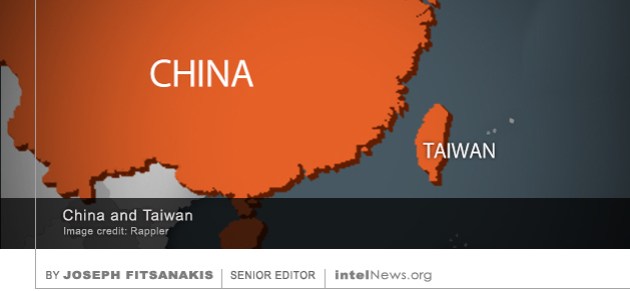
China and TaiwanA Taiwanese government official has alleged that China maintains an army of more than 5,000 spies in Taiwan, many of whom have infiltrated the highest levels of government and industry. The allegation came after two sensational arrests were made in Taiwan last week, of people accused of spying for Beijing. Taiwanese counterintelligence officers reportedly arrested a bodyguard of Annette Lu, Taiwan’s former vice president. The bodyguard, who has been identified in Taiwanese media as Wang Hong-ju, has been charged with receiving payments from his Chinese intelligence handler in return for providing information about Mrs. Lu. This incident followed another arrest, made earlier in the week, this time of a Chinese man who is believed to have initially come to Taiwan as a student. Zhou Hong-xu is accused of trying to recruit officials in the Taiwanese government by offering them money.
Following reports of the arrests, Taiwanese media quoted an official, who spoke on condition of anonymity, as saying that Beijing maintains “about 5,000 individuals” who spy in Taiwan. These agents are allegedly tasked with “collecting state secrets” in the island country, over which China claims ownership. The anonymous Taiwanese official said that authorities in Taipei had uncovered no fewer than 60 espionage plots linked to China since 2002. Less than a third of those were uncovered before 2009, said the official. The year is important, because it marks the time when communications and transportation systems between the two nations were reestablished after decades of mutual isolation. The ease with which people from the two countries can travel in each other’s territory has increased exponentially since 2009. But so have instances of espionage by China, said the Taiwanese official.

Asked about the alleged targets of Chinese espionage in Taiwan, the official said that nearly 80 percent of identified cases of espionage by Beijing’s agents were aimed at military targets, with only 20 percent focusing on the civilian sector. However, the apparent disparity in numbers does not mean that China shows more interest in Taiwanese military secrets. Rather, the Taiwanese military has better counterintelligence defenses and thus a higher detection rate than the country’s civilian sector, said the anonymous source.

Author: Joseph Fitsanakis | Date: 20 March 2017 | Permalink

Swedish intelligence says it identified foreign spies searching for secrets

Sweden militaryThe military intelligence service of Sweden warned last week that there were increasing incidents of espionage perpetrated against Sweden by operatives identified “beyond doubt” as agents of foreign powers. In its annual report for 2016, the Swedish Military Intelligence and Security Service (MUST) said large numbers of spies were detected around “sensitive installations” mostly of a military nature. Headed by an Army general, MUST is responsible for military intelligence and counterintelligence in Sweden. Every year it produces a report of its activities for the Swedish government and defense establishment, and also publishes a declassified version. Its latest report warns about growing attempts by foreign countries to “gather intelligence about Sweden’s defense assets and capabilities”.
On Friday, Swedish newspaper Svenska Dagbladet published an interview with senior MUST official Jan Kinnander. He told the paper that MUST was able to identify beyond doubt that certain individuals were “connected to the intelligence services of foreign states”. These persons traveled to Sweden “under false pretenses”, according to the official. A few of them were diplomats, said Kinnander, while most attempted to travel around the Scandinavian country using “conspiratorial methods”. Many were detected prowling around government installations that are linked to Sweden’s national defense while having “no reasonable cause” to be there, said Kinnander.

When asked to identify the countries that engage in espionage against Sweden, Kinnander said he could not elaborate, except to say that MUST linked the alleged spies with “several countries, including Russia”. In December of last year, MUST Director Gunnar Karlsson told Swedish media that Russia was a leading perpetrator of intelligence operations against Sweden. These operations included active measures involving propaganda, deception and other psychological activities, he said. In recent years, the Swedish authorities have arrested Polish, Lithuanian and other Eastern European nationals, allegedly because they were seen photographing Swedish military installations.

Author: Ian Allen | Date: 27 February 2017 | Permalink

Indonesia to investigate North Korean restaurant reportedly used as spy base

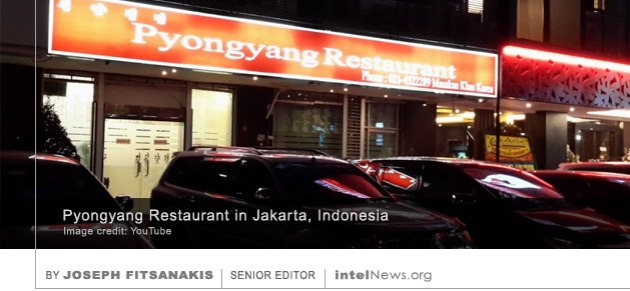
Pyongyang Restaurant in Jakarta, IndonesiaIndonesian authorities said on Sunday that they will investigate a North Korean restaurant in the country, after a Singaporean news agency claimed it was being used as a center for espionage. The announcement comes amidst heightened tensions between North Korean and its neighbors, following the murder last week in Malaysia of Kim Jong-nam, half-brother of North Korea’s Supreme Leader Kim Jong-il. Kim, the grandson of North Korea’s founder Kim Il-Sung, died after two women approached him at the Kuala Lumpur International Airport and splashed his face with liquid poison. Sources in South Korea and the United States have pointed at Pyongyang as the culprit of the assassination.
On Friday of last week, the Singapore-based news agency Asia One published a lengthy report into alleged North Korean espionage operations in Southeast Asia. The report claimed that North Korean intelligence agencies have operated extensive networks of operatives in Indonesia, Malaysia and Singapore, and that these networks have operated unimpeded for over two decades. The news agency cited an unnamed “intelligence source” as saying that the spy networks are operated by North Korea’s Reconnaissance General Bureau (RGB). The RGB is in charge of special activities abroad, which include covert operations and intelligence collection involving espionage. It operates under the Ministry of State Security and answers directly to North Korea’s supreme leader.

According to Asia One, the RGB maintains some of its largest spy networks abroad in Indonesia, Singapore and Malaysia, where Kim Jong-nam met a gruesome death last week. RGB personnel operating in these countries are North Korean citizens who are employed in the construction sector, as well as the tourism industry. Some operate North Korean restaurants, which are popular tourist attractions across Southeast Asia. The unnamed intelligence source told Asia One that North Korean restaurants serve “as a main front to conduct intelligence gathering and surveillance [against] Japanese and South Korean politicians, diplomats, top corporate figures and businessmen”. The RGB’s network in Indonesia is based in textile factories located in several Indonesian cities, said Asia One. There is also “an apartment located above a North Korean restaurant in [the Indonesian capital] Jakarta that is part of the RGB Indonesia office”, according to the report.

Following the news agency’s allegations, Argo Yuwono, senior commander for the Indonesian National Police, said that an investigation would take place into Asia One’s allegations. He said that his detectives would coordinate their activities with the Indonesian Foreign Ministry before moving ahead with the probe.

Author: Joseph Fitsanakis | Date: 21 February 2017 | Permalink

Turkish diplomats stepping up espionage in Europe, claims German report

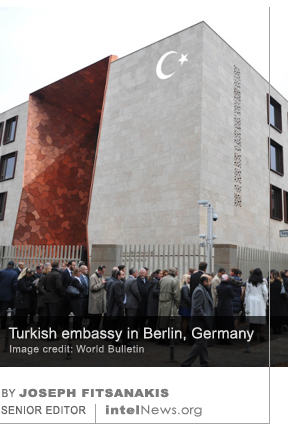
Turkish embassy in GermanyTurkish state agencies have asked the country’s diplomats stationed all over Europe to spy on Turkish expatriate communities there, in an effort to identify those opposed to the government, according to a German report. The government of Turkish President Recep Tayyip Erdoğan accuses members of the so-called Gülen movement of orchestrating a military coup in July of last year, which resulted in an armed attack on the country’s parliament and the murder of over 200 people across Turkey. The Gülen movement consists of supporters of Muslim cleric Fethullah Gülen, who runs a global network of schools, charities and businesses from his home in the United States. The government of Turkey has designated Gülen’s group a terrorist organization and claims that its members have stealthily infiltrated state institutions since the 1980s.
According to German newsmagazine Der Spiegel, the Erdoğan government has now tasked its diplomats stationed abroad to engage in intelligence collection targeting alleged Gülen sympathizers. The report cited “a confidential analysis by the Federal Office for the Protection of the Constitution” (BfV), Germany’s counterintelligence agency. The analysis allegedly states that Turkish diplomats are now conducting systematic espionage activities in Germany, Austria, Switzerland, Holland, Belgium, and other Western European countries. The BfV report allegedly claims that much of the espionage conducted by Turkish diplomats is directed by the country’s Religious Affairs Directorate, known as Diyanet. The agency is seen as the institutional guardian of Turkey’s Sunni Muslim orthodoxy. It provides schools with religious education that is carefully tailored to be compatible with the country’s secular constitution, and trains the country’s imams, who are employed by the state. Der Spiegel claimed on Monday that Diyanet has asked its religious representatives stationed in Europe to look for Gülen sympathizers. According to the German newsmagazine, information is now pouring in from Turkey’s embassies and consulates. It includes names of individuals, as well as student groups, cultural organizations, schools and day-care centers that are seen as not sufficiently critical of the Gülen movement. Der Spiegel said it had seen a report sent to Diyanet by the Turkish embassy in Berne, Switzerland, which warned that many Gülenists had left Turkey and were now operating in Switzerland.

Late last summer, Der Spiegel claimed that Turkey’s National Intelligence Organization (known by its Turkish initials, MİT) secretly contacted its German counterpart, the Federal Intelligence Service (BND) and asked for assistance to investigate and arrest supporters of the Gülen movement living in Germany, some of whom are German citizens. The BND reportedly refused to cooperate with the request. Another German news outlet, Die Welt, cited an unnamed German security official who said that the MİT employed more operatives in Germany than the East German spy agency did at the height of the Cold War.

Author: Joseph Fitsanakis | Date: 20 February 2017 | Permalink

Iran sentences professor at Belgian university to death for spying

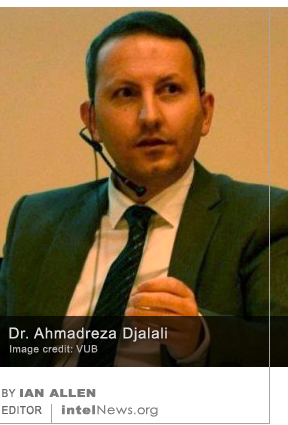
Ahmadreza DjalaliAn Iranian scientist who works at a university in Belgium has been sentenced to death in Iran, allegedly for spying. According to his family and his employer in Belgium, Dr. Ahmadreza Djalali is currently in prison in Tehran. Dr. Djalali, 45, is professor of disaster medicine at the Vrije Universiteit Brussel (VUB), a Dutch-speaking university located in the Belgian capital. For the past few years, Dr. Djalali has been based in Italy, where he teaches in the VUB’s European Master’s program in Disaster Medicine. According to an announcement on the VUB’s website, Dr. Djalali is now awaiting execution, which has been scheduled to take place later this month.

It is believed that the professor was arrested in April of last year, while visiting his family in Iran. But his family in Europe chose not to publicize his arrest, in hopes of getting him released. They spoke to the media only after Dr. Djalali was given a death sentence last week. The reason for the scientist’s arrest has not been made clear, but it is thought to relate to his collaboration with other researchers in Belgium and Italy, some of whom are Israeli citizens. Iran considers Israel an “enemy entity” and does not allow its citizens to interact with Israeli citizens. Officials at VUB claim that Dr. Djalali is has not been involved in political campaigns or discussions, and that his contacts with foreign scientists are solely research-driven.

According to his family, Dr. Djalali has protested his detention by launching hunger strikes on three separate occasions, which have severely affected his health. He also claims that he was not allowed access to lawyers and that he was not given a trial. Instead, he said he was interrogated and forced to sign a confession admitting to an offence that he does not recognize. Iranian authorities have refused comment on the matter.

Author: Ian Allen | Date: 07 February 2017 | Permalink

Lebanon claims arrests of five Israeli spies holding third country passports

GDGS LebanonThe security services of Lebanon announced on Wednesday that they had arrested five foreign nationals who were allegedly spying of Israel. A brief statement issued by Lebanon’s General Directorate of General Security (GDGS, also known as the General Security Directorate) said the five individuals were members of a “spy ring” set up by the Mossad, Israel’s external intelligence agency. The five —three men and two women— are accused of contacting Israeli embassies in countries in the Middle East, Europe and Asia, with the aim of passing information about domestic Lebanese affairs.

The statement from the GDGS said the alleged spy ring consisted of two male holders of Lebanese passports, a Palestinian Arab man (passport not specified), and two women with Nepalese passports. It said that the five foreigners were interrogated and “confessed to the charges”, which include “spying for Israeli embassies abroad”. According to articles in the Lebanese media, the members of the alleged spy ring admitted that they had dialed telephone numbers that were operated by the embassies of Israel in: Amman, Jordan; Ankara, Turkey; London, United Kingdom; and Kathmandu, Nepal. The reports state that the five foreigners said the reason they contacted the Israeli embassies was to “pass on information”, but no specifics were offered.

According to An Nahar, Lebanon’s leading daily newspaper, the two Nepalese women had been tasked with recruiting other Nepalese women working in Israel as maids or nannies. The recruits were allegedly instructed to call telephone numbers belonging to Israel’s embassy in Nepal and share information about their employers’ activities. No information has been given about the identity and occupation of those who employed the domestic workers. The GDGS statement said that the agency was seeking to arrest “the rest of the culprits”, but did not specify whether these were members of the same alleged spy ring.

Author: Ian Allen | Date: 26 January 2017 | Permalink

New Zealand spy agency warns of persistent foreign espionage threats

NZSIS New ZealandThe intelligence agency of New Zealand has issued a report warning that the country is being targeted by foreign spies who operate using fake covers. Many of them aim to infiltrate some of the highest levels of the government, according to the agency. The warning appeared in the annual report of the New Zealand Security Intelligence Service (NZSIS), the country’s main national intelligence organization, which is responsible for intelligence, counterintelligence and counter- terrorism. The NZSIS’ latest report covers the 12 months leading up to June 30, 2016. The unclassified version of the report was presented last week to the New Zealand House of Representatives, which must by law be kept informed about the activities of the NZSIS.

The report warns that “[f]oreign powers continue to conduct espionage activity and other hostile state-sponsored activities, including foreign interference, against New Zealand”. To illustrate this point, the report mentions the case of an alleged “foreign intelligence officer” who entered New Zealand under a “cover identity”, presumably in 2016. The officer approached and met senior New Zealand government officials, including some “with high level security clearances”, claims the report. The undercover officer also came in contact with individuals who worked in “key New Zealand business facilities” and sensitive industries, according to the document. However, NZSIS was able to identify the officer and subsequently contacted all New Zealand government officials that came in contact with the officer. The officials were debriefed and advised to be “cautious in their conversations” with foreign nationals, said the report.

The case study may point to efforts by foreign intelligence agencies to gain insights or manipulate the operations of New Zealand’s government and business community, said NZSIS. However, when asked by reporters, the agency refused to provide further details of the case of the foreign undercover officer. An agency spokesman said simply that the case highlights “some of the security threats that New Zealand currently faces”. The NZSIS is currently in the middle of a hiring spree, after its budget was raised last year. It is estimated that the agency’s staff has increased by nearly a fifth since late 2015.

Author: Ian Allen | Date: 16 January 2017 | Permalink

Accused Chinese nuclear spy ‘to plead guilty’ in US court this week

China General Nuclear PowerA man at the center of the first case of Chinese nuclear espionage in United States history will be pleading guilty on Friday, according to court documents. This could mean that the alleged spy has decided to give the Federal Bureau of Investigation (FBI) details of Chinese nuclear espionage in the US. The accused man is Szuhsiung ‘Allen’ Ho, a Taiwanese-born engineer and naturalized American citizen. Ho was arrested by the FBI in April on charges of sharing American nuclear secrets with the government of China.

The investigation began when the Tennessee Valley Authority (TVA) contacted the FBI with concerns about Ching Huey, a TVA senior manager. When the FBI questioned the TVA executive, he admitted that Allen Ho had paid him in exchange for information about nuclear power production. He also said that he had traveled to China for that purpose, and that the Chinese government had covered his travel expenses. A few months later, the FBI arrested Ho in Atlanta, Georgia, and charged him with espionage. The FBI also claims that Ho’s US business firm, Energy Technology International, gave secrets to China General Nuclear Power, a Chinese company that supplies nuclear energy technology to the Chinese government. According to Ho’s indictment, he used his technical expertise and business acumen to give Beijing US government information that could help China’s civilian and military nuclear program.

Government prosecutors argued successfully that Ho, who has close family in China, including a son from a former marriage, could flee there if freed. Prosecutors also claim that Ho has access to several million US dollars abroad. For the past months, Ho’s defense denied the espionage accusations against him. But on Tuesday, a newspaper in Knoxville, Tennessee, where Ho has been charged, said that the jailed engineer is preparing to plead guilty in court on Friday. Observers believe that this move by Ho’s legal team means that he has decided to cooperate with the FBI. He could therefore provide US authorities with information about Chinese nuclear espionage in the US, and secrets on “the inner workings of China’s nuclear program”, said the newspaper.

Author: Ian Allen | Date: 4 January 2017 | Permalink

Year in review: The 10 biggest spy-related stories of 2016, part II

End of Year ReviewSince 2008, when we launched intelNews, it has been our end-of-the-year tradition to take a look back and highlight what we think were the most important intelligence-related stories of the past 12 months. In anticipation of what 2017 may bring in this highly volatile field, we present you with our selection of the top spy stories of 2016. They are listed below in reverse order of significance. This is part two in a two-part series; you can access part one here.

5. Turkey’s intelligence agency wins the 2016 ‘clueless’ award. It seems everyone predicted the July 15 coup in Turkey, except its spy agency. Unlike countless political analysts in Turkey and abroad, who have been warning about a possible coup as early as October 2015, Turkey’s National Intelligence Organization (MİT) was caught in the dark. So unprepared was the agency, that it was unable to defend its headquarters in Ankara from an attack on the morning of July 16 by military helicopters. Meanwhile, dozens of Turkish nationals with diplomatic passports have been applying for political asylum in Germany and elsewhere since the coup. How many of those are MİT personnel, one wonders?

4. Panama papers leak shows immense extent of global financial crime. This year saw the unauthorized release of the Panama Papers, 11.5 million leaked documents that represent history’s largest leak. The documents were leaked form the vaults of the secretive Panamanian law firm Mossack Fonseca, and reveal secret information relating to over 200,000 offshore entities. This website opined at the time that the Panama Papers reveal the enormous extent of tax evasion and money laundering on a worldwide scale, which now directly threatens the very survival of the postwar welfare state. National intelligence agencies must begin to view offshore tax evasion as an existential threat to the security of organized government and need to augment their economic role as part of their overall mission to protect and secure law-abiding citizens.

3. Nuclear power plant computers found to be infected with viruses. In April, the computers of Gundremmingen, a nuclear power plant in southern Germany, were found to be infected with computer viruses that are designed to steal files and provide attackers with remote control of the system. The power plant is located in Germany’s southern district of Günzburg, about 75 miles northwest of the city of Munich. It is owned and operated by RWE AG, Germany’s second-largest electricity producer. RWE AG insisted that the malware did not pose a threat to the nuclear power plant’s computer systems, because the facility is not connected to the Internet. But there was no explanation of how the viruses found their way into the nuclear power plant’s systems in the first place.

2. German intelligence accuses Russia of pretending to be ISIS online. In June, a German intelligence report alleged that the so-called ‘Cyber Caliphate’, the online hacker wing of the Islamic State, is in fact a Russian front, ingeniously conceived to permit Moscow to hack Western targets without retaliation. The Cyber Caliphate first appeared in early 2014, purporting to operate as the online wing of ISIS. Now, however, a German intelligence report claims that the Cyber Caliphate is in fact a project of APT28 (also known as ‘Pawn Storm’), a notorious Russian hacking collective with close ties to Russian intelligence. The findings of the German intelligence report echo previous assessments by French and American authorities.

1. Intelligence features heavily in domestic US politics. Many, including this website, saw last week’s expulsion of 35 Russian diplomats by US President Barack Obama as a move directed “more towoard domestic American politics than foreign policy”. The expulsion aimed to expose Moscow’s alleged campaign of interference in the 2016 US Presidential elections. But another of its goals was to force president-elect Donald Trump, seen widely as a Russo-file, to take sides. Russian President Vladimir Putin responded by saying Moscow “reserves the right” to retaliate, but would not do so at this point. The Russian response was unexpected and highly uncharacteristic, an important reminder of the uncharted waters that US politics –and US-Russian relations– have entered in 2016. Still, it is remarkable to see the president-elect of the US effectively side with the Kremlin and not with his own country’s Intelligence Community. If nothing more, 2017 promises to be exceedingly interesting from an intelligence point of view.

This is part two in a two-part series; you can access part I here.

Author: Joseph Fitsanakis and Ian Allen | Date: 30 December 2016 | Permalink

Year in review: The 10 biggest spy-related stories of 2016, part I

End of Year ReviewSince 2008, when we launched intelNews, it has been our end-of-the-year tradition to take a look back and highlight what we think were the most important intelligence-related stories of the past 12 months. In anticipation of what 2017 may bring in this highly volatile field, we present you with our selection of the top spy stories of 2016. They are listed below in reverse order of significance. This is part one in a two-part series; part two is here.

10. Kim Philby videotaped lecture surfaces in Germany. While working as a senior member of British intelligence, Harold Adrian Russell Philby, known as ‘Kim’ to his friends, spied on behalf of the Soviet NKVD and KGB from the early 1930s until 1963, when he secretly defected to the USSR from his home in Lebanon. Philby’s defection shocked Western intelligence and is seen as one of the most dramatic moments of the Cold War. In April of this year, the BBC found a videotaped lecture by Philby in the archives of the BStU, the Federal Commissioner for Stasi Records in Germany. During the one-hour lecture, filmed in 1981, Philby addresses a select audience of operations officers from the Stasi, the Ministry of State Security of the former East Germany. Excerpts were aired publicly for the first time.

9. Britain’s MI6 to increase in size by 40% by 2020. It was revealed in July that, according to satellite images, the headquarters of the Russian Foreign Intelligence Service, known as SVR, has doubled, and possibly tripled, in size in the past nine years. So it probably shouldn’t come as a surprise that the British government plans to implement a 40 percent increase in personnel numbers for MI6 over the next four years. The agency, which is formally known as the Secret Intelligence Service, currently employs about 2,500 people. But that number will rise to approximately 3,500 by 2020. Experts agree that we are witnessing the most significant growth in the size of state intelligence agencies since the end of the Cold War.

8. Israel’s Mossad has a successful year, allegedly. It has been quite a year for Israel’s primary external intelligence agency, the Mossad. In 2015, the secretive organization got a new director, Yossi Cohen. Since that time, it has emerged that Bassam Mahmoud Baraka, a senior member of the military wing of Hamas, the Palestinian militant group that governs the Gaza Strip, has defected to Israel. Mossad is also believed to be behind the killing of Mohamed Zaouari, a senior aviation engineer who headed Hamas’ unmanned aerial vehicle program. Zaouari was shot dead outside his home in Tunisia earlier this month, by a group of assailants using gun silencers.

7. Information points to previously unknown ISIS spy agency. According to The New York Times, the Islamic State has set up a secretive intelligence agency whose task is to set up sleeper cells abroad and has already sent “hundreds of operatives” to Europe and Asia. The ISIS intelligence agency goes by the name Emni and appears to be a multilevel organization that includes domestic and external operational components. Emni’s external unit is tasked with conducting terrorist operations abroad. These are the responsibility of several lieutenants, who are permitted to recruit the most capable members of ISIS from around the world.

6. South Korea announces most high-profile defection from North since Korean War. An announcement issued by the South Korean government in April said it had given political asylum to a colonel in the Korean People’s Army, who worked for the Reconnaissance General Bureau, a military-intelligence agency that resembles the US Central Intelligence Agency’s Special Activities Division. The unnamed man is the most high profile defector to the South since the end of the Korean War in 1953, according to authorities in Seoul. Meanwhile, Thae Yong-Ho, the second-in-command at the North Korean embassy in the United Kingdom, also defected with his wife and children in August, and was given political asylum in South Korea.

This is part one in a two-part series; part two is here.

Author: Joseph Fitsanakis and Ian Allen | Date: 29 December 2016 | Permalink

Greece jails member of alleged network of German retirees spying for Turkey

Kos GreeceA German retiree living in Greece, who admitted in court that he was part of a network of German and other Western European residents of Greece recruited as spies by Turkish intelligence, has been jailed for 14 years. The 65-year-old man, who has not been named, was arrested two years ago in the southeastern Aegean island of Kos. He was born in Cold-War-era East Germany and worked as a locksmith before serving for 15 years in the East German National People’s Army. From 2009 to 2012, he lived in Turkey before moving permanently to Greece.

On the morning of October 15, 2014, the German national was arrested by Greek police, who said they spotted him taking pictures of a Greek military outpost while sitting in his parked car. The police officers confiscated his camera and searched his vehicle, finding a pair of binoculars, various camera lenses and several memory sticks. His camera contained photographs of Greek military installations and government buildings on the island, which is located less than 3 miles off the Turkish coast. More photographs of Greek defense installations, military vehicles and communications facilities were found in the man’s house on the island. Police also found there documents in the Turkish language and notepads bearing coordinates of Greek military bases, public buildings and bridges located on Kos. The prosecution claimed that the German man was also monitoring the activities of Frontex, the European Border and Coast Guard Agency that maintains a base on the Greek island.

During the trial, the accused said he was recruited by Turkey’s intelligence service, known as MİT, in 2011, when he was living in Turkey. He also told the court that he was one of many German and other Western European retirees living in Greece, who have been recruited by Turkish intelligence to spy on Greek military and civilian government facilities. He added that, in return for his services, his Turkish handlers deposited €2,000 every month to his bank account in Germany. He had also been instructed to meet his handlers in Germany, not in Greece or Turkey. A court in the Greek island of Rhodes convicted the German man to 14 years in prison, one year less than the 15-year sentence requested by the prosecution.

Author: Joseph Fitsanakis | Date: 09 Dec 2016 | Research credit: Strategy Reports | Permalink