Chinese diplomat who defected to Australia breaks silence to warn of spies

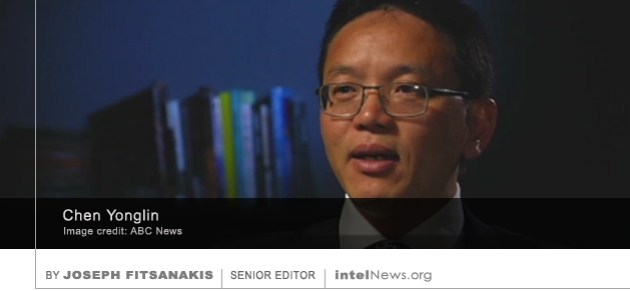
Chen YonglinA Chinese diplomat, who made international news headlines in 2005 when he defected to Australia, has ended a decade of silence to warn about an alleged increase in Chinese espionage operations against his adopted country. Chen Yonglin was a seasoned member of the Chinese diplomatic corps in 2001, when he was posted as a political affairs consul at the Chinese consulate in Sydney, Australia. His job was to keep tabs on the Chinese expatriate community in Australia, with an emphasis on individuals and organizations deemed subversive by Beijing. He later revealed that his main preoccupation was targeting members of the Falun Gong spiritual movement, which is illegal in China. He also targeted supporters of Taiwanese independence, as well as Tibetan and East Turkestan nationalists who were active on Australian soil.
But in 2005, Chen contacted the Australian government and said that he wanted to defect, along with his spouse and six-year-old daughter. He was eventually granted political asylum by Canberra, making his the highest-profile defection of a Chinese government employee to Australia in over half a century. During a subsequent testimony given to the Parliament of Australia, Chen said that he was in contact with Australian intelligence and was giving them information about alleged Chinese espionage activities. He said at the time that China operated a network of over 1,000 “secret agents and informants” in Australia. Chen distinguished agents and informants from Chinese intelligence officers, most of whom were stationed in Chinese diplomatic facilities.

Chen, who now works as a businessman, disappeared from the public limelight after his defection. But last weekend, he reappeared after a decade of obscurity and gave an interview to ABC, Australia’s national broadcaster. The ABC journalist reminded Chen that in 2005 he had estimated the number of Chinese agents and informants operating in Australia at 1,000, and asked him how many he thought were active today. Chen responded that an increase in the number is certain, given that “China is now the wealthiest government in the world”. That meant, said Chen, that Beijing has the funds that are necessary to maintain “a huge number of spies” in Australia. However, the former diplomat said that most Chinese agents are “casual informants”, not trained spies, and that they are dormant for long periods of time in between operations.

Author: Joseph Fitsanakis | Date: 24 November 2016 | Permalink

Iran arrests 12 nuclear negotiators on espionage charges

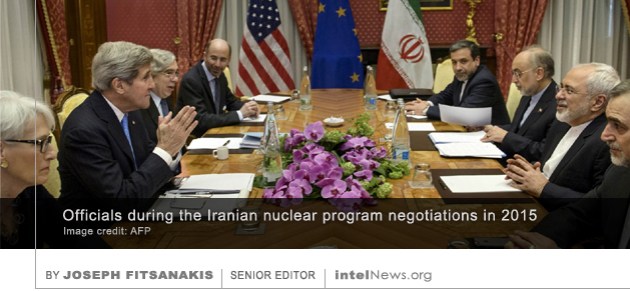
Iran nuclear negotiationsIranian authorities have reportedly arrested at least 12 members of the country’s team of nuclear negotiators on charges of espionage. The 12 are believed to have represented Iran in international talks about its nuclear program between the Islamic Republic and a group of nations known as P5+1, representing the five permanent members of the United Nations Security Council plus Germany.
The arrests were revealed by Iranian opposition parliamentarian Hussein Ali Haji Degana, who told reporters on Thursday that those detained held significant posts in the Iranian team that negotiated with representatives of the P5+1 group. Mr. Degana added that some of the 12 held dual citizenships, but did not specify the names of those arrested or their countries of citizenship. Iranian media, which is heavily controlled by the government in Tehran, did not report Degana’s comments. But they were widely publicized by Arab media, including Saudi and Iraqi news agencies.

In March of 2015, Amir Hossein Motaghi, a media advisor to the Iranian president, who covered the international negotiations on the country’s nuclear program, defected to the West. Last August, the office of the Iranian prosecutor said that a dual national with Iranian citizenship had been arrested for spying on Tehran for an unspecified foreign intelligence service. The individual was later identified as Abdolrasoul Dorri Esfahani, a dual Iranian and Canadian citizen, who was allegedly recruited by Britain’s Secret Intelligence Service, known as MI6. Esfahani was said to be an accountant with some involvement in the financial aspects of the nuclear negotiations between Iran and foreign powers.

It is not known whether the alleged arrests of 12 more members of the Iranian negotiating team are connected with the espionage charges against Esfahani. Mr. Degana said he hopped that the names of the 12 detainees will be released to the media by the authorities and that their trials will be transparent and open to public scrutiny.

Author: Joseph Fitsanakis | Date: 18 November 2016 | Permalink

Russian defectors claim US intelligence agencies failed to protect them

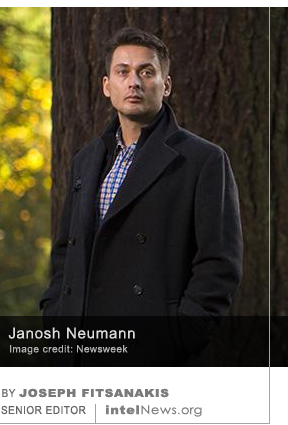
Janosh NeumannTwo Russian intelligence officers, who defected to the United States in 2008, claim that they had to fend for themselves after American spy agencies failed to protect them despite promises to the contrary. Janosh Neumann (born Alexey Yurievich Artamonov) and his wife Victorya were employees of Russia’s Federal Security Service (FSB) specializing in investigations of money laundering and corruption. But in 2008 they traveled from Russia to Germany and from there to the Dominican Republic. Once in the Caribbean island, they entered the US embassy and offered to work for the Central Intelligence Agency (CIA).
The couple claim that they provided “a trove of secrets” to the CIA, including information on FSB officials who engaged in corrupt practices such as bribing, money-laundering and large-scale tax evasion. In return, the CIA transported the Neumanns to America, where they were granted permission to settle temporarily based on humanitarian grounds. The two Russian defectors claim that they were promised green cards and, eventually, American citizenship. For several months following their entry into the US, the Neumanns were kept in a government safe house, where they were debriefed, given polygraph tests, and met regularly with officials from the Departments of Justice and Treasury, as well as with employees of the Federal Bureau of Investigation (FBI) and the CIA. They say they gave information to the CIA about the methods used by Russian intelligence operatives to infiltrate American corporations. But when the CIA tried to convince them to move back to Russia and work there for the US government as agents-in-place, the Neumanns refused and chose instead to work for the FBI.

The two Russians say the worked for the Bureau for five years, during which time they were paid approximately $1 million. But in 2013 when their employment contracts expired, the FBI did not renew them. Later that year, the Neumanns’ temporary visa to remain in the US expired. Meanwhile, US immigration authorities denied Janosh’s application for a green card because he allegedly hinted that he tortured people for the FSB during his interview with a US immigration official. Eventually, the Russian defectors convinced the FBI to send immigration officials a letter stating that there was no reason to assume that Janosh had tortured or persecuted people in Russia. Earlier this year, the Newmanns, who recently had a baby here in the US, were allowed to stay and have now applied for green cards again. But they say they reserve the right to sue the US government for having previously denied them protection and citizenship.

Author: Ian Allen | Date: 17 November 2016 | Permalink

India and Pakistan recall diplomats accused of espionage

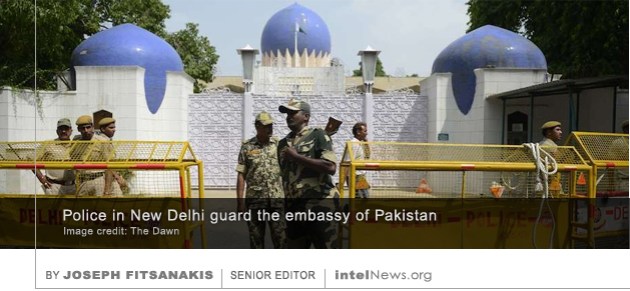
Pakistani embassy in IndiaIndia is in the process of recalling eight of its diplomats from Pakistan, after their names and photographs were published in Pakistani newspapers with accusations that they are intelligence officers. According to anonymous sources in the government of Pakistan, three of the eight recalled diplomats have already left Islamabad for New Delhi. Five more are expected to leave the country before the end of the week. The three who left Pakistan yesterday were identified in the Pakistani media as Madhavan Nanda, Vijay Kumar Verma and Anurag Singh. Pakistani media said earlier this week that the three are “undercover agents”, suggesting that they are intelligence officers posted in India under diplomatic cover.
The eight Indian diplomats were recalled less than a week after Pakistan withdrew six of its diplomats from its embassy in New Delhi. Their names were released to the Indian media by the country’s intelligence services, following the arrest of Mahmood Akhtar, a Pakistani diplomat who was detained by Indian authorities, allegedly while committing espionage. Indian authorities said Akhtar admitted he was an intelligence officer under interrogation, and identified five more Pakistani diplomats as undercover intelligence operatives. All six were accused of espionage by New Delhi, declared persona non grata (unwanted persons) and were ordered to leave the country. Observers see the recent outing of the Indian diplomats in the Pakistani media as a tit-for-tat response by Islamabad.

Interestingly, none of the eight Indian diplomats were officially declared persona non grata by Pakistani authorities. But the publication of their names and photographs in the Pakistani media were sufficient to prompt the Indian government to recall them back to New Delhi. Tensions between the two neighboring countries have been rising in recent months, mostly over ethnic and religious tensions in the disputed region of Kashmir, which belongs to India but is populated primarily by Muslims. On Tuesday, one Indian soldier and thee Pakistani civilians were killed on both sides of the border, after fire was exchanged between warring sides.

Author: Joseph Fitsanakis | Date: 09 November 2016 | Permalink

Political tension rises in Serbia amidst espionage allegations

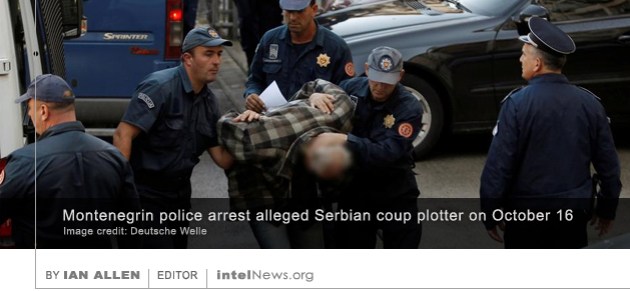
Montenegro coupA weapons cache that was found buried last week near the apartment of Serbia’s prime minister has fuelled tensions in the Balkan country, amid rumors that a failed coup in neighboring Montenegro was planned in Serbia by Russian spies. Serbian authorities announced the discovery of the stockpile on October 29; it included ammunition, hand grenades and a portable missile launcher and was located near the residence of Prime Minister Aleksandar Vučić. The government later said that the weapons find dated back to the Balkan wars of the 1990s and was not connected with  at Vučić’s administration. But politics in the country remain tense, following allegations made earlier in October that Russian intelligence agents used Serbia as a base to plan a military coup in Montenegro.
The coup allegations surfaced on October 16, after 20 Serbians and Montenegrins were arrested by Montenegrin authorities for allegedly planning a military coup against the government. The arrests took place on election day, as Montenegrins were voting across the country of 650,000 people. According to media reports, the failed coup aimed to prevent the reelection of Prime Minister Milo Đukanović, who is pushing for Montenegro to join the North Atlantic Treaty Organization. Đukanović, who was eventually reelected, claimed that the coup plotters were supported by Russia. Moscow has raised strong objections to the possibility of Montenegro joining NATO. A few days later, Serbian Prime Minister Vučić appeared to substantiate Đukanović’s allegations. According to Vučić, the Serbs who were arrested in Montenegro had hatched their coup plot in Serbia, assisted by Russian intelligence. Vučić added that he would not allow Serbia to “act as the puppet of world powers”, a comment that was clearly directed at Moscow.

However, Serbian authorities made no arrests following the October 16 developments in Montenegro, despite much media attention in Belgrade. Shortly prior to the alleged failed coup in Montenegro, Nikolai Patrushev, former director of the Russian Federal Security Service (FSB) and current secretary of Russia’s Security Council, visited the Serbian capital. There were rumors that he returned to Moscow with three Russian intelligence officers who had been caught engaging in espionage by Serbian counterintelligence. Meanwhile, some Serbian newspapers alleged last week that an official in the Ministry of Justice and Public Administration had been arrested for selling classified information to the United States Central Intelligence Agency. Meanwhile, Russian and Byelorussian troops arrived in Serbia this week to hold joint military exercises with their Serbian counterparts, codenamed Slavic Brotherhood.

Author: Ian Allen | Date: 03 November 2016 | Permalink

NSA contractor charged with spying removed both electronic and printed files

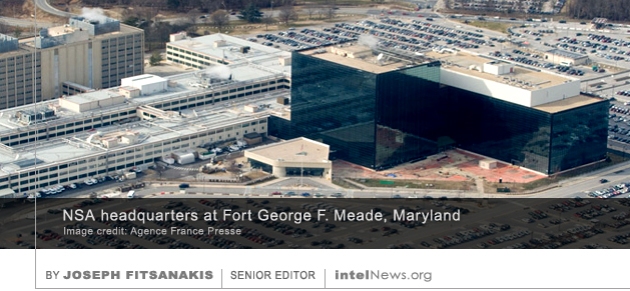
NSAA United States federal contractor, who was charged with espionage after he was found to have stolen classified documents, was able to remove both electronic and printed files from his office at the National Security Agency, according to a report. The man was identified by The New York Times last week as Harold Thomas Martin III, a 51-year-old employee of Booz Allen Hamilton, one of the largest federal contractors in the US. Last August, agents of the Federal Bureau of Investigation raided Martin’s house in Maryland and arrested him on charges of stealing government property and illegally removing classified material.

In reporting on the disclosure earlier this week, we noted that the FBI found classified information “on a variety of electronic devices that Martin had stored —though apparently not hidden— in his house and car”. It turns out, however, that at least some of the classified files in Martin’s possession were in printed format. According to The Washington Post, which revealed this information on Wednesday, this means that Martin extracted the information from his office at the NSA “the old-fashioned way, by walking out of the workplace with printed-out papers he had hidden”. The paper cites unnamed US government officials who claim that Martin was repeatedly able to walk out the front door of the NSA with what one anonymous congressional aide described as “a whole bunch of stuff”. The paper alleged that printed classified material found in Martin’s possession amounts to “thousands of pages”.

It appears that Martin extracted most of the documents before the fall of 2013, when the NSA and other US intelligence agencies imposed strict security controls on data access following the defection of Edward Snowden, another federal contractor who worked for the NSA and is today living in Russia. But the revelation will undoubtedly raise further questions about the ability of US intelligence agencies to scrutinize the activities of hundreds of thousands of employees who have access to classified information. The Post notes that the NSA and other US intelligence agencies do not employ universal searches of personnel that enter or exit government facilities. Instead they prefer random checks for reasons of convenience and to foster a sense of trust among employees. That, however, may change if more cases like those of Snowden and Martin become known.

Author: Joseph Fitsanakis | Date: 14 October 2016 | Permalink

Arrested contractor may have worked for NSA’s elite cyber spy unit

NSAA United States federal contractor, who remains in detention following his arrest last summer for stealing classified documents, may have worked for an elite cyber espionage unit of the National Security Agency. The man was identified by The New York Times last week as Harold Thomas Martin III, a 51-year-old employee of Booz Allen Hamilton, one of the largest federal contractors in the US. The paper said that, prior to joining Booz Allen Hamilton, Martin served as a US Navy officer for over a decade, where he specialized in cyber security and acquired a top secret clearance. But last August, agents of the Federal Bureau of Investigation raided Martin’s house in Maryland and arrested him on charges of stealing government property and illegally removing classified material.

Media reports suggest that the FBI discovered significant quantities of classified information, some of it dating back to 2006, on a variety of electronic devices that Martin had stored —though apparently not hidden— in his house and car. Another interesting aspect of the case is that there is no proof at this point that Martin actually shared the classified information with a third party. There is some speculation that he may be behind a disclosure of a collection of NSA hacking tools, which were leaked in August of this year by a previously unknown group calling itself “the Shadow Brokers”. But some speculate that Martin may have taken the classified material home so he could write his dissertation for the PhD he is currently undertaking at the University of Maryland’s Information Systems program.

A few days ago, The Daily Beast quoted an unnamed former colleague of Martin who said that the NSA contractor was a member of one of the agency’s elite cyber spy units. The existence of the secretive unit, which is known as the NSA’s Office of Tailored Access Operations, was revealed in June 2013 by veteran NSA watcher Matthew M. Aid. Writing in Foreign Policy, Aid cited “a number of highly confidential sources” in alleging that the NSA maintained a substantial “hacker army” tasked with conducting offensive cyber espionage against foreign targets. More information on NSA’s TAO was provided in January 2014 by German newsmagazine Der Spiegel. If The Daily Beast’s allegations about Martin are accurate, they would explain why anonymous government sources told The Washington Post last week that some of the documents Martin took home “could be expected to cause exceptionally grave damage to the national security of the United States”. The case also highlights the constant tension between security and the privatization of intelligence, which was also a major parameter in the case of Edward Snowden, another Booz Allen Hamilton contractor who defected to Russia in 2013.

Meanwhile, Martin remains in detention. If he is convicted, he will face up to 11 years behind bars.

Author: Joseph Fitsanakis | Date: 10 October 2016 | Permalink

British judge denies request to name alleged new member of Cambridge spy ring

Corpus Christi College CambridgeA document that allegedly contains the name of a man who could be connected to one of the most sensational spy rings of the Cold War is to remain secret after a judge rejected a request to have it released. The man is believed by some to have been associated with the so-called ‘Cambridge spy ring’, a group of upper-class British graduates of Cambridge University, who spied for the USSR from the 1930s until the 1960s. Among them was Guy Burgess, Donald Maclean and H.A.R. “Kim” Philby, all of whom eventually defected to the Soviet Union. In 1979, it was revealed that Anthony Blunt, an art history professor who in 1945 became Surveyor of the King’s Pictures and was knighted in 1954, was also a member of the group. A fifth member, career civil servant and former intelligence officer John Cairncross, was publicly outed as a Soviet in 1990, shortly before his death.


Over the years, more individuals have been suggested by historians as potential members of the group, including intelligence officers Leo Long and Guy Liddell, academics Ludwig Wittgenstein and Andrew Gow, and physicist Wilfrid Mann. But according to British newspaper The Daily Mail, another individual may be identified in a classified document as a possible member of the Cambridge spy ring. The document was allegedly traced by Andrew Lownie, who authored the recently published Stalin’s Englishman: The Lives of Guy Burgess. Lownie filed a Freedom of Information request to have the document, which is held at the National Archives in London, released. But the request was denied, and a judge has now upheld the decision.

In denying the request, the judge argued that the man named in the document is still alive and that a possible release of the document could “jeopardize […] personal relationships”. He also contended that the case is too old to warrant immediate public interest, and thus there was “no pressing need” to declassify the file. The Mail speculates that the individual named in the document could have cooperated with the British government in the past in return for protection, or that the file in question may contain details that could embarrass the British government.

Author: Joseph Fitsanakis | Date: 20 September 2016 | Permalink

Conflicting details on Iranian nuclear negotiator arrested for espionage

Iran nuclear negotiationsIranian officials have confirmed reports from earlier this month that a member of the country’s team of nuclear negotiators has been arrested for engaging in espionage for a foreign country. But there are conflicting details about the case in Iranian media reports. Rumors about the identity of the individual began to circulate on August 16, after the office of the Iranian prosecutor announced that a dual national with Iranian citizenship had been arrested for spying on Tehran for a foreign intelligence service. The individual was not named, but some reports connected him with Britain’s Secret Intelligence Service, known as MI6.

On Sunday, Iran’s judiciary spokesman, Gholamhossein Mohseni Ejeie, identified the man as Abdolrasoul Dorri Esfahani. Ejeie was specifically asked about the espionage case during his weekly press conference, and responded saying that an “espionage infiltration” had indeed been detected and that “legal action” was being taken against Esfahani. He did add, however, that the arrest and concurrent investigation had not yet resulted in a case that could stand in court, thus Esfahani had been released on bail. When asked whether Esfahani would be charged, Ejeie said that official charges had not been filed, because “the charge against [Esfahani] has not been proven yet”. He implied, however, that charges would eventually be filed.

There are also conflicting reports about Esfahani’s background and involvement with the Iranian government. Early reports suggested that he is a dual citizen of Canada and Iran. But subsequent reports stated that he holds both Iranian and British passports, and that he had been recruited by MI6. Some unconfirmed reports claimed that Esfahani received payments from both British and American intelligence agencies. What appears more certain is that Esfahani is an accountant with some involvement in the financial aspects of the recent nuclear negotiations between Iran and foreign powers. It is also believed that he was not a core member of Iran’s negotiating team, but provided a supporting role on financial aspects of the negotiations.

The recently concluded negotiations, were aimed at bridging the differences between the Islamic Republic and a group of nations that have come to be known as P5+1, representing the five permanent members of the United Nations Security Council plus Germany. In March 2015, Hossein Motaghi, a media advisor to the Iranian president Hassan Rouhani, who was in Switzerland to cover the negotiations, defected and filed an application for political asylum in Switzerland.

Author: Joseph Fitsanakis | Date: 30 August 2016 | Permalink

Turkey has more spies in Germany than Stasi had during Cold War: expert

Turks in GermanyThe Turkish intelligence service currently employs more operatives in Germany than the East German spy agency did at the height of the Cold War, according to a German expert on espionage. The comment was made following the disclosure that Turkey maintains close to 6,000 informants and other intelligence operatives in Germany. An unnamed German security official told German newspaper Die Welt on Monday that the informants are operational throughout Germany and are handled by Turkey’s National Intelligence Organization, known as MİT.

According to Die Welt, many of these informants are tasked with keeping tabs on Germany’s large Kurdish community, which Ankara views as domestic threats to Turkish national security. More recently, however, MİT operatives in Germany have been instructed to infiltrate groups of supporters of the charismatic Muslim cleric Fethullah Gülen who lives in the United States. A former ally of Turkish President Recep Tayyip Erdoğan, Gülen and his millions of supporters around the world now oppose the Turkish government and are described as terrorists by Ankara. President Erdoğan has personally accused “Gülenists” of orchestrating the failed July 15 coup in Turkey. In addition to infiltration, MİT informants in Germany are allegedly engaged in psychological operations against perceived opponents of the Turkish government, and sometimes engage in blackmail and intimidation of targeted individuals or groups, according to Die Welt.

Erich Schmidt-Eenboom, one of Germany’s best known independent researchers on intelligence, and a widely published author, said he was surprised that the number of alleged MİT operatives in Germany is this high. If the number of 6,000 operatives is accurate, said Schmidt-Eenboom, it would place the MİT above the level of the Stasi during the Cold War. He was referring to the Ministry for State Security, the intelligence agency of communist-era East Germany, which was known for its extensive networks of informants during the Cold War. Schmidt-Eenboom said that, according to Stasi records, the agency handled approximately 10,000 operatives in West Germany, a country that at the time had a population of 60 million. In contrast, the 6,000 MİT operatives in Germany are primarily tasked with monitoring the Turkish and Kurdish immigrant community there, which numbers no more than 3 million. Consequently, said Schmidt-Eenboom, there are 500 potential human targets for each present-day MİT operative, whereas there were 6,000 West German citizens for every Stasi operative during the Cold War.

The article in Die Welt did not specify whether the alleged MİT informants are paid agents or simply supporters of the Turkish government who have volunteered their services. As intelNews reported earlier this week, some members of the German Bundestag’s Committee on Parliamentary Oversight, including its chairman, Clemens Binninger, plan to launch an official investigation into the activities of Turkish intelligence in Germany. Of particular interest to the committee is the alleged cooperation between German and Turkish intelligence agencies following the failed coup in Turkey this past July.

Author: Joseph Fitsanakis | Date: 26 August 2016 | Permalink

Video footage shows alleged CIA spy tackled outside US Moscow embassy

US embassy scuffleA Russian television station has aired footage allegedly showing a Russian guard stationed outside the United States embassy in Moscow trying to stop an American diplomat from entering the embassy. The Kremlin claims that the alleged US diplomat was in fact a Central Intelligence Agency officer who was returning to the embassy in disguise following a spy operation. As intelNews reported on July 1, the incident took place in the early hours of Monday, June 6. The American diplomat was making his way to the front entrance of the US embassy complex, which is located in the Presnensky District in downtown Moscow.

According to American sources, the diplomat was approached by an employee of the Russian Federal Security Service, the FSB, which regularly stations security personnel around the sizeable US embassy complex. The FSB claims that the guards are there to protect US diplomats, though it is common knowledge that the Russian agency, which is responsible for counterespionage, is primarily there to monitor activities in and around the US embassy. American sources claim that the diplomat presented the Russian guard with proof of identification when asked to do so. But he was then physically attacked and struck repeatedly by the FSB officer, which left him with several injuries, including a broken shoulder. The diplomat managed to enter the embassy grounds and had to be flown out of the country for urgent medical treatment. He has not returned to Russia.

On Thursday, Russian television channel NTV aired video footage purporting to show the altercation between the US diplomat and the FSB guard. The video aired on NTV shows a man exiting a taxi in a hurry and heading to what appears to be the US embassy’s front-perimeter entrance. However, as the man makes heads for the entrance, a uniformed individual jumps out of a guard station located nearby and tackles the man, throwing him on the ground. A scuffle ensues, during which the alleged diplomat is seen desperately trying to reach the entrance of the US embassy, which is American soil. He eventually manages to enter the embassy grounds, despite the effort of the uniformed guard to prevent him from entering. The same NTV report identified the American diplomat as Daniel Van Dyken and showed the photograph of a man said to be him. The report states that Van Dyken serves as third secretary of the US embassy’s Political Department.

Last week, Russian Foreign Ministry spokeswoman Maria Zakharova alleged that the diplomat in question was an intelligence officer. “It is well known”, said Zakharova, “that this very diplomat was in fact an agent of the CIA and was returning [to the US embassy], in disguise, after conducting an intelligence operation the previous night”. She also said that the Russian government employee involved in the altercation was a “police officer” who was attacked by the alleged spy when he asked to be shown proof of identification. Instead of supplying identification documents, the American diplomat “struck the guard in the face with his elbow before disappearing into the embassy”, said Zakharova. The US State Department and the CIA have refused to comment on Zakharova’s allegations.

Author: Ian Allen | Date: 08 July 2016 | Permalink

Muslim man held in New York prison claims he was CIA spy

Blerim SkoroAn ethnic Albanian man facing deportation from the United States says he was trained by the Central Intelligence Agency to spy on “the most ruthless, dangerous terrorists in the Balkans and the Middle East”. Blerim Skoro, 45, from the former Yugoslav Republic of Kosovo, was arrested last February in Brooklyn, New York, for illegally using a discounted student MetroCard. He was then found to have entered the US illegally and is currently in prison in New Jersey, facing possible deportation back to Kosovo. But Skoro told The New York Times in an interview published on Wednesday that he cannot be sent back to Kosovo because he operated there as a spy for the CIA.

According to The Times, Skoro came to the US in 1994. Six years later, he was convicted in a New York court of transporting drugs and laundering nearly $700,000 in criminal proceeds. But while in prison, Skoro was recruited as an informant for the Federal Bureau of Investigation, and was tasked with monitoring inmates with militant Islamist leanings. In 2007, when Skoro was released from prison and deported back to Kosovo, he allegedly continued working for US intelligence. He told The Times that he was trained by US operatives in a CIA safe house in the former Yugoslav Republic of Macedonia before taking on assignments in the Balkans, the Middle East and even Pakistan. Throughout that time, Skoro says he posed as a militant Islamist who had become radicalized while serving his prison sentence in America. He claims to have supplied the CIA with intelligence relating to al-Qaeda and other Sunni Islamist groups.

However, in 2010, while traveling to a CIA safe house in Macedonia for a meeting, he was shot by assailants who probably knew he was working for a foreign spy agency. That incident prompted the CIA to sever its relationship with him, dismissing him from his agent status and offering him approximately $40,000 in compensation. Soon afterwards, Skoro made his way to Canada, from where he entered the US illegally, in November 2014. Before getting arrested in Brooklyn in February, he says he made contact with US intelligence officials, offering to spy for the US against the Islamic State. But his offer was not accepted. The Times article speculates that US intelligence may have no use for Skoro because his identity has been compromised, or because his reliability has come into question.

Currently Skoro is being held without bond at the Bergin County Jail in northern New Jersey, because federal prosecutors believe he might flee if released. The Times contacted the CIA, the FBI and police sources, but all declined to comment.

Author: Joseph Fitsanakis | Date: 07 July 2016 | Permalink

Diplomat involved in fight with US embassy guard is CIA spy, says Russia

FSB - IAThe Russian government says that an American diplomat, who was allegedly beaten up by a Russian security guard outside the United States embassy compound in Moscow, is an undercover spy. The man, who has not been named, was stationed in the Russian capital by the State Department as an accredited diplomat with immunity from prosecution in Russia. However, The Washington Post reported earlier this week that the American diplomat was severely beaten by a Russian government employee while attempting to enter the US embassy compound.

The alleged incident is reported to have taken place in the early hours of Monday, June 6. The American diplomat was making his way to the front entrance of the US embassy complex, which is located in the Presnensky District in downtown Moscow. According to American sources, the diplomat was approached by an employee of the Russian Federal Security Service, the FSB, which regularly stations security personnel around the sizeable US embassy complex. The FSB claims that the guards are there to protect US diplomats, though it is common knowledge that the Russian agency, which is responsible for counterespionage, is primarily there to monitor activities in and around the US embassy. American sources claim that the diplomat presented the Russian guard with proof of identification when asked to do so. But he was then physically attacked and struck repeatedly by the FSB officer, which left him with several injuries, including a broken shoulder. According to The Washington Post, the diplomat managed to enter the embassy grounds and had to be flown out of the country for urgent medical treatment. He has not returned to Russia.

The US government believes the attack was intentional. But what caused it? One theory entertained by The Washington Post is that the diplomat was in fact an officer of the Central Intelligence Agency working in Moscow under official cover, pretending to be a State Department employee. According to this theory, the FSB was chasing the American diplomat through the streets of Moscow after a spy operation that went awry. The Russians then tried unsuccessfully to prevent him from entering the US embassy, which constitutes American soil.

On Thursday, Russian Foreign Ministry spokeswoman Maria Zakharova alleged that the diplomat in question was an intelligence officer. “It is well known”, said Zakharova, “that this very diplomat was in fact an agent of the CIA and was returning [to the US embassy], in disguise, after conducting an intelligence operation the previous night”. She also said that the Russian government employee involved in the altercation was a “police officer” who was attacked by the alleged spy when he asked to be shown proof of identification. Instead of supplying identification documents, the American diplomat “struck the guard in the face with his elbow before disappearing into the embassy”, said Zakharova. The US State Department and the CIA refused to comment on Zakharova’s allegations.

Author: Ian Allen | Date: 01 July 2016 | Permalink

Portuguese, Russian spies arrested in Rome may have accomplices

Frederico Carvalhão,A Portuguese intelligence officer arrested a week ago in Rome, allegedly while passing classified documents to his Russian handler, may have accomplices with access to North Atlantic Treaty Organization (NATO) secrets. IntelNews reported last week on the capture of Frederico Carvalhão, a section chief for Portugal’s Security Information Service (SIS), which is tasked with domestic security and counterintelligence. Carvalhão was arrested on May 23 at a café in the Trastevere district of Rome while passing a folder with six classified documents to a Russian man. The man is believed to be an employee of Russia’s Foreign Intelligence Service, known as SVR, though notably he does not have diplomatic status or immunity, and was therefore arrested. As we noted last week, this is atypical for an intelligence officer, as most of them operate as registered diplomats.

According to Portuguese media reports, the classified information that Carvalhão appears to have been sharing with the SVR since at least 2014 relate to NATO and the European Union (EU), of which Portugal is a member. However, the London-based newspaper Daily Telegraph reports that there are suspicions in Lisbon that Carvalhão was not working alone for the Russians. In other words, Portuguese investigators are looking into the possibility that the arrested spy was what is known as a ‘principal agent’. The latter signifies a mole that acts as a middle person between his foreign handlers and a cell of other agents working for him or her. The possibility that Carvalhão may not have been working alone was commented on by Portugal’s Minister of Foreign Affairs, Augusto Santos Silva, who said last week that the judicial investigation into the spy case was “ongoing”.

It appears that Carvalhão somehow managed to access NATO- and EU-related documents from the SIS’ Ameixoeira Fort headquarters in the Portuguese capital, to which he had no need-to-know access. Moreover, SIS computers do not accept flash drives, while all printed documents contain a secret watermark that identifies them as having been printed on an SIS printer. But Carvalhão appears to have somehow managed to acquire non-watermarked documents without having extracted them from an SIS computer with the use of a flash drive. Does that mean that someone else from inside SIS provided him with the documents? The EU and NATO are eagerly waiting for an answer.

Author: Joseph Fitsanakis | Date: 30 May 2016 | Permalink

Russian, Portuguese intelligence officers arrested in Rome on espionage charges

Frederico CarvalhãoTwo intelligence officers, one Russian and one Portuguese, have been arrested by Italian authorities on charges of espionage. The arrests took place in Rome on Monday by Italian police, who were reportedly accompanied by Portuguese counterintelligence officers. It is suggested in Portuguese media that the two men were arrested in the act of exchanging classified documents and money. The Portuguese intelligence officer has been identified in news reports as Frederico Carvalhão, a section chief for Portugal’s Security Information Service, which is tasked with domestic security and counterintelligence. The Russian intelligence officer has not been identified, but is believed to be an employee of Russia’s Foreign Intelligence Service, known as SVR. Interestingly, the Russian officer does not have diplomatic status and was therefore arrested, since he holds no diplomatic immunity.

A press release by the Portuguese government prosecutor said that Carvalhão had been arrested “along with a foreign subject linked to an intelligence organization” after a lengthy investigation into “concerns that [classified] information was being exchanged for money”. It is believed that Portuguese authorities began investigating Carvalhão in 2015, and now believe that he frequently traveled abroad to meet his Russian handler. He is thought to have been recruited by the Russians in 2014. According to Portuguese media reports, the documents that Carvalhão appears to have been giving the SVR contain information about the European Union and the North Atlantic Treaty Organization, of which Portugal is a member.

Carvalhão is said to have flown from Lisbon to Rome on Friday of last week in order to meet his SVR handler. The two men were meeting in a café on Saturday when they were arrested. The Portuguese government prosecutor said that Saturday’s arrests resulted from “rigorous collaboration between Portuguese and Italian authorities”. He also thanked Eurojust, a European Union agency based in the Netherlands, which focuses on cross-national judicial cooperation between European Union member-states. Security officers also raided Carvalhão’s home in Portugal, where they allegedly seized “documents and cash”. Both he and his alleged Russian hander remain in detention in Rome, while Italy is preparing to extradite them to Portugal.

Author: Joseph Fitsanakis | Date: 26 May 2016 | Permalink | News tip: C.W.