News you may have missed #894: Economic warfare edition
January 26, 2018 2 Comments
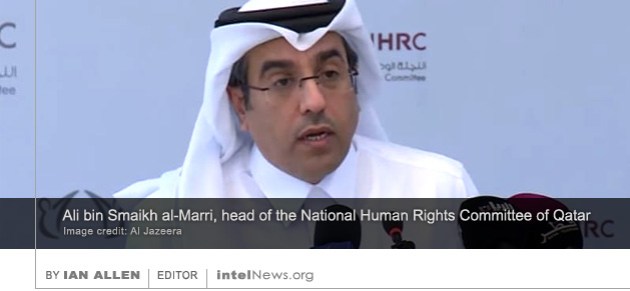 ►►This website has covered extensively the ongoing diplomatic war between Qatar, widely seen as an Iranian ally, and a coalition of Arab countries led by Saudi Arabia. In July of last year, the Saudi-led coalition —namely the United Arab Emirates, Egypt and Bahrain— broke relations with Qatar and imposed a commercial embargo on the small oil kingdom, which they accuse of supporting Iran and Iranian-backed militant groups in the region. On January 8, the National Human Rights Committee of Qatar accused Saudi Arabia and its allies of carrying out a “unilateral, abusive, arbitrary” and illegal economic blockade. The head of the committee, Ali bin Smaikh al-Marri, said that the Saudi-led blockade amounted to “economic warfare”. Does he have a point? Does economic warfare constitute a tangible part of the arsenal of modern nations, or is it a fantastical concept with little relation to reality?
►►Giuseppe Gagliano, director of the Centro Studi Strategici Carlo De Cristoforis in Italy, argues that economic warfare has been practiced for centuries. While examining the concept of economic intelligence in contemporary French strategic thinking, Professor Gagliano, explains that the concept of economic warfare has deep historical roots. He argues that, in its contemporary form, economic warfare originates in the period immediately after the end of World War II. Traditionally, it has defensive and offensive applications: Nations strive to limit outsourcing in order to preserve their industrial resources; at the same time, they seek to conquer international markets and, when able, resources. Although outsourcing has played a major role in economic warfare, the financial crisis of 2008 significantly upped the stakes and renewed the central role of the state in economic warfare theory and practice, argues Gagliano.
►►It should perhaps be noted that economic warfare does not operate simply an appendage to traditional warfare. In fact, it often takes place in the absence of traditional warfare, or indeed between wars. David Katz, senior analyst at the United States Special Operations Command and a career Foreign Service Officer, argues that economic warfare can, if used substantially and effectively, deter proxy warfare. In an article [pdf] published last year in Parameters, the quarterly journal of the United States Army War College, Katz suggests that the principles of economic warfare could be used “independently and within campaigns” by state actors. He also argues that the US should not hesitate to employ economic warfare to preempt the non-traditional warfare capabilities of its adversaries.
► Author: Ian Allen | Date: 26 January 2018 | Permalink
 An American former supreme allied commander of the North Atlantic Treaty Organization has warned that a possible Greek exit from the Eurozone “could become a geopolitical nightmare” for the European Union and NATO. James Stavridis, a retired four-start US Navy admiral, who served as NATO’s 16th Supreme Allied Commander Europe from 2009 to 2013, said solving the Greek crisis should not be left to the central bankers. In an article
  Several Western countries issued travel warnings for Greece on Sunday, as the Greek government shut down all banks and imposed capital controls following the breakdown of talks between Athens and the European Union.











 intelNews.org
Netanyahu ignored calls to disrupt Hamas finances, claims ex-Mossad official
February 26, 2024 by intelNews 8 Comments
The allegation was made by Udi Levy, a 30-year veteran of the Israeli intelligence community, who served as an intelligence officer in the Israel Defense Forces before being appointed to head the Economic Warfare Division of the Mossad, Israel’s external intelligence agency. During his tenure in the Mossad, which ended with his retirement in 2016, Levy was a member of Task Force Harpoon, which aimed to disrupt the flow of funds to militant Palestinian groups, including Hamas.
Last week, Levy told the BBC’s flagship investigative television program Panorama that Task Force Harpoon had identified around 40 companies in the Middle East and North Africa, which were part of Hamas’ investment portfolio. These companies, based in countries such as Sudan, Algeria, Turkey, Saudi Arabia, and Qatar, were active in the areas of real estate, mining, construction, and tourism, among others. Some of the companies were even directly controlled by Hamas, said Levy.
The income from these financial investments allowed Hamas to use “billions, not millions” of dollars to build its military infrastructure in the Gaza Strip, according to the former Mossad official. That investment income was supplemented with direct cash infusions from Iran and Qatar, which in some cases arrived monthly through special envoys, according to Levy. He added that Turkey was “a critical focal point” in Hamas’ money network, as it served as a financial hub for the militant group’s holdings.
Levy told the BBC that he personally advised Netanyahu to “target Hamas’ finances” and explained to him that “Israel had the means to crush Hamas by using only financial tools”. However, Levy claims that, not only did the Israeli prime minister ignore Levy’s advice, but he proceeded to shut down the Mossad’s Task Force Harpoon. This is not the first time that Levy has made these claims. In December 2023, he told The New York Times that Task Force Harpoon analysts were so frustrated with the Israeli government’s inertia, that they resorted to “uploading some documents to Facebook” in hopes that the Israeli authorities would be forced to take action once details about Hamas’ finances were disclosed.
► Author: Joseph Fitsanakis | Date: 26 February 2024 | Permalink
Filed under Expert news and commentary on intelligence, espionage, spies and spying Tagged with 2023 Israel-Hamas War, financial warfare, Hamas, Israel, Mossad, News, Palestine, Udi Levy