Pristine Cold War-era wiretapping rooms uncovered in Slovenian hotel
April 13, 2017 3 Comments
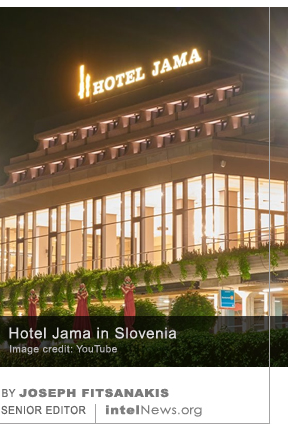 Four hidden communications-surveillance compartments which are believed to date back to the Cold War, have been found in one of the most prestigious hotels of the former Yugoslavia. The discovery was made during an extensive renovation project that was recently completed in the Hotel Jama. The hotel is located in the southeastern Slovenian city of Postojnska, near the Italian border. For over a century, Postojnska has been famous for its network of limestone caves, which are among the largest in the world. Eager to cater to Italian, Austrian and other Western tourists, the government of Yugoslavia began construction on Hotel Jama in 1969. The hotel opened its doors in 1971, amidst much publicity and fanfare. It eventually became known as one of the most luxurious hotels in the communist world.
As the hotel’s reputation soared, the government of Yugoslavia began hosting foreign dignitaries there. Though socialist, the government of Yugoslavia never became an integral member of the communist bloc, preferring a policy of nonalignment. Because of that, it was courted by both East and West, with many Western leaders and other officials visiting the country regularly. On many occasions, they would use Hotel Jama as a retreat. Numerous world leaders stayed there with their entourage, escorted by Yugoslavia’s longtime communist leader Josip Broz, known commonly as Tito.
Today the hotel is situated on the territory of Slovenia, a small mountainous state of two million people, which declared its independence from Yugoslavia in 1991. The regional instability caused by the Yugoslav Wars of the 1990s nearly demolished Slovenia’s tourism industry, and Hotel Jama was forced to declare bankruptcy. In 2010, under new ownership, the hotel underwent major renovations. These were completed in 2016, when the hotel opened its doors to the public once again. It was during these renovations that construction crews discovered the surveillance rooms. The four compartmented rooms were found behind a large door made of steel at the back of the hotel, and are adjacent to a network of limestone caves, for which the area is famous.
News reports said the four rooms feature 1970s-era wiretapping equipment, most of which appears to be in pristine condition. There is a thick layer of dust over all the surfaces, which indicates that the rooms have not been used in several decades. The construction crews also found sets of cables that run from the surveillance compartments to several guest rooms in the hotel’s original wing that dates to the early 1970s.
Experts suggest that the rooms were built in the early stages of the hotel’s construction in the late 1960s. The equipment was probably operated by the State Security Service (SDB), Yugoslavia’s internal security police. It is believed that the surveillance facilities were used to facilitate the systematic wiretapping of foreign dignitaries and delegations that frequented the hotel during the Cold War. Hotel Jama’s administration said on Wednesday that there are plans to turn the surveillance rooms into part of an exhibit on the Cold War history of the establishment.
► Author: Joseph Fitsanakis | Date: 13 April 2017 | Permalink
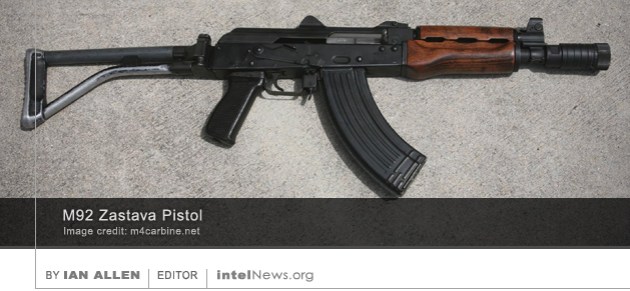 One of the guns used by Islamist militants to attack locations in downtown Paris on November 13 was purchased legally through a dealer in the United States, according to a report by the Associated Press. Investigators have confirmed that several of the weapons used in the attack, which killed 130 and injured hundreds more, were manufactured in Serbia. Most are slightly modified versions of the Soviet-era AK-47, known in the West as “shortened Kalashnikov”. All were produced in a weapons factory called Zastava, which is located in the city of Kragujevac, in central Serbia. They were made in the 1980s and sold within the former Yugoslavia.









 intelNews.org
Senior Serb intelligence officials given prison sentences for war crimes
July 1, 2021 by Joseph Fitsanakis Leave a comment
TWO SENIOR FORMER OFFICIALS in the now defunct domestic security apparatus of Serbia have been given prison sentences totaling 24 years, after being found guilty of war crimes by a United Nations court. The crimes of the two officials stem from the Yugoslav Wars, a series of bloody ethnic conflicts that followed the breakup of the former Yugoslavia in 1991.
The two former officials, Jovica Stanišić, 70, and Franko “Frenki” Simatović, 71, deny that they trained Serbian elite police units in methods of exterminating non-Serb populations in various regions of the former Yugoslavia. The two men were initially acquitted of all charges against them by the International Criminal Tribunal for the former Yugoslavia (ICTY). But the initial ruling was quashed, and the two men were tried again, this time by United Nations Mechanism for International Criminal Tribunals, which took over ICTY’s operations after its mandate ended.
Stanišić directed the State Security Service (SDB), which operated under the Ministry of Internal Affairs of Serbia as the country’s primary domestic security agency. Simatović was an intelligence officer who, from 1991 until 1998, commanded the feared Special Operations Unit, known as JSO. The JSO was an elite police force that operated under Stanišić’s SDB. Prosecutors accused the two men of working under direct orders by Serb President Slobodan Milošević, with the aim of ethnically cleansing non-Serbian populations. Milošević died in 2006 in prison at The Hague, Netherlands, where he was held facing charges of genocide and crimes against humanity.
On Wednesday, each of the two men were given 12 years in prison. Simatović has already served eight years in prison, and Stanišić close to five. Both continue to deny the charges against them, and their lawyers said they would appeal the convictions.
► Author: Joseph Fitsanakis | Date: 01 July 2021 | Permalink
Filed under Expert news and commentary on intelligence, espionage, spies and spying Tagged with former Yugoslavia, Franko Simatovic, International Criminal Tribunal for the Former Yugoslavia (ICTY), Jovica Stanišić, State Security Service (Serbia), State Security Service Special Operations Unit (Serbia), war crimes, Yugoslav Wars