Judge rules that Trump’s tweet did not disclose top-secret CIA operation in Syria
July 4, 2018 Leave a comment
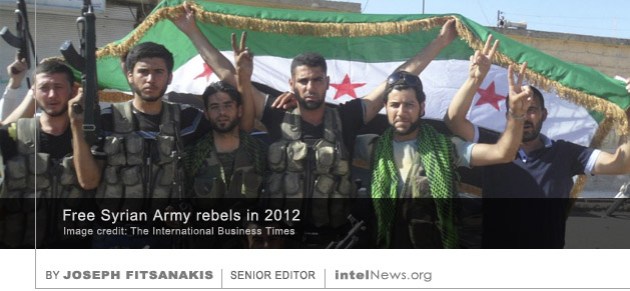 A United States federal judge ruled on Monday that a tweet by President Donald Trump did not inadvertently disclose a top-secret program by the Central Intelligence Agency to aid rebel groups in Syria. The lawsuit, brought by The New York Times, centered on news reports published in 2017 by Reuters, The Washington Post, and others, claiming that the US president had terminated an extensive CIA program that provided assistance to rebel forces engaged in the Syrian Civil War. The program was reportedly initiated by US President Barack Obama, who in 2015 instructed the CIA to assist armed groups operating under the umbrella of the Free Syrian Army. Aside from training, the CIA assistance reportedly included the provision of light and heavy ammunition, such as antitank missiles, mines and grenades.
But President Trump allegedly terminated $1 billion program soon after he took office. Last July, the president openly disputed an account by The Washington Post’s Greg Jaffe and Adam Entous, which claimed that Trump had ended the program as a concession to Russia. In a tweet, Trump said: “The Amazon Washington Post fabricated the facts on my ending massive, dangerous, and wasteful payments to Syrian rebels fighting Assad”. Shortly afterwards, another newspaper, The New York Times, filed a Freedom of Information Act (FOIA) request, arguing that the president’s tweet had effectively disclosed the existence of the covert CIA program and seeking full details from the government. But the CIA rejected the The New York Times’ rationale, at which point the paper took the case to court.
But on Monday, US District Court Judge Andrew Carter Jr. dismissed the paper’s argument. In a 20-page decision, posted online by the US-based news website Politico, Judge Carter said that President Trump’s tweet had been too vague and ambiguous to be considered as effectively declassifying the secret CIA program. At no point did the US president “make an unequivocal statement, or any statement for that matter, indicating that he was declassifying information”, said the judge. Additionally, Trump’s tweet and other public statements on the matter did not undermine the legal authority of the US government to continue to keep details about the CIA program under wraps. According to Politico, which reported on Judge Carter’s decision, this development will make it difficult for other FOIA filers to use Trump’s tweets as justification for seeking information about secret government programs. Meanwhile, The New York Times said on Monday that it would seek to appeal Judge Carter’s decision.
► Author: Joseph Fitsanakis | Date: 04 July 2018 | Permalink
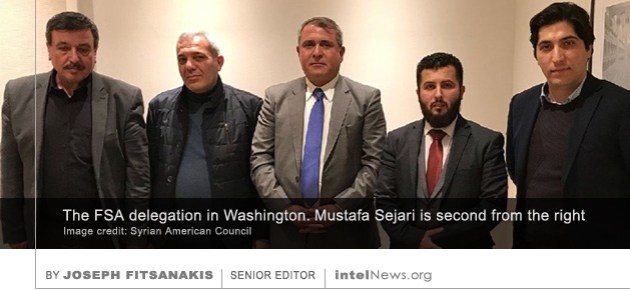 A delegation of Syrian rebels is currently in Washington to ask that that United States President Donald Trump authorizes the Central Intelligence Agency to resume giving them military assistance. In 2013, the then-US President Barack Obama instructed the CIA to provide covert support to fighters in Syria. The CIA promptly began to assist fighters affiliated with the Free Syrian Army (FSA), whose goal was to topple the regime of Syrian President Bashar al-Assad. Under the project, which was codenamed TIMBER SYCAMORE, CIA personnel trained FSA fighters and gave them light weaponry. But in July of last year, President Trump
 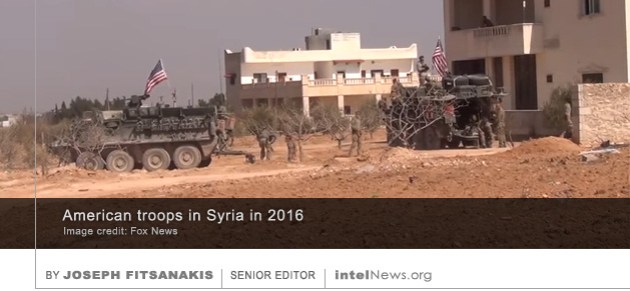 American troops deployed in Syria have exchanged fire with rebels that were until recently supported by the United States Central Intelligence Agency. In 2013, soon after the outbreak of the Syrian Civil War, the then-US President Barack Obama instructed the Central Intelligence Agency to provide covert support to fighters in Syria. Acting on the president’s directive, the CIA promptly joined forces with spy agencies from Britain, France, Saudi Arabia and the United Arab Emirates, to assist fighters affiliated with the Free Syrian Army. At that time, Washington saw the Free Syrian Army and forces affiliated with it as ideologically moderate. It also agreed with the group’s main aim, which was to topple the regime of Syrian President Bashar al-Assad.
 The decision by the White House to terminate American support for rebels in war-torn Syria could backfire by causing the suddenly unemployed fighters to join jihadist organizations, according to experts. The United States’ support for the rebels began in secret in early 2013, after the then US President, Barack Obama, instructed the Central Intelligence Agency to provide covert support to fighters in Syria. The CIA then joined forces with spy agencies from Britain, France, Saudi Arabia and the United Arab Emirates, to assist fighters affiliated with the Free Syrian Army. At that time, Washington saw the Free Syrian Army and forces affiliated with it as ideologically moderate. It also agreed with the group’s main aim, which was to topple the regime of Syrian President Bashar al-Assad.
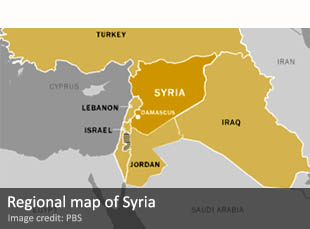
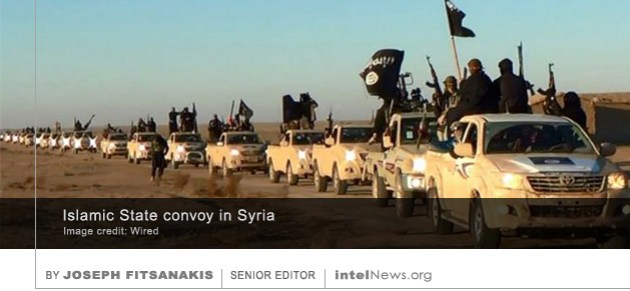 The two main warring parties in the Syrian Civil War, the government of Syria and the Islamic State, frequently contact one another in pursuit of commercial and military deals, according to internal Islamic State documents. British-based news agency Sky News said on Monday that it had acquired “secret Islamic State files”, which included handwritten orders to operatives sent directly from officials at the organization’s headquarters in Raqqa, Syria. The group said it received the documents from a regional branch of the Free Syrian Army (FSA), a largely secular armed opposition group that was formed in 2011 by defectors from the Syrian Armed Forces. The FSA unit in Raqqa left the Syrian city once it was occupied by the Islamic State, and is currently based in Turkey. One of the group’s core preoccupations is assisting Islamic State defectors in their efforts to escape from Raqqa and reach Turkey. It was through these defectors, according to Sky News, that the secret Islamic State documents were acquired.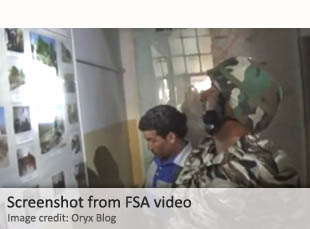
 By IAN ALLEN | intelNews.org |







 intelNews.org
Turkish spy agency hid Islamist views of candidates for CIA-funded Syrian rebel group
July 28, 2020 by Joseph Fitsanakis 1 Comment
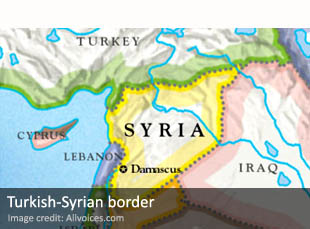
By 2015, much of the recruitment and vetting for the FSA was taking place in Turkish regions bordering northern Syria, where thousands of opponents of al-Assad’s regime had fled with their families. The CIA relied on its Turkish counterpart, the National Intelligence Organization, known as MİT, to recruit and conduct initial vetting of FSA volunteers from Syrian refugee camps. The MİT was desperately short of personnel for such a large-scale operation, and reached out to the Turkish Special Forces Command for assistance. Eventually, Special Forces Command officers were put in charge of reaching out to potential FSA volunteers and vetting them. Successful candidates would then be forwarded to the CIA.
One such officer was Lt. Murat Aletirik, who vetted dozens of FSA volunteers in 2015 and 2016. However, he was arrested following the failed coup of July 15, 2016, and was tried for alleged participation in armed insurrection against the Turkish government. During his testimony in 2018, which was leaked this week, Lt. Aletirik told the court that he and his fellow officers were issued guidelines by the MİT on how to select fighters for the CIA-funded program.
According to Lt. Aletirik, the MİT guidelines centered on whether FSA candidates were “sympathetic towards the [Kurdistan Workers’ Party, known as] PKK, the [Democratic Union Party, or] PYD, or offshoots of the PKK”. These groups support autonomy for the Kurds, a non-Turkish and non-Arab ethnic group in the Middle East. Turkey, along with the European Union and the United States, classify the Turkish-based PKK as a terrorist organization. Turkey claims that the PYD, which operates in Syria, is also a terrorist group. However, Washington supports and funds the PYD, and even worked with its militias in the war against the Islamic State.
According to Lt. Aletirik, the MİT guidelines had little to say about how to filter out potential FSA volunteers who were found to harbor sympathies for Salafi-Jihadist groups, such as the Islamic State, al-Qaeda, or al-Nusra. In fact, said Lt. Aletirik, he and his fellow officers had instructions to downplay such findings and forward candidates to the CIA, so long as they did not have pro-Kurdish sympathies. It is believed that, eventually, the CIA caught on to this, and began turning down hundreds of FSA candidates that had been vetted by the Turkish military. This slowed down the vetting process tremendously, with only a fraction —possibly fewer than 10 percent— of all candidates joining the CIA-run program.
In 2017, the United States shut down the program, reportedly after a direct order was issued by President Donald Trump. Today the FSA is almost completely supported and funded by the Turkish state. Locals often refer to it tongue-in-cheek as the “Free Syrian Turkish Army”.
► Author: Joseph Fitsanakis | Date: 28 July 2020 | Permalink
Filed under Expert news and commentary on intelligence, espionage, spies and spying Tagged with CIA, Free Syrian Army, Kurdistan, Murat Aletirik, MİT (Turkey), News, Syria, Syrian Civil War, United States