Spy novel written by Kim Philby’s granddaughter to be published this week
July 15, 2019 2 Comments
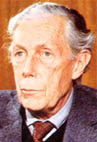
 A spy novel written by the granddaughter of Kim Philby, the British senior intelligence officer who secretly spied for the Soviet Union, will be published this week. Charlotte Philby, 36, is the London-based daughter of John Philby, who was one of the five children Kim Philby had with his English wife Aileen Furse. While working as a senior member of British intelligence, Harold Adrian Russell Philby, known as ‘Kim’ to his friends, spied for the Soviet NKVD and KGB. His espionage activities lasted from about 1933 until 1963, when he defected to the USSR from his home in Beirut, Lebanon. Philby’s defection sent ripples of shock across Western intelligence and is often seen as one of the most dramatic incidents of the Cold War. He was part of a larger ring of upper-class British spies, known collectively as ‘the Cambridge spies’ because they were recruited by Soviet intelligence during their student days at the University of Cambridge in England.
Following his sensational defection, Philby lived in the Soviet capital until his death in 1988 at the age of 76. His granddaughter gave an interview to British newspaper The Sunday Telegraph, in which she said that her father, John, “never said anything against Kim” and “enjoyed a very good relationship” with him. The family visited Kim Philby in Moscow every year until his death, when Charlotte was five. She told The Telegraph that she remembers these trips, and staying at Kim Philby’s apartment. She said the family would be met at the airport in Moscow “by men in grey suits” who would usher them into a government car and “whiz [them] to the gated apartment block where Kim lived” in downtown Moscow. During those trips, the family would give the double spy supplies of his favorite English foods and magazines. This may surprise some, given that Philby abandoned his second wife, an American, and his five children from his first wife. She had died six years prior to his defection, so the children, including Charlotte Philby’s father, were raised by relatives and family friends.
Charlotte Philby worked as a journalist for The Independent, a London-based British newspaper that ceased print circulation in 2016, and has since been writing as a freelancer. Her first novel, entitled The Most Difficult Thing, features a female protagonist who has to balance her espionage work with her relationship with those closest to her. The author says that Kim Philby’s ghost “hovers over the pages”. She notes that, if her grandfather had any regrets at the end of his life, “they wouldn’t be to do with betraying his country but with the individuals and the family members that he had to dupe and separate from”.
► Author: Joseph Fitsanakis | Date: 15 July 2019 | Permalink
 In a sign of worsening relations between the United Kingdom and Russia, a busy intersection in Moscow has been named after Kim Philby, the British senior intelligence officer who secretly spied for the Soviet Union. While working as a senior member of British intelligence, Harold Adrian Russell Philby, known as ‘Kim’ to his friends, spied on behalf of the Soviet NKVD and KGB. His espionage activities lasted from about 1933 until 1963, when he secretly defected to the USSR from his home in Beirut, Lebanon. Philby’s defection sent ripples of shock across Western intelligence and is often seen as one of the most dramatic incidents of the Cold War. He was part of a wider ring of upper-class British spies, known collectively as ‘the Cambridge spies’ because they were recruited by Soviet intelligence during their student days at the University of Cambridge in England.
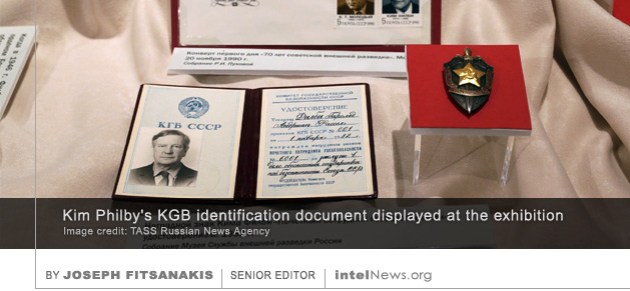 The life of Kim Philby, one of the Cold War’s most recognizable espionage figures, is the subject of a new exhibition that opened last week in Moscow. Items displayed at the exhibition include secret documents stolen by Philby and passed to his Soviet handlers during his three decades in the service of Soviet intelligence. While working as a senior member of British intelligence, Harold Adrian Russell Philby, known as ‘Kim’ to his friends, spied on behalf of the Soviet NKVD and KGB. His espionage lasted from about 1933 until 1963, when he secretly defected to the USSR from his home in Beirut, Lebanon. Philby’s defection sent ripples of shock across Western intelligence and is often seen as one of the most dramatic incidents of the Cold War.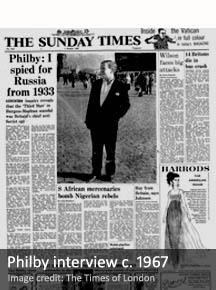










 intelNews.org
Extracts from Kim Philby’s espionage confession published today for the first time
September 24, 2019 by Joseph Fitsanakis Leave a comment
Britain’s intelligence establishment has never released Philby’s confession, which he made to his friend Nicholas Elliott, an intelligence officer in the Secret Intelligence Service (MI6) in January 1963. The MI6 had sent Elliott to Beirut, where Philby was working as a journalist, to inform him that his espionage role for the Soviets had been established beyond doubt. The MI6 officer had been authorized to offer Philby immunity from prosecution in return for a full confession. Philby accepted the offer and began his confession while in Beirut. But a few days later he vanished and reemerged in Moscow in July of that year. He died there in 1988.
The file that is scheduled to be released today by the National Archives is marked “Secret” and comes from the Security Service (MI5), Britain’s primary counterintelligence agency. It contains details about Philby’s first assignments for Soviet intelligence, which included identifying other communist students at Cambridge who would be susceptible to recruitment. Philby’s list included the names of Donald Maclean and Guy Burgess, who later became members of the Cambridge spy ring. Philby states in his confession that he cautioned his Soviet handlers about recruiting Burgess due to “his unreliability and indiscretion”, but his objections were “overruled”, he says.
When asked by Elliott how he could have sided with Soviet intelligence at a time when the Soviet leader, Joseph Stalin, was slaughtering millions, Philby responds by comparing his service for the KGB to joining the armed forces. Following orders, he says, does not imply that a soldier unquestionably agrees to every action of the government he serves. He goes on to reveal that his Soviet handlers never attempted to win his “total acceptance on the technical level. In short”, Philby continues, “I joined [Soviet intelligence] as one joined the army [… I often] obeyed orders although convinced they were wrongly conceived”.
► Author: Joseph Fitsanakis | Date: 24 September 2019 | Permalink
Filed under Expert news and commentary on intelligence, espionage, spies and spying Tagged with Cold War, counterintelligence, declassification, defectors, H.A.R. "Kim" Philby, history, MI5, MI6, News, Nicholas Elliott, UK, UK National Archives