Hungarian media accuses Russia of working with far-right militia
November 29, 2016 Leave a comment
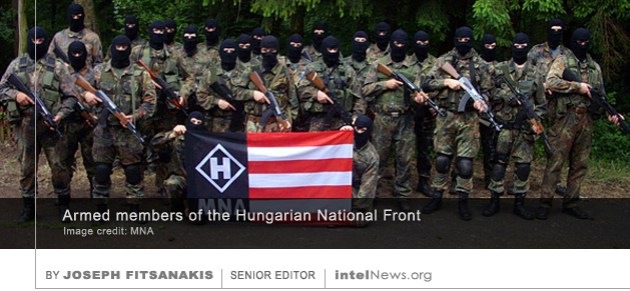 Media in Hungary have accused the Russian government of funding and training one of Hungary’s most notorious far-right organizations. The Hungarian National Front (MNA) was founded in 1989 as the Hungarian National Socialist Action Group. After the end of communism in Hungary, the organization began to espouse an openly neo-Nazi ideology, led by its leader, István Győrkös, a self-styled unreconstructed fascist. Győrkös, who idolizes Hungary’s wartime anti-Semitic Arrow Cross movement, set up links with similar groups in Central and Southern Europe. He served several prison terms in the 1990s for illegally possessing weapons and explosives and openly espousing pro-Nazi ideas. On November 6, Győrkös was taken to custody after opening fire against officers from the National Bureau of Investigation, who tried to enter his house to search for weapons. One officer was killed in the shootout.
Following Győrkös’ arrest, Hungarian police have conducted several raids throughout the country, targeting MNA members’ homes and offices. According to a report in the London-based Financial Times newspaper, the raids have uncovered weapons stockpiles that are more sizeable and technologically advanced than expected. And, according to the paper, some Hungarian media now allege that the MNA has been armed, funded and trained by Moscow. Emails exchanged between MNA members, which were leaked to the Hungarian press, allegedly show that the party’s leadership consciously cultivated a pro-Russian strategy in recent years, including an outright support for Russia’s invasion of Ukraine. Győrkös also allegedly used party funds to set up a Hungarian-language website with pro-Russian information about the war in eastern Ukraine. Some unnamed Hungarian officials have claimed in the press that the government has evidence of joint training exercises between members of the MNA and Russian intelligence officers in eastern Hungary.
The Financial Times article quotes Hungarian investigative reporter András Dezső, who has written extensively about the Hungarian far-right, as saying that the Kremlin will work with whichever Eastern European political groups can help destabilize local politics, regardless of ideology. It also quotes Hungary’s former prime minister, Ferenc Gyurcsány, who argues that the current government in Budapest has turned the blind eye to Russian intelligence activities in the country, which has effectively “turned Budapest into a ‘Little Moscow’”. The country’s current Prime Minister, conservative Viktor Orbán, has kept a moderately friendly stance toward Russia, having argued repeatedly at European Union meetings that Brussels should not impose economic sanctions on Moscow in response to its invasion of Ukraine.
► Author: Joseph Fitsanakis | Date: 29 November 2016 | Permalink
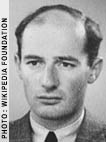
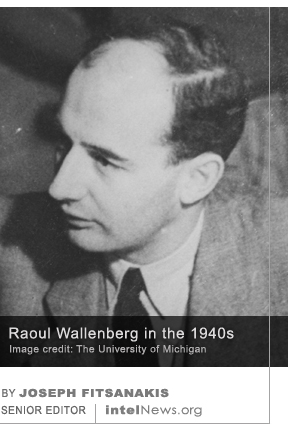 The recently discovered memoirs of a former director of the Soviet KGB suggest that a senior Swedish diplomat, who disappeared mysteriously in the closing stages of World War II, was killed on the orders of Joseph Stalin. The fate of Swedish diplomat Raoul Wallenberg is one of the 20th century’s unsolved espionage mysteries. In 1944 and 1945, the 33-year-old Wallenberg was Sweden’s ambassador to Budapest, the capital of German-allied Hungary. During his time there, Wallenberg is said to have saved over 20,000 Hungarian Jews from the Nazi concentration camps, by supplying them with Swedish travel documents, or smuggling them out of the country through a network of safe houses. He also reportedly dissuaded German military commanders from launching an all-out armed attack on Budapest’s Jewish ghetto.
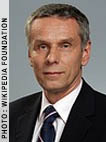
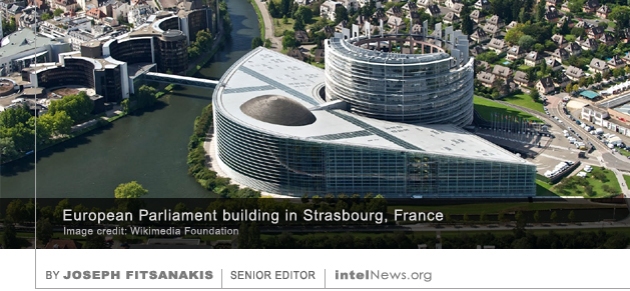 In a historic first, the parliament of the European Union (EU) has waived the immunity of one of its elected members over “reasonable suspicions” that he may have spied for Russia. The member of the European Parliament (MEP) is Béla Kovács, 55, who belongs to the far-right Movement for a Better Hungary. Founded in 2003, the party, known as Jobbik (movement, in Hungarian), has called for Hungary to leave the EU and instead join the Eurasian Union, an economic and political alliance led by Russia. In the 2014 parliamentary elections, Jobbik won just over 20% of the popular vote, placing third nationwide. The result was a marked difference from its performance in 2006, when it had barely received 2.2% of the vote share.












 intelNews.org
Russian bank accused of being ‘den of spies’ relocates to NATO member Hungary
September 3, 2019 by Joseph Fitsanakis Leave a comment
In 1991, following the disintegration of the Soviet Union and the Eastern Bloc, the IIB entered a period of stagnation, as did many Soviet institutions of the Cold War period. But in 2002 Russian President Vladimir Putin spearheaded a government-led effort to revive the bank. Today the Russian government has a 47 percent stake in the IIB, with the remaining 53 percent owned by its other member-countries. These are all communist of former communist states: Cuba, Vietnam, Cuba, Bulgaria, Romania, Slovakia, the Czech Republic, and Hungary. Each of these member states is represented on the IIB with an official who speaks for his or her government.
Some critics express concerns that the IIB continues to serve as a front company for Russian intelligence. Some point to the IIB’s director, Nikolai Kosov, whose parents were officers in the KGB and served in several European countries, including Hungary, during the Cold War. Such criticisms resurfaced earlier this year, when it was announced that the IIB would move its headquarters to Budapest. The Hungarian government said it would host IIB’s 100 personnel and granted the IIB building privileges that are usually extended to diplomatic facilities. For instance, Hungarian authorities will not be able to enter the IIB premises without prior authorization by the bank.
The Hungarian government of Prime Minister Viktor Orban has said that the IIB’s relocation to Budapest will further-strengthen Hungary’s relations with Russia and help promote the former Soviet ally as a growing financial hub in Europe. But one critic told the Al Jazeera news network that the IIB “is more likely to make Budapest a Russian intelligence center than a financial hub”. Another critic, referred to by Al Jazeera as a “diplomatic source”, said that NATO has limited its sharing of classified information with Hungary “due to fears it leaves the door open to Russia”.
► Author: Joseph Fitsanakis | Date: 03 September 2019 | Permalink
Filed under Expert news and commentary on intelligence, espionage, spies and spying Tagged with COMECON, front companies, Hungary, International Investment Bank, News, Nikolai Kosov, Russia