Iran denies murder plot after alleged assassin caught with gun and silencer in Cyprus
October 5, 2021 2 Comments

ISRAEL HAS ACCUSED IRAN of being behind a plot to kill Israeli citizens in the Republic of Cyprus, following the arrest of a man who was reportedly found carrying a gun fitted with a silencer in the Cypriot capital Nicosia. The man reportedly entered Cyprus on a flight that landed at Larnaca International Airport last week. He is believed to be a 38-year-old Azeri national, who allegedly entered Cyprus using a Russian passport.
Cypriot police kept tabs on the suspected assassin as soon as he entered Cyprus, according to reports. IntelNews hears that the Israeli intelligence agency Mossad may have been behind a tip given to the Cypriots about the man’s presence on the island. In the days following his arrival, the suspect crossed several times into the Turkish-occupied northern region of Cyprus, using his Russian passport and “trying to keep a low profile”, according to Israeli media reports.
The Azeri man was eventually arrested in Nicosia, shortly after entering from northern Cyprus at the Agios Dometios checkpoint. Some local news reports suggest that he was found to be carrying a gun fitted with a silencer, and that he was planning to target a number of prominent Israeli business people who live on the island. Reports in Israel claim that the alleged assassin’s primary target was Teddy Sagi, an Israeli investor who owns online gambling platforms, as well as properties in the United Kingdom and Cyprus. He is believed to be among Israel’s richest citizens.
Iran has vehemently denied Israel’s claim that Cypriot police averted “an act of terror [that] was orchestrated by Iran against Israeli business people” in Cyprus. However, the Israeli government’s announcement did not go into details, while Israeli officials refused to confirm that Teddy Sagi was the target of the alleged operation.
► Author: Joseph Fitsanakis | Date: 05 October 2021 | Permalink

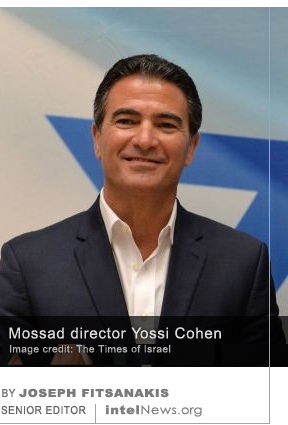 UNITED STATES JOE BIDEN reportedly told the director of Israel’s external intelligence agency, the Mossad, that Washington has “a long way to go” before rejoining a 2015 agreement aimed at halting Iran’s nuclear ambitions. The meeting between Biden and Mossad director Yossi Cohen reportedly took place last Friday, during Cohen’s visit to Washington last week, to discuss bilateral security issues with a series of American officials. On Thursday Cohen met with a number of Biden administration officials, including Secretary of State Anthony Blinken and Brett McGurk, who is the National Security Council’s Coordinator for the Middle East and North Africa.
 A WEB SERVER BASED in Holland and owned by a company registered in Cyprus is being used by the Iranian government to spy on its critics abroad, according to Dutch public radio. The information about Iranian espionage was
  AN IRANIAN DIPLOMAT, WHO in reality was the head of Iran’s European spy network, had contacts all over Europe, which are now being investigated by Western intelligence agencies, according to reports. Four Iranians are currently on trial in Belgium, accused of
 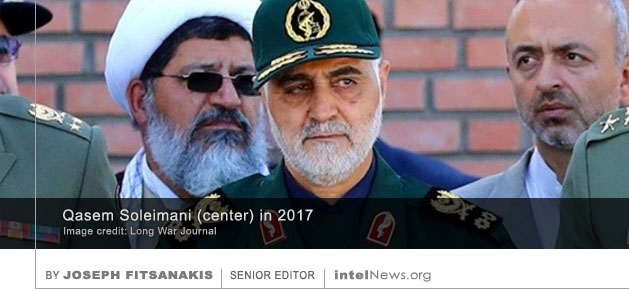 IRANIAN STATE MEDIA CLAIMED last week that several countries, including Britain and Germany, helped the United States assassinate its top paramilitary commander, Qassem Soleimani (pictured). The reports emerged on the one-year anniversary of the assassination of Soleimani, who led Iran’s Islamic Revolutionary Guard Corps (IRGC). He was
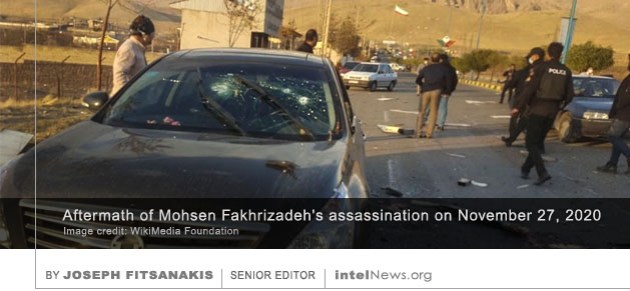
 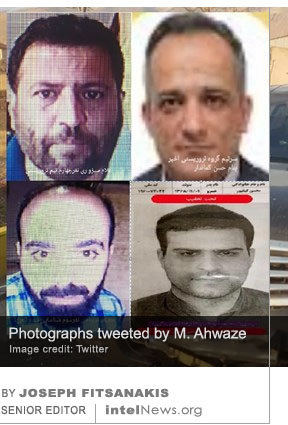 REPORTS IN BRITAIN AND Israel claim that Iranian authorities have visually identified the assassins who were allegedly involved in the killing of Mohsen Fakhrizadeh, a nuclear scientist believed to have led Iran’s nuclear program. Fakhrizadeh was a brigadier general in the Islamic Revolutionary Guard Corps (IRGC), Iran’s elite paramilitary force. He was accused by the United States and Israel of leading the Islamic Republic’s nuclear weapons program, whose existence Tehran strongly denies.
 An Iranian plot to kill the United States’ ambassador to South Africa was reportedly uncovered by American intelligence agencies, which believe Tehran is still seeking to avenge the assassination of General Qassem Soleimani in January of this year. The head of the Islamic Revolutionary Guard Corps, Iran’s elite paramilitary force, was killed by a US drone strike during a visit to the Iraqi capital Baghdad, sparking major tension between Washington and Tehran.
 Intelligence insiders, including a former senior Central Intelligence Agency operations officer who spent decades in the Middle East, have described the establishment of official relations between Israel and some Gulf States as “the biggest change in the region in decades”.








Norway charges former Iranian diplomat in 1993 assassination attempt
November 15, 2021 by Joseph Fitsanakis Leave a comment
In 1989 Nygaard was behind the publication of the Norwegian edition of Salman Rushdie’s novel The Satanic Verses. The bestselling novel was condemned as blasphemous by conservative Muslims, due to its portrayal of the Prophet Muhammad. In the spring of 1989, Iranian Supreme Leader Ruhollah Khomeini issued a fatwa (decree) sentencing to death the novel’s author and all those who had a role in publishing the book, and urging followers of Islam to execute them at will. Nygaard began receiving threats almost immediately, and was given police protection for almost a year.
On the morning of October 11, 1993, Nygaard was shot and left for dead outside his house in the northern outskirts of Oslo. He survived after being rushed to the hospital, where he remained for several months during what became a long and painstaking period of recovery. The police was unable to find the culprits of the attempted murder, and the investigation stalled after a few years, as it was unclear whether the motives were political or personal. Nygaard consistently argued that the attempt on his life was politically motivated.
Nygaard’s claims were revived in 2018, when the Norwegian Police Service said it had pressed charges against two individuals for the attempted murder of the publisher. No information was publicized about the identities of the two suspects. However, a clue emerged when a spokeswoman for Norway’s National Criminal Investigation Service said that the incident “was about more than an attack on one man” and represented “a violent attempt to shut down free speech”.
Since then there have been rumors about the identities of the two suspects. Last week, Iranian dissidents living abroad began claiming that one of the men was a Lebanese national, and the other a retired Iranian diplomat. On Friday, a report by the Norwegian Broadcasting Company stated that the Iranian former diplomat in question is Mohammad Nik-Khah. The report added that Nik-Khah served as first secretary of the Iranian embassy in Norway when Nygaard was shot, and that he now lives in Iran.
Over the weekend, a press statement issued by the Iranian embassy in Oslo confirmed that Nik-Khah served as a diplomat there in the late 1980s and early 1990s. But the statement claimed that Nik-Khah had left Norway several days prior to the attempted killing of Nygaard.
► Author: Joseph Fitsanakis | Date: 15 November 2021 | Research credit: LCP | Permalink
Filed under Expert news and commentary on intelligence, espionage, spies and spying Tagged with assassinations, freedom of speech, Iran, Iranian embassy in Norway, Mohammad Nik-Khah, News, Norway, Salman Rushdie, William Nygaard