Many see Israel behind May 22 killing of Iranian paramilitary leader in Tehran
May 25, 2022 2 Comments
 A GROWING NUMBER OF security observers point to Israel as the most likely culprit behind the assassination of a leading member of the Islamic Revolutionary Guard Corps (IRGC), Iran’s powerful paramilitary force. Brigadier General Hassan Sayyad Khodaei, who was killed in broad daylight in Tehran on May 22, served as deputy director of the Quds Force, a major branch of the IRGC. The mission of the Quds Force is to carry out unconventional warfare, especially in support of IRGC operations against adversaries abroad.
Observers regularly describe the IRGC as a ‘praetorian guard’ that operates inside Iran’s governing apparatus. Today the IRGC is a military force with a command structure that is distinct from Iran’s regular Armed Forces. It maintains its own army, navy and air force, has its own paramilitary and political protection units, and oversees Iran’s nuclear program. The IRGC’s weapons development falls under the duties of the Quds Force, in which Khodaei was a leading figure. He was also known to have been closely mentored by IRGC Commander Qasem Soleimani, who was assassinated by the United States in 2020.
Kodaei was assassinated in broad daylight on May 22, as he was heading home from his office in downtown Tehran, located a few blocks from the main building of Iran’s Consultative Assembly. According to eyewitness reports, Kodaei’s vehicle was rapidly approached by two individuals riding on a motorbike. They sped away seconds after shooting Kodaei five times, killing him almost instantly. The entrance to the street where Kodaei was attacked was allegedly blocked by a white van, which also sped away following the shooting.
Israel is known for carrying out assassinations of Iranian officials using motorbikes, which can move with relative ease in the congested streets of Tehran. IntelNews regulars will recall that Israeli intelligence claimed last month to have detained and interrogated an alleged Iranian assassin named Mansour Rasouli. A video of his alleged testimony emerged, which was reportedly filmed at a Mossad safehouse somewhere in Iran. Meanwhile, Kodaei’s assassins remain at large.
► Author: Joseph Fitsanakis | Date: 25 May 2022 | Permalink
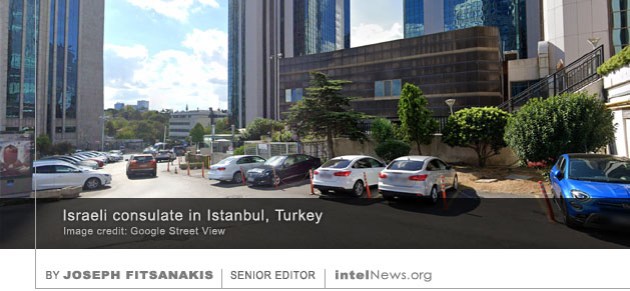 ISRAEL’S MOSSAD INTELLIGENCE AGENCY allegedly foiled a plot by Iranian intelligence to send assassins abroad and kill an Israeli diplomat, an American military official and a French reporter, according to reports. The information about the alleged plot first surfaced late last week in the Iran International News Channel, a British-based Iranian news agency, which is opposed to the government in Tehran. The news agency claimed that the plot had been organized by the Quds Force, the paramilitary wing of the Islamic Revolutionary Guards Corps.
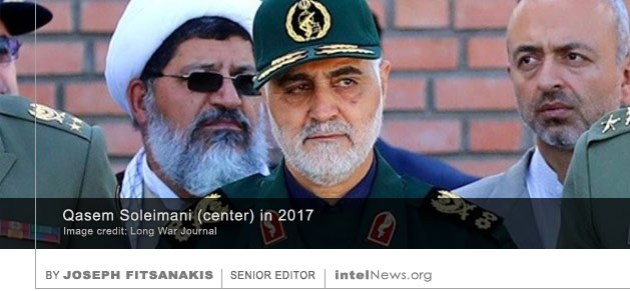 IRANIAN STATE MEDIA CLAIMED last week that several countries, including Britain and Germany, helped the United States assassinate its top paramilitary commander, Qassem Soleimani (pictured). The reports emerged on the one-year anniversary of the assassination of Soleimani, who led Iran’s Islamic Revolutionary Guard Corps (IRGC). He was
  REPORTS IN BRITAIN AND Israel claim that Iranian authorities have visually identified the assassins who were allegedly involved in the killing of Mohsen Fakhrizadeh, a nuclear scientist believed to have led Iran’s nuclear program. Fakhrizadeh was a brigadier general in the Islamic Revolutionary Guard Corps (IRGC), Iran’s elite paramilitary force. He was accused by the United States and Israel of leading the Islamic Republic’s nuclear weapons program, whose existence Tehran strongly denies.
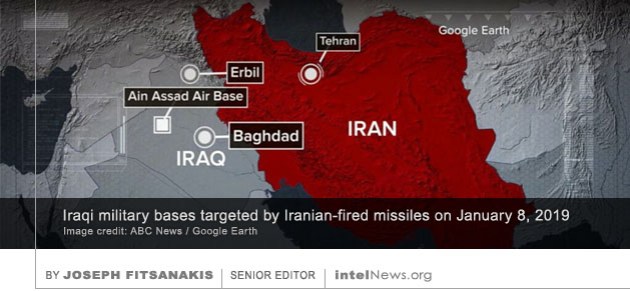 The missiles that targeted American troops in Iraq a few hours ago offer significant clues about the evolving confrontation between Iran and the United States. The attack appears to have been largely symbolic —a somewhat rushed attempt to restore some of Iran’s wounded prestige following the assassination of its military commander, Qasem Suleimani. At the same time, however, it is also the prelude to a broader regional conflict that appears increasingly unavoidable.
 Soleimani’s killing is viewed by Tehran as too insulting to be responded to indirectly. This does not mean that Tehran will not revert to its standard method of employing proxies in the future. But the fact that it consciously chose to deviate from that time-tested method is in itself extremely important.
 why US President Donald Trump made the decision to kill Soleimani, and why he did so now.
 The Iranian government may have used a female intelligence officer to lure a leading Iranian dissident from his home in France to Iraq, where he was abducted by Iranian security forces and secretly transported to Iran. Iranian authorities
  Iranian authorities have announced the capture of a Paris-based Iranian dissident, who was reportedly lured out of France and then abducted by Iranian agents in a third country. The kidnapped dissident is Ruhollah Zam, 46, son of Mohammad-Ali Zam, a well-known reformist cleric who served in top Iranian government posts after the 1979 Islamic Revolution. But in 2009 the younger Zam distanced himself from this father and sided with the so-called Green Movement, whose leaders called for the toppling of the government in Tehran. Around that time, Zam was part of a group of Internet-savvy Iranians who launched AmadNews. The website’s stated purpose was “spreading awareness and seeking justice” in Iran, and it soon became the online voice of the Green Movement.
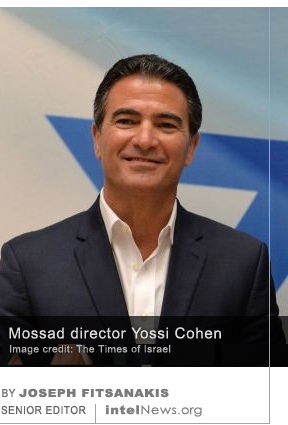 Yossi Cohen, the chief of the Mossad —Israel’s main external intelligence agency— said he has authorized “more than a few” assassinations during his tenure and warned that more may be on the way. Cohen, 57, who took command of the Mossad in 2016, spoke last week to Mishpacha, a magazine aimed at ultra-orthodox Jews. His comments were
  In a rare public appearance, the director of the Mossad spy agency said that the Middle East is witnessing a historic shift of alliances as many Arab states are forming tacit pacts with Israel against Iran and its proxies. Yosef “Yossi” Cohen
  A senior Iranian security official said on Monday that Tehran had dismantled “one of the most complicated” espionage operations by the United States Central Intelligence Agency, leading to “arrests and confessions” of suspects in several countries. The announcement was made by Ali Shamkhani (pictured), secretary of the Supreme National Security Council of Iran, the Islamic Republic’s highest security decision-making body, which is chaired by the country’s president.
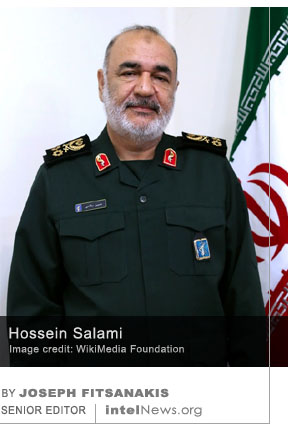 Authorities in Tehran revealed on Sunday the sudden replacement of the head of the Islamic Revolutionary Guard Corps. The unexpected move was announced by pro-government media, but no explanation was given. Since 2007, the IRGC has been led by Major General Mohammad Ali Jafari, 61, a conservative military commander who is widely believed to have consolidated the IRGC’s role within Iran’s power structure. Under his leadership, the IRGC has come to be seen as the staunchest defender of the principles of the 1979 Iranian Revolution. Many Western observers describe the IRGC as a ‘praetorian guard’ whose members possess immense power and often wealth. Today the IRGC is a military force with a command structure that is distinct from that of Iran’s regular Armed Forces. It maintains its own army, navy and air force, has its own paramilitary and political protection units, and is in charge of Iran’s nuclear program.






 intelNews.org
Notes on the assassination of Iranian IRGC Commander Hassan Mahdawi
April 26, 2024 by intelNews 2 Comments
On the day of the attack, a building adjacent to the Iranian Embassy in the Syrian capital of Damascus was attacked with rockets. The attack killed seven IRGC members: General Muhammad Reza Zahedi, also known as Hassan Mahdawi, his deputy, and five additional officers. Mahdawi is the most senior Iranian commander to be killed since the assassination of IRGC Quds Force Commander Qasem Soleimani by the United States in 2020.
Mahdawi had close ties with Hezbollah. He maintained a close relationship with Hezbollah Secretary-General Hassan Nasrallah and was perceived by Israel to be directly coordinating the military attacks on Israel from Lebanon and Syria. In Tehran’s collective memory, Israel’s history of attacks against it includes numerous strikes on Iranian nuclear sites, assassinations of scientists within Iran, and actions against Iranian proxies in Syria, Lebanon, Iraq, and Yemen. Traditionally, these attacks have been invariably met with attacks by Iran’s proxies in the region.
This time, it was different. Iran recognized Mahdawi’s assassination as a direct attack on Iran that it could not tolerate, and had to respond to differently. Just days following Mahdawi’s assassination, Iran attacked Israel. According to the Israel Defense Forces, 99 percent of the more than 330 weapons fired at Israel (including at least 185 drones and 110 surface-to-surface missiles) were intercepted, mostly over the territory of countries adjacent to Israel. Iran’s attack on Israel was unprecedented. It was launched directly from Iranian territory in contrast to prior cases, when Iran has used its proxies, supposedly leaving its hands clean.
Israel could not tolerate such a blatant infringement on its sovereignty. After Israeli officials vowed a response to the Iranian attack, the Jewish State counter-attacked, causing minor damage to the Eighth Shekari Air Base in northwest Esfahan, a dozen kilometers from the Natanz nuclear facility. It was a calculated response designed to deliver a message to Iran that Israel could and would respond to an attack. Following Israel’s counterattack, the tensions between Iran and Israel have subsided for the time being.
While the attack on General Mahdawi was based on excellent operational intelligence, it became evident that the Israeli assessment regarding a possible Iranian response was erroneous. The Israeli assessment was that the Iranian response would be similar to what occurred in the past —namely limited attacks by Hezbollah on northern Israel and attacks on the Golan heights by Iranian proxies in Syria. Israel simply did not anticipate a direct Iranian attack on Israel from Iranian territory.
It seems that Israeli senior analysts were entangled in a conception of Iran’s past behavior and anticipated that Tehran’s response would be similar to prior cases, namely utilizing Iran’s proxies. Israel did not pay enough attention to the difference between Mahdawi’s assassination and previous attacks against Iran. This time, the attack targeted the Iranian embassy in Damascus and the target was a very senior official, who was close to Iran’s Supreme Leader Ali Khamenei.
It appears that Israel’s assessment of the Iranian response to Mahdawi’s assassination was a strategic failure. It appears more likely that the Israeli War Cabinet was provided with an incorrect assessment by the nation’s intelligence community, and less likely that it was provided with an incorrect assessment, which it then decided to ignore. There is concern in Israel that the intelligence assessment was once again wrong, after the colossal failure to anticipate the October 7 attack on Israel by Hamas.
► Author: Avner Barnea | Date: 26 April 2024 | Permalink
Dr. Avner Barnea is research fellow at the National Security Studies Center of the University of Haifa in Israel. He served as a senior officer in the Israel Security Agency (ISA). He is the author of We Never Expected That: A Comparative Study of Failures in National and Business Intelligence (Lexington Books, 2021).
Filed under Expert news and commentary on intelligence, espionage, spies and spying Tagged with Analysis, assassinations, Avner Barnea, Hassan Mahdawi, Iran, Islamic Revolutionary Guard Corps, Israel, Quds Force