Canada bans Chinese reporters over spy concerns
August 21, 2014 Leave a comment
 By JOSEPH FITSANAKIS | intelNews.org
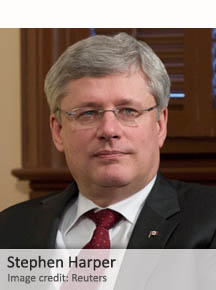
The office of the prime minister of Canada has banned reporters working for China’s state-owned media from covering the Canadian leader’s official trip to the Arctic, due to concerns that they may be spies. For the past several summers, Canada’s Prime Minister Stephen Harper has undertaken official tours of the Canadian Arctic, in an effort to promote the country’s northern economy and attend military exercises. However, in a move that has raised eyebrows in Ottawa and Beijing, the organizers of the trip have issued a ban on a number of Chinese reporters from joining the Canadian prime minister’s entourage. The Winnipeg Sun reported on Wednesday that the unprecedented step was taken over concerns that the Chinese journalists in question may in fact be intelligence operatives in the service of China. The paper cited a quote by a spokesman from the office of the prime minister, who reportedly told the Québecor Média International news agency that “certain news outlets are no longer welcome” to travel with the prime minister. It appears that the reporters in question include primarily those working for The People’s Daily newspaper and the Xinhua news agency, both of which are owned by the government of China. Two Chinese journalists working for these outlets, Li Xue Jiang, and Zhang Dacheng, caused controversy during Harper’s trip to the Arctic in 2013. The two appeared to show more interest in photographing their fellow journalists and the interior of Canada’s prime ministerial airplane than covering Harper’s trip. Li even wrote an article for the Chinese-language edition of The People’s Daily at the time, in which he mentioned that he had come under suspicion of spying for China, saying that a secretary from the office of the Canadian prime minister had tasked an officer of the Royal Canadian Mounted Police to keep an eye on him. IntelNews readers will recall that in 2012 Canadian reporter Mark Bourrie resigned his post as parliamentary correspondent for Xinhua, accusing the Chinese news agency of running spy operations in Canada. Read more of this post









 intelNews.org
‘Day of the Jackal’ author reveals he was MI6 agent for 20 years
August 31, 2015 by Joseph Fitsanakis 1 Comment
But Forsyth had never commented on these rumors until last weekend, when was interviewed on the BBC’s main evening news program. He spoke to the station on the occasion of the upcoming publication of his autobiography, The Outsider: My Life, which will be in stores in October. He told the BBC that he was first recruited by the Secret Intelligence Service (MI6) in the late 1960s while covering the Nigerian Civil War. The bloody conflict, which is also known as the Biafran War, pitted the separatist Igbo people against the Nigerian federal government. Like other military conflicts in postcolonial Africa, it attracted the attention of the world’s powers, including France, the Soviet Union, the United States, and Britain. London was firmly on the side of the government in Lagos, but MI6 had reservations, believing that the Nigerian military forces were committing mass atrocities in Biafra. Forsyth said he was recruited by an MI6 officer who wanted to know if children were dying in Biafra as a result of the Nigerian government’s military policies against the Igbo separatists. The intelligence service were apparently hoping that they could use this information to change London’s stance on the brutal civil war. The author told the BBC that he spent the rest of the war “sending both journalistic reports to the media and other reports to my new friend”, referring to his MI6 handler.
When asked if he was paid for his services, he said his assistance to MI6 was provided on a strictly voluntary basis. “The attitude, the spirit of the age, was different back then”, he said, adding that “the Cold War was very much on” and when the British government asked a reporter for a favor it was “very hard to say no”. He did say, however, that MI6 promised to approve passages of some of his novels by way of payment. The author of The Day of the Jackal said he was given a number to call and told to send MI6 his manuscripts for vetting. “If they are too sensitive, we will ask you not to continue”, Forsyth told the BBC.
► Author: Joseph Fitsanakis | Date: 31 August 2015 | Permalink
Filed under Expert news and commentary on intelligence, espionage, spies and spying Tagged with Cold War, Frederick Forsyth, history, informants, journalism, literature, MI6, News, Nigeria, Nigerian Civil War, UK