In historic first, alleged North Korean spy to face trial in the United States
March 29, 2021 1 Comment
FOR THE FIRST TIME in history, an alleged intelligence officer of North Korea is going to be tried in a United States court, according to American government officials. In a surprise move last week, Malaysia extradited to the US an export-finance trader named Mun Chol-myong. Aged 55, Mun is a North Korean citizen based in Singapore, where until 2019 he worked for a company called Sinsar Trading Pte. Ltd. The Malaysians arrested him in May 2019 and charged him with using his position to defraud a number of international banks and launder money though the US financial system.
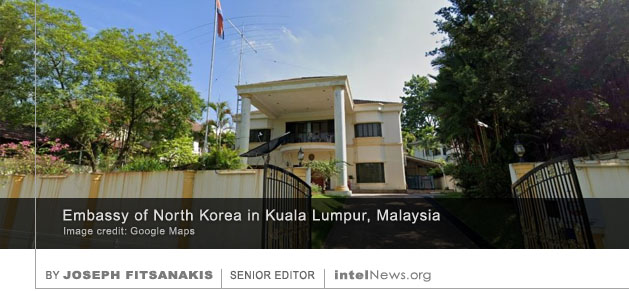
Responding to a US request to have Mun tried in a US court, Malaysia announced his extradition last week, angering Pyongyang. Shortly following Mun’s extradition to the US, North Korea shut down its embassy in Kuala Lumpur, one of only 46 embassies maintained by Pyongyang across the world. Then last Wednesday North Korea fired two ballistic missiles in violation of United Nations sanctions designed to restrict the country’s nuclear weapons program. North Korea’s fury at Mun’s extradition can perhaps be explained by information contained in the newly unsealed indictment [pdf], which dates to 2018. The indictment accuses Mun and a number of other unnamed suspects of being North Korean “intelligence operatives”.
Specifically, the indictment accuses Mun of being an undercover employee of the Reconnaissance General Bureau (RGB), North Korea’s primary foreign-intelligence agency. The RGB operates under the supervision of the General Staff Department of the Korean People’s Army and the Central Committee of the ruling Workers’ Party of Korea. According to the indictment, Mun utilized shell companies set up by Pyongyang in order to hide his connections with the RGB. His primary mission was allegedly to gain access to international banking institutions and wire services, with the aim of laundering illicit North Korean cash and breaking sanctions imposed on Pyongyang by the United Nations and the United States. The indictment accuses Mun of having personally participated in the laundering of $1.5 million in funds in recent years.
In a statement released last week, John Demers, assistant attorney general for the National Security Division of the US Department of Justice, described Mun as “the first North Korean intelligence operative —and the second ever foreign intelligence operative— to have been extradited to the United States”. Meanwhile, the administration of US President Joe Biden said last week it was still reviewing “in depth” the state of US-North Korean relations following the administration of Biden’s predecessor, Donald Trump.
► Author: Joseph Fitsanakis | Date: 29 March 2021 | Permalink
 Kim Jong-nam, the half-brother of North Korean leader Kim Jong-un, held regular meetings with American intelligence officers before he was assassinated with VX nerve gas at a busy airport terminal in Malaysia. Two women
  The second of two female assassins who killed the half-brother of North Korean leader Kim Jong-un in 2017 in Kuala Lumpur has been released from prison by the Malaysian state, after a mostly secret trial. The two women, Doan Thi Huong of Vietnam and Siti Aisyah of Indonesia (pictured),
  Citing “Western intelligence officials”, Israeli newspaper Haaretz said on Thursday that a deepening alliance between Malaysia and Iran is expected to enable Tehran evade some of the economic sanctions imposed on it by the United States. In the past, every time Washington has imposed economic sanctions on Iran, it has issued renewable waivers for a number of countries whose economies have historically depended on substantial Iranian energy imports. This is done in order to prevent these economies from entering a recession due to lack of access to sufficient energy supplies. This week, however, US President Donald Trump said that Washington would
  Eight senior officials of Malaysia’s external intelligence agency, including its former director, have been arrested, allegedly for stealing over $16 million from government coffers. The arrests represent a dramatic widening of the anti-corruption campaign that has gripped the Asian nation of 31 million since it was launched in May of this year. The campaign is led by a special task force within the Malaysian Anti-Corruption Commission (MACC). The task force was set up by Malaysia’s Prime Minister Mahathir Mohamad, with the aim of probing the so-called 1MDB scandal. The acronym refers to the 1Malaysia Development Berhad, a government-owned strategic development company spearheaded by Malaysia’s then Prime Minister, Dato Sri Najib Razak, with the aim of raising funds to match foreign direct investment in the country.
 A highly radioactive device used by an energy company has gone missing in Malaysia, sparking a nationwide emergency for fear that it might have been stolen by a militant group. According to Malaysia’s Straits Times newspaper, a radioactive dispersal device (RDD), which is used for the industrial radiography of oil and gas supplies, disappeared during transit on August 10. The device, which weighs approximately 50 pounds, or 23 kilograms, disappeared from the back of a company truck in the early hours of the morning while it was being transported by two technicians. They were
  The sensational assassination of Kim Jong-nam, half-brother of North Korea’s Supreme Leader Kim Jong-un, on February 13, revealed much about the current operational mindset of Pyongyang. But it also brought to light the shady network of front companies set up by the North Korean regime to facilitate the country’s illicit financial activities around the world. This extensive network permits Pyongyang to evade international sanctions against it, and to coordinate the activities of hundreds of clandestine operatives around the world. Through these activities, the reclusive country has been able to develop its weapons of mass destruction program unabated, despite concerted efforts by the United Nations to prevent it from doing so.
 Indonesian authorities said on Sunday that they will investigate a North Korean restaurant in the country, after a Singaporean news agency claimed it was being used as a center for espionage. The announcement comes amidst heightened tensions between North Korean and its neighbors, following the
 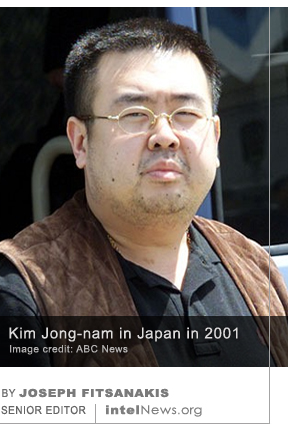 Two women have been arrested in the past 48 hours in connection with the assassination of Kim Jong-nam, half-brother of North Korea’s supreme leader, who died in Malaysia on Monday. Kim, the grandson of North Korea’s founder Kim Il-Sung, died after two women approached him at the Kuala Lumpur International Airport and splashed his face with liquid poison. Some reports suggest that he was injected with a poisoned needle.
  The half-brother of North Korean Supreme Leader Kim Jong-un has been killed in an audacious attack in Malaysia, reportedly by two female assassins who used a poisonous substance to murder him. Kim Jong-nam, was the eldest son of Kim Jong-il, and grandson of Kim Il-Sung, who founded the Democratic People’s Republic of Korea in 1948. However, he left the country in 2007, reportedly after it became clear that his younger half-brother, Kim Jong-un, was the regime’s preferred successor to his father, Kim Jong-il.
 As many as 100 Malaysian immigration officers are implicated in a widening investigation involving the deliberate sabotage of the country’s electronic passport control system. The investigation, which began over three months ago, focuses on a criminal ring of immigration personnel at the Kuala Lumpur International Airport (KLIA), one of Southeast Asia’s major travel hubs.
 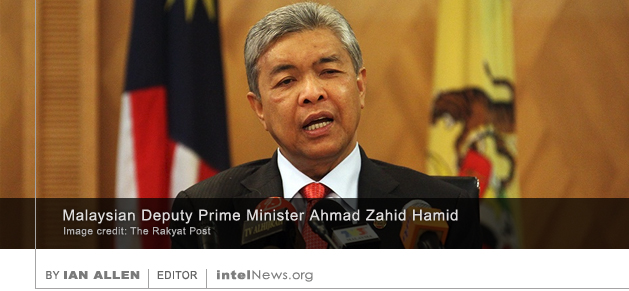 Authorities in Malaysia said they managed to foil a plan by the Islamic State to kidnap the country’s prime minister and two other senior cabinet officials, in exchange for ransom. According to the government of Malaysia, the Islamic State also planned to stage armed attacks throughout the country, including in major urban centers, such as Kuala Lumpur, the nation’s capital. News of the alleged plot was revealed in the Dewan Rakyat, the lower house of the Malaysian parliament, by Ahmad Zahid Hamid, the country’s deputy prime minister. He told members of parliament that Malaysian intelligence had managed to detect the plot, which had been planned for January 30, 2015, but that the government did not believe it was prudent to alarm the country until the investigation of the alleged plot had been finalized.







 intelNews.org
A dramatic kidnap case in Malaysia may point to changes in Mossad’s tactics
October 24, 2022 by intelNews 2 Comments
Omar al-Balbaisi completed a bachelor’s degree in computer science at the Islamic University in Gaza, where he allegedly joined the Izz-ad-Din Al-Qassam Brigades, specializing in hacking mobile phones. In or around 2020, al-Balbaisi left the Gaza Strip for Istanbul, where, according to reports, a Hamas secret intelligence and cyber unit was established in 2020. The unit allegedly operated on instructions from the Hamas leadership in Gaza, without the knowledge of the Turkish authorities.
When al-Balbaisi was kidnapped, he was reportedly returning from lunch with another Palestinian expatriate. According to the report, a white van drove toward the two men. Four people emerged from the van, grabbed al-Balbaisi and dragged him into the vehicle, while yelling at him: “our boss wants to talk to you”. The other Palestinian tried to help al-Balbaisi, but was warned to stay away from the scene. He subsequently filed a report at a police station, reportedly about 40 minutes after his friend was kidnapped.
According to the reports, the kidnapped Palestinian was taken bound and blindfolded to a safe house, where his Malaysian captors tied him to a chair. They then called two men, allegedly Israelis, who told the abductee: “you know why you are here”. According to another report, al-Balbaisi was interrogated, allegedly by two Israelis, believed to be Mossad agents, via a video call. However, the video call was disconnected when Malaysian police officers broke into the safe house.
Upon receiving the information about the kidnapping, Malaysian police immediately sought to locate al-Balbaisi. They subsequently managed to raid the house where the Palestinian was being held, while his interrogation was underway. A source told the Malaysian newspaper that “the Israelis wanted to know about [al-Balbaisi’s] experience in the field of software, about the strengths of Hamas in this field, and the members of the Izz ad-Din al-Qassam Brigades that he knew”. Read more of this post
Filed under Expert news and commentary on intelligence, espionage, spies and spying Tagged with abductions, Hamas, Israel, Izz ad-Din al-Qassam, Lexington Books, Malaysia, Mossad, News, Omar al-Balbaisi, Palestine