Relations between UK spy agencies “broke down” during war on terrorism

Eliza Manningham-BullerRelations between two of Britain’s most powerful intelligence agencies, MI5 and MI6, suffered a “serious and prolonged breakdown” during the American-led war on terrorism. Citing sources in the British government, the London-based Guardian newspaper said on Tuesday that the two agencies entered an extensive row over Britain’s support for extraordinary rendition. The policy refers to the government-sponsored abduction of individuals and their extrajudicial transfer across national borders. It was widely practiced by the administration of US President George W. Bush, despite its connection to documented cases of torture of terrorism detainees, in countries like Egypt, Libya, and Jordan.

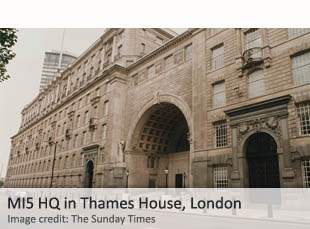
In Britain, the administration of Prime Minister Tony Blair secretly supported Washington’s extraordinary rendition operations. It instructed the Secret Intelligence Service, known as MI6, to assist its American counterpart, the Central Intelligence Agency, in efforts to abduct and rendition terrorism suspects. However, not everyone in Britain’s intelligence establishment was in agreement with government policy. One strong critic was Eliza Manningham-Buller, the then-director of Britain’s Security Service, commonly known as MI5, which she led from 2002 to 2007. According to The Guardian’s sources, Manningham-Buller was “evidently furious” when she discovered that MI6 had secretly colluded with governments like those of Libya and Egypt to rendition terrorism detainees. Believing extraordinary rendition and torture to be “wrong and never justified”, the MI5 director effectively stopped her agency from cooperating with MI6. She even “threw out” of MI5’s Thames House headquarters several MI6 liaison staff who were working there at the time, said The Guardian.

Soon afterwards, Manningham-Buller complained in writing to Prime Minister Blair about the conduct of some MI6 officers, whose actions allegedly “threatened Britain’s intelligence gathering” and “compromised the security and safety of MI5 officers and their informants”. The Guardian does not provide further elaboration of the contents of Manningham-Buller’s letter to the prime minister, but alleges that it contributed to a “serious and prolonged breakdown” in relations between MI5 and MI6. The paper says it contacted the two intelligence agencies, as well as Manningham-Buller, who has since retired, but no one wished to comment on the story. Sources did tell the paper, however, that the relationship between the two agencies “has now been repaired after a difficult period”.

Author: Joseph Fitsanakis | Date: 02 Jun 2016 | Permalink

British government releases MI5 file on little-known Cold War spy

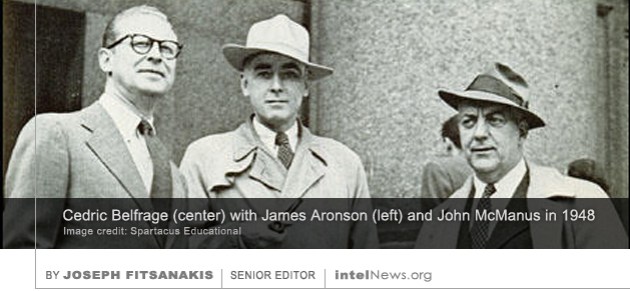
Cedric BelfrageThe British government has released a nine-volume file on an influential film critic who some believe was “one of the most important spies the Soviet Union ever had”. Cedric Belfrage was born in 1904 in London and read English Literature at Cambridge University in the 1920s. While a student at Cambridge he made a name for himself as a reviewer of motion pictures, and by the early 1930s he was known as Britain’s highest-paid film critic. Soon afterwards he moved to the American city of Los Angeles, where he became a film and theater correspondent for British tabloid newspaper The Daily Express. But a multivolume file on him compiled by the British Security Service (MI5) and released last week by the National Archives in London, confirms that Belfrage spied for Soviet intelligence under the codename BENJAMIN.

According to the file, Belfrage turned to communism after witnessing the effects of the Great Depression in the United States. After a 1936 trip to the USSR, he reached out to the Communist Party of the US, which eventually put him in touch with a number of Soviet intelligence operatives in America. In 1940, the Secret Intelligence Service (MI6) set up the British Security Coordination (BSC) in New York. It was a clandestine propaganda project aimed at turning local public opinion in favor of America’s entry into World War II. Belfrage was one of many writers and intellectuals that were recruited by the BSC to help counter the prevalent isolationist sentiment in the country. The film critic worked for MI6 until 1943, and then returned to Britain to join another wartime propaganda outfit, the Political Warfare Executive.

At war’s end, Belfrage returned to the US, only to find that he had attracted the attention of the Federal Bureau of Investigation. The FBI had discovered that the British film critic had dealings with the Communist Party in the 1930s and suspected that he may have worked for Soviet intelligence. Further investigations revealed that Belfrage had indeed conducted espionage under the guidance of Jacob Golos, a Ukrainian-born American who managed a large network of pro-Soviet spies in America in the interwar period. But when he was questioned by the FBI, Belfrage said that he had given Golos a number of British —not American— government documents under direct orders by MI6. The latter allegedly hoped that the Soviets would reciprocate the move within the context of the anti-Nazi alliance between the UK and the USSR.

Eventually, Belfrage was brought up before the House Un-American Activities Committee (HUAC) of the US Congress in 1953. The Committee was conducting public hearings aimed at unmasking suspected communist sympathizers in the American entertainment industry. But the British-born film critic refused to answer questions put to him, prompting HUAC to recommend that he should be deported from the country. The government adopted the Committee’s recommendation and deported Belfrage in 1955 for having been a member of the Communist Party under a fake name. Belfrage traveled throughout the Caribbean and Latin America before settling in Mexico, where he died in 1990, aged 86.

Interestingly, the British files reveal that MI5 decided not to prosecute Belfrage, most likely in order to avoid the embarrassment of admitting that British intelligence had employed a Soviet spy. The decision was probably not unrelated to the public scandal that followed the escape of the so-called Cambridge spies to the Soviet Union. Interestingly, Belfrage studied at Cambridge at the same time that Kim Philby (Soviet cryptonym STANLEY), Donald Duart Maclean (HOMER) and Guy Burgess (HICKS) were students there. But there is no evidence he ever collaborated with them, as he was not interested in politics at that time.

Author: Joseph Fitsanakis | Date: 24 August 2015 | Permalink
IRA spy’s lawsuit against MI5 to be judged in secret, UK court decides

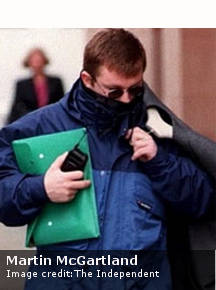
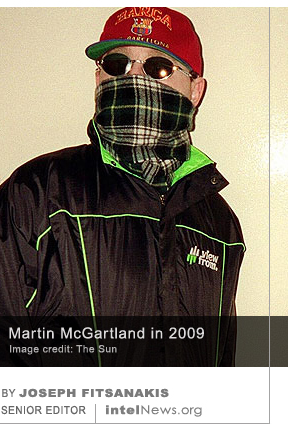
Martin McGartlandA lawsuit against Britain’s Security Service (MI5) by a former spy, who in the 1980s infiltrated the Provisional Irish Republican Army, commonly known as IRA, is to be judged in secret, a court in London has decided. The spy, Martin McGartland, of Belfast, Northern Ireland, was recruited by the Special Branch of the Royal Ulster Constabulary in the mid-1980s. The information he supplied to the security agencies over several years is widely credited with having saved the lives of at least 50 British police officers and soldiers. His autobiographical experiences formed the basis of the 2008 motion picture 50 Dead Men Walking.

However, McGartland’s cover was dramatically blown in 1991, when the IRA began suspecting that he might be an MI5 mole. After several hours of interrogation by the IRA’s Internal Security Unit, McGartland managed to escape his captors by throwing himself out of a third-floor window. He survived serious injuries and was taken into hiding by MI5, living in a series of safe houses across Britain for nearly a decade. In 1999 the IRA caught up with him at an MI5 safe house in North Tyneside, in the northeast of England, where he was shot and left for dead by an IRA hit team while walking to his car.

McGartland is now suing MI5 and its institutional patron, the British Home Office, claiming that they failed to support him after he was shot by the IRA. In his lawsuit, McGartland claims that the government funding he was receiving for treatment for post-traumatic stress disorder was withdrawn after he publicly criticized the British government’s counterterrorism policies. In May of 2013, it emerged that Home Office solicitors had filed a formal request to hold the trial as a Closed Material Procedure (CMP) hearing. This type of practice, which became law in Britain under the 2013 Justice and Security Act, allows the court to decide a case without giving the plaintiff party any details of the information against them.

In many cases, the government resorts to CMP ostensibly to protect ‘sources and methods’. But McGartland’s legal team said that the secret hearing was designed “solely to cover up [MI5’s] own embarrassment and wrongdoing and not, as the Government has been claiming, to protect national security”. Moreover, civil rights groups warned that applying CMP to McGartland’s lawsuit would open the way for the imposition of wider restrictions on the principle of open justice and would normalize secret hearings in the civil courts.

After the judge hearing the case decided to impose CMP on the proceedings, McGartland’s legal team filed an appeal. Now the appeal judges seem to have sided with the Home Office. In a decision published on Tuesday, the judges opined that the imposition of CMP was “a case management decision properly open to the judge and there is no proper basis for this court to interfere with it”. They added that their decision did not represent a blanket approval of secret legal proceedings, but that they expected court judges to scrutinize future CMP applications “with care”.

The ruling means that McGartland’s legal team will not be allowed to hear testimony by certain MI5 witnesses or view court material designated as “sensitive” by the government. Lawyers for the former IRA informant said on Tuesday that the approval of the imposition of CMP represented “a serious aberration from the tradition of open justice”. But lawyers for the Home Office said that the ability to protect sensitive information was central to the proper function of a national security service.

Author: Joseph Fitsanakis | Date: 15 July 2015 | Permalink: https://intelnews.org/2015/07/15/01-1735/

British spy testifies in disguise in alleged al-Qaeda member’s trial

MI5 HQ Thames HouseBy IAN ALLEN | intelNews.org
A heavily disguised British intelligence officer has given evidence in the trial of the alleged leader of an al-Qaeda cell who is being tried in the United States for planning to bomb the New York subway system. Abid Naseer, 28, from Pakistan, was a studying in Britain in April 2009, when he was arrested by British police along with 12 other people for allegedly planning a series of suicide bombings in a popular shopping center in the city of Manchester. In January 2013, however, he was extradited to the US, where he also faces changes of having tried to organize suicide attacks against the New York public transportation system.

American prosecutors claim Naseer received paramilitary training in Pakistan before moving to the UK intent on carrying out terrorist attacks. Last year, the prosecution asked the judge whether six intelligence officers from the UK’s Security Service (also known as MI5), who monitored Naseer’s activities in the months leading up to his arrest, could provide evidence in court. Moreover, the prosecution requested that the MI5 officers be allowed to provide evidence without revealing their identities, since they work as surveillance operatives and are currently involved in counterterrorism investigations. The judge agreed, and the first of the six MI5 officers gave evidence this week through a video link from an undisclosed location in the Britain.

The witness concealed his identity by wearing a false goatee beard, thick spectacles and what reporters described as “a long black wig”. He was also wearing heavy make-up and was identified in court only as “serial number 1603”, according to British newspaper The Daily Telegraph. He told the court that he was part of a large team of MI5 surveillance officers who closely followed Naseer for over a month while he was allegedly planning suicide operations in Britain and the US. The physical surveillance included following the suspect as he was scouting targets in Manchester and sitting behind him on a bus traveling from Manchester to Liverpool. Naseer is defending himself in the trial and had the chance to cross-examine the MI5 officer, said The Telegraph.

Links revealed between UK spy agencies and Gaddafi-era Libya

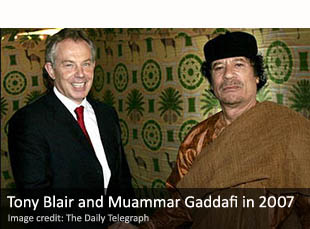
By JOSEPH FITSANAKIS | intelNews.orgTony Blair and Muammar Gaddafi in 2007
British spy agencies had close operational links with their Libyan counterparts during the rule of Colonel Muammar al-Gaddafi, and even allowed Libyan spies to operate on British soil, according to documents. The Libyan government files, unearthed in the North African country following the fall of the Gaddafi regime in 2011, allegedly reveal a degree of cooperation between London and Tripoli that goes far beyond what has been publicly acknowledged. According to London-based newspaper The Guardian, which saw the documents, intelligence agencies from the two countries launched a series of joint operations between 2006 and 2011, aimed at political enemies of the Libyan ruler, many of whom were thought to have links with al-Qaeda. In an article published on Friday, The Guardian said that the Security Service (commonly known as MI5), invited Libyan intelligence operatives to Britain and allowed them to spy on enemies of the Gaddafi regime who were living there, having been granted political asylum by the British government. The paper said that the Libyan intelligence officers were even allowed to “intimidate a number of Gaddafi opponents” who were trying to organize anti-Gaddafi campaigns on British soil. In return, the Libyan government allowed MI5 and the Secret Intelligence Service (MI6) access to captured anti-Gaddafi dissidents in Libya, while the latter underwent interrogation that almost certainly involved torture. The British paper said the unearthed documents, which come straight from the archive vaults of the Gaddafi government, are being used in a lawsuit filed in Britain against MI5, MI6, as well as against a number of British government departments, by former anti-Gaddafi dissidents. The plaintiffs, all members of the Libyan Islamic Fighting Group (LIFG), which tried to depose Gaddafi in the years prior to his death, claim that evidence against them was obtained through torture in Libyan prisons. They also claim that British intelligence agencies knew they were being tortured when they cooperated with the Libyan intelligence services that had captured them. In 2014, a former senior leader of LIFG, Abdul-Hakim Belhaj, won the right to sue the British government over his claim that he was tortured by Libyan intelligence operatives with the cooperation of British and American intelligence agencies. In 2012, another prominent Libyan political dissident, Sami al-Saadi, was awarded £2.2 million ($3.5 million) by a British court, after claiming that he underwent torture in Libya following his abduction in a joint British/Libyan/American intelligence operation.

British spy agencies launch recruitment drive for Russian speakers

MI5 HQ Thames HouseBy JOSEPH FITSANAKIS | intelNews.org
Amid mounting tensions between Russia and the West, British spy agencies have announced an ambitious recruitment campaign aimed at hiring a new generation of Russian-language specialists. The Security Service, known as MI5, which is responsible for domestic security and counterintelligence, posted an advertisement on its website this week, alerting potential applicants that the job search for Russian-language speakers will officially launch “in mid-November 2014”. The recruitment campaign, which is described on the spy agency’s website as “an exciting opportunity to match your language skills to a position in MI5”, appears to be jointly administered with the General Communications Headquarters (GCHQ), Britain’s signals intelligence agency, which is tasked with intercepting foreign communications. The move takes place in a wider context of deteriorating relations between Moscow and Western Europe, notably in response to Russia’s ongoing invasion of southeastern Ukraine and annexation of Crimea. Some suggest that there has also been a low-intensity intelligence war taking place between London and Moscow ever since the assassination in the British capital of former KGB officer Alexander Litvinenko. In late 2012, an officer of the Royal Navy was captured during a counterintelligence sting operation while trying to sell top-secret British government documents to people he believed were Russian intelligence operatives. A few months later, the British government let it be known of its increasing annoyance by persistent allegations made in the Russian media that Denis Keefe, the UK’s deputy ambassador to Moscow, was “an undercover spy, with his diplomatic position serving as a smokescreen”. In March of 2013, Oleg Gordievsky, the Soviet KGB’s former station chief in London, who defected to the UK in the 1980s, alleged in an interview that Russia operates as many spies in Britain today as it did during the Cold War. His comments were echoed earlier this year by the former director of MI5, Jonathan Evans, who said that there had been no change in the number of undeclared Russian intelligence officers operating in Britain since the end of the Cold War. Evans said that up to 50 undeclared Russian military and civilian spies were believed to be operating in Britain at any given moment. In June of this year, intelNews reported that the crisis in Crimea had caused the British military to hurriedly reach out to hundreds of retired Russian-language analysts who left the service at the end of the Cold War, most of whom are now in their 60s.

Newly released British files shed light on 20th-century espionage

Eric HobsbawmBy IAN ALLEN | intelNews.org
Files released last week by Britain’s National Archives have brought to the fore interesting new clues on the history of intelligence operations in the 20th century. One of the files relates to Migel Piernavieja del Pozo, a Spanish journalist in his mid-20s, who arrived in the United Kingdom in 1940, ostensibly to cover British public attitudes to the war in the continent. Britain’s counterintelligence agency, the Security Service, also known as MI5, placed Pozo under surveillance, after the debonair Spaniard proclaimed in public meetings that he was grateful for German Chancellor Adolf Hitler’s support to Spain’s royalist forces and said he hoped Germany would emerge victorious from the war in Europe. The agency was right to do so, as Pozo eventually approached an agent of the Abwehr —Nazi Germany’s military intelligence agency— in the UK, and told him that he too was working secretly for Berlin. But the Abwehr agent, codenamed GW in MI5 documents, was in fact a double spy for the Crown and managed to pass deceptive information to the Spaniard. Eventually, Pozo gave GW a tin of talcum powder containing over £3,500 in banknotes, which is approximately $150,000 in today’s money. Professor Christopher Andrew, official historian of MI5, told The Daily Telegraph that the money supplied by Pozo was “probably the largest sum yet handed to a British agent” by a rival spy. Eventually, Pozo’s inability to acquire useful intelligence in the UK prompted his recall back to Spain.

Another set of files, also released last week by the National Archives, appears to show that C.A.N. Nambiar, a friend of India’s first prime minister and deputy to one of the country’s most fervent pro-independence activists, was a Soviet spy. Nambiar was known as an old comrade of Jawaharlal Nehru, the first elected leader of post-colonial India, who dominated Indian affairs for much of the last century. He was also a close associate of Subhas Chandra Bose, a pro-independence activist considered a hero by Indian nationalists, whose hatred for India’s British occupiers led him to side with Nazi Germany and Imperial Japan in the early 1940s. After India’s independence in 1947, Nambiar worked as a diplomat in Berne, Switzerland, before becoming India’s ambassador to Sweden and later to West Germany. But according to MI5 documents released last week, an Eastern Bloc defector fingered Nambiar in 1959 as an agent of Soviet military intelligence, known as GRU. The source said Nambiar had been recruited while visiting the USSR as a guest of the Soviet state in 1929. Read more of this post

Historian names wartime British spy who fooled Nazi sympathizers

Eric RobertsBy JOSEPH FITSANAKIS | intelNews.org
A British counterintelligence agent, who managed to neutralize an extensive wartime network of Nazi sympathizers in the United Kingdom by pretending to represent the German government, has been named. Regular intelNews readers might remember our post about a wartime agent identified only as “Jack King” in files released by the British National Archives in February. “Jack King” was the operational codename given to the agent by his handlers in the British Security Service, commonly known as MI5, which is tasked with counterintelligence duties. Senior officials at the agency described “King” as “a genius” at luring Nazi sympathizers in the UK. The files show that “King’s” work helped MI5 identify hundreds of residents in Britain —most of them British citizens— as committed Nazis who were prepared to pass national secrets to Berlin. “King” reportedly utilized his pro-German contacts in the southeast of England and was able to infiltrate pro-Nazi circles operating in and around London. He did so by posing as an agent of the Gestapo, Nazi Germany’s secret police. He quickly gained the trust of some of the most fervent pro-German activists operating in the British Isles. These included Edgar Whitehead, Hilda Leech, and Marita Perigoe, a Swedish resident of the UK who was so fervently pro-Nazi that she once dismissed Oswald Mosley’s British Union of Fascists as “insufficiently extreme”. When the “Jack King” files were declassified, some intelligence historians suggested that the operational codename referred to John Bingham, a legendary MI5 office and fluent German speaker who is said to have inspired John le Carré’s fictional character George Smiley. But Cambridge University historian Christopher Andrew, who in 2009 authored In Defense of the Realm, an officially-commissioned history of MI5, has revealed the name of “Jack King” as Eric Roberts. Professor Andrew told The Daily Telegraph newspaper that Roberts was an unassuming suburban bank clerk who lived in a small market town called Epsom in Surrey. Roberts was born in nearby Sussex, in southeastern England, in 1907, married at a young age and had three children —two sons and a daughter. His MI5 files document that, by the time World War II started, he was “thoroughly familiar” with networks of Nazi sympathizers in the south of England, though just how he had managed to do that remains a mystery. Roberts eventually attracted the attention of Maxwell Knight, a legendary MI5 spymaster who headed the organization’s Section B5(b), tasked with infiltrating subversive political groups in Britain. Read more of this post

MI5 releases documents on Dutch double spy Mata Hari

Mata HariBy JOSEPH FITSANAKIS | intelNews.org
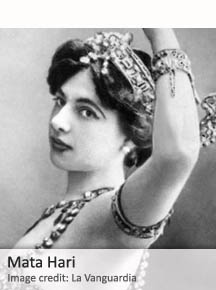
The British government has released a set of documents relating to the capture and eventual execution of Mata Hari, modern history’s most legendary female spy. Mata Hari was born Margaretha Geertruida Zelle in northern Holland in 1876. In 1895 she married Rudolf MacLeod, a Dutch Army Captain of Scottish descent serving the Dutch colonial administration of what is now Indonesia. She eventually divorced the alcoholic and abusive MacLeod, who was 20 years her senior, and joined the circus in Paris. Eventually she became wildly popular as an exotic dancer, a position that placed her in close contact with several influential men in France, including the millionaire industrialist Émile Étienne Guimet, who became her longtime lover. Several of her male devotees came from military backgrounds from various European countries. Most historians agree that by 1916 Zelle was working for French intelligence, gathering information from a host of German lovers. However, in February of the following year she was arrested by French counterintelligence officers in Paris and accused of spying on behalf of the German Empire. French prosecutors accused Zelle of having provided Berlin with tactical intelligence that cost the Triple Entente the lives of over 50,000 soldiers. A set of documents released this month by Britain’s Security Service, commonly known as MI5, reveal that allied intelligence operatives trailed the exotic dancer across several European countries before she was apprehended in Paris. They also allege that, while under French custody, the Dutch spy admitted that she had conducted espionage on behalf of the German Secret Service and that her codename was H21. She is also alleged to have admitted that she received payments of approximately 20,000 French francs for her servicse. The papers also suggest that Zelle admitted that several vials of invisible ink fond in her hotel suite had been given to her by her German handlers. However, the MI5 reports claim that the accused spy “never made a full confession” and “never gave away anyone” as her accomplice, leading the British author of the report to conclude that she must have been “working alone”. Read more of this post

British spies infiltrated Nazi sympathizer groups, wartime files show

Page from MI5's Jack King filesBy JOSEPH FITSANAKIS | intelNews.org
A British counterintelligence agent managed to neutralize an extensive network of Nazi sympathizers in the United Kingdom by pretending to represent the German government, newly released files show. The documents, which were released this week by the British National Archives, identify the agent only as “Jack King”, which was the operational codename given to him by his handlers in the British Security Service, commonly known as MI5. Senior officials at the agency, which is tasked with counterintelligence, described “King” as “a genius” at luring in Nazi sympathizers in the UK. The files show that “King’s” work helped MI5 identify hundreds of residents in Britain —most of them British citizens— as committed Nazis who were prepared to pass national secrets to Berlin. The MI5 operative utilized his pro-German contacts in the southeast of England and was able to infiltrate pro-Nazi circles operating in and around London. He did so by posing as an agent of the Gestapo, Nazi Germany’s secret police. He quickly gained the trust of some of the most fervent pro-German activists operating in the British Isles. These included Edgar Whitehead, Hilda Leech and Marita Perigoe, a Swedish resident of the UK, who was so fervently pro-Nazi that she once dismissed Oswald Mosley’s British Union of Fascists as “insufficiently extreme”. Many of these Nazi supporters pledged to “King” that they could be relied on to assist in the event of an invasion of Britain by Nazi forces. The files released by the National Archives show that “King” was well connected with British Nazis by 1942. Read more of this post

Thatcher was warned about CIA activities in Britain, files show

Margaret ThatcherBy JOSEPH FITSANAKIS | intelNews.org
British Prime Minister Margaret Thatcher was warned in 1984 that American intelligence carried out operations in the United Kingdom without London’s consent. Although she dismissed the warnings, she authorized British counterintelligence to investigate the matter. A secret file from the British Foreign Office, which was declassified last month, shows that concerns about alleged American spy activity in the UK were communicated to the Tory Prime Minister by Paddy Ashdown —now Lord Ashdown— a Member of Parliament for Britain’s Liberal Party. In November of 1984, Ashdown notified Thatcher that he was concerned about a series of “clandestine activities” carried out by the United States Central Intelligence Agency (CIA) aimed at preventing communist countries from acquiring advanced computer technology developed by companies based in Britain. The written warning stated that CIA operatives had made “clandestine approaches” targetting individuals employed by leading British computer firms, inquiring about technology transfers to the Soviet Bloc. Ashdown added that the American intelligence agency had failed to provide the British government with advance notice of these activities, as was customary between the two allies. In his letter to Thatcher, the Liberal Party MP concluded that, based on his personal investigation into the matter, he was convinced the CIA operation was “still continuing”. The Prime Minister responded to Ashdown with an official letter explaining that there was “no evidence of improper activity by the CIA” or that British espionage laws had been violated by American intelligence personnel. She added that there was “close cooperation” between London and Washington on enforcing multilaterally agreed export controls, which included computer technology, and concluded that saw no need for an inquiry at that time. But London-based newspaper The Guardian, which accessed the declassified files on the case, said that Whitehall ordered the Foreign Office to investigate Ashdown’s allegations. The Foreign Office then tasked the Security Service (MI5) to find out whether the US had broken an agreement between the two countries to refrain from clandestine operations on each other’s territory unless the latter were authorized by both nations. Read more of this post

Spy agencies failed to share intelligence on Omagh bombing: report

Real IRA paradeBy IAN ALLEN | intelNews.org |
A new report on the 1998 bombing of downtown Omagh by an Irish republican splinter group claims that the tragedy could have been avoided had British, Irish and American intelligence agencies shared information with British police. The car bomb attack was carried out on August 15, 1998, by the Real Irish Republican Army (RIRA). The militant organization consisted of former Provisional Irish Republican Army volunteers who rejected the Good Friday Agreement, part of the Northern Ireland peace process. It devastated the small Northern Irish town of Omagh, killing 29 and injuring over 200 people, including six children, several teenagers and a woman who was pregnant with twins. There have been no criminal convictions in connection with the bombing, despite the fact that it was the single worst instance of violence in the so-called Northern Ireland Troubles, which began in the 1960s and ended in 1998, largely because of the Omagh bombing. But now a new report commissioned by the families of the victims of the bombing claims that intelligence services from three countries failed to share information with British police, which could have prevented the disaster in Omagh. The report, authored by a group of retired security experts on behalf of London-based law firm SBP, says the RIRA had been infiltrated by the United States Federal Bureau of Investigation (FBI), Britain’s Security Service (MI5) and the Irish Garda’s Crime and Security Branch. These agencies, claims the report, had at least two informants inside the RIRA: a smalltime Irish criminal named Paddy Dixon, who frequently smuggled stolen cars from Ireland into Britain for use by the RIRA, and David Rupert, an American of Irish descent. Read more of this post

British spy agency to scrap $140m IT system over security fears

DeloitteBy IAN ALLEN | intelNews.org |
Britain’s domestic intelligence agency, MI5, has decided to “accept defeat” and scrap a multimillion digital records management program over fears it could create a dangerous “intelligence vacuum”. The program, which has so far cost the British taxpayer over £90 million ($140 million) in payments to private consultants, was first conceived in the run-up to the London 2012 summer Olympic Games. While evaluating terrorist-related threats posed by the hosting of the Games in the United Kingdom, British security officials decided that the government-wide intelligence-sharing system in place was archaic and in need of serious overhaul. They hired a group of senior IT management consultants from Deloitte, one of the world’s largest professional services firm, headquartered in New York, NY. The pricey corporate experts were tasked with helping MI5 digitally collate intelligence data collected or produced by all departments of the British government. Deloitte’s planning team had projected that the multi-million dollar system would be in place and operational by the summer of 2012, before the Olympic Games were held in London. This, however, proved wildly optimistic; Deloitte barely managed to scrape together a watered-down version of the promised records management program in late 2012. When the program was tested by MI5’s intelligence collection managers, it was found to contain serious errors that, according to British newspaper The Independent, could leave the country’s intelligence agencies “vulnerable and struggling with an intelligence vacuum”. When initially questioned about the Deloitte debacle by British lawmakers, MI5’s (now retired) Director, Sir Jonathan Evans, told the frustrated members of the British House of Commons Intelligence and Security Committee not to worry. Read more of this post

MI5 wants secret court session over IRA informant’s lawsuit

Martin McGartlandBy JOSEPH FITSANAKIS | intelNews.org |
Britain’s domestic intelligence agency, MI5, has requested a secret court hearing to deliberate a lawsuit from a high-profile spy who infiltrated the Provisional Irish Republican Army, commonly known as IRA. The mole, Martin McGartland, of Belfast, Northern Ireland, was recruited by the Special Branch of the Royal Ulster Constabulary in the 1980s. The information he supplied to the security agencies over several years is widely credited with having saved the lives of at least 50 British police officers and soldiers. His autobiographical experiences formed the basis of the 2008 motion picture 50 Dead Men Walking, written and directed by Kari Skogland and starring Jim Sturgess as Martin and Ben Kingsley. McGartland’s cover was dramatically blown in 1991, when the IRA began suspecting that he might be an MI5 mole. After several hours of interrogation by the IRA’s Internal Security Unit, McGartland managed to escape his captors and throw himself out of a third-floor window. He survived serious injuries and was taken into hiding by MI5, living in a series of safe houses across Britain for nearly a decade. However, in 1999 the IRA caught up with him at an MI5 safe house in North Tyneside, in the northeast of England, where he was shot by an IRA hit team while walking to his car one morning and left for dead. McGartland is now suing MI5 and its institutional patron, the British Home Office, claiming that they failed to support him after he was shot by the IRA. In his lawsuit, McGartland claims that government funding he was receiving for treatment for post-traumatic stress disorder was withdrawn after he publicly criticized the British government’s counterterrorism policies. Read more of this post

MI5 chief credited with ‘transforming the agency’ to step down

Jonathan EvansBy IAN ALLEN | intelNews.org |
The head of MI5, Britain’s primary domestic intelligence agency, is to step down at the end of this month, it has been announced. Sir Jonathan Evans is widely credited with transforming MI5, also known as the Security Service, in one of the agency’s most turbulent periods following 9/11/2001. A career MI5 officer, Sir Jonathan entered MI5 in 1980 and eventually joined the agency’s G-Branch, which focuses on international counter-terrorism. He rose to lead G-Branch just 10 days before the 9/11 attacks and the subsequent launch of America’s ‘war on terrorism’. In 2005, Evans was faced with another major crisis as chief of G-Branch, when Britain suffered the bloody July 7 suicide attacks —also known as the 7/7 attacks— which killed 56 and injured nearly 1,000 people. Two years later, in 2007, he rose to the post of Director General at MI5, replacing Eliza Manningham-Buller (now Baroness Manningham-Buller), who had been only the second female intelligence officer to head the organization. Perhaps inevitably, considering world events, Evans helped steer MI5’s operational focus away from Irish republican groups and toward Islamist-inspired militancy in the United Kingdom and beyond. In early 2009, in a move that stunned some intelligence insiders, Evans gave the first public interview by a serving MI5 Director General in the organization’s 100-year history. He answered questions in a face-to-face interview with a carefully selected group of security correspondents representing a handful of British media outlets. The event was seen as reflecting a sea of change in the culture of MI5 —an agency that had never revealed the identities of its Director Generals until 1990. Later in the same year, however, Sir Jonathan caused controversy by suggesting during a public lecture that the intelligence extracted by torturing suspects after 9/11 had stopped “many attacks” on Western and other targets. Read more of this post