Nazi official Heinrich Himmler’s daughter worked for West German intelligence
July 2, 2018 Leave a comment
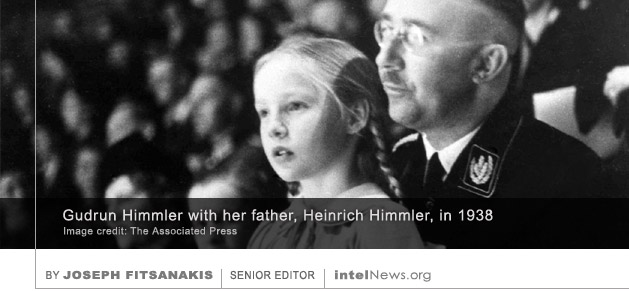 The daughter of Heinrich Himmler, who was second in command in the German Nazi Party until the end of World War II, worked for West German intelligence in the 1960s, it has been confirmed. Gudrun Burwitz was born Gudrun Himmler in 1929. During the reign of Adolf Hitler, her father, Heinrich Himmler, commanded the feared Schutzstaffel, known more commonly as the SS. Under his command, the SS played a central part in administering the Holocaust, and carried out a systematic campaign of extermination of millions of civilians in Nazi-occupied Europe. But the Nazi regime collapsed under the weight of the Allied military advance, and on May 20, 1945, Himmler was captured alive by Soviet troops. Shortly thereafter he was transferred to a British-administered prison, where, just days later, he committed suicide with a cyanide capsule that he had with him. Gudrun, who by that time was nearly 16 years old, managed to escape to Italy with her mother, where she was captured by American forces. She testified in the Nuremberg Trials and was eventually released in 1948. She settled with her mother in northern West Germany and lived away from the limelight of publicity until her death on May 24 of this year, aged 88.
Late last Thursday, an article in the German tabloid newspaper Bild revealed for the first time that Burwitz worked for West Germany’s Federal Intelligence Service (BND) in the early 1960s. The BND continues to operate today as reunited Germany’s main external intelligence agency. According to Bild, Himmler’s daughter had a secretarial post at the BND’s headquarters in Pullach, where the spy agency was headquartered for most of its existence. The paper said that Burwitz managed to be hired by the BND by using an assumed name. In a rare public statement, the BND’s chief archivist, Bodo Hechelhammer, confirmed Bild’s allegations. The archivist, who serves as one of the BND’s official historians, told the newspaper that Burwitz “was an employee of the BND for a number of years, until 1963”, working “under an assumed name”. She was dismissed once the BND began to purge former Nazis from its staff, toward the end of the tenure of its first director, Reinhard Gehlen. Gehlen was a former general and military intelligence officer in the Nazi Wehrmacht, who had considerable experience in anti-Soviet and anti-communist operations. In 1956, in the context of the Cold War, the United States Central Intelligence Agency, which acted as the BND’s parent organization, appointed him as head of the organization, a post which he held from until 1968.
It is believed that Burwitz remained a committed Nazi until the end of her life. She doggedly defended her father’s name and insisted that the Holocaust was an Allied propaganda ploy. It is also believed that she was a prominent member of Stille Hilfe (Silent Help), an underground group of leading former Nazis, which was established in 1945 to help SS officers and other Nazi officials escape prosecution for war crimes. Several German experts on neo-Nazi groups have alleged that Burwitz continued to attend neo-Nazi events and SS reunions throughout Europe, some as recently as 2014. Burwitz is believed to have died in Munich.
► Author: Joseph Fitsanakis | Date: 02 July 2018 | Permalink
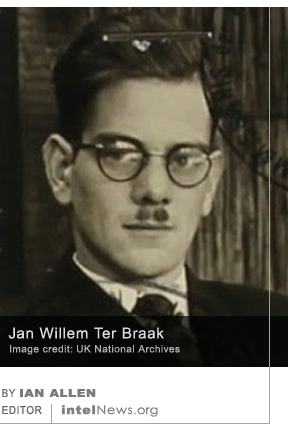 The unmarked grave of a Dutch-born Nazi spy, who killed himself after spending several months working undercover in wartime Britain, will be marked with a headstone, 76 years after his death by suicide. Born in 1914 in The Hague, Holland, Englebertus Fukken joined the National Socialist Movement in the Netherlands, the Dutch affiliate of the National Socialist German Workers’ Party led by Adolf Hitler, in 1933. In 1940, shortly after the German invasion of Holland, Fukken, who had been trained as a journalist, was recruited by the Abwehr, Nazi Germany’s military intelligence. Abwehr’s leadership decided to include Fukken in the ranks of undercover agents sent to Britain in preparation for Operation SEA LION, Germany’s plan to invade Britain.
 A congratulatory letter sent by a senior Nazi official to









 intelNews.org
Vienna’s wartime Gestapo chief worked for West German intelligence, records show
April 7, 2021 by Joseph Fitsanakis 1 Comment
THE HEAD OF THE secret police in Nazi-occupied Vienna, who oversaw the mass deportation of Austrian Jews to concentration camps, worked for West Germany’s postwar spy agency, according to newly released records. Starting his career as a police officer in Munich during the Weimar Republic, Franz Josef Huber joined the Nazi Party in 1937. Due to his prior law enforcement work, he was immediately appointed to the office of Heinrich Müller, who headed the Gestapo —Nazi Germany’s secret police.
Following the German annexation of Austria in 1938, the Nazi Party sent Huber to Vienna, where he oversaw all criminal and political investigations by the Gestapo. He remained head of the Nazi secret police in the Austrian capital until December of 1944. Under his leadership, the Vienna branch of the Gestapo became one of the agency’s largest field offices, second only to its headquarters in Berlin, with nearly 1000 staff members. Huber himself was in regular communication with Adolf Eichmann, who was the logistical architect of the Holocaust. Nearly 66,000 Austrian Jews, most of them residents of Vienna, perished in German-run concentration camps under Huber’s watch.
In May of 1945, following the capitulation of Germany, Huber surrendered to American forces and was kept in detention for nearly four years. During his trial in the German city of Nuremburg, Huber admitted to having visited German-run concentration camps throughout his tenure in the Gestapo. But he claimed that he had not noticed signs of mistreatment of prisoners. He was eventually cleared of all charges against him and released in 1949, allegedly because allied forces wanted to concentrate on more senior members of the Nazi Party, including Huber’s boss, Heinrich Müller.
Last week, German public-service broadcaster ARD said it found Huber’s name in records belonging to the Federal Intelligence Service —Germany’s external intelligence agency. It turns out that, following his release from detention in 1948, Huber joined the Gehlen Organization —named after the first director of the BND, Reinhard Gehlen. Gehlen was a former general and military intelligence officer in the Nazi Wehrmacht, who had considerable experience in anti-Soviet and anti-communist operations. In 1956, as the Cold War was intensifying, the United States Central Intelligence Agency, which acted as the BND’s patron, appointed Gehlen as head of the BND, a post which he held until 1968. During his tenure, Gehlen staffed the BND with numerous Nazi war criminals, who had considerable expertise on the Soviet Union and anti-communism.
According to the ARD, Huber worked for the BND under Gehlen until 1967, when he retired along with other former Nazi BND officers. His retirement occurred at a time when the BND, under popular pressure, tried to cut ties with some of the most notorious former Nazis in its ranks. However, Huber was given a state pension, which he kept until his death in 1975. Following his retirement from the BND, he allegedly worked for an office equipment supplier in his hometown of Munich, without ever facing any prosecution for his wartime role in the Gestapo. In an article published on Monday, The New York Times claimed that the United States government was fully aware of Huber’s Nazi past.
► Author: Joseph Fitsanakis | Date: 07 April 2021 | Permalink
Filed under Expert news and commentary on intelligence, espionage, spies and spying Tagged with BND, Cold War, Franz Josef Huber, Gestapo, history, National Socialist German Workers' Party, News, Reinhard Gehlen, World War II