North Korean hackers operating secretly in China, says defector

Shenyang railway stationBy JOSEPH FITSANAKIS | intelNews.org
An underground network of North Korean hackers are conducting complex cyberattacks against worldwide targets from Chinese cities without the knowledge of Beijing, according to a former professor who trained them. Kim Heung-Kwang was a professor of computer science in North Korean capital Pyongyang, until his defection in 2004. He told CNN on Tuesday that part of his job was training members of North Korea’s elite cyberintelligence corps, whose task was to compromise computer systems around the world. Kim alleged that some of the hackers joined a specialized outfit called Bureau 121. It was established in complete secrecy in 1995 and ten years later it began sending its operatives abroad, especially in northern China. According to Kim, Bureau 121 set up a complex network of hackers in the Chinese city of Shenyang, in northern China’s Liaoning Province. Shenyang is the largest Chinese city near North Korea, and Bureau 121 operatives were allegedly able to effortlessly blend in the sizeable Korean community there. The former professor told CNN that the hackers “entered China separately” over time, “in smaller groups […], under different titles” such as officer workers, trade company officials, or even diplomatic personnel. They operated like typical spies, working regular jobs by day and “acting on orders from Pyongyang” by night, said Kim. They gradually set up an underground “North Korean hacker hub”, operating secretly in Shenyang for several years, relocating from place to place in order to shield their activities from computer security experts. Kim told CNN that Shenyang’s bustling, money-driven life and its good Internet facilities made it easy for Bureau 121 members to work secretly on several projects that required sophisticated telecommunications infrastructure. North Korea lacks China’s telecommunications network capabilities, said Kim, which is why Pyongyang decided in the early days of the Internet to transport its hackers to Shenyang. He added that Bureau 121 has rolled back considerably its overseas operations in recent years, due to the advancement of high-speed telecommunications networks in North Korea; but some North Korean hackers are still active in northern China, he said.

Hezbollah official admits group ‘battling espionage’ in its ranks

Naim QassemBy JOSEPH FITSANAKIS | intelNews.org
Public comments by a senior Hezbollah official appear to confirm earlier reports that the man who directed the personal security detail of the Lebanese group’s leader was a spy for Israel. Several Lebanese news outlets reported in December that Mohammed Shawraba, a 42-year-old Hezbollah official from southern Lebanon, had been arrested by Hezbollah’s counter-intelligence force and was undergoing trial for having leaked sensitive information to Israel for several years. Sources said that Shawraba used to oversee the security detail of Hassan Nasrallah, Hezbollah’s secretary-general. He was subsequently promoted to director of Hezbollah’s Unit for Foreign Operations, also known as Unit 910, which conducts intelligence operations on Israeli targets abroad. One Lebanese source described the Shawraba case as “one of the most significant security breaches” in the history of Hezbollah. Ever since the first public allegations emerged, the militant Shiite group has remained silent. On Saturday, however, Naim Qassem, Hezbollah’s Deputy Secretary General, admitted that the group was “battling espionage within its ranks” and that its counter-spies had been able to uncover “a number of significant infiltrations”. Qassem’s comments, made during an interview on Al-Nour, a Beirut-based radio station affiliated with Hezbollah, have been taken by observers as an indirect admission that the rumors about Shawraba are accurate. Qassem told the radio station that Hezbollah was a party that aimed for virtue and pureness, but that it was made up of human beings who are inevitably fallible. But he refused to be more specific about the cases of espionage, saying only that Hezbollah was Lebanon’s strongest and most resilient political organization and would easily overcome any harm caused by double agents within its ranks. A spokesman for the militant group, who was asked on Sunday whether Qassem’s comments were a reference to Shawraba, refused to comment on the case.
Iran says it foiled Mossad assassination of nuclear scientist

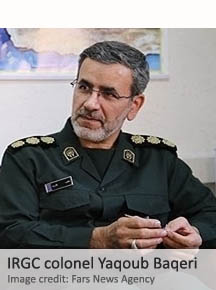
Yaqoub BaqeriBy IAN ALLEN | intelNews.org
A senior Iranian military official has claimed that Tehran foiled an attempt by Israeli spies to assassinate a scientist working for Iran’s nuclear program. In a report filed on Saturday, Iran’s semi-official Fars News Agency quoted Colonel Yaqoub Baqeri saying that the Islamic Revolutionary Guards Corps (IRGC) had managed to prevent Israel from killing the scientist “during the last two years”. Baqeri is deputy chief liaison officer in the air force division of the IRGC, a branch of Iran’s armed forces dedicated to protecting and furthering the goals of the 1979 Islamic Revolution. Baqueri told Fars, which is known to have strong links with the IRGC, that Israel’s covert-action agency, the Mossad, had been “trying hard to assassinate an Iranian nuclear scientist”, but that the well-timed involvement of the IRGC had “thwarted the terrorist operation”. At least five Iranian nuclear scientists have been targeted by unknown assailants since 2007, when Ardeshire Hassanpour, who worked at Iran’s Isfahan nuclear facility, was found dead in his Tehran apartment, allegedly having suffocated in his sleep from fumes from a faulty gas pipe. Another Iranian nuclear scientist, Shahram Amiri, disappeared in 2009, while Masoud Ali Mohammadi, described by the Iranian government as a “dedicated revolutionary professor”, was killed in 2010 by a remotely controlled explosive device that had been planted at the entrance of his residence. Later that year, two near-simultaneous bomb attacks killed Majid Shahriari and injured Fereydoon Abbasi Davan, nuclear researchers and professors at the Shahid Beheshti University. The two were attacked in separate incidents by motorcyclists who targeted them during the morning rush hour in Tehran as they were driving to work. The assailants attached small bombs to the car surfaces of their targets and detonated them from a relatively safe distance before speeding away through heavy traffic. The Fars News Agency report also claimed that Iran’s intelligence agencies had uncovered secret training bases run by the Mossad and located “within the territories of one of Iran’s western neighbors”, in which teams of assassins were allegedly being “trained and assisted” by the Israelis. In 2012, Israel’s two leading intelligence correspondents, Dan Raviv and Yossi Melman, claimed in their book Spies Against Armageddon: Inside Israel’s Secret Wars, that the “decapitation program” against the Iranian nuclear effort was led by Israel with the expressed but passive endorsement of the United States.

Shiite rebels abduct, then release, Yemen’s intelligence chief

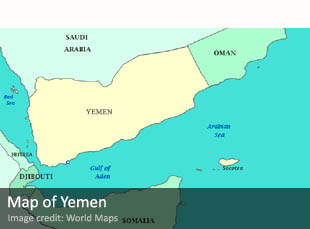
YemenBy IAN ALLEN | intelNews.org
Shiite rebels, who are in control of most of Yemeni capital Sana’a, released the country’s intelligence chief a few hours after abducting him from his home, according to local sources. The chief, Major General Yehia al-Marani, directs Yemen’s Political Security Organization (PSO), and is regularly referred to as the second most powerful security official in the country, after the director of the country’s National Security Bureau. The Associated Press reported early on Thursday that about 20 armed militia members appeared outside al-Marani’s home in Sana’a at daybreak and demanded that the general come with them. The PSO chief ordered his bodyguards to lay down their weapons and then went away escorted by the rebels. Al-Marani’s kidnappers were almost certainly Houthi militiamen, who are members of a Shiite militant group known as Ansarullah. The Houthis, who come from western Yemen, have been engaged in a secessionist armed struggle since 2004 against the Sunni-dominated Yemeni government. Last September, they took advantage of the power-vacuum created by the collapse of the regime of longtime dictator Ali Abdullah Saleh and stormed the Yemeni capital, easily taking control of it within a few days. Their official reason for the takeover was their expressed desire to force President Abed Rabbo Mansour Hadi, who succeeded Saleh, to dissolve Yemen’s Sunni-led government, which the Houthis said was closely connected with al-Qaeda in the Arabian Peninsula (AQAP). After a period of prolonged negotiations with the rebels, President Hadi dissolved the government and replaced it with a more inclusive group of non-partisan technocrats. But the rebels refused to disband and disarm, and have since intensified their armed campaign, taking over a number of Yemeni cities and several major roads across the country. The Houthi leadership claims that they need to remain armed in order to fight militant Sunni groups operating in the country, and to battle corruption. Al-Marani was released by the rebels late on Thursday, with no explanation given as to his earlier abduction. It is believed that, before his appointment as head of PSO, the General served for 15 years as the Organization’s regional director in Sa’dah province, a Shiite stronghold where the Houthi insurgency has its roots. Some speculate that the rebels intended to settle old scores with al-Marani. Yemen government officials have refused to confirm or deny the reports of the Generals’ abduction and release.

Germany announces arrest of alleged Turkish spies

Embassy of Turkey in BerlinBy JOSEPH FITSANAKIS | intelNews.org
German authorities have announced the arrest of three citizens of Turkey on charges of conducting espionage activities in Germany on behalf of the Turkish government. In a statement issued on December 18, the office of the German federal prosecutor said the three Turks had been arrested on the previous day, following a prolonged counterintelligence investigation. In accordance with German federal law, the statement identified the three only by their first name and age, which are: Mohammed Taha G., 58, Göksel G., 33, and Ahmed Duran Y., 58. It said the detainees had been charged with conducting illegal espionage activities on German soil, on behalf of Turkey’s National Intelligence Organization, known locally as MİT. The announcement by the office of the prosecutor said a warrant for the arrest of the three had been issued on November 11, implying that the Turks had been monitored for several months prior to their December 17 arrest. According to the official account, Mohammed Taha G. and Göksel G. were arrested at Frankfurt Airport, presumably as they were attempting to leave the country. Shortly afterwards, Ahmed Duran Y. was also arrested at his home in the German state of North Rhine-Westphalia. German authorities believe the three were members of an organized spy ring, which was headed by Mohammed Taha G. Its primary operational goal appears to have been to collect intelligence on Germany’s sizable Turkish expatriate community, much of which consists of ethnic Kurds. Some sources told German media that the three Turks were using their contacts with a local branch of the Turkish Cooperation and Development Agency (TIKA) as a cover for their espionage operations. However, this has been denied in Turkish media reports, which cite unnamed security officials as saying that neither TIKA nor the three detainees are connected to MİT. Meanwhile, spokespersons at the Turkish Ministry of Foreign Affairs, MİT, and the embassy of Turkey in Berlin refused to comment on the story. There is little doubt, however, that this news comes at a particularly tense period in German-Turkish relations. Last August, unconfirmed German media reports suggested that Germany’s main external intelligence agency, the BND, had been actively spying on the Turkish government since at least 2009. According to the reports, the BND designated Turkey as a “priority target” in 2009, even though both countries are allied members of the North Atlantic Treaty Organization. Meanwhile, the Turkish government has reacted angrily at accusations by German politicians that Ankara is turning a blind eye to the rise of the Islamic State for Iraq and al-Sham, also known as ISIS, allegedly in an effort to combat the resurgent Kurdish separatism in Anatolia.

Hezbollah leader’s senior bodyguard was Mossad agent

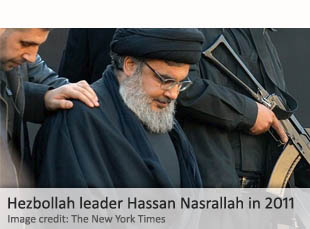
Hezbollah leader Hassan NasrallahBy JOSEPH FITSANAKIS | intelNews.org
The man who directed the personal security detail of the secretary-general of Lebanese militant group Hezbollah was an agent of Israeli intelligence, according to multiple sources in Lebanon. The agent, who was arrested earlier this year by Hezbollah’s counter-intelligence force, and is now undergoing trial, was able to penetrate the highest levels of the Shiite militant group, and leaked sensitive information to Israel for several years prior to his capture. American newspaper The Washington Post and Lebanese newspaper The Daily Star cite “security officials and people in Lebanon” who say they are familiar with the incident. They say the agent’s activities constitute “one of the most significant security breaches” in the history of Hezbollah, the Shiite militant group that controls large swathes of Lebanese territory. Media reports have identified the alleged agent as Mohammed Shawraba, a man in his late 30s or early 40s 42, who is believed to come from a small village in southern Lebanon. According to reports from Lebanon, several years ago Shawraba used to direct the personal security detail of Hassan Nasrallah, Hezbollah’s secretary-general. Nasrallah has led the militant group since 1992, when his predecessor, Abbas al-Musawi, was assassinated by Israel. In 2008, after a number of years in the service of Nasrallah’s personal security detail, Shawraba was promoted to director of the group’s Unit for Foreign Operations, also known as Unit 910, which collects information on Israeli activities abroad. However, unbeknownst to Hezbollah officials, Shawraba had been recruited by the Israeli spy agency Mossad even before he joined Nasrallah’s personal security team. According to The Post, the information he shared with the Mossad on a regular basis helped Israel thwart a number of high-profile Hezbollah operations in Lebanon and Israel, especially in 2006. Eventually, however, Hezbollah’s military commanders became increasingly suspicious of the high rate of failed operations, and began to suspect that a mole inside the group’s senior command structure was feeding sensitive operational information to the Israelis. Eventually, Shawraba was arrested after Hezbollah’s leadership was given crucial information from Iranian intelligence sources. Shortly afterwards, Shawraba was arrested in a Hezbollah-led sting operation, reportedly along with four other people who worked for him in the group’s Foreign Operations Unit. In an article published last week, the Beirut-based Daily Star said Shawraba is currently undergoing trial in a Hezbollah court. Israeli government officials have refused comment on the story.

News you may have missed #886 (CIA torture edition)

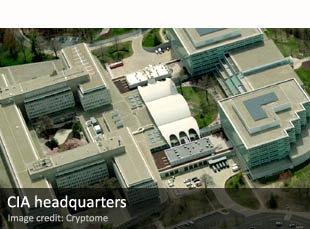
CIA headquartersBy IAN ALLEN | intelNews.org
►►What the Vietcong learned about torture that the CIA didn’t. The CIA is hardly the only spy service to grapple with blowback from making prisoners scream. Even leaders of Communist Vietnam’s wartime intelligence agency, notorious for torturing American POWs, privately knew that “enhanced interrogation techniques”, as the CIA calls them, could create more problems than solutions, according to internal Vietnamese documents.
►►Half of all Americans think CIA torture was justified. Americans who believe the CIA’s post-Sept. 11 interrogation and detention program was justified significantly outnumber those who don’t think it was warranted, according to a poll released Monday. A survey conducted by Pew Research Center found 51% of Americans think the CIA practices were warranted, compared with 29% who said the techniques were not, and 20% who didn’t express an opinion. A majority of those polled, 56%, believed the interrogation methods provided intelligence that helped prevent terrorist attacks.
►►Author of interrogation memo says CIA maybe went too far. As former Vice President Dick Cheney argued on Sunday that the CIA’s aggressive interrogation of terrorism suspects did not amount to torture, the man who provided the legal rationale for the program said that in some cases it had perhaps gone too far. Former Justice Department lawyer John Yoo said the sleep deprivation, rectal feeding and other harsh treatment outlined in a US Senate report last week could violate anti-torture laws.

Estonian intel officer comes out as Russian spy in TV interview

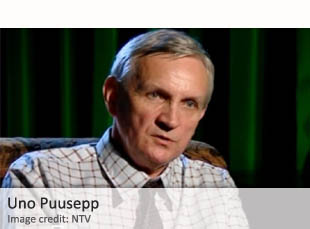
Uno PuuseppBy JOSEPH FITSANAKIS | intelNews.org
Estonian authorities have charged a retired officer in the country’s internal intelligence service with espionage, after he revealed in a television interview that he spied for Russia for nearly 20 years. Uno Puusepp retired from the Internal Security Service of Estonia, known as KaPo, in 2011. He first joined the Soviet KGB as a wiretapping expert in the 1970s, when Estonia was part of the USSR. Following the dissolution of the USSR, when Estonia became an independent nation, he was hired by KaPo and worked there until his retirement, three years ago, at which time he moved permanently to Russian capital Moscow. Last Sunday, however, Puusepp was the main speaker in a documentary entitled Our Man in Tallinn, aired on Russian television channel NTV. In the documentary, Puusepp revealed that he was a double spy for the Russian Federal Security Service (FSB), which is KGB’s successor, from 1996 until his retirement. He told the network that he was one of several former KGB operatives who had gone on to work for independent Estonia’s intelligence agencies, but that he had quickly decided that his true allegiance was to Russia. He eventually supplied Moscow with information on the activities of Western intelligence agencies in Estonia, including those of the American CIA, Britain’s MI6 and Germany’s BND. One commentator said in the documentary that “for 15 years, practically everything that landed on the desk of the Estonian security service’s director also landed on the desk of the FSB” thanks to Puusepp. The retired double spy said that one of his successes was letting the FSB know about a planned CIA operation that involved setting up a signals intelligence station in a disused bunker in the northern Estonian town of Aegviidu. The station was aimed at collecting communications from Russian diplomats and intelligence officers, but the Russian side terminated those networks once it got word of the CIA’s plans. Puusepp’s FSB recruiter and handler, Nikolai Yermakov, also spoke in the documentary, saying that the Estonian double spy was not motivated by financial profit, but rather by grievances against what he called “the Estonian establishment”. It is unclear why the Russian authorities permitted Puusepp to speak publicly at this particular time.

Norway probes intercept equipment found near PM’s home

Parliament of NorwayBy JOSEPH FITSANAKIS | intelNews.org
Authorities in Norway are probing a possible espionage operation by a foreign intelligence agency, following the discovery of several electronic surveillance devices located near government buildings in downtown Oslo. The presence of the devices was revealed on December 12 in a leading article by Norwegian daily newspaper Aftenposten, which published the findings of what it said was a two-month technical investigation into the matter. The paper said its reporters teamed up with two leading companies specializing technical surveillance countermeasures. According to the article, investigators came up with a network of surveillance devices disguised to look like cell phone base stations, known as transceivers. But the devices were actually International Mobile Subscriber Identity (IMSI) catchers, essentially fake cell phone towers that are often used clandestinely to intercept telephone traffic among users, as well as their movements. Aftenposten said that the devices, whose unauthorized use is illegal in Norway, had been placed outside the official residence and office of the prime minister, outside the houses of parliament, as well as near major banks and corporate headquarters. IMSI catchers cannot access the content of cellular communications, as most providers encrypt them nowadays; but they can record the telephone numbers of users, as well as pen-register data —namely who calls whom, when, for how long, etc. Additionally, if those behind the surveillance knew the telephone numbers of targeted subscribers, they could keep track of their physical movements through their phone’s GPS system, and identify who they contact on their cellular devices. The newspaper said the surveillance devices were almost certainly installed to monitor the activities of senior Norwegian government officials, as well as perhaps senior executives of companies headquartered in the Norwegian capital. On Monday, Norway’s National Security Authority (NSM) said it thought Aftenposten’s claims were probably correct. NSM Director Kjetil Nilsen said the main question was now who was behind the installations. Norwegian Police Security Service (PST) spokeswoman Siv Alsen told reporters on Monday that “the possibility that this is coming from foreign state agencies” could not be dismissed. She added that the PST would now proceed to probe whether the surveillance network was the work of foreign spies or organized criminal networks. Norway, a founding member of the North Atlantic Treaty Organization, is traditionally seen as an ally of the United States and has seen its relations with Russia and China strained in recent years.

Yemeni troops kill al-Qaeda suspects disguised as women

Yemeni women in Ta'izzBy IAN ALLEN | intelNews.org
Troops in Yemen shot dead five men, believed to be members of al-Qaeda, who tried to pass through a security checkpoint disguised as women. The incident reportedly happened on Saturday at an emergency roadside checkpoint set up by Yemeni troops in Harad, a dusty desert town located 10 miles south of Yemen’s border with Saudi Arabia. According to official reports, a minivan drove up to the checkpoint carrying what appeared to be six women, which was heading toward the Saudi border. All passengers were dressed in black robes and wore the niqab, a black cloth used to hide the face and worn along with the hijab, which typically covers a woman’s hair. The niqab is worn in several Arab countries, including Yemen, Saudi Arabia, Oman, and Bahrain. Yemeni soldiers conferred briefly with the male driver of the vehicle before one of them climbed onboard the minivan for a routine inspection. At that moment, one of the minivan passengers opened fire at the soldier, wounding him. The rest of the members of the inspection unit then opened fire on the passengers, killing five of them. Following the incident, the Yemeni soldiers discovered that the minivan’s passengers were all men and had been armed. An official speaking at a press conference later that day reported that at least two of those killed were Saudi citizens. He added that one of the passengers, who was also disguised as a woman, survived, as did the male driver of the minivan. All are believed to be members of al-Qaeda in the Arabian Peninsula (AQAP), an armed Islamist movement that is widely seen as the most formidable branch of al-Qaeda anywhere in the world. Following the 2011 uprising in Yemen, which was part of the Arab Spring, AQAP took advantage of the collapse of the Yemeni state and took over large swathes of territory in Sunni-dominated eastern and southern Yemen. These areas are still considered AQAP strongholds today. Security forces in Yemen often conduct roadside inspections, but they rarely enter vehicles carrying women, in an attempt to respect tribal customs in what is a very conservative part of the Arab world. Authorities in Harad said on Saturday that, following the shootout, a suicide belt and several weapons were discovered onboard the minivan. The surviving passenger is being questioned, along with the driver of the vehicle.

Reactions to US Senate’s CIA report fall along party lines

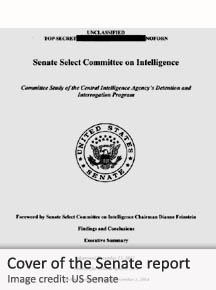
Cover of the Senate reportBy JOSEPH FITSANAKIS | intelNews.org
Almost immediately following the release of the United States Senate Intelligence Committee’s summary-report on the Central Intelligence Agency’s interrogation program, American public figures began to hurriedly fall in line along predictable partisan positions on the subject. The 500-page document, released on Tuesday, represents the publicly available version of a 6,000-page report that dismisses the CIA’s post-9/11 detention and interrogation program as an intelligence failure. It also details instances of systematic use of torture by the Agency and accuses it of lying to Congress and the Executive about the effectiveness of its detention methods. But the published report was boycotted by the Senate Committee’s Republican Party members; consequently, it was authored solely by the group’s Democratic Party members, who currently constitute a majority in the Committee. Its Republican members, led by Senator Saxby Chambliss (R-Ga), released an alternative 160-page minority report that dismisses the majority document as an inaccurate and hastily produced account, which endangers American national security. The Republican-supported minority statement praises the CIA for weakening al-Qaeda in the years after 9/11 and lambasts its critics for “misrepresentations of fact” rooted in “political motivations”. Meanwhile, as senior officials in the administration of US President Barack Obama voiced support for the Senate report, an anonymous group of former senior CIA officials launched a website lambasting it as “the single worst example of Congressional oversight in our many years of government service”. IntelNews understands that the website, entitled “CIA Saved Lives”, is organized by Bill Harlow, the CIA’s public-affairs director from 1997 to 2004, who is close to the Agency’s former Director, George Tenet. Tenet was a trusted advisor of then-US President George W. Bush, and led the CIA during the implementation of the early stages of the post-9/11 interrogation program. The CIA’s own response to the Senate report came in a public press release that acknowledged “serious mistakes” in the interrogation program while defending its alleged effectiveness in weakening of al-Qaeda. Rare examples of public figures that broke party lines were Susan Collins (R-Me), the only Senate Intelligence Committee Republican not to endorse the minority report, and Senator John McCain (R-Az). McCain, who underwent years of torture as a prisoner of war in North Vietnam, said the CIA’s use of torture “stained [America’s] national honor” and had done “much harm and little practical good”.

Irish police mole helped entire IRA leadership avoid capture in 1974

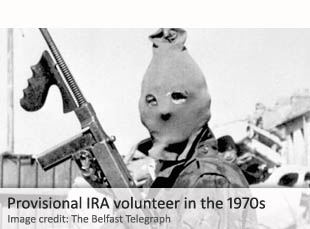
Provisional IRA volunteer in the 1970sBy JOSEPH FITSANAKIS | intelNews.org
The former intelligence director of the Provisional Irish Republican Army has claimed that an informant within the Irish police helped the entire leadership of the militant organization avoid capture during a raid in 1974. The raid was conducted in December of 1974 by Garda Síochána, the police force of the Republic of Ireland, in the village of Feakle, County Claire, in western Ireland. On the day of the raid, the entire leadership of the Provisional IRA was taking part in a secret meeting with Protestant clergy, which had been pursued by the separatist organization following the so-called pub bombings in the English cities of Guildford and Birmingham. The bombings were meant to take the war in Northern Ireland to the British mainland, but were eventually deemed disastrous to the image of the IRA. Nearly 30 people died in the bombings, while hundreds were injured, many of them seriously. The secret meeting between the IRA’s leadership and Protestant clergy was part of a wider negotiation campaign between republican separatists and pro-British loyalists, which eventually led to a ceasefire that lasted until the start of 1975. However, an informant had given the Garda accurate information about the meeting location between the IRA senior command and Protestant clergy, and the agency’s Crime and Security Branch planned to swoop on the meeting and arrest the republican militants. However, in an interview with British newspaper The Guardian, the IRA’s former director of intelligence, Kieran Conway, said the IRA leadership managed to escape arrest thanks to “a tip-off from high-placed figures within the Garda”. Conway joined the IRA in 1970 and became director of its intelligence wing in 1974. He left a year later and joined again in 1981 during the hunger strikes by republican prisoners. He left for good in 1993, in protest against the IRA’s decision to sign the Downing Street Declaration, which formed the basis of the IRA’s eventual decision to decommission its weapons and enter the political process. Conway also told The Guardian that the IRA had the support of “prominent members of the Irish establishment” including mainstream politicians, senior bankers, stockbrokers and journalists. Many of these supporters provided safe houses for members of the IRA in affluent neighborhoods of Irish capital Dublin, he claimed. Conway was speaking to promote his recently published book, called Southside Provisional: From Freedom Fighter to the Four Courts. This is not the first time allegations have surfaced about IRA moles inside the Irish Garda. In 2011, an Irish government investigation unearthed intelligence reports claiming that an informant within the agency helped the IRA plan the killings of a judge and two senior British police officers in the 1980s.

After China, Russia may ban some Apple products, fearing espionage

Russian State DumaBy JOSEPH FITSANAKIS | intelNews.org
Parliamentarians in Russia are preparing a bill that would prevent lawmakers from using several Apple products, including iPhones and iPads, due to fears that they are susceptible to penetration by foreign intelligence agencies. A group of lawmakers in the State Duma, the lower house of the Federal Assembly of Russia, have drafted the bill, which argues that State Duma deputies with access to confidential or classified government information should be banned from using iPhones and iPads, among other Apple products. One deputy, Dmitry Gorovtsov, from the center-left Just Russia party, said parliamentarians should simply “switch to simple mobile phones”, preferably produced by Russian manufacturers, and should use them “only for phone calls”. Last month, the Russian Ministry of Defense stepped in to deny media reports that it was about to ban Apple products. The denial came in response to a leading article in mass circulation daily Izvestia, which cited an unnamed Defense Ministry employee as saying that the Russian armed forces were about to ban the use of iPhones by all servicemen. The article claimed the move was designed to stop “information leaks”. But a Russian Ministry of Defense spokesman, Major General Igor Konashenkov, told a press conference that the Russian armed forces had no plans to ban “the mobile devices of a certain manufacturer”. The news from Russia comes a just months after authorities in China announced the removal of some Apple products from a government procurement list, reportedly because of fears that they were susceptible to electronic espionage by the United States. As intelNews reported at the time, nearly a dozen Apple products were removed from the Chinese government list; they included the iPad and iPad Mini, as well as MacBook Air and MacBook Pro products —though interestingly the inventory of removed items did not include Apple smartphone products. The Russian State Duma initiative to ban some Apple products has already been approved by a security-related committee and has now been forwarded to the Duma Council. The latter will consider the bill for approval, before sending it to a plenary session on the floor of the Duma for discussion. The process is expected to take up to two weeks.

Israeli ex-spy chief says Netanyahu policies ‘will destroy Israel’

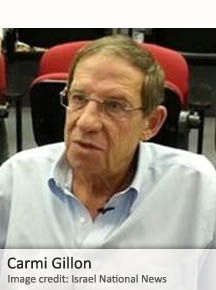
Carmi GillonBy IAN ALLEN | intelNews.org
The former director of Israel’s internal security service has warned that the policies of the Israeli government could lead to the complete destruction of the country. Carmi Gillon, Israel’s former ambassador to Denmark, led the Shin Bet, also known as Israel’s Internal General Security Service, from 1994 to 1996. In a scathing attack against Israel’s current Prime Minister, Benjamin Netanyahu, Gillon accused him of being “an egomaniac” heading “a bunch of pyromaniacs” in government, who are leading the state of Israel “to its final destruction”. Gillon, 64, was speaking on Saturday evening at the “Peace Now” rally, organized outside the official residence of the Prime Minister in Jerusalem. Participants in the rally were protesting against the so-called Jewish State Law, a bill currently being discussed in the Israeli Knesset, which seeks to officially define Israel as “the nation state of the Jewish people”. The effort enjoys broad support from the Israeli right, including from Prime Minister Netanyahu. But it has been condemned by the country’s left, as well as by non-Jewish citizens of Israel, as a deliberate attempt to marginalize approximately a quarter of Israel’s population, which is non-Jewish. Some critics claim that Netanyahu and his supporters are attempting to prevent Israel from ever becoming a binational state, consisting largely of Jewish and Arab citizens, thus forever eliminating the so-called ‘one-state solution’ to the Jewish-Palestinian problem. The bill had been scheduled to be voted on in the Knesset on Wednesday, but its supporters in the Israeli parliament postponed the vote, following a wave of popular anger against the bill that has erupted throughout Israel in recent days. Speaking on Saturday at the rally in Jerusalem, Gillon said the Jewish State Law would “enshrine Israel’s status as a Jewish state” and would “eat the body of the entire nation like a cancer”. He added that he was speaking “with full professional authority” and urged opponents of the bill to “fight this fascism” that was propagated by “Bibi Netanyahu and the extreme right”. Later on Saturday, Israel’s former President, Shimon Peres, also spoke out against the proposed bill, which he described as “an attempt to undermine [Israel’s] Declaration of Independence for political interests”. He added that, if enacted, the bill would “damage the country both at home and abroad” and would “erode the democratic principles of the State of Israel”.

Pollard’s Mossad handler says he failed to follow agreed escape plan

Jonathan PollardBy JOSEPH FITSANAKIS | intelNews.org
A convicted spy who betrayed American secrets to Israel in the 1980s was captured by the FBI because he failed to follow a prearranged escape plan to flee America for Israel, according to his Israeli former handler. Jonathan Jay Pollard is a former intelligence analyst for the United States Navy, who has so far served nearly 29 years in prison for selling American government secrets to Israel. Ron Olive, an Assistant Special Agent at US Navy Counterintelligence, who in cracked the Pollard case, leading to the spy’s arrest and conviction, has called Pollard the most damaging spy in American history. “Pollard stole so many documents, so highly classified, more so than any other spy in the history of this country, in such a short period of time”, he said in 2012. On November 21, 1985, while under investigation by the Federal Bureau of Investigation, Pollard panicked and attempted to gain asylum at the Israeli embassy in Washington, DC. However, he was thrown out by embassy guards and was immediately arrested by FBI agents, who had surrounded the Israeli embassy. Ever since his arrest and conviction, Pollard and his family have repeatedly hinted that his Israeli handlers failed to protect him when he sought their help. But in an interview on Israeli television, Rafi Eitan, Pollard’s handler at the time of his arrest, placed the blame squarely on Pollard himself. Eitan was at the time head of the Scientific Relations Office, an obscure unit inside Israeli intelligence agency Mossad, for which Pollard had agreed to spy in exchange for money. On Monday, he told Israel Channel 2 television’s flagship investigative program Uvda that Pollard had been specifically instructed by the Israelis to stay away from their Washington embassy. Instead, said Eitan, the American spy had agreed to follow “a prearranged escape plan that would get him safely out of the United States”. But instead of following the plan as soon as he was approached by the FBI, Pollard waited for three days before panicking and deciding to go to the Israeli embassy without giving his Mossad handler prior notice. Eitan told his Channel 2 interviewers that he received a telephone call notifying him that Pollard was at the gates of the embassy asking for asylum, while the embassy had been surrounded by FBI personnel. “I immediately said ‘throw him out'”, said Eitan, “and I don’t regret it”, since offering Pollard asylum in the presence of a strong FBI force around the Israeli embassy, would have “created an even greater crisis between the United States and Israel”, said the former Mossad spy handler. Eitan added that he took full responsibility for the decision to abandon Pollard. As for the decisions that led to Pollard’s arrest, he said: “you can’t wage war without making mistakes”.