Medical review article considers Arafat poisoning theory
October 14, 2013
 By IAN ALLEN | intelNews.org
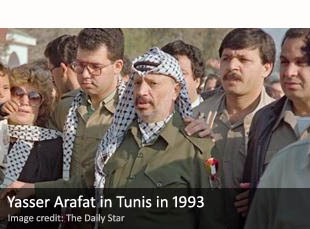
The publication of a peer reviewed article in one of the world’s leading medical journals has reinforced the possibility that the late Palestinian leader Yasser Arafat may have died of poisoning. A nine-month study into the possible poisoning of the founder of Palestinian nationalist group Fatah, was commissioned in 2012 by Qatari news channel Al Jazeera. It was undertaken by a team of researchers at the Institut de Radiophysique (IRA) in Lausanne, Switzerland. According to the results, announced in July of that year, significant traces of the radioactive substance polonium 210 were discovered on the personal artifacts that Arafat used during his final days while in hospital in Paris, France, in 2004. According to the IRA, some of the Fatah leader’s personal belongings, including his underwear and his toothbrush, contained levels of polonium that were as many as ten times higher than those in random samples used as control subjects in the study. Shortly after the IRA study, Arafat’s wife and daughter filed an official complaint with French judicial authorities, who in turn decided to open an official murder investigation into the death of the late Palestinian national leader. Now British medical journal The Lancet has published a peer reviewed analysis of the IRA research, which outlines and endorses its conclusions. The article, entitled “Improving forensic investigation for polonium poisoning”, was authored by a group of researchers at the IRA in Lausanne and at the University Centre of Legal Medicine, which is also in Switzerland. It explains the procedures followed during the forensic investigation of Arafat’s belongings, and examines the theory that Arafat may have been poisoned. The researchers state that the “findings [of the investigation] support the possibility of Arafat’s poisoning with 210Po”. Read more of this post










 intelNews.org
KGB ‘ran two Australian politicians as agents’ in 1970s: document
October 15, 2013 by Joseph Fitsanakis
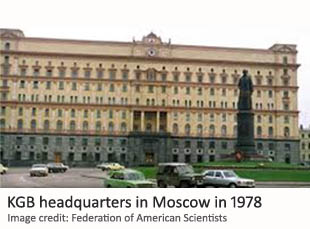
Soviet intelligence recruited and ran at least two Australian elected politicians as agents for the USSR in the 1970s, according to a confidential account authored by an Australian counterintelligence officer. The report’s author is allegedly an unnamed former employee of the Australian Security Intelligence Organisation (ASIO), which is tasked with counterespionage. Australia’s Fairfax Media, which claimed yesterday to have accessed the report, described it as “an unusually candid document”. It allegedly describes Soviet intelligence activities on Australian soil during the last two decades of the Cold War and names known Soviet intelligence officers operating in Australia at the time. Among those named is Vladimir Yevgenyevich Tulayev, described in the confidential report as “a hard-eyed, well-dressed thug” who was “aggressively involved in intelligence operations in Australia”. The document also names Geronty Lazovik, considered by AFIO as a “definite agent runner”. Australian counterintelligence described Lazovik as a far more refined operative than Tulayev and kept tabs on him as he developed and cultivated “a wide range of contacts” across Australia’s Federal Parliament. The report suggest that Australian Labor Party politicians, aides and lobbyists were among Lazovik’s “contacts” in Australia, though it does not explicitly name them as agents of the Soviet KGB. Arguably the most important allegation made in the report is that another KGB operative in Australia, Vladimir Aleksandrovich Aleksyev, was able to recruit and run “two Australian politicians as agents” in the late 1960s and early 1970s. The document states that Aleksyev was able to handle the two alleged recruits “using tradecraft of a fairly high order”, suggesting that he was perhaps one of the KGB’s most successful known case officers in Australia. The confidential report alleges that the ASIO leadership approached the Australian government with information about the operations of the KGB officers. Read more of this post
Filed under Expert news and commentary on intelligence, espionage, spies and spying Tagged with ASIO, Australia, Australian Security Intelligence Organisation, Cold War, espionage, Geronty Lazovik, Gough Whitlam, history, KGB, News, USSR, Vladimir Aleksandrovich Aleksyev, Vladimir Aleksyev, Vladimir Tulayev, Vladimir Yevgenyevich Tulayev