Allegations of espionage rock Credit Suisse, as more employees come forward

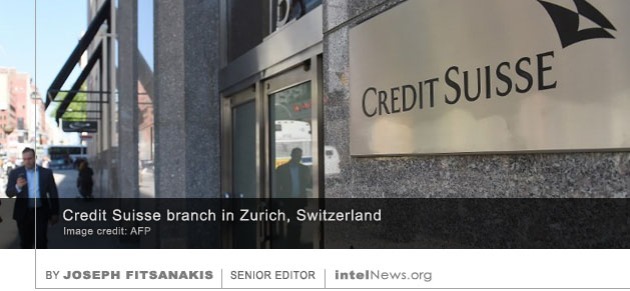
Credit SuisseCredit Suisse, one of the world’s most powerful banking firms, says it has opened an investigation into claims that it paid private investigators to spy at individuals, just two months after a similar scandal involving espionage and surveillance rocked the company.
In October of this year, two senior Credit Suisse executives resigned amidst a high-stakes espionage scandal, which may have prompted a suicide. The alleged target of the espionage was Iqbal Khan, the former Chief Executive Officer (CEO) of Credit Suisse’s wealth-management division. Khan alleged that he was spied on by private investigators, paid for by Credit Suisse, after leaving the firm. One of the private investigators involved in the case, described as “an external security expert” who mediated between Credit Suisse and the investigation firm, committed suicide.

At the time, Credit Suisse described the surveillance on Khan as “strictly an isolated incident”. However, on December 11, The Wall Street Journal published allegations by another Credit Suisse executive, Colleen Graham, who said that she had been spied on after leaving her job at the firm. She alleged that she underwent three days of intensive surveillance by persons unknown in July of 2017. Credit Suisse was dismissive of Graham’s claims, saying that they were baseless.

But on Wednesday the firm announced the launching of a new probe after a third employee, who used to work directly under Credit Suisse Chief Executive Officer Tidjane Thiam, alleged that he too had been spied on. The allegations were made by Peter Goerke, and were the subject of a headline article by the respected Swiss daily Neue Zürcher Zeitung. The article was accompanied by documents and photographs submitted by Goerke, which are said to support his claims.

There are now concerns that spying on former and current employees may have been a standard operating procedure at Credit Suisse. In an article published on Wednesday, The Wall Street Journal said that the alleged incidents “highlight the ethical and reputational pitfalls companies encounter when they physically monitor employees”.

Author: Joseph Fitsanakis | Date: 19 December 2019 | Permalink

German government to hire 600 new officers to help monitor far-right activity

German Federal Criminal Police OfficeThe German government has announced plans to hire hundreds of new police and intelligence officers, in order to step up its monitoring of violent far-right groups in the country. The announcement came at a press conference hosted on Tuesday in Berlin by Horst Seehofer, Germany’s Interior Minister.
Seehofer told reporters that the Federal Office for the Protection of the Constitution —BfV, Germany’s domestic intelligence and counterterrorism agency— would hire 300 new officers whose job will be to focus on domestic far-right extremism. The German Federal Criminal Police Office will hire an additional 300 offers for the same purpose, added Seehofer. With these additional 600 officers, federal authorities will be able to increase their monitoring of far-right political groups, football fan clubs, far-right websites, and other hubs of far-right activity, said the minister.

German authorities estimate that there are 12,000 committed far-right extremists in the country who are willing and able to carry out violent attacks inside Germany or abroad. However, nearly 50 percent of actual attacks by adherents of far-right ideologies that have taken place in Germany in recent years have been carried out by individuals who were not on the radar of the police and intelligence services.

In addition to hiring 300 new intelligence officers, the BfV will set up a new “Central Office for Far Right Extremism in Public Service”, whose task will be to uncover adherents of far-right ideologies working in government agencies. The new office will concentrate its investigations on the police, the military and other government bodies.

During his press conference on Tuesday, Minister Seehofer stressed that the intensification of investigations into far-right terrorism would not happen at the expense of probing political violence from the far left and Islamist extremists.

Author: Joseph Fitsanakis | Date: 18 December 2019 | Permalink

Denmark arrests 22 in counter-terrorism raids, allegedly with help from Israel

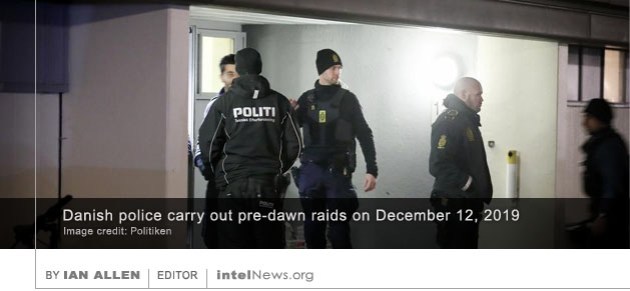
Danish policeLast Thursday Danish authorities arrested 22 terrorism suspects in early morning raids across the country. Reports from Israel suggest that the raids were carried out following a tip from Israeli intelligence. The 22 suspects include men and women. Danish police said they were involved in the final stages of a plot to carry out attacks “in Denmark or abroad”, but have provided no specific information, except to say that the attacks were “thwarted” while they were well underway.
Danish media reported that the early-morning raids by police and intelligence personnel resulted in the arrest of 22 individuals. These have not yet been named in accordance with Denmark’s strict privacy laws. Among them are four men between 21 and 25 years of age, and a 38-year-old woman. All were remanded in a court in Copenhagen on Thursday and Friday of last week. A sixth individual, aged 28, was remanded to custody separately from the other five. His hearing was reportedly held in secret, and no information other than his age and gender has been made public.

The six suspects are accused of trying to build bombs using triacetone triperoxide (TATP) explosive. They are also accused of trying to purchase guns, ammunition and sound suppressors, commonly known as silencers. Danish police said the suspects planned to use the explosives and guns “in connection with one or more terrorist attacks inside Denmark or abroad”. However, no further information has been provided about the targets of the alleged terrorist plot.

Meanwhile on Saturday, Israel’s Channel 12 television claimed that the Danish counter-terrorism raids were sparked by information provided to Danish authorities by the Mossad, Israel’s primary external intelligence agency. The channel, a popular privately owned television station, did not provide evidence of the claim, or any specific information about the alleged intelligence tip.

Danish police said on Monday that 16 of those arrested last week have been released, but remain suspects in the investigation. The remaining six suspects all pleaded not guilty to charges of terrorism on Saturday. They will remain in prison on pre-trial custody while the authorities continue to investigate the alleged terrorist plot.

Author: Ian Allen | Date: 17 December 2019 | Permalink

US expels Chinese diplomats for the first time since 1987

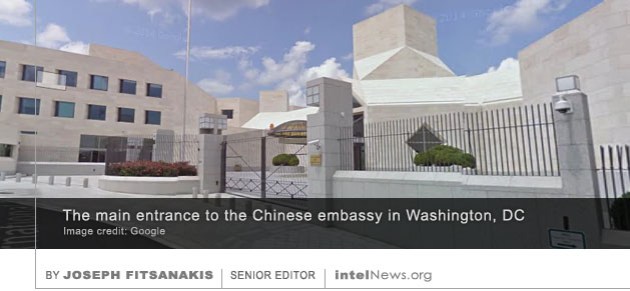
Chinese embassy in the United StatesThe United States quietly expelled two Chinese diplomats in October of this year, a move that neither Washington nor Beijing chose to make public, according to a report published on Sunday. If true, the incident would signify the first known expulsions of Chinese diplomatic personnel from the US since 1987.

The incident was reported by The New York Times, which cited “six people with knowledge of the expulsions”. It said that the expulsions were triggered by an incident that took place in September in the US state of Virginia. It involved at least two Chinese diplomats stationed in Washington, who allegedly attempted to enter “a sensitive installation” near the city of Norfolk. The paper did not name the installation, but said that it belongs to the US Armed Forces and is also used by members of Special Operations forces.

According to the American side, a car carrying the Chinese diplomats and their spouses drove up to one of the checkpoints of the military installation. Upon realizing that the car’s passengers did not have permission to enter the base, the guard at the checkpoint asked the driver to proceed through the gated entry and immediately turn around, thus exiting the base. But the car allegedly drove straight into the base and did not slow down after military personnel pursued it. It came to a stop only after several fire trucks blocked its way.

Once apprehended, the car’s passengers claimed that their knowledge of English was limited and had thus misunderstood the instructions given to them by the guard at the entrance to the base. The New York Times reported that this explanation was echoed by associates of the Chinese diplomats, who said that they were on “a sightseeing tour when they accidentally drove onto the base”.

But US officials told The Times they are skeptical of that explanation, and suspect the Chinese diplomats were trying to assess the physical security of the installation. Moreover, at least one of the Chinese diplomats was allegedly an intelligence officer operating under diplomatic cover —a clue that heightened the skepticism of American officials.

Interestingly, although it complained about the expulsions of its diplomats following the incident in Virginia, Beijing did not retaliate, as is customary in such cases. Therefore, no American diplomats or intelligence officers have been expelled from China in response to Washington’s move. The last time the US expelled Chinese diplomats from its soil was in 1987, when two employees of the Chinese embassy in Washington —almost certainly intelligence officers operating under diplomatic cover— were declared personae non gratae.

Author: Joseph Fitsanakis | Date: 16 December 2019 | Permalink

Germany convicts married couple of spying for Indian intelligence service

Manmohan S. Kanwal Jit K.A court in Frankfurt has found a married couple guilty of spying in Germany on behalf of India’s external intelligence service. Due to Germany’s strict privacy laws, the couple have been identified only as 50-year-old Manmohan S. and his wife, Kanwal Jit K., who is 51.

According to the prosecution, Manmohan S. was recruited by India’s Research and Analysis Wing (RAW) in January of 2015. His wife joined his intelligence-collection activities in July 2017. Following their arrest, the couple told German authorities that they held regular meetings with a RAW case officer who was serving as a diplomat in the Indian consulate in Frankfurt. They also said they were paid nearly $8,000 for their services.

The two convicted spies said at their trial that they were tasked to spy on adherents of the Sikh religion and members of the Kashmiri expatriate community in Germany. The central European country is believed to host as many as 20,000 Indian Sikhs, many of whom openly proclaim secessionist aspirations. Many Sikhs in India and abroad campaign for the creation of a Sikh state in parts of northwestern India and Pakistan, which they call Khalistan. India is also concerned about the secessionist aspirations of Kashmiris, a predominantly Muslim population of 10 million that lives in the region of Jammu and Kashmir. Delhi has long claimed that expatriate groups living in Europe and the United States provide funding for secessionist groups that operate in the region.

On Thursday, Frankfurt’s Higher Regional Court found the couple guilty of conducting illegal espionage activities on German soil. It handed Manmohan S. a one-and-a-half-year suspended jail sentence, while Kanwal Jit K. was given a fine that equates to 180 days of income.

Author: Joseph Fitsanakis | Date: 13 December 2019 | Permalink

Belgian university shuts down Chinese-funded institute due to espionage claims

Xinning SongOne of Belgium’s leading universities has decided to shut down a research institute funded by the Chinese government, after the Belgian intelligence service accused its director of spying on behalf of Beijing. The news was announced on Wednesday by the Vrije Universiteit Brussel (VUB), one of Belgium’s leading higher-education institutions. The Confucius Institute has been operated at VUB since 2006. But the university’s board of directors now says that it will not be renewing its contact with the Institute in 2020.

The Confucius Institute at VUB is one of more than 500 such research bodies that the government of China has funded around the world since 2004. Their mission is to promote the language and culture of China to the world. However, numerous academic institutions in Japan, Canada, and a number of European countries, have recently shut down Confucius Institute branches, following allegations that their staff members carried out espionage tasks, or tried to stifle academic research critical of China. In Europe alone, the University of Lyon in France, Stockholm University in Sweden, and Holland’s University of Leiden have all recently terminated their cooperation with the Confucius Institute.

In October of this year, Belgium’s State Security Service (VSSE) concluded that the VUB Confucius Institute director, Dr. Song Xinning, carried out espionage tasks on behalf of the Chinese government. As a result, the Belgian government refused to renew the work visa of Dr. Song, who had lived in Belgium for over a decade. Additionally, the Chinese academic was barred from entering the European Union’s Schengen Area —which comprises 26 European countries— for eight years.

Dr. Song alleges that his work visa was revoked after he refused to cooperate with an American diplomat stationed in Brussels. He also denies that he was ever in the service of Chinese intelligence or the Chinese state. But the VUB appears to have sided with the Belgian government in this dispute. The university annulled its contract with Dr. Song and, as of January, will be terminating its relationship with the Confucius Institute. In a press statement published online, VUB Rector Caroline Pauwels said that the work of the Confucius Institute did not meet the “current policy objectives” of the university.

Author: Ian Allen | Date: 12 December 2019 | Permalink

Victor Sheymov, among Cold War’s most important KGB defectors, dies at 73

Victor SheymovVictor Ivanovich Sheymov, who is often referred to as one of the most important intelligence defectors of the Cold War, has reportedly died in the American state of Virginia. He was one of the most senior officials in the Soviet Union’s Committee for State Security (KGB) to ever defect to the West, and revealed important KGB secrets to the United States.
Sheymov was born in 1946 to a family of elite Soviet scientists. His father was an engineer and his mother a doctor specializing in cardiology. A gifted mathematician and student-athlete, Sheymov was recruited into the KGB almost as soon as he graduated from the elite Bauman Moscow State Technical University, where he majored in engineering. By his early 30s, Sheymov had risen to the rank of major under the KGB’s Eighth Chief Directorate, which handled secret communications systems. He oversaw a large unit that monitored the flow of information between the KGB’s headquarters and the agency’s operatives around the world. In later years, Sheymov was assigned code-breaking and counter-espionage tasks, and oversaw the preparation of daily classified briefings for the Politburo —the Communist Party’s highest policy-making body.

But in the 1970s Sheymov grew disillusioned with Soviet politics, and began to feel slighted by the infighting and incompetence inside the KGB. While visiting Poland on KGB business, he volunteered his services to the Central Intelligence Agency (CIA) by walking into the US embassy in Warsaw. The CIA eventually gave him the cryptonym CKUTOPIA and, after verifying his senior status inside the KGB, exfiltrated him to the United States along with his wife and 5-year-old daughter. His was the first known instance of a successful CIA exfiltration of a defector from Soviet territory.

After spending several months being debriefed and polygraphed at a CIA safe house, Sheymov and his family were given new identities and US citizenship. But the defector decided to emerge from hiding in 1990, as the USSR was dissolving. In his book about his espionage work and defection, titled Tower of Secrets, Sheymov said he informed the CIA about the KGB’s unsuccessful plots to assassinate Pope John Paul II and about the successful operation to assassinate Afghan President Hafizullah Amin in 1979. His insights were also instrumental in the decision of the US State Department to demolish the US embassy in Moscow, due to fears about the presence of listening devices planted inside the building’s walls by Soviet builders. The building was eventually replaced with another structure built by vetted American workers.

Sheymov was awarded the US Intelligence Medal and lived the rest of his life in America, where he headed a computer security company. He died on October 18 in Vienna, Virginia, but his death was not publicly reported until this week. Sheymov’s wife told reporters that he died from health complications arising from chronic pulmonary disease.

Author: Joseph Fitsanakis | Date: 10 December 2019 | Permalink

Unprecedented trial of ‘secret prisoner’ in Australia raises legal questions

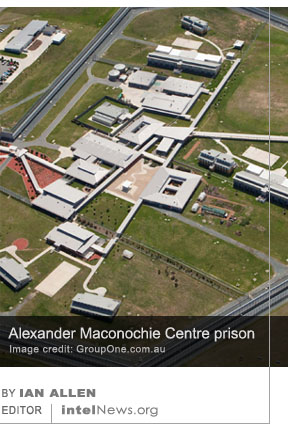
Alexander Maconochie CentreAn unprecedented closed-door trial of a man identified only as “Witness J”, who was convicted earlier this year of a crime that cannot be revealed, has raised questions about the relationship between security and the law in Australia. The man, who is also known as “Prisoner 123458”, was sentenced to a jail sentence in February of this year. His sentencing came following a closed-door hearing, which was described by a judge as “generally undesirable” and “unusual”.
Witness J is believed to be in his mid-30s and to have served as an intelligence officer in the Australian military, with a Top Secret security clearance. According to ABC News, he served in Iraq, Afghanistan, and East Timor and had a distinguished service record. But he drew the attention of counterintelligence investigators in 2018, while undergoing a five-year re-evaluation of his security clearance status. During that time he was reportedly serving as a civilian in an undisclosed country in Southeast Asia.

ABC News said that “some anomalies in [Witness J’s] answers” —presumably while he was undergoing a polygraph test— raised further questions about whether “he could be compromised”. This, according to ABC News, coincided with the deterioration of his mental health, which led him to seek “internal help” from his employer on several occasions. Reportedly, his Top-Secret clearance status did not allow him to seek outside professional advice about his condition. Witness J was eventually jailed in mid-May 2018 and spent a month in solitary confinement. He was then placed in a high-security wing for serious sex offenders at the Alexander Maconochie Centre prison in Canberra. This was not because he was a sex offender, but because it was determined that he would be safer there than in the other wings of the prison.

In February of this year, Witness J was sentenced in a closed-door trial, held under the secrecy provisions of Australia’s 2004 National Security Act. Australia’s Attorney General, Christian Porter, told ABC that the information shared in Witness J’s hearing was “of a kind that could endanger the lives or safety of others”. The only reason why records of Witness J’s incarceration have appeared on the public record was because officers of the Australian Federal Police obtained a warrant to search his prison cell in order to confiscate a personal memoir that they allege the prisoner composed about his case during his incarceration.

It is believed that Witness J was released from prison in August of this year, 16 months before completing his sentence. He is not able to speak to the press, or identify himself in public in connection with this case. According to ABC News, he is only allowed to refer to his conviction as having been for “mishandling classified information”. Several experts have commented on the secret trial of Witness J One expert, Bret Walker, a barrister and former independent national security legislation monitor, told “ABC News that the case of Witness J was “a perfectly well-intentioned piece of national security legislation might not be operating in the way one would like”.

Author: Ian Allen | Date: 09 December 2019 | Permalink

Estonian court to release defense official who spied for Russia for 13 years

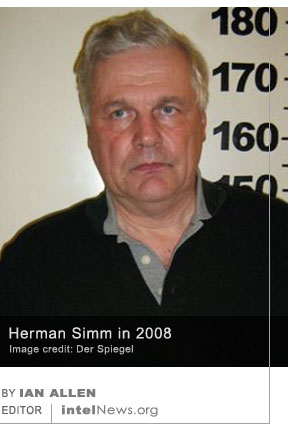
Herman SimmA court in Estonia has ordered the release of a former senior defense official who spied on the North Atlantic Treaty Organization for Russia, causing what experts described at the time as “the most serious case of espionage against NATO since the end of the Cold War”. Herman Simm was a high-level official at the Estonian Ministry of Defense, who once led the country’s National Security Authority. This meant that he was in charge of Estonia’s national cyber defense systems and supervised the issuing of security clearances.

He was arrested in 2008 along with his wife and charged with spying for Russia for over a decade. At the time of his arrest Simm was responsible for handling all of Estonia’s classified and top secret material regarding NATO. This prompted European and American security officials to describe Simm as the most damaging spy against NATO since the collapse of the Soviet Union in 1991. In February of 2009 Simm was sentenced to 12½ years in prison.

On Thursday, a county court in Estonia’s southeastern city of Tartu ruled that Simm is eligible for parole, because he has served the majority of his prison sentence without committing any disciplinary infractions. Officials from the Tartu County Prison and the prosecutor’s office agreed that early release would provide Simm with an incentive to abide with Estonian law. The court also stated in its decision that Simm had no more access to classified information and that he was of no further interest to foreign countries and intelligence organizations.

Simm is expected to be released within days, and will remain under probation until March of 2021. The court’s decision can be appealed by December 20.

Author: Ian Allen | Date: 06 December 2019 | Permalink

Elite Russian spy unit used French Alps region as logistical base

Chamonix FranceAn elite group Russian military intelligence officers, who have participated in assassinations across Europe, have been using resorts in the French Alps as logistical and supply bases, according to a new report. The report concerns Unit 29155 of the Main Directorate of the General Staff of the Russian Armed Forces, commonly known as GRU. According to The New York Times, which revealed its existence of 29155 in October, the unit has been operating for at least 10 years. However, Western intelligence agencies only began to focus on it in 2016, after it was alleged that an elite group of Russian spies tried to stage a coup in the tiny Balkan country of Montenegro.

Unit 29155 is believed to consist of a tightly knit group of intelligence officers led by Major General Andrei V. Averyanov, a hardened veteran of Russia’s Chechen wars. The existence of the unit is reportedly so secret that even other GRU operatives are unlikely to have heard of it. Members of the unit frequently travel to Europe to carry out sabotage and disinformation campaigns, kill targets, or conduct other forms of what some experts describe as the Kremlin’s hybrid war. They are believed to be responsible for the attempt on the life of Sergei Skripal, a former GRU intelligence officer who defected to Britain. He almost died in March 2018, when two Russian members of Unit 29155 poisoned him in the English town of Salisbury.

On Wednesday, a new report in the French newspaper Le Monde claimed that Unit 29155 used the French Alps as a “rear base” to carry out operations throughout Europe. According to the paper, the information about the unit’s activities in France emerged following forensic investigations of the activities of its members by British, Swiss, French and American intelligence agencies. In the same article, Le Monde published the names of 15 members of Unit 29155, which allegedly stayed in various French alpine towns and cities between 2014 and 2018. The paper said that they traveled to France from various countries in Europe, such as Spain, the United Kingdom, Switzerland, or directly from Russia.

The alleged Russian spies stayed in France’s Haute-Savoie, which borders Switzerland, and is among Europe’s most popular wintertime tourist destinations. The area includes the world-famous Mont Blanc mountain range and the picturesque alpine towns of Annemasse, Evian and Chamonix. Several members of the unit visited the region repeatedly, said Le Monde, while others entered France once or twice, in connection with specific spy missions. It is believed that the reasoning behind their trips to the French Alps was to blend in with the large numbers of international tourists that travel to the region throughout the year. However, the unit also utilized several other areas in Eastern Europe as rear bases, including cities and towns in Moldova, Montenegro and Bulgaria, said Le Monde.

Author: Joseph Fitsanakis | Date: 05 December 2019 | Permalink

Switzerland claims embassy worker was abducted by Sri Lankan security officers

Swiss embassy Sri LankaSwitzerland has filed a formal complaint after an employee of the Swiss embassy in Sri Lanka was allegedly abducted by men who forced her to divulge sensitive information about the embassy and its activities. The Swiss Ministry of Foreign Affairs said on Tuesday that the embassy employee was kidnapped by four men while walking in the Sri Lankan capital Colombo, on November 25. The men took her to what appeared to be a safe house and interrogated her for several hours.

The men eventually forced the Swiss embassy employee, who is a Sri Lankan national, to unlock her personal cell phone. According to Swiss government officials, they appeared to be looking for information about a senior Sri Lankan police detective who recently fled to Switzerland with his family and was granted political asylum. Some Sri Lankan media identified the man as Nishantha Silva, a police detective who until recently headed the Sri Lankan Criminal Intelligence Division’s Organized Crime Investigation Unit.

Silva is one of hundreds of members of Sri Lanka’s public sector who have fled abroad following the election of President Gotabaya Rajapaksa last month. The Rajapaksa family is one of the most powerful in the country, and has a long history of influencing Sri Lankan politics. Hours after assuming power, the ultra-nationalist Rajapaksa pledged to “hunt down” the leadership of the police and security services who investigated his family after 2015, when the Rajapaksas were ousted from the government. Hundreds of police and security officers have since been arrested or summarily fired.

On Tuesday, a Swiss Foreign Ministry spokesman told The New York Times that the Swiss government had verified the details of the abduction of its embassy worker. The spokesman added that the employee was forced to disclose “embassy-related information” after she was “threatened at length” by the men. The latter released her after warning her that she would be killed if she spoke to anyone about her ordeal.

On Monday, a spokesman for President Rajapaksa told reporters in Colombo that the Sri Lankan government questioned the accuracy of the Swiss embassy worker’s account of her abduction. Later, however, the Sri Lankan government announced that it had launched an investigation into the allegations. It now appears that the Sri Lankan government is preventing the embassy worker from leaving the country while the investigation into her claims is underway.

Author: Joseph Fitsanakis | Date: 04 December 2019 | Permalink

FBI examining FaceApp over potential counterintelligence concerns

FBIThe United States Federal Bureau of Investigation says it is examining possible counterintelligence threats in connection with the popular online application FaceApp, which is headquartered in Russia. The application first made its appearance in January of 2017 and quickly became popular among smartphone users around the world. It allows users to upload a photograph of their face and then edit it with the help of artificial-intelligence software. The software can change the user’s photograph to make it look younger or older, or make it look as if it is from the opposite gender. The result can be impressively realistic and life-like.

The St. Petersburgh-based company behind FaceApp, Wireless Lab, claims that the photos of users are uploaded to cloud servers situated in New Zealand, Australia and Singapore. They are then deleted within two days from the moment they are uploaded by users, without ever being transferred to servers located in the territory of Russia. But the FBI does not seem to believe these assurances. In a letter sent late last month to the Minority Leader of the US Senate, Charles Schumer (D-NY), the Bureau said it was examining FaceApp as part of its counterintelligence mission.

In the letter, which was published on Monday, Jill Tyson, Assistant Director of the FBI’s Office of Congressional Affairs, said the fact that Wireless Lab is based in Russia raised a number of counterintelligence concerns. These relate to the types of data Wireless Lab collects on its customers and the privacy policies that apply to Russian Internet companies. According to Tyson, the Russian Federal Security Service (FSB) has the right to “remotely access all communications and servers on Russian networks without making a request” to network providers. He added that, if the FBI found that FaceApp was involved in activities meant to interfere with upcoming elections in the United States, the Bureau would investigate the matter further, and possibly involve the Foreign Influence Task Force, an FBI-led body that was established after the 2016 US presidential elections.

The FBI’s letter was written in response to an earlier letter sent to the Bureau by Senator Schumer in July, which expressed concerns about potential threats posed by FaceApp to the privacy of American Internet users and to the nations’ security as a whole.

Author: Joseph Fitsanakis | Date: 03 December 2019 | Permalink

Airbus fires employees for accessing classified German military documents

AirbusThe European multinational aerospace corporation Airbus has fired 16 of its employees for illegally possessing classified documents belonging to the German military. The Netherlands-registered aviation company, one of the world’s largest, has been cooperating with an investigation into the incident. The probe has been led by German authorities since September of 2018.

The incident, which German authorities have termed as industrial espionage, concerns two Airbus cybersecurity projects for weapons systems used by the German military. The projects are led by Airbus scientists at the company’s Communications, Intelligence and Security (CIS) program line, which is based in the German city of Munich. In September of last year, German media reported that a number of Airbus employees at the CIS facility had been found to possess classified files belonging to the German military, which they should not have been able to access.

An Airbus official said at the time that the classified documents related “to two future German [military] procurement projects”, and that the company had “self-reported […] potential wrongdoings by several employees […] to German authorities”. The official added that “[s]ome of our employees had documents that they shouldn’t have had”. It later emerged that the documents related to plans by the German Armed Forces to acquire a communication system from one of Airbus’ rival companies.

Following the September 2018 announcement, Airbus said that it had suspended 20 of its employees while it conducted an “ongoing internal review with the support of an external law firm”. At the same time it said that it was “fully cooperating with relevant authorities [in Germany] to resolve the matter”. It was also reported at the time that the German military had taken disciplinary action against one of its employees, but no further information was disclosed.

It has now emerged that Airbus has fired 16 of its CIS employees who were suspended last year. The news was first announced on Sunday by Deutsche Presse-Agentur (DPA), Germany’s largest news agency. Airbus subsequently confirmed the DPA’s report, but provided no further details about the case. It is not currently known whether the case has been closed.

Author: Joseph Fitsanakis | Date: 02 December 2019 | Permalink

Extradition fight over Russian man held in Greece may point to spies’ use of bitcoin

Aleksandr VinnikAn intense fight between the United States and Russia over the extradition of a Russian cryptocurrency tycoon being held in Greece, is raising questions about the possible use of cryptocurrencies by spies. The tycoon in question is Aleksandr Vinnik, 39, who in 2011 co-founded BTC-e, an international cryptocurrency-trading platform. BTC-e allowed users to buy or sell several popular cryptocurrencies, including bitcoin and litecoin, using Russian rubles, United States dollars, or European Union euro currencies. Although headquartered in Russia, BTC-e’s servers were located in Bulgaria, while its operations were conducted through its offshore components in Cyprus and the Seychelles.

By 2015, BTC-e was reportedly facilitating just over 3 percent of the worldwide daily volume of cryptocurrency trading. But, according to some sources, the company was also facilitating up to 70 percent of worldwide criminal activity involving cryptocurrencies. Washington alleges that the company was built on a model that relied heavily on the activities of criminal entities, as the latter sought the ability to conduct online monetary transactions without being tracked by governments.

In 2017, American authorities seized BTC-e’s website —a move that terminated the company’s operations. Washington also prompted authorities in Greece to arrest Vinnik, while he was vacationing at a Greek resort with his family. The Russian co-founder of BTC-e is today in a Greek prison, awaiting a decision by the Greek authorities to extradite him to the United States. If this happens, he will be tried on 21 counts of international money laundering and a host of other criminal charges.

Interestingly, however, shortly after Vinnik’s arrest, the Russian government filed a court order to have Greece extradite him to Russia, where he is reportedly wanted for relatively minor fraud-related charges. What is more, the Greek government was directly lobbied by no other than the Russian President Vladimir Putin —an unusually high-level approach, when one considers Vinnik’s trivial charges in Russia. France has also sought to have Vinnik extradited there, instead of the United States.

What lies behind these moves? There are many who believe that American authorities moved against BTC-e after realizing that Russian spies used the company to hide their traces while trying to meddle with the 2016 presidential elections in the United States. A recent report by the State Department’s RFE/RL news website claims that a number of London-based observers from groups such as Global Witness and Elliptic Enterprises believe there are strong links between Russian spy agencies and BTC-e. American authorities have managed to access information about the inner workings of BTC-e’s website. They are probably viewing Vinnik as an intelligence asset, who can potentially shed light on the company’s alleged role as a money laundering mechanism for Russian spies —and probably others as well.

Author: Joseph Fitsanakis | Date: 29 November 2019 | Permalink

As Australia launches probe, skeptics cast doubts on Chinese defector’s spy claims

Wang LiqiangAs the Australian government has launched an official investigation into the claims made by a self-styled Chinese intelligence defector, some skeptics have begun to cast doubts about his revelations. The claims of Wang “William” Liqiang have dominated news headlines in Australia for over a week. The 26-year-old from China’s eastern Fujian province reportedly defected to Australia in October, while visiting his wife and newborn son in Sydney. He is currently reported to be in a safe house belonging to the Australian Security Intelligence Organization (ASIO).

The Australian spy agency confirmed last week that Mr. Wang had provided a 17-page sworn statement, in which he detailed his work as an undercover intelligence officer for Chinese military intelligence. He is also said to have shared the identities of senior Chinese intelligence officers in Taiwan and Hong Kong, and to have explained how they plan to carry out espionage operations on behalf of Bejing. Some media reports claimed that Mr. Wang had shared details about deep-cover Chinese intelligence networks in Australia. The Australian government said on Tuesday that an official investigation had been launched into Mr. Wang’s claims.

But some skeptics in Australia and elsewhere have begun to raise doubts about the Chinese defector’s claims, suggesting that he has given little —if any information— that is genuinely new. Some argue that Mr. Wang is much too young to have been entrusted with senior-level responsibilities in the intelligence agency of a country that rarely promotes twenty-somethings in high-ranking positions. Additionally, Mr. Wang appears to have no military background —he claims to have been recruited while studying fine art— which is not typical of a Chinese military intelligence operative.

Furthermore, Mr. Wang episode interviewers from Australian television’s 60 Minutes program that he began feeling tormented by moral dilemmas when his staff officers supplied him with a fake passport bearing a different name, in preparation for an operation in Taiwan. However, by his own admission, Mr. Wang had been supplied with fake passports for previous operations, so it is not clear why he lost his nerve at the time he did. In fact, case officers usually covet the opportunity to go undercover and feel a sense of exhilaration when they receive fake identification documents for an undercover mission.

Is Mr. Wang not sharing the entire background to his decision to defect to Australia? Or could he be deliberately amplifying his role in Chinese intelligence, in an effort to appear useful to the Australian government and thus secure political protection by Canberra? In the words of Alex Joske, an analyst at the  International Cyber Policy Centre of the Australian Strategic Policy Institute, the details in some of Mr. Wang’s claims mean that “government investigations should uncover the facts eventually. But we don’t know the full story and we probably never will”.

Author: Joseph Fitsanakis | Date: 26 September 2019 | Permalink