Brazil judges block international requests to extradite alleged Russian spy

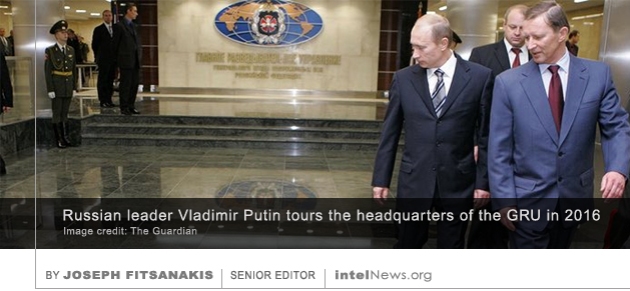
GRUTHE BRAZILIAN GOVERNMENT IS blocking requests from the United States and Russia to extradite an alleged Russian deep-cover spy, whose forged Brazilian identity papers were discovered by Dutch counterintelligence. Sergey Cherkasov was expelled by authorities in the Netherlands in June 2022, after he attempted to enter the country using a Brazilian-issued passport under the name of Victor Muller Ferreira.
Within a few days of his expulsion, Dutch and American counterintelligence had outed Cherkasov as an intelligence officer of the Main Directorate of the Russian Armed Forces’ General Staff, which is commonly known as GRU. Cherkasov is alleged to have built his forged identity over several years, while operating in Brazil and the United States. Upon returning to Brazil, Cherkasov was sentenced to 15 years in prison for using forged Brazilian identity documents.

Last week, Cherkasov’s sentence was reduced to 5  years, after a court in Brazil dropped some of the initial charges that had been filed against him by the Brazilian government prosecutor’s office. Cherkasov’s lawyers are now arguing that their client does not pose a flight risk and should therefore be allowed to serve the remainder of his sentence outside of prison, wearing an electronic tagging device.

These recent developments are of concern to authorities in the United States. The latter have filed an extradition request for Cherkasov, claiming that he spent several years as a graduate student in an American university while using his forged Brazilian identity papers. During that time, Cherkasov is alleged to have repeatedly communicated with his Russian intelligence handlers, supplying them with information about American politics and policy.

However, the Ministry of Justice and Public Security of Brazil said on Friday that Washington’s extradition request had been denied and that Cherkasov would remain in Brazil. The apparent reason for the denial is that Brazil’s Supreme Federal Court had already approved a similar extradition request for Cherkasov, which was filed in April by the Russian government. Moscow claims that Cherkasov is wanted in Russia for narcotics trafficking. The Russians also deny that the alleged spy worked for the GRU or any other government agency.

Yet, despite claims to the contrary, the Brazilian government appears to be essentially stalling on Moscow’s extradition request. On Friday, Flávio Dino, who serves as Minister of Justice under the administration of President Inácio Lula, stated that Cherkasov would continue to serve his prison sentence in Brazil until further notice. In the United States, CBS News reported that Cherkasov’s extradition to Russia would take place “only […] after the final judgment of all of his cases here in Brazil” has been issued, according to the accused spy’s lawyers.

Author: Joseph Fitsanakis | Date: 31 July 2023 | Permalink

Revealed: Little-known Russian counterintelligence unit that targets foreigners

FSB - JFAN INVESTIGATIVE REPORT BY the Wall Street Journal discusses a little-known Russian counterintelligence unit that targets foreign diplomats in ways that often “blur the lines between spycraft and harassment”. Among other activities, this secretive unit is likely behind a string of operations targeting American citizens, which have led to the arrest of at least three of them since 2018. These include the Wall Street Journal correspondent Evan Gershkovich, who earlier this year became the first American reporter to be held in Russia on espionage charges since the Cold War.
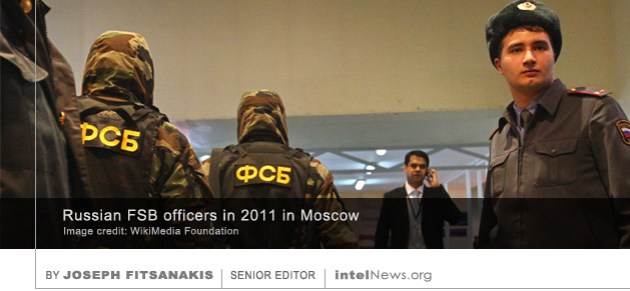
The Journal Text highlights the activities of the Department for Counterintelligence Operations, or DKRO, a highly clandestine unit belonging to the counterintelligence arm of Russia’s Federal Security Service (FSB). It is believed that the DKRO is responsible for monitoring the activities of foreigners living in Russia. The unit reports to Vladislav Menshchikov, director of the counterintelligence arm of the FSB. Prior to his current post, Menshchikov headed the Office of Special Presidential Programs, a Kremlin outfit that operates and safeguards secret underground facilities in Russia’s metropolitan areas.

According to the paper, the DKRO consists of sub-units that focus on various nationalities of foreigners living in Russia, including diplomats. Its first and largest section, known as DKRO-1, focuses on Americans and Canadians. The operations of this sub-unit have intensified significantly in recent times, as relations between Washington and Moscow have worsened. The Journal’s information reportedly came from “dozens of interviews” with senior Western diplomats in Europe and the United States, American citizens that were previously detained and imprisoned in Russia, as well as Russian analysts and journalists who now live abroad.

In addition to Menshchikov, the DKRO has been behind operations that led to the arrests of two other Americans, Paul Whelan (arrested in 2018) and Trevor Reed (arrested in 2019), both of whom were charged with carrying out espionage for the United States. However, most of the activities of the DKRO focus on monitoring the activities of foreign subjects inside Russia. These include journalists and diplomats. Many of the DKRO’s targets have been subjected to campaigns of harassment and intimidation, the Journal claims. Examples include following diplomats’ children to school, breaking into diplomats’ residences to plant recording devices, sabotaging diplomatic vehicles, and even “cutting the power to the residence of the current U.S. Ambassador”.

The paper also reports that, according to American diplomatic staff, the Russian police officers that are posted along the perimeter of the United States embassy in Moscow are in fact “DKRO officers in disguise”. The Journal said it reached out to the FSB and the Kremlin for comment on these allegations, but received no response. The paper also reached out to the United States embassy in Moscow and to the State Department, but officials there declined to comment.

Author: Joseph Fitsanakis | Date: 12 July 2023 | Permalink

German spy services had foreknowledge of Wagner mutiny, report claims

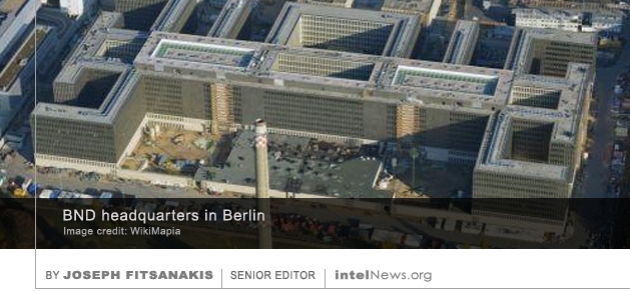
BND GermanyCONTRARY TO EARLIER CLAIMS that the German intelligence agencies failed to anticipate last month’s showdown between PMC Wagner and the Kremlin, German intelligence did in fact have foreknowledge of the mercenary group’s uprising, a new investigative report has concluded. The report further claims that German intelligence had unique and real-time insights into the negotiations between Wagner PMC leader Yevgeny Prigozhin and Belarussian President Aleksandr Lukashenko, who intervened in the dispute.
In the days following the June 23 mutiny by soldiers of the Russian private military firm Wagner Group, German intelligence agencies were publicly criticized for allegedly failing to warn Berlin about the unprecedented incident. Specifically, it was claimed that Germany’s primary foreign intelligence agency, the Federal Intelligence Service (BND), did not issue an actual warning about the mutiny until Saturday —a full 12 hours after the first clashes had erupted between Wagner mercenaries and forces loyal to the Russian Ministry of Defense.

Much of the criticism came from the ranks of the center-left German Social Democratic Party (SPD), which is the primary political party behind the government of German Chancellor Olaf Scholz. However, criticism also came from the Green Party, which supports Scholz’s administration, and the liberal center-right Free Democratic Party (FDP), which also supports Scholz’s government. The criticism intensified after June 28, when, during a live television interview, Chancellor Scholz appeared to confirm speculation that the BND had left his administration in the dark about the Wagner mutiny until it was too late.

Late last week, however, a joint investigation by two of Germany’s most respected public television broadcasters, the Hamburg-based NDR and the Cologne-based WDR, concluded that the BND had been far more informed about the Wagner mutiny than its critics have claimed. The investigation concluded that, not only did the BND have foreknowledge of the mutiny nearly a week before it materialized, but that it was able to listen-in to the frantic telephone conversations between Prigozhin and Belarussian President Lukashenko, as the latter tried to dissuade the Wagner leader from storming the Russian capital with his heavily armed band of mercenaries.

According to the NDR-WDR report, the BND had been able to hack into Wagner’s internal communications system up for over a year. However, its operation was betrayed by “Carsten L.”, a German intelligence officer who was arrested late last year for spying for Russia. However, the German spy service was able to continue to monitor the internal affairs of Wagner through other sources and had access to channels of information within Wagner in the months leading up to the mutiny. Thus, according to the report, the BND had “vague indications of an imminent uprising by Wagner” about a week prior to June 23.

However, the agency was unsuccessful in verifying these indications through other sources, including its foreign counterpart agencies. For this reason, it chose not to notify the German Chancellery in concrete terms.

Nevertheless, the BND did issue a warning on Friday evening, a few hours before the Wagner mutiny began. The warning was issued a full day prior to the takeover of Wagner’s armed takeover of the Russian armed forces’ operational headquarters in Rostov, which occurred on Saturday. The two state broadcasters reportedly reached out to the BND for confirmation of the report’s findings. However, a BND spokesperson declined to comment on the matter, saying simply that the BND “generally does not comment publicly on matters relating to intelligence findings or operations”.

Author: Joseph Fitsanakis | Date: 11 July 2023 | Permalink

Brazil launches investigation into illegal activities of Russian deep-cover spies

José Giammaria Mikhail MikushinAUTHORITIES IN BRAZIL HAVE launched a nationwide probe into the abuse of the country’s citizenship documentation system by Russian spies, who are allegedly using it to build forged identities. According to The Wall Street Journal, Brazil was placed “in an uncomfortable international profile” in the past year, after at least three alleged Russian deep-cover spies were outed by intelligence services in the Netherlands, Norway and Greece.

In June of 2022, authorities in the Netherlands expelled Sergey Cherkasov after he attempted to enter the country using a Brazilian-issued passport under the name of Victor Muller Ferreira. As intelNews explained at the time, Dutch and American counterintelligence outed Cherkasov as an intelligence officer of the Main Directorate of the Russian Armed Forces’ General Staff, which is commonly known as GRU. Cherkasov is alleged to have built his forged identity over several years, while operating in Brazil and the United States. Cherkasov is currently serving a 15-year prison sentence in Brazil for using forged identity documents. He is wanted in the United States for espionage. The alleged spy has reportedly admitted to the use of forged documents, but is denying he worked as a Russian intelligence officer.

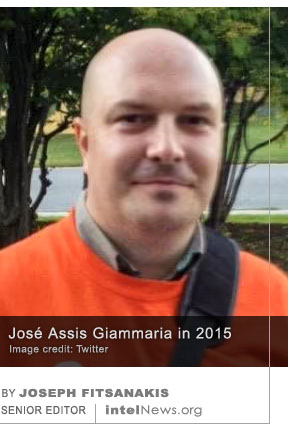
In October of last year, the Norwegian police arrested another Brazilian citizen, José Assis Giammaria (pictured), accusing him of operating under deep cover on behalf o the GRU. According to the Office of the Norwegian state prosecutor, the suspect’s actual name is Mikhail Mikushin. He is believed to have been operating as a deep-cover spy in Brazil, Canada and Norway since 2006. Mikushin is now facing charges of “aggravated intelligence-gathering activity targeting state secrets”, which carry a maximum prison term of 10 years.

In early 2023, Gerhard Daniel Campos Wittich, a resident of Rio de Janeiro, disappeared while traveling abroad. A few months later, he was connected to Irena Shmyrev, a Russian deep-cover spy who was living in Greece under an assumed Greek identity, until she disappeared without trace, reportedly leaving the country in a hurry. According to Greek counterintelligence investigations, Wittich was Irena A.S.’s Russian husband who, like her, worked as a deep-cover intelligence operative out of Brazil.

According to The Wall Street Journal, an official investigation is currently underway in Brazil into how many Russian deep-cover intelligence operatives may be using forged Brazilian citizenship documents to “lurk undetected within the country or around the world”. The paper says that Brazilian investigators have shared “few public details about their probe”. However, it cites “people familiar with the matter” in claiming that the probe centers on “security gaps within Brazil’s documentation system”, which appear to be exploited by undercover spies. Such security gaps allegedly include the ability to obtain a Brazilian identity card and a passport with the use of a single document, namely a birth record.

Author: Joseph Fitsanakis | Date: 03 July 2023 | Permalink

Russian intelligence planned to assassinate SVR defector living in the United States

Aleksandr PoteyevTHE RUSSIAN INTELLIGENCE SERVICES planned to assassinate a Russian former intelligence officer, who had defected to the United States and was living in an apartment complex in Florida, according to a new report. The alleged assassination plan is discussed in the forthcoming book Spies: The Epic Intelligence War Between East and West (Simon and Schuster), authored by Harvard University academic Calder Walton.
According to Dr. Walton, Russian intelligence targeted Aleksandr Poteyev, who served as Deputy Director of the Russian Foreign Intelligence Service (SVR) from 2000 until 2010. Poteyev was reportedly in charge of the SVR’s Directorate “S”, which oversees the work of illegals —a term that refers to SVR operations officers who work in without official cover around the world. It is believed that Poteyev began working for the United States Central Intelligence Agency (CIA) in 1999, as an agent-in-place.

By 2010, when he openly defected to the United States, Poteyev had provided the CIA with information that led to the high-profile arrest of 10 Russian illegals by the Federal Bureau of Investigation (FBI). Some believe that the SVR defector was also responsible for the arrests of Russian spies in Germany and Holland. In 2011, a Russian court tried Poteyev in absentia and sentenced him to 25 years in prison. Poteyev remains at large and is believed to be living in the United States under the protection of the CIA’s National Resettlement Operations Center.

On Monday, The New York Times reported that it had independently confirmed Dr. Walton’s claims, with the help of “three former senior American officials who spoke” to the paper “on the condition of anonymity”. According to The Times, a 2016 report by the Moscow-based Interfax news agency, which claimed that Poteyev had died in the United States, was part of a deliberate disinformation operation by the SVR, which was aimed at enticing the defector to emerge from his hideout.

When that attempt failed, the SVR allegedly recruited a Mexican scientist who lived in Singapore, Hector Alejandro Cabrera Fuentes, to travel to Miami, Florida, in 2020, in order to locate Poteyev. But Fuentes attracted the attention of the authorities while driving around in Miami and was subsequently detained by US Customs and Border Protection agents as he was trying to board a flight to Mexico City. Fuentes then provided details of his mission to the FBI. The Bureau eventually determined that the goal of the SVR had been to assassinate Poteyev.

According to The New York Times, the realization that the SVR had planned to carry out an assassination operation on American soil “spiraled into a tit-for-tat retaliation by the United States and Russia”, which included cascading sanctions and diplomatic expulsions on both sides. The paper reports that, in April 2021, the White House ordered the expulsion of 10 Russian diplomats from the United States, including the SVR’s chief of station, who had two years left on his Washington, DC, tour. The Kremlin responded by expelling an equal number of American diplomats from Russia, including the CIA station chief in Moscow.

Author: Joseph Fitsanakis | Date: 21 June 2023 | Permalink

Ukrainian drone strikes may have targeted Moscow homes of Russian spies

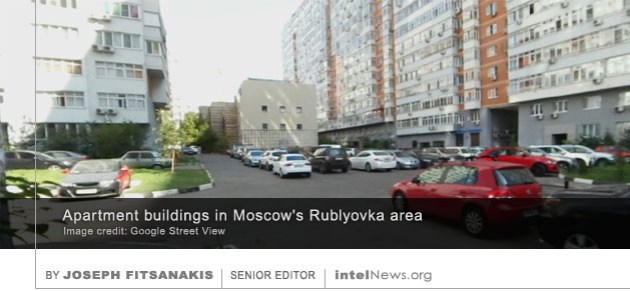
Rublyovka, MoscowA SERIES OF COORDINATED drone strikes that struck Moscow last week were not random, but may in fact have targeted the homes of senior Russian intelligence officials, according to a new report by an American television network, which cited knowledgeable sources and data by an open-source research firm.
In the early morning hours of May 30, a fleet of at least six unmanned aerial vehicles (UAVs) struck what appeared to be residential apartment blocks in Moscow’s southeastern suburbs. The targets were all located in Moscow’s Rublyovka area, which contains some of the wealthiest neighborhoods in the Russian capital. Many expressed surprise at the airborne assault, as it was the first known attack against residential targets in Moscow since the latest phase of the Russian invasion of Ukraine, which began in February 2022.

Upon initial inspection, the targets of the early-morning attack appeared to have been chosen at random. Yesterday, however, the American television network NBC claimed that the targets of the attack had been carefully selected as “a part of Ukraine’s strategy of psychological warfare against Russia”. Citing “multiple sources familiar with the strikes”, including a senior United States official and a congressional staffer, NBC said that the targets of the attacks were all residences of Russian government personnel.

The television network also cited data by Strider Technologies, an open-source strategic intelligence company located in the American state of Utah, according to which at least one of the buildings that were struck by the UAVs housed a Russian state-controlled military contractor. According to Strider Technologies, the contractor provides services to a military unit that is known to be a front for Russia’s Foreign Intelligence Service (SVR). NBC further claimed that other targets in the alleged Ukrainian operation targeted the residences of senior Russian intelligence personnel.

Author: Joseph Fitsanakis | Date: 08 June 2023 | Permalink

Ukraine is running networks of saboteurs inside Russia, report claims

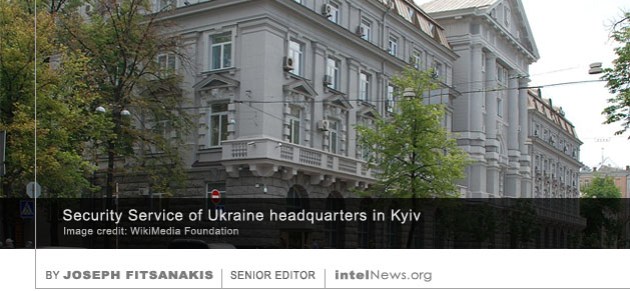
Security Service of Ukraine SBUTHE UKRAINIAN INTELLIGENCE SERVICES are training and arming cells of saboteurs inside Russia, who are responsible for several acts of sabotage on Russian soil, including a recent attack on the Kremlin, according to CNN. In an exclusive report published on Monday, the American television channel cited “multiple people familiar with US intelligence on” the activities of Ukrainian “agents and sympathizers” inside Russia.
According to the report, pro-Ukrainian saboteurs may be responsible for a growing number of incidents involving mysterious explosions, fires and malfunctions of Russian critical infrastructure. In recent months, such incidents have caused serious damage on Russian military warehouses, energy pipelines, fuel depots and refineries, railway networks, and military enlistment offices. Last month saw a widely reported attack by a fleet of unmanned aerial vehicles (UAVs) on the Kremlin, which serves as the official residence of the Russian president in Moscow.

The CNN report claims that the UAV attack on the Kremlin, and possibly other similar incidents that have taken place inside Russia in recent months, represent the “culmination of months of effort” by the Ukrainian government. The latter has now allegedly assembled and is operating semi-autonomous sabotage cells inside Russia. These cells are said to consist of Ukrainian nationals operating in an undercover capacity, as well as of Russian nationals who sympathize with Ukraine. They also include Russians who are militantly opposed to the administration of President Vladimir Putin.

These cells have been “well-trained” in sabotage and have been provided with lethal hardware —including UAVs or UAV components— by the Ukrainian government, CNN said. These provisions reach the saboteurs through “well-practiced smuggling routes” that the Ukrainians have established across the Ukrainian-Russian border. The latter is “vast and very difficult to control”, and has been so for decades, according to the report. In most cases, the weaponry used in acts of sabotage is assembled and operated from within Russia, rather than from command centers in Ukraine, the CNN report claims.

The broad strategic parameters of the saboteurs Russia have reportedly been established by the highest echelons of the Ukrainian government, under the direct supervision of President Volodymyr Zelensky. However, the Security Service of Ukraine (SBU) officers who handle, train and arm the saboteurs have deliberately given them significant autonomy in terms of targeting and tactics. CNN said it contacted the Ukrainian government for comment on this report. The SBU did not confirm or deny that it was involved in handling cells of saboteurs inside Russia. However, a SBU spokesperson told CNN that “the mysterious explosions and drone strikes inside Russia would continue”.

Author: Joseph Fitsanakis | Date: 06 June 2023 | Permalink

Senior representatives of dozens of spy agencies held secret meeting in Singapore

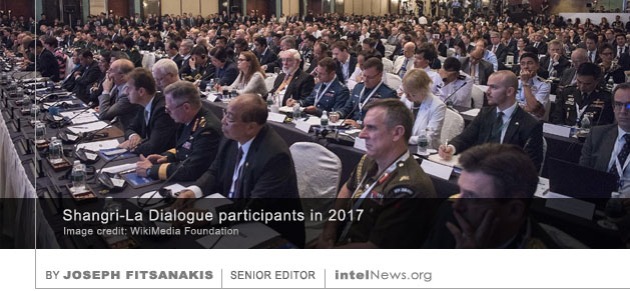
Shangri-La DialogueSENIOR REPRESENTATIVES FROM OVER 20 intelligence agencies from around the world, including the United States and China, reportedly participated in a secret meeting in Singapore last week. The meeting allegedly took place in parallel to the Shangri-La Dialogue, a high-level security conference held annually in Singapore. The conference, focused on security issues in the Asia-Pacific region, has been organized since 2002 by the International Institute for Strategic Studies (IISS), a London-based think-tank.


The Shangri-La Dialogue is typically attended by defense ministers of major Western powers and regional Asian powers, along with security and intelligence representatives from participating nations. However, the existence of a separate closed-door meeting of intelligence officials has never been reported before. On Saturday, the Reuters news agency cited discussions with “five sources”, who claimed that such a meeting occurred between June 2 and 4.

According to Reuters, the meeting was discreetly organized by the Singaporean government and held at a separate venue alongside the security summit. This type of meeting has reportedly been taking place annually for several years, but was previously undisclosed. The secret meeting is believed to have included representatives from approximately two dozen major intelligence agencies from countries such as the United States, China, and India. The United States intelligence community was represented by Avril Haines, the Director of National Intelligence, according to the news agency.

The Reuters report did not mention whether the Russian intelligence community participated in the event. When asked about the alleged secret meeting, a spokesperson from the Singapore Ministry of Defense said that participants at the Shangri-La Dialogue included “senior officials from intelligence agencies”, who “also take the opportunity to meet their counterparts”. The spokesperson added that the Singapore Ministry of Defense “may facilitate some of these bilateral or multilateral meetings”, because “participants have found such meetings held on the sidelines of the [main event] beneficial”.

The governments of the United States, China and India did not respond to requests for comment by Reuters.

Author: Joseph Fitsanakis | Date: 05 June 2023 | Research Credit: C.E. | Permalink

Russia says it uncovered U.S. operation to compromise Apple phones

Apple iPhoneRUSSIAN OFFICIALS SAID THEY uncovered a sophisticated espionage effort by the United States government, which targeted the smartphones of thousands of Apple users living in Russia, including foreign diplomats. According to the Russians, the operation was carried out by the National Security Agency (NSA), an American intelligence agency that specializes in gathering foreign signals intelligence and securing the United States government’s information and communication systems.

The source of the allegation is the Federal Security Service (FSB), Russia’s primary counterterrorism and counterintelligence agency. On Thursday, the FSB said that “an intelligence action of the American special services” had been uncovered by FSB officers with the assistance of the Federal Protective Service. Known in Russia by its initials, FSO, the Federal Protective Service operates federal emergency communications systems and provides personal security for high-ranking government officials.

According to the FSB, “several thousand Apple telephones” were targeted in the alleged NSA operation, including devices belonging to “domestic Russian subscribers”, as well as devices belonging to foreign diplomats stationed in Russia. The latter allegedly include diplomats from Israel, Syria and China, according to the FSB. The Russian agency also claimed that Russia-based foreign diplomats from North Atlantic Treaty Organization member-states had their phones targeted, as well as diplomats from former Soviet states.

In the same press release, the FSB accused the NSA and Apple of working in “close cooperation” with each other —an allegation that the Russian government has been making for several years. In a follow-up media statement, the Russian Ministry of Foreign Affairs accused the United States of engaging in “hidden data collection” and dismissed Apple iPhones as “absolutely transparent”.

Kremlin spokesman Dmitry Peskov urged Russians to avoid using Apple products and lamented reports that one in three Russian government workers continue to utilize Apple products for their personal use. When asked by reporters if the Russian government had plans to outlaw the use of Apple products by government employees, Peskov responded that the Kremlin did “not have the power to even recommend that”, except for those government employees with access to classified information.

Author: Joseph Fitsanakis | Date: 02 June 2023 | Permalink

Israeli, Italian intelligence officers drown as boat capsizes in Lake Maggiore

ONE ISRAELI AND TWO Italian intelligence officers are among the victims of a boating accident in northern Italy. Local reports indicate that the incident occurred last Sunday evening, when a passenger boat named the Gooduria capsized and sank rapidly in Italian territorial waters. The boat was on a sightseeing trip near the Italian shoreline of Lake Maggiore, a popular destination situated on the southern side of the Alps between Italy and Switzerland.

It has been reported that nearly all of the approximately two dozen passengers aboard the Gooduria were current or former members of the Italian and Israeli intelligence services. These individuals were believed to have collaborated professionally as intelligence officers and had gathered for “a convivial meeting to celebrate the birthday of one of the group”, according to a statement issued by the Italian government.

It is worth noting that some Italian news outlets have expressed skepticism about the precise nature of the gathering. An article in the Italian daily Corriere della Sera suggested that “the gathering was a working meeting of intelligence agents”. Another Italian daily, La Stampa, said that the gathering was “an opportunity to exchange information between agents of the two countries”. These claims have not been confirmed by the Italian and Israeli governments.

Italian authorities have stated that no foul play is suspected in the accident. Instead, it is believed that inclement weather, possibly coupled with overcrowding onboard the Gooduria, contributed to the incident. The Ministry of Foreign Affairs of Israel released a brief statement on Sunday acknowledging the death of a retired member of the Israeli intelligence services, without identifying the victim by name or professional title. However, local media reports have identified the deceased as Shimoni Erez, 50, a recent retiree from the Mossad, Israel’s external intelligence agency.

The two Italian victims of the accident have been identified as Claudio Alonzi, 62, and Tiziana Barnobi, 53, both of whom were intelligence officers. Additionally, among the casualties was a Russian national named Anna Bozhkova, 50, who was reportedly the wife of the captain of the Gooduria. Following the capsizing of the boat, Israeli diplomats promptly arranged for the immediate evacuation of ten active Israeli intelligence officers from Italy. They were swiftly removed from regional hospitals and transported back to Israel via a military flight.

Author: Ian Allen | Date: 31 May 2023 | Permalink

Turkey claims it uncovered Israeli spy cell that targeted Iran

Israeli consulate Istanbul TurkeyON MONDYA, TURKEY’S NATIONAL intelligence organization (MİT) announced the arrest of several members of an alleged spy network, who were reportedly recruited, trained and handled by Israel’s intelligence agency, the Mossad. Two members of the alleged spy ring were arrested two months ago, according to the Office of the Istanbul Chief Public Prosecutor and Turkey’s National Intelligence Organization (MİT).

The arrests reportedly came as a result of an investigation into a threatening package sent that was sent in the mail by one of the spy suspects. The investigation was initiated by the Istanbul branch of the General Directorate of Security (Turkish police), which later revealed a connection with a separate 18-month long counterintelligence investigation by the MİT. It eventually led to the arrest of  Selçuk Küçükkaya, a Turkish national, who is accused of operating as the head of the alleged spy ring.

On Monday, Istanbul police arrested 11 associates of Küçükkaya, who the MİT believes to be members of the alleged spy cell. Some reports indicate that Turkish authorities are still searching for two additional suspects who are believed to be part of the alleged spy ring. The MİT states that the spy ring had established a front company through which its members conducted business activities in Iran, with the assistance of intermediaries operating abroad.

The Istanbul Chief Public Prosecutor’s office alleges that Küçükkaya made contact with Israeli intelligence through a member of the so-called Gülen movement. The Gülen movement consists of supporters of Muslim cleric Fethullah Gülen, who runs a global network of schools, charities and businesses from his home-in-exile in the United States. The Turkish government has designated Gülen’s group a terrorist organization and claims it was behind the failed 2016 coup against Turkey’s President, Recep Tayyip Erdoğan.

Küçükkaya is further-accused of having had several in-person meetings with Mossad officers in various locations around Europe. During those meetings, Küçükkaya allegedly received assignments designed to test his intelligence-gathering abilities. It is alleged that Küçükkaya was eventually hired as a spy by the Mossad, who also provided him with instructions on how to use a clandestine communication system to contact his Israeli handlers.

The claim by the Turkish government that it has busted a Mossad spy cell operating in its territory is not unprecedented. In October 2021, the MİT disclosed the arrests of 15 members of an alleged Mossad spy ring following a series of raids across four Turkish provinces. Last December, Turkish media reported that 44 individuals had been detained and interrogated for allegedly spying on Palestinian exiles living in Turkey on behalf of the Mossad. What is new about this latest claim is the alleged connection between the Mossad and the Gülen movement, which the administration of Turkish President Erdoğan views as an existential domestic security threat.

Author: Joseph Fitsanakis | Date: 24 May 2023 | Permalink

U.S. charges Greek businessman with smuggling military and dual-use goods to Russia

Rijen NetherlandsThe United States Department of Justice has charged a Greek national with wire fraud and smuggling sensitive military-grade and dual-use goods from the United States to Russia. The suspect, Dr. Nikolaos “Nikos” Bogonikolos, 59, was arrested in Paris, France, on May 9, at the request of the United States, and is currently in custody pending extradition proceedings.

Bogonikolos is a mathematician and self-described “serial entrepreneur”, with business activities dating back to 1987. He has authored and co-authored academic articles, holds a number of patents, and has published a book entitled Total Process Security Reengineering. Following the ECHELON revelations in the late 1990’s, he authored a report (.pdf) entitled “The Perception of Economic Risks Arising from the Potential Vulnerability of Electronic Commercial Media to Interception” as part of a study for the European Parliament.

In 2005, Bogonikolos received his PhD from the Kharkov National Economic University in Ukraine, focusing on applications of artificial intelligence in the field of economics. According to his own claims, he has been active as an entrepreneur or researcher in some 40 countries, including Russia. Bogonikolos is the founder of a Greek-based company called Aratos Group. In 2016, Aratos Systems BV was registered as legal entity in The Netherlands. Since 2020, the company has been located in the town of Rijen, which is also home to the main operational military helicopter base of the Royal Netherlands Air Force.

Aratos Systems BV describes itself on its website (currently offline) as an “independent and leading member of the Greek Aratos Group”. Its activities, as declared to the Netherlands chamber of commerce, are “the collection, processing, protecting, and selling of earth observation data to public and private parties”. Aratos Systems also “owns and runs a fully equipped Satellite Ground Station constantly connected with EUMETSAT” —the latter being the European operational satellite agency for monitoring weather, climate and the environment from space.

Last week, the Netherlands Public Prosecution Service and the Fiscal Information and Investigation Service raided the Aratos Systems offices in Rijen. According to the unsealed complaint (.pdf) it is believed that Bogonikolos was contacted in December 2017 by representatives of an illicit Russian procurement network that acquires sensitive military-grade and dual-use technologies, under the direction of Russia’s Foreign Intelligence Service (SVR). Elements of that network are often referred to by Western government officials as “the Serniya Network” or “Sertal”, among other names. In December 2022 the United States charged five Russian nationals, including a suspected intelligence officer, believed to be part of that network, as well as two United States nationals.

In December 2017, Bogonikolos allegedly accepted an invitation to travel to Moscow alone for a meeting. The complaint cites an email exchange between senior members of Sertal and Serniya Network, including Yevgeniy Grinin and Aleksey Ippolitov, who are both wanted by the FBI. In the email exchange, it is suggested that Bogonikolos is a “supporter of the Orthodoxy” and that he sees it as “the basis of friendship with Russia”.

Read more of this post

U.S., Russian spy agencies publish rival ads encouraging would-be informants

Russia Ukraine WarRIVAL ONLINE CAMPAIGNS BY American and Russian intelligence agencies are encouraging each other’s citizens to contact them, share information and possibly even defect. At least three ads have been  on social media, with the Federal Bureau of Investigation (FBI) issuing the earliest one in February of this year. The Central Intelligence Agency (CIA) and its Russian counterpart, the Foreign Intelligence Service (SVR), are now believed to have published similar ads.

The FBI ad initially appeared on Twitter, directing users to the website of the Bureau’s Washington Field Office. There, a text in Cyrillic urges Russian nationals to “change [their] future” by contacting the FBI. The CIA followed suit on Monday of this week by posting a video on its new channel on Telegraph, a popular social media platform among young Russians. The CIA video portrays frustrated Russian government employees morally torn by the Kremlin’s policies. It concludes with them contacting the CIA through a secure online connection. A narrator’s voice states, “my family will live with dignity thanks to my actions”. Viewers are then assured that their safety is the CIA’s highest priority, should the choose to do the same.

Shortly after the CIA video appeared online, the Russian Ministry of Foreign Affairs’ Director of Information, Maria Zakharova, said that the Russian government would respond “appropriately” to what she called a “CIA provocation”. On Wednesday, a number of Western media outlets reported that the SVR had unveiled a short recruitment video seemingly targeting Americans. The video, shared on Telegram, includes archival news footage of United States military and police personnel, flag-burning demonstrators, and protests against abortions. It concludes with footage of President Joe Biden overlaid with a sniper crosshairs. A narrator states in English: “If you want to help normalcy, help the Foreign Intelligence Service of the Russian Federation”.

Amid the ongoing war in Ukraine, both the United States and Russia are engaging in extensive cyber-enabled operations aimed at each other’s targets. However, these recruitment videos underscore the continued need for highly placed human sources and their central role in multi-platform intelligence collection efforts.

Author: Joseph Fitsanakis | Date: 18 May 2023 | Permalink

China sentences US citizen to life for espionage following closed-door trial

Hong KongA CHINESE COURT HAS sentenced a United States passport holder to life in prison on espionage charges, following a brief closed-door trial. However, no information has been made available about the precise charges against him. Closed-door trials are frequent occurrences in Chinese courts, especially in cases relating to national security, which include charges of espionage against the state. However, life sentences are exceedingly rare for espionage cases.

The individual convicted in this case has been named in media reports as John Shing-Wan Leung, 78. He is reportedly a permanent resident of Hong Kong, a special administrative region of China, over which Beijing has near-absolute control. It is not known if Leung was a Chinese citizen at any time in his life. China does not recognize joint citizenship and requires its citizens to drop their Chinese citizenship when swearing allegiance to another country. The Reuters news agency reported on Monday that Leung was at some point a member of two American-based Chinese expatriate groups, which it described as “pro-China”. These are the United States-China Friendship Promotion Association and the United States-China Friendship Association.

Leung is believed to have been arrested in Hong Kong in 2021 by local Chinese counterintelligence officers. He has been held in prison ever since his arrest. A press release issued on Monday by the Intermediate People’s Court in Suzhou, a city located in southern Jiangsu province, 700 north of Hong Kong, said Leung had been found “guilty of espionage”. The press release added that Leung had been “sentenced to life imprisonment and deprived of [his] political rights for life”. However, the statement provided no information about Leung’s alleged crimes, or the country he was found to have spied for.

According to the BBC, the United States embassy in Beijing refused to discuss the details of this case, stating only that the United States government was aware of Leung’s conviction. An embassy spokesperson told the BBC that “the Department of State has no greater priority than the safety and security of US citizens overseas”.

Author: Joseph Fitsanakis | Date: 15 May 2023 | Permalink

Senior members of South Korea’s largest trade union charged with espionage

KCTU South KoreaSOUTH KOREAN PROSECUTORS have charged four senior members of one of the country’s largest trade unions with espionage on behalf of North Korea. The move, which is seen as highly controversial by South Korea’s liberal opposition, has come a few months after the conservative administration of President Yoon Suk Yeol launched what some commentators have described as South Korea’s largest counter-espionage operation in over 30 years.

The operation came to light on January 18, when hundreds of police officers, led by officers of the National Intelligence Service (NIS), conducted search raids at a number of regional offices of the Korean Confederation of Trade Unions (KCTU). Founded in the mid-1990s, the KCTU represents over 1.1 million members. Most of its membership consists of supporters of the Democratic Party of Korea (DPK), a left-of-center liberal coalition that ruled South Korea until last year. Since its establishment in 2014, the DPK has been engaged in a bitter political rivalry with the People Power Party (PPP), a conservative coalition that currently governs South Korea.

On Wednesday, four KCTU officials, all of them men, between the ages of 48 and 54, were charged with several violations of South Korea’s National Security Act, including carrying out espionage on behalf of North Korea and meeting illegally with North Korean intelligence officers. South Korean government prosecutors accuse the four of meeting several times with their alleged North Korean handlers. The alleged meetings too place during overseas trips in Vietnam and Cambodia between 2017 and 2019.

While abroad, the four alleged spies were allegedly trained and given instructions to establish what prosecutors describe as “an underground organization [operating] under the guise of legal union activities”. The four men were allegedly tasked with steering the KCTU toward actions and rhetoric that were against the United States and Japan. They were also asked to helping organize worker rallies against the policies of the PPP. In other instances, the alleged spies photographed American military installations located in South Korea.

The opposition DPK has strongly condemned the charges, calling them politically motivated and describing them as a return to the days of rightwing military rule, which South Korea experienced until 1987. The NIS remains highly controversial among left-of-center South Koreans, many of whom view it as a corrupt state entity that is politically aligned with the conservative PPP. Between 2018 and 2022, the liberal DPK government spearheaded what it described as an “anti-corruption campaign” inside the NIS. As a result of that campaign, three former NIS directors were charged with —and eventually convicted of— secretly diverting funds from the agency’s clandestine budget. The funds were eventually used to aid the re-election campaign of the then-South Korean President, Park Geun-hye. Their apparent goal was to prevent the DPK from coming to power, fearing that the left-of-center party was too close to Pyongyang. President Park also went to prison for accepting financial bribes from the NIS.

Author: Joseph Fitsanakis | Date: 12 May 2023 | Permalink