Russian whistleblower who died in 2012 may have been poisoned
May 21, 2015 Leave a comment
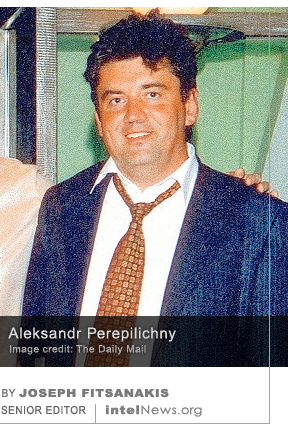 A Russian businessman, who died in London while assisting a Swiss probe into a massive money-laundering scheme, may have been poisoned with a substance derived from a highly toxic plant, an inquest has heard. Aleksandr Perepilichny was an influential Moscow investment banker until he fled Russia in 2009, saying that his life had been threatened after a disagreement with his business partners. A few months later, having moved to an exclusive district in Surrey, south of London, Perepilichny began cooperating with Swiss authorities who were investigating a multi-million dollar money-laundering scheme involving senior Russian government officials. The scheme, uncovered by a hedge fund firm called Hermitage Capital Management (CMP), and described by some as the biggest tax fraud in Russian history, defrauded the Russian Treasury of at least $240 million. The case made international headlines in 2009, when one of its key figures, a CMP lawyer named Sergei Magnitsky, died in mysterious circumstances while being held in a Russian prison. After Magnitsky’s death, Perepilichny said he too had been warned in no uncertain terms that his name featured on a Russian mafia hit list.
On November 10, 2012, having just returned to his luxury Surrey home after a three-day trip to France, Perepilichny went out to jog. He was found dead later that evening, having collapsed in the middle of a side street near his house. He was 44. A postmortem examination by police concluded that he had died of natural causes and pointed to the strong possibility of a heart attack. However, lawyers representing the late businessman’s family told a pre-inquest hearing on Monday that, according to new medical evidence, Perepilichny stomach was found to have traces of a poisonous plant. The shrub-like plant, known as gelsemium, is extremely rare and mostly grows in remote parts of China. One of the lawyers, Bob Moxon-Browne, claimed at the hearing that gelsemium is a “known weapon of assassination [used] by Chinese and Russian contract killers”. The Perepilichny family’s legal team said that further forensic tests are to be carried out, so that the claim of poisoning can be examined in more detail.
 A congratulatory letter sent by a senior Nazi official to
 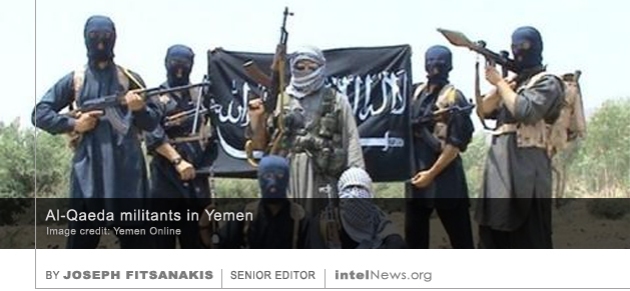 Al-Qaeda and its affiliates continue to pose the most serious unconventional threat to American security, despite the meteoric rise of the Islamic State of Iraq and al-Sham, according to a former senior official in the United States Central Intelligence Agency (CIA). Michael Morell, who was deputy director of the CIA, and served twice as the Agency’s acting director, did not deny that the Islamic State, also known as ISIS, poses a significant threat to the security of the US. However, the militant group “is not the most significant threat to the homeland today”, he said. Morell made the comment while












 intelNews.org
Defectors provide rare glimpses of North Korean spy operations
May 25, 2015 by Joseph Fitsanakis 1 Comment
It was only after years of training, said Kim, that he was told he was going to be a spy. Most likely, that meant he was detailed to the Reconnaissance General Bureau, a military-intelligence agency that resembles the United States Central Intelligence Agency’s Special Activities Division. He told CNN that he was not permitted to be captured alive by adversary agencies, and that his loyalty to the North Korean regime would be questioned if he failed to commit suicide at the conclusion of an aborted mission. Kim said his first mission abroad took him to South Korea, where he helped exfiltrate a North Korean intelligence officer named Lee Sun-sil, who had been working in the South as a non-official-cover operative for over a decade. His second mission involved trying to recruit South Koreans who were believed to be sympathetic toward Pyongyang. In 1995, however, he was captured alive during his third mission to South Korea, after failing to commit suicide as per his operational instructions. For that, he said, his entire family was executed back in North Korea, though his claim is admittedly difficult to verify.
CNN spoke to another high-profile North Korean defector, Kang Myong-do, son-in-law of the country’s former Prime Minister, Kang Song-san, who died in 2007. Kang, who was once described by The New York Times as “the most damaging defector ever to escape from North Korea”, used to work for the United Front Department, a civilian intelligence outfit that is subordinate to the ruling Workers’ Party of Korea. He told CNN that there are probably “hundreds” of North Korean intelligence officers operating in the United States at any given point, and that their main goal is to “recruit Korean-Americans who lean towards supporting North Korea”. He added that Pyongyang sees intelligence officers as crucial assets in its confrontation with its adversaries, and that it treats them exceedingly well when they are loyal. In North Korea, “spies are treated on the same level as generals”, he said.
Filed under Expert news and commentary on intelligence, espionage, spies and spying Tagged with Kang Myong-do, Kim Dong-sik, Korean People's Army, News, North Korea, North Korean Reconnaissance General Bureau, United Front Department (North Korea)