ISIS militant was first-ever Filipino suicide bomber, say police officials
July 3, 2019 Leave a comment
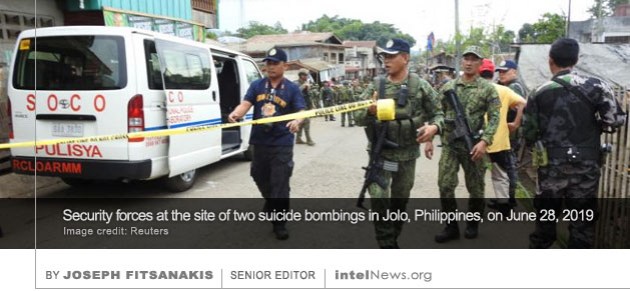 An Islamic State militant who blew himself up in the Philippines last week was probably history’s first-ever Filipino suicide bomber, according to police officials. The man was one of two militants who detonated suicide vests in Indanan, a town in the southern Philippines island of Sulu, on Friday. The twin blasts killed six people, in addition to the two suicide bombers. The target of the attack was a military base that houses the 1st Brigade Combat team of the Philippine Army. The 1,500-strong brigade is leading the counterinsurgency campaign in the country’s heavily Muslim southern regions. Three of the victims were 1st Brigade Combat team soldiers, while three civilians who happened to be walking nearby were also killed.
The Islamic State —known also as the Islamic State of Iraq and Syria (ISIS)— claimed responsibility for the attack, leading many to speculate that the suicide bombers were not Filipinos, but other Arab nationals. That would fit the pattern of the two previous suicide bombings that have taken place in the history of the Philippines. In July of 2018, a Moroccan ISIS follower drove a van laden with explosives at an army checkpoint on the island of Basilan, killing ten people. And in January of this year, two Indonesian suicide bombers attacked a Roman Catholic congregation on Jolo Island, killing 23 and injuring over 100 churchgoers. All three suicide bombers were members of Abu Sayyaf, a Filipino Salafi jihadist group that pledged allegiance to ISIS in 2014. Moreover, none of the three suicide bombers were native Filipinos; rather they had traveled to the island country in order to carry out terrorist attacks.
This pattern may have changed as of last Friday, however. According to local military officials, a Filipino woman identified the remains of one of the two suicide bombers as belonging to her son. The woman reportedly told authorities that her son was named Norman Lasuca and was 23 years old. She also said that he, like his father, belonged to the Tausūg, a million-strong predominantly Muslim ethnic group that includes many recent converts to Islam.
On Tuesday, several Philippine Army commanders gave a press conference in Sulu, where they discussed the latest information regarding last week’s suicide attacks. One of the speakers, Brigadier-General Edgard Arevalo, said that the purported mother of the suicide bomber had provided DNA samples to the authorities, in order to help positively identify the body. If the DNA tests are positive “then […] we can say conclusively that the person is Filipino”, which will be a first, said Arevalo. A positive result would suggest that the ideology of ISIS may be more appealing to local Filipino youth than has generally been assumed by counterterrorism officials, Arevalo concluded.
► Author: Joseph Fitsanakis | Date: 03 July 2019 | Permalink
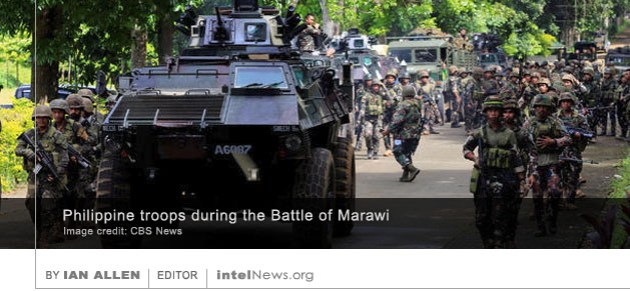 The number of foreign Islamic State fighters entering the Philippines is growing, and the momentum they generate among local Islamist groups may prompt them to declare a new caliphate, according to experts. British newspaper The Guardian cited “a high-ranking intelligence officer” who said that between 40 and 100 foreign fighters have joined the Islamic State in the southern Philippines in the past 12 months. Most of them come from neighboring countries, such as Indonesia, Malaysia and Singapore. But there are also fighters from Pakistan, Bangladesh and several Middle Eastern countries, said the intelligence officer. One of them, a Moroccan militant,
 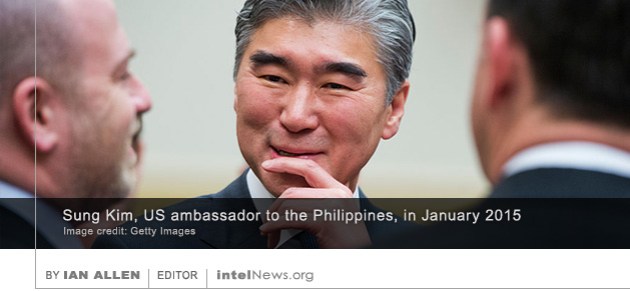 The United States ambassador to the Philippines has been summoned by Manila in response to the publication of an American intelligence report that described President Rodrigo Duterte as a threat to democracy. The report, published on February 13, represents a joint assessment of worldwide challenges to the interests of the United States. It is compiled annually by all 16 member agencies that make up the US Intelligence Community.
 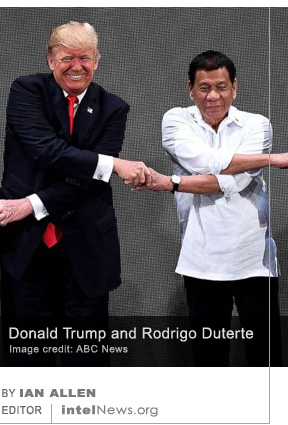 A wide-ranging assessment by the United States Intelligence Community views the President of the Philippines, Rodrigo Duterte, as a major threat to democracy and human rights in Southeast Asia. The report, published on February 13, represents a joint assessment of worldwide challenges to the interests of the United States. It is compiled annually by all 16 member agencies that make up the US Intelligence Community. This year’s report warns that democratic governance and human rights would continue to be “fragile” in 2018, because of the autocratic governing style of several national administrations. Many Southeast Asian governments were also corrupt and displayed nepotistic tendencies, says the report. It singles out the government of Myanmar, which has been widely criticized for its inhuman treatment of the country’s Muslim Rohingya minority. It also mentions the autocratic government of Thailand, which recently changed the country’s constitution, giving increased legislative powers to the country’s armed forces.
 The United States is reportedly weighing plans to launch airstrikes in the Philippines, against militant groups that are affiliated with the Islamic State of Iraq and Syria. However, some American officials are skeptical about reports of possible airstrikes, while Philippine government officials claim no such action is necessary. For more than 40 years, the Philippine army has been fighting a counterinsurgency campaign against secessionist Moros in the country’s southwest. The region is home to most of the Philippines’ Muslim population, which constitutes around 6 percent of the country’s overall population. In recent years, some Muslim secessionist groups, including the most formidable, Abu Sayyaf, have pledged allegiance to the Islamic State of Iraq and Syria, known as ISIS.









 intelNews.org
U.S. Pentagon ran secret COVID-19 anti-vaccination campaign to undermine China
June 17, 2024 by Ian Allen 1 Comment
According to the Reuters news agency, which uncovered the alleged plot, the psychological operation initially targeted the Philippines in the spring of 2020. During that time, the Southeast Asian nation relied heavily on the CoronaVac, also known as the Sinovac COVID-19 vaccine, which was manufactured by the Chinese biopharmaceutical firm Sinovac Biotech. The CoronaVac vaccine was approved for human consumption by the World Health Organization.
An investigation by Reuters determined that the U.S. Pentagon attempted to undermine the efficacy of the Chinese-manufactured vaccine, in order to sabotage the relations between China and the Philippines. Over time, the Pentagon project morphed into an anti-vax campaign that questioned the quality of Chinese-produced coronavirus test kits and Chinese-supplied face masks. There was also an attempt to stigmatize Chinese-produced medical supplies relating to COVID-19. The campaign argued that the coronavirus had originated in China, which made Chinese-manufactured medical supplies suspect.
The psychological operation utilized hundreds of fake social media accounts on multiple platforms, which were unified under the hashtag #Chinaangvirus —Tagalog for “China is the virus.” By early 2021, the campaign had expanded to the Middle East and Central Asia. Some social media posts claimed that Muslims should not be using the Sinovac COVID-19 vaccine because it contained pork gelatin and should thus be considered forbidden under Islamic law. These tactics raised objections by some U.S. government officials, notably from the State Department, who expressed them in meetings with Pentagon personnel. The secret campaign was terminated in June of 2021.
The Reuters news agency spoke to Greg Treverton, former chairman of the U.S. National Intelligence Council, which ensures that the work of the nation’s intelligence agencies reflect the government’s policy priorities. Treverton told the news agency that getting “as much vaccine in people’s arms as possible” would have been in the national interest of the U.S., adding that the Pentagon’s secret operation “crosses a line”. Reuters said that a senior Pentagon official acknowledged a secret psychological operation was indeed launched, in order to “disparage China’s vaccine in the developing world.” However, the official “declined to provide details” of the operation.
► Author: Ian Allen | Date: 17 June 2024 | Permalink
Filed under Expert news and commentary on intelligence, espionage, spies and spying Tagged with biomedical intelligence, China, Coronavirus, COVID-19, disinformation, News, Philippines, psyops, Sinovac Biotech, social networking, US DoD