Attack kills wife of Ukraine commander behind alleged plan to assassinate Putin
October 31, 2017 Leave a comment
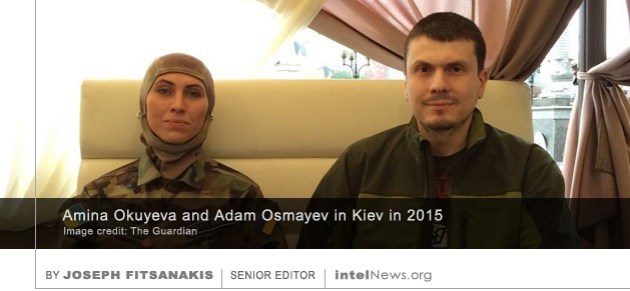 An armed attack in the outskirts of Kiev has killed the wife of a Chechen commander of a Ukrainian paramilitary unit, who is wanted in Russia for an alleged plan to kill President Vladimir Putin. Adam Osmayev is believed to have survived the attack, but his wife, Amina Okuyeva, was reportedly shot in the head and died on the spot. Osmayev, a Russian Chechen, became widely known in Ukraine in February of 2012, when he was arrested by police in Odessa, a major port city located on the northwestern shore of the Black Sea in the country’s south. He was found to be carrying forged identity documents. When police searched his apartment, they found large quantities of illegal explosives. Authorities in Moscow told the Ukrainian government that Osmayev was involved in a conspiracy to kill Russian President Vladimir Putin. A Chechen associate of Osmayev, Ilya Pyanzin, was handed over to Russia by the Ukrainians and was given a 10-year prison sentence by a Moscow court.
But Osmayev’s legal team was able to argue that his human rights would not be guaranteed if Ukraine extradited him to Russia. In 2013, the European Court of Human Rights ruled that Osmayev should serve his sentence in Ukraine, at which point Kiev rejected Moscow’s extradition request. In late 2014, Osmayev was released from prison and allowed to remain in Ukraine. Soon after his release from prison, Osmayev entered the ranks of the Dzhokhar Dudayev battalion. The armed group was one of over 30 paramilitary units organized by Ukraine’s Ministry of Defense to combat pro-Russian separatists in southeastern Ukraine. By early 2015, Osmayev had risen to the rank of commander of the battalion and was increasingly treated as a celebrity by Ukrainian nationalists. But he continued to face threats from Russia and pro-Russian separatists in Ukraine. On June 1 of this year, Osmayev and Okuyeva survived an apparent assassination attempt by a man who was wounded but managed to escape following a shootout with the couple.
Ukrainian media reported on Monday that Okuyeva was killed earlier that day, after the car that her husband was driving was ambushed by a group of masked assailants on the outskirts of Kiev. According to eyewitnesses’ accounts, the assailants opened fire at Osmayev’s car as it was passing through a railway crossing. Osmayev was reportedly injured in the attack, but Okuyeva was shot in the head and died at the scene. Footage aired on Ukrainian national television showed Osmayev’s heavily damaged car, which reportedly sustained “a hail of bullets” fired by the attackers. The Chechen paramilitary commander told reporters that the attackers’ main goal was to assassinate him. No group or government has claimed responsibility for the attack.
► Author: Joseph Fitsanakis | Date: 31 October 2017 | Permalink
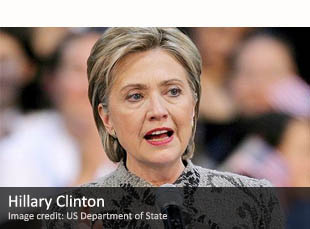 A major reason behind the Federal Bureau of Investigation’s decision to arrest ten Russian spies across the United States in 2010 was their increasing proximity to the then-Secretary of State Hillary Clinton, it has been claimed. The spies had been specifically instructed by their handlers in Moscow to target Clinton, who was seen as the most likely successor to US President Barack Obama, according to recently released FBI files. Ten Russian deep-cover spies, who had no official cover and thus no diplomatic immunity, were
  Israeli spy services were reportedly behind the United States government’s recent decision to purge Kaspersky Lab antivirus software from its computers, citing possible collusion with Russian intelligence. Last month, the US Department of Homeland Security issued a directive ordering that all government computers should be free of software products designed by Kaspersky Lab. Formed in the late 1990s by Russian cybersecurity expert Eugene Kaspersky, the multinational antivirus software provider operates out of Moscow but is technically based in the United Kingdom. Its antivirus and cybersecurity products are installed on tens of millions of computers around the world, including computers belonging to government agencies in the US and elsewhere. But last month’s memorandum by the US government’s domestic security arm alarmed the cybersecurity community by alleging direct operational links between the antivirus company and the Kremlin.
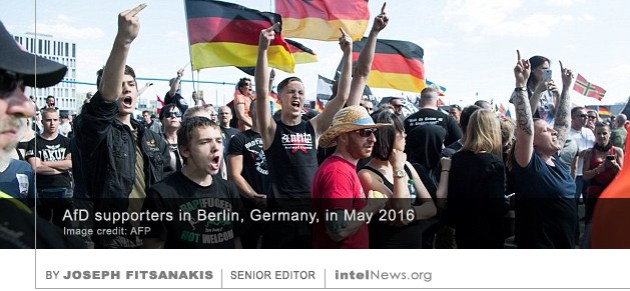 A senior German intelligence official has warned that foreign powers, including Russia, could try to shape the outcome of talks by German parties to form a governing coalition, following last week’s national elections. The elections resulted in a major shakeup of Germany’s political landscape, as Chancellor Angela Merkel’s Christian Democratic Union lost nearly 10 percentage points compared to its 2013 election result. It is now forced to seek the participation of other conservative or centrist political parties in a broad governing alliance. Meanwhile, the far-right Alternative for Germany (AfD) won 12.6 percent, propelling it to third place and giving it 91 seats in the Bundestag. The AfD result marks the first time since 1945 that a German far-right party has managed to secure parliamentary representation.
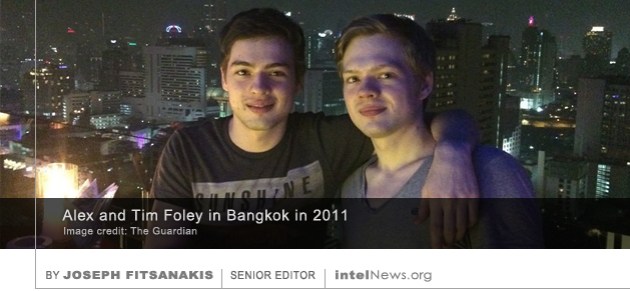 The sons of a Russian couple, who fraudulently acquired Canadian citizenship before being arrested for espionage in the United States, are seeking to reinstate their Canadian citizenship, which was annulled when their parents were found to be Russian spies. Tim and Alex Vavilov are the sons of Donald Heathfield and Tracey Foley, a married couple arrested in 2010 under Operation GHOST STORIES —a counterintelligence program run by the US Federal Bureau of Investigation (FBI). Following their arrest, their sons, who allegedly grew up thinking their parents were Canadian, were told that their parents were in fact Russian citizens and that their real names were Andrei Bezrukov and Elena Vavilova. Their English-sounding names and Canadian passports had been forged in the late 1980s by the KGB, the Soviet Union’s primary external intelligence agency.
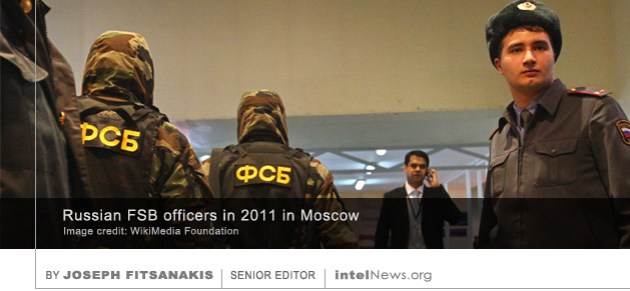 Two senior officers in the Russian intelligence services were charged with treason after they were found to have helped the United States catch two notorious Russian hackers, according to reports in the Russian media. Sergey Mikhailov was a career officer in the Federal Security Service —a descendant of the domestic section of the Soviet-era KGB— which is often referred to as Russia’s equivalent of the United States Federal Bureau of Investigation. Mikhailov had risen through the ranks of the FSB to eventually head the agency’s Center for Information Security. Known in Russia as CIB, the Center is tasked with investigating electronic crime in the Russian Federation.
 Russian intelligence services say they have foiled a large-scale bomb plot, after raiding an explosives laboratory belonging to the Islamic State and arresting four suspects. The four men were allegedly planning to target the Moscow Metro transit system and a busy shopping center in the Russian capital. In a statement released to the media this morning, the Russian Federal Security Service (FSB) did not specify the intended targets of the plotters. But it said it had arrested four people during an early morning raid at an explosives laboratory located in the Moscow suburbs. The FSB said that its officers
 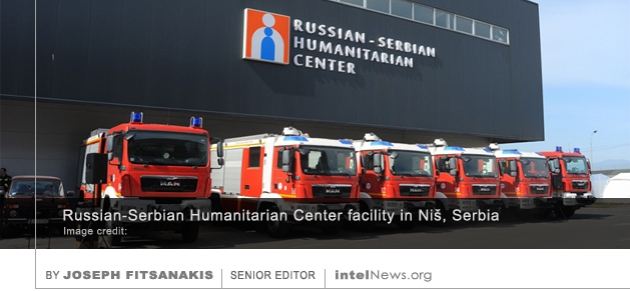 Staff at a Russian disaster relief center in southern Serbia have rejected claims by American officials that the facility operates as an espionage arm of Moscow’s foreign policy in the Balkans. The Russian-Serbian Humanitarian Center was built in 2012, at a cost of nearly $40 million, following an agreement between Belgrade and Moscow. Its
  Russia is planning to expel approximately 30 American diplomats from its territory, and seize buildings and property belonging to the United States Department of State, according to Russian media reports. The expulsions will be in response to the expulsion last December of 35 Russian diplomats stationed in the US by the administration of President Barack Obama. In addition to expelling the diplomats, Washington also reclaimed two “recreational facilities” (in reality intelligence outposts) that were used by the Russians in New York and Maryland. The White House said that the expulsions were ordered in response to alleged efforts by Russia to interfere in the 2016 US presidential election.
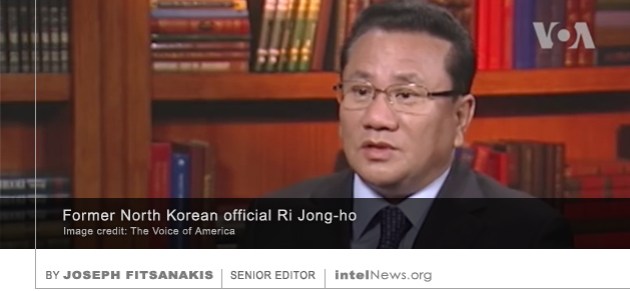 The government of North Korea uses intermediary firms in Singapore to import thousands of tons of Russian oil each year, according to a senior North Korean defector who has spoken publicly for the first time since his defection. Ri Jong-ho was a senior official in the Democratic People’s Republic of Korea under its previous leader, the late Kim Jong-il. He rose through the ranks of the Workers’ Party of Korea and was directly mentored by Kim, who personally appointed him to a post in Bureau 39. The powerful body is in charge of securing much-needed foreign currency for Pyongyang —often through illegal activities— and partly funds the personal accounts of the ruling Kim dynasty.
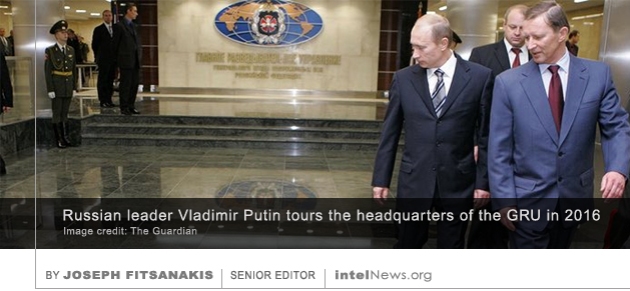 New information about carefully targeted attempts by Russian operatives to compromise the November 2016 presidential elections in the United States have emerged in a newly published intelligence document. The document, which dates from May of this year, was produced by the US National Security Agency and
  Russian espionage in the United States has become increasingly sophisticated and brazen, and American counterintelligence professionals are finding it difficult to contain it “after years’ worth of inattention” according to sources.
  Ukrainian security service personnel raided the offices of a Russia-based internet search engine firm in two cities on Tuesday, as part of a treason investigation. The probe is reportedly related to the ongoing dispute between Kiev and Moscow, which intensified after 2014, when Russia unilaterally annexed the Russian district of Crimea. The Ukrainian government also accuses the Kremlin of clandestinely supporting pro-Russian insurgents in southeastern Ukraine, something that Moscow denies.
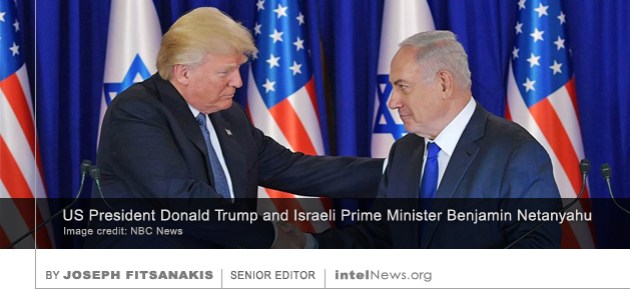 Authorities in Israel have revised their intelligence-sharing protocols with the American government after it became known that United States President Donald Trump inadvertently exposed Israeli secrets to Russia. The alleged exposure of Israeli secrets came earlier this month, during a meeting between Mr. Trump and a delegation of Russian government officials, which included Foreign Minister Sergey Lavrov and Sergey Kislyak, Moscow’s Ambassador to Washington.








Fire at top-secret Moscow facility highlights rapid growth of Russian spy headquarters
November 9, 2017 by Joseph Fitsanakis 1 Comment
The fire, which local news agencies described as “huge”, was reported early in the afternoon of Wednesday. Television images showed smoke coming out of one of the multistory towers that make up the SVR building complex. According to SVR spokesman Sergey Ivanov, the fire started in what he called “a technical installation” that houses “a cable gallery” and is located beneath the multistory building. The 21-story tower block is adjacent to a large Y-shaped building and is visible for several miles around. It became operational in the early 1970s, when the KGB’s First Chief Directorate began a decade-long process of moving to the new, state-of-the-art complex in the southern suburbs of the Russian capital. Today the complex houses the entire apparatus of the SVR, including its espionage wing, and is informally known as les (the forest) or kontora (the office). Approximately 15 fire crews arrived at the scene soon afterwards, and were able to coordinate their movements despite the fact that mobile communications are blocked at the site of the compound.
The SVR spokesman added that the fire is believed to have begun at a section of the facility that is undergoing extensive maintenance work. Three members of the crew that were initially missing during the early stage of the fire were later rescued, said Ivanov, and the fire was eventually extinguished without causing fatalities or injuries. But the incident highlighted the reportedly unprecedented growth of the SVR complex that observers have noted in recent years. As intelNews reported in 2016, satellite images show that the top-secret facility has doubled —and possibly tripled— in size in the past decade. The most recent images were compiled by Allen Thomson, an analyst who worked for the United States Central Intelligence Agency in the 1970s and 1980s. They were published by Steven Aftergood, who edits the Federation of American Scientists’ Secrecy News blog. The images clearly show that at least three more large buildings have been erected alongside the landmark skyscraper and the adjoining Y-shaped office block. These additions, said Aftergood in 2016, appear to have increased the SVR headquarters’ floor space “by a factor of two or more”. Moreover, the nearby parking capacity at the complex “appears to have quadrupled”, he added. Observers often describe the compound as a constant construction site, with new buildings and facilities being built at an unprecedented speed.
On Wednesday evening, SVR officials told the Moscow-based TASS news agency that the agency would investigate the cause of the fire. It was “too early to give any comments” about it, they said, but the SVR had already initiated an official probe into the incident.
► Author: Joseph Fitsanakis | Date: 09 November 2017 | Permalink
Filed under Expert news and commentary on intelligence, espionage, spies and spying Tagged with Moscow, News, Russia, SVR (Russia), Yasenevo (Russia)