Russian spy service accused of role in Norwegian journalist’s firing
October 7, 2015 Leave a comment
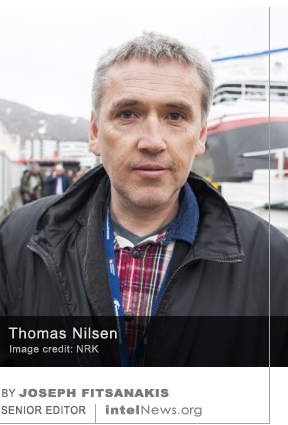 Norway’s state broadcaster has alleged that the Russian intelligence service pressured a Norwegian newspaper to fire one of its journalists who covered fossil fuel exploration in the Arctic Ocean. Last week, journalist Thomas Nilsen was fired by The Barents Observer, a Norwegian government-run newspaper that covers developments in the Arctic. Headquartered in the northern Norwegian town of Kirkenes, The Barents Observer publishes daily news in English and Russian from the four countries that border the region, namely Norway, Sweden, Finland and Russia. It is owned by the Norwegian Barents Secretariat (NBS), a government-owned agency that aims to encourage collaboration between Norway and Russia, two countries that share fishing, fossil fuel and mining interests in the Barents Sea.
Since the end of the Cold War, the NBS has funded collaborative projects between Norway’s state-owned oil company Statoil, and its Russian equivalent, Rosneft, which aim to promote offshore oil exploration in the Barents region. The move reflects a recognition by the Norwegian government that close relations with Russia are vital for Norwegian interests. But Nilsen is one of many Norwegian investigative journalists who have challenged Oslo’s collaboration with Moscow in Arctic oil exploration. Last year, Mikhail Noskov, Russia’s consul in Kirkenes, spoke publicly against Nilsen’s reporting, which he described as “damaging to the bilateral relations between Norway and Russia”. He also reportedly contacted the offices of The Barents Observer to complain about Nilsen’s articles.
Last week, when Nilsen was fired, staff at the newspaper protested that his removal from the paper had been ordered by the government in Oslo and described it as a clear case of government censorship. But on Saturday, Norway’s state-owned NRK broadcaster said that Nielsen had been fired following pressure from the Russian Federal Security Service, known as FSB. Citing an unnamed Norwegian government source, NRK reporter Tormod Strand alleged that the FSB had threatened that cooperation between Russia and Norway in the Arctic would be negatively affected if Nilsen was not removed from his post. The NRK contacted the embassy of the Russian Federation in Oslo, where a spokesman denied that Moscow had intervened in any way in Nilsen’s firing. An official from the Norwegian government told the station that he had seen no evidence showing that Tormod’s allegations were factual.
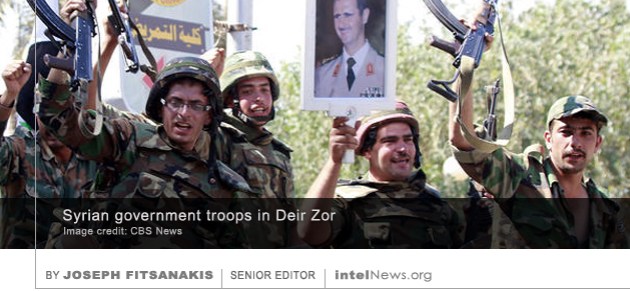 Hundreds of ground troops from Iran and Lebanon have been entering Syria in the past two weeks and are about to launch a large-scale ground attack against rebel groups, according to Reuters. The news agency quoted Lebanese sources “familiar with political and military developments in the conflict”. One source said that the Russian airstrikes in Syria, which began earlier this week, are the first phase of a large-scale military offensive against the Islamic State and other anti-government forces operating on the ground.
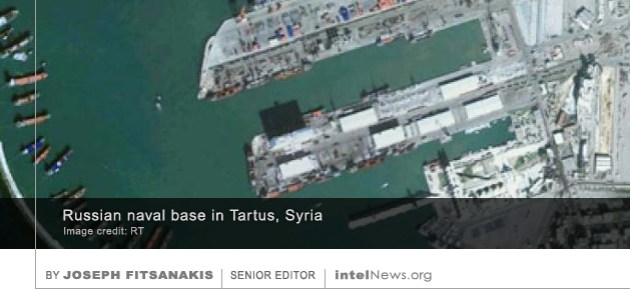 The governments of Russia, Syria and Iran have entered a formal intelligence-sharing agreement with Iraq, in an effort to defeat the Islamic State, it has been announced. Intelligence-sharing has been practiced for a while between Russia, Syria and Iran; but this is the first time that Iraq, an American ally, has entered the alliance. According to the Baghdad-based Iraqi Joint Forces Command, the agreement entails the establishment of a new intelligence-sharing center in the Iraqi capital. It will be staffed with intelligence analysts from all four participating countries, who will be passing on shared information to their respective countries’ militaries.
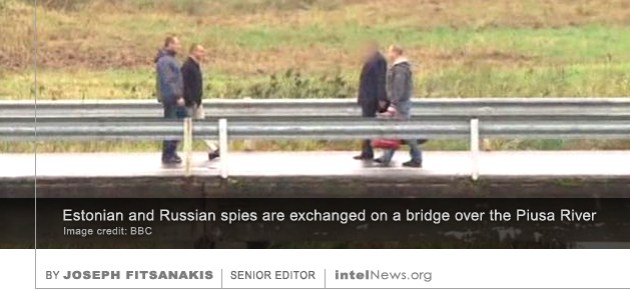 The Russian and Estonian intelligence services have exchanged two men accused by each country of spying for the other, in a rare public example of what is commonly referred to as a ‘spy-swap’. The exchange took place on Saturday on a bridge over the Piusa River, which forms part of the Russian-Estonian border, separating Estonia’s Polva County from Russia’s Pskov Oblast.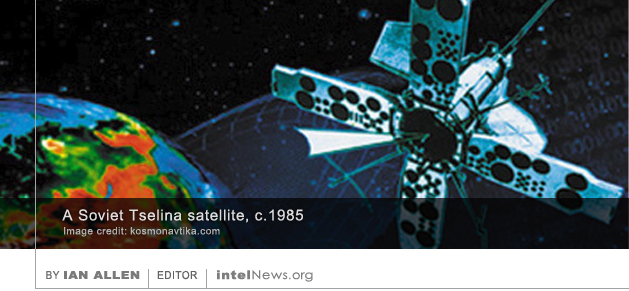
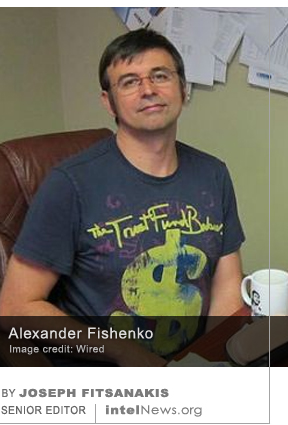 A resident of Texas, who is accused by United States authorities of setting up a front company in order to illegally acquire American technology on behalf of Russia’s intelligence services, has pleaded guilty to espionage charges. Alexander Fishenko, 49, was one of 11 people
 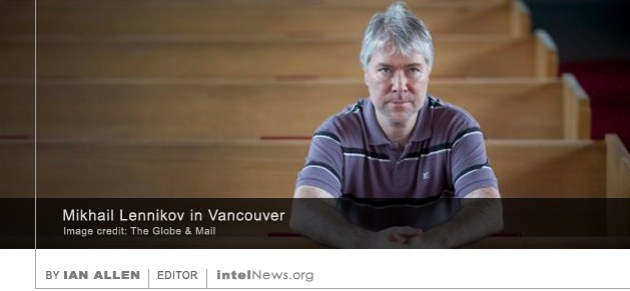 A Russian former officer in the Soviet KGB, who defied deportation orders issued against him by the Canadian government by taking refuge in a Vancouver church for six consecutive years, has voluntarily left the country. Mikhail Lennikov, who spent five years working for the KGB in the 1980s, had been living in Canada with his wife and son since 1992. But in 2009, Canada’s Public Safety Ministry rejected Lennikov’s refugee claim and
 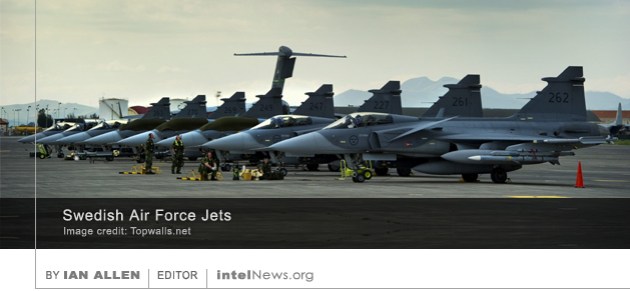 Swedish Air Force spy planes conducted reconnaissance flights over Russia on Wednesday —and there was nothing the Kremlin could do about it. The flights were part of the 1992 Treaty on Open Skies, an international agreement designed to build trust among former Cold War rivals. The treaty was first proposed by the United States in 1990, with the intention of covering all member-states of the Warsaw Pact and the North Atlantic Treaty Organization. When it was eventually signed, on March 24, 1992, it was ratified by 23 countries, including the US and Russia. An additional 11 states have joined the treaty at various times since, with Sweden joining in 2002. On Wednesday, Swedish reconnaissance airplanes conducted flights over a number of Russian military installations as part of the treaty, as they do every year during predetermined times.
 The German and Dutch governments allegedly joined forces to investigate a Russian supercomputer specialist, who studied in Germany and Holland, suspecting him of passing technical information to Russian intelligence. German weekly newsmagazine Der Spiegel, which published the report in its current issue, identified the physicist only as “Ivan A.” and said that the 28-year-old man was a member of a physics laboratory affiliated with the Max Planck Institute in the western German city of Bonn.
 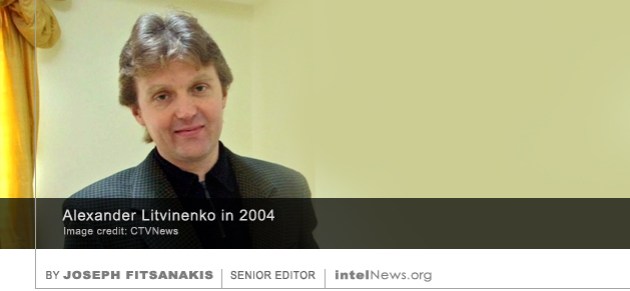 A Russian former intelligence officer, who is accused by the British government of having killed a former KGB spy in London, has agreed to testify at a public inquiry to be held in the British capital next month. British government prosecutors believe Russian businessman Dmitri Kovtun, who worked for the KGB during the Cold War, poisoned his former colleague in the KGB, Alexander Litvinenko, in 2006. Litvinenko was an officer in the Soviet KGB and one of its successor organizations, the FSB, until 2000, when he defected with his family to the United Kingdom. He soon became known as a vocal critic of the administration of Russian President Vladimir Putin. In 2006, Litvinenko came down with radioactive poisoning soon after meeting Kovtun and another former KGB officer, Andrey Lugovoy, at a London restaurant. He was dead less than two weeks later.
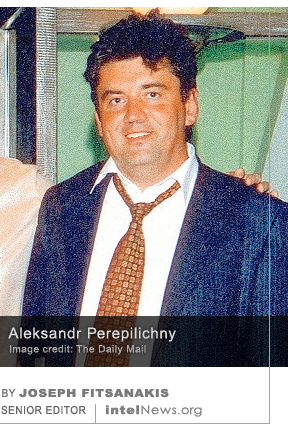 A Russian businessman, who died in London while assisting a Swiss probe into a massive money-laundering scheme, may have been poisoned with a substance derived from a highly toxic plant, an inquest has heard. Aleksandr Perepilichny was an influential Moscow investment banker until he fled Russia in 2009, saying that his life had been threatened after a disagreement with his business partners. A few months later, having moved to an exclusive district in Surrey, south of London, Perepilichny began cooperating with Swiss authorities who were investigating a multi-million dollar money-laundering scheme involving senior Russian government officials. The scheme, uncovered by a hedge fund firm called Hermitage Capital Management (CMP), and described by some as the biggest tax fraud in Russian history, defrauded the Russian Treasury of at least $240 million. The case made international










Iraq now using Russian intelligence in war against Islamic State
October 15, 2015 by Joseph Fitsanakis Leave a comment
According to US media reports, the headquarters of the intelligence-sharing center is located in Baghdad’s so-called Green Zone, where US forces were stationed until 2012. Each of the member states has six officers at center, who are given intelligence by their respective countries’ militaries with the intent of sharing it with the other three participating militaries. In addition to these officers, there are two Russian one-star generals stationed at the center, according to The Washington Times, which cited “an Iraqi official who asked not to be identified”.
Back in September, when the four-partite agreement was announced, the US said it respected Iraq’s freedom to enter into security pacts with regional governments, but warned that Syria was a major violator of human rights and should not be part of the intelligence-sharing treaty. On Tuesday, White House press secretary Josh Earnest said he could see no reason why Baghdad would want to enter into an intelligence-sharing agreement with Moscow, given that the US-led coalition had been sharing intelligence with Iraq for over a year. The coalition’s intelligence collaboration with Baghdad had “worked effectively with the Iraqis to make progress against [the Islamic State] inside of Iraq”, he said.
► Author: Joseph Fitsanakis | Date: 15 October 2015 | Permalink
Filed under Expert news and commentary on intelligence, espionage, spies and spying Tagged with intelligence cooperation, Iran, Iraq, Islamic State of Iraq and al-Sham, Islamic State of Iraq and Greater Syria, Josh Earnest, News, Russia, Syria, United States