June 26, 2023
by Joseph Fitsanakis
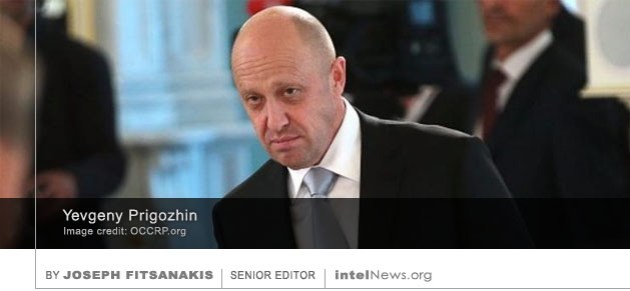 IN THE EARLY HOURS of June 23, PMC Wagner leader Yevgeny Prigozhin declared the launch of an armed campaign against the Ministry of Defense of the Russian Federation. Within hours, several thousand soldiers belonging to Wagner, one of the world’s largest private military companies, had abandoned their positions in eastern Ukraine and were en route to Moscow. Their mission, according to Prigozhin, was to arrest Minister of Defense Sergei Shoigu and Chief of the General Staff Valery Gerasimov, and try them for mismanagement and corruption.
In the ensuing hours, National Guard units along the M-4, a 1,100-mile-long expressway that connects the northeastern shores of the Black Sea to Moscow, began blocking or destroying critical junctures across that vast road network, in an attempt to obstruct the Wagner convoy. In a televised nationwide address, a visibly shaken Vladimir Putin accused Prigozhin of leading an armed insurrection, and warned those who followed him that they would be treated as traitors. Meanwhile, tickets on flights from Moscow to several visa-free international destinations were sold out within hours, as Muscovites braced for the outbreak of civil war.
Yet, within fewer than 24 hours, Prigozhin, who had repeatedly vowed to reach Moscow or die trying, was on his way to Belarus. He had seemingly accepted a deal to abandon his loyal troops in exchange for amnesty and a life in exile. Prigozhin’s sudden about-face surprised many observers, who had expected to see firefights between Spetsnaz units and Wagner forces in Moscow’s southern districts by Sunday afternoon. Even some of Prigozhin’s own troops took to social media to openly accuse their former leader of betrayal, and vow revenge.
PRIGOZHIN: A RATIONAL AND CALCULATED ACTOR
How are we to explain this unexpected turn of events? The difficulty of such a task is amplified by the lack of reliable reporting from Russia, along with the inherent chaos of war and the rapidly changing nature of events. It must be stressed, however, that Prigozhin is neither impulsive nor irrational. His maneuvers over the past week were calculated and almost certainly pre-planned and choreographed —most likely long in advance. His ultimate decision to seek political asylum in Belarus —one of the few countries in the world that is unlikely to turn him over to the United States— makes sense under one premise: that the motive behind his “justice march” to Moscow was not to challenge Putin, but to save his life.
To begin with, the bitter feud between Prigozhin and the Russian Ministry of Defense is not new. It has been raging for years. It both precedes and exceeds Russia’s ongoing military campaign in Ukraine. The  Wagner leader has repeatedly expressed his dismay at being viewed as an outsider by the Ministry of Defense, which it views as an elitist and incompetent bureaucracy. His experience in Ukraine, where Wagner’s forces faced stiff resistance from the local population and the Ukrainian military alike, added fuel to his rage against a host of Russian defense officials. Prigozhin has been voicing his denunciations of the way these officials have managed the war since March of 2022, just two weeks into the invasion of Ukraine.
PRIGOZHIN’S DISILLUSIONMENT
The disastrous Russian military campaign in Ukraine only served to sharpen Prigozhin’s criticism of his country’s defense establishment. One can observe this in the evolution of his critiques over time. In recent months, the Wagner leader has not only criticized the Ministry of Defense, accusing his leadership of corruption, but he has increasingly directed his ire against broad segments of Russian society. In his video tirades, he often decries what he describes as “the Russian elite” and the “oligarchy”, whom it accuses of living in luxury, while Russia’s working class fights and dies in Ukraine, Syria, Libya, and elsewhere. Read more of this post
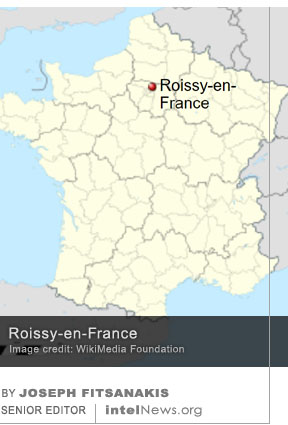 AN INVESTIGATION HAS BEEN launched in France after a Ukrainian-born Russian national reportedly detonated explosives in a hotel room near Paris, suffering severe burns in the process. Sources from France’s National Anti-Terrorism Prosecutor’s Office (PNAT) said the incident occurred on Monday in a hotel in Roissy-en-France, a small bedroom community located 15 miles northeast of downtown Paris.
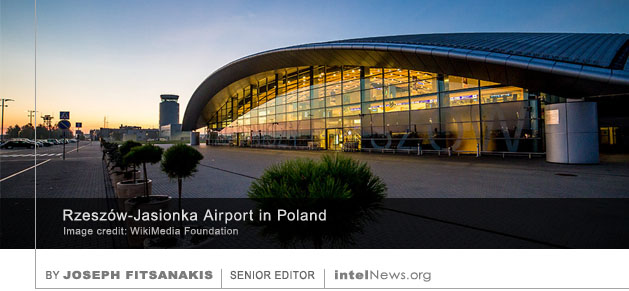 AUTHORITIES IN GERMANY and Poland have charged three individuals with working on behalf of Russian military intelligence in planning acts of sabotage and assassination on European soil. One of the plots allegedly involved an effort to assassinate Ukrainian President Volodymyr Zelenskyy. Another aimed to sabotage commercial airport facilities that are being managed by the United States military.
 A SERIES OF COORDINATED drone strikes that struck Moscow last week were not random, but may in fact have targeted the homes of senior Russian intelligence officials, according to a new report by an American television network, which cited knowledgeable sources and data by an open-source research firm.
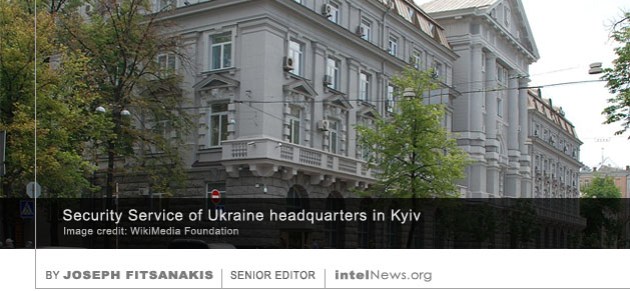 THE UKRAINIAN INTELLIGENCE SERVICES are training and arming cells of saboteurs inside Russia, who are responsible for several acts of sabotage on Russian soil, including a recent attack on the Kremlin, according to CNN. In an
 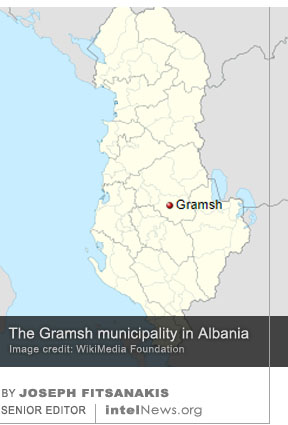 A COURT IN ALBANIA
  A UKRAINIAN PARAMILITARY GROUP has claimed to be behind a targeted attack against an influential figure in Russian literature and social media on Saturday, which killed his fellow passenger and prompted strong denouncements by the Kremlin. The attack appeared to target Yevgeny Nikolayevich Prilepin, 47, known in Russia as Zakhar Prilepin. One of the best-known novelists in Russia, Prilepin spent much of his late teens and early twenties serving in the Russian National Guard. He saw action during two tours in Chechnya.
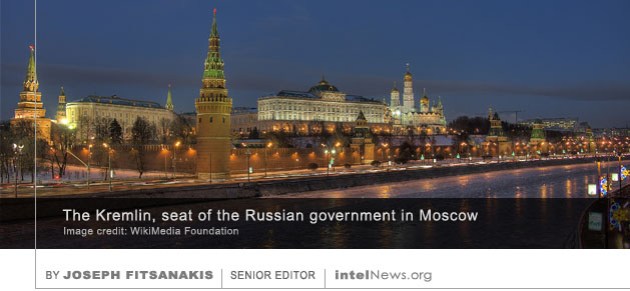 OFFICIALS IN UKRAINE HAVE
  Russia’s border with Belarus, two trains were
 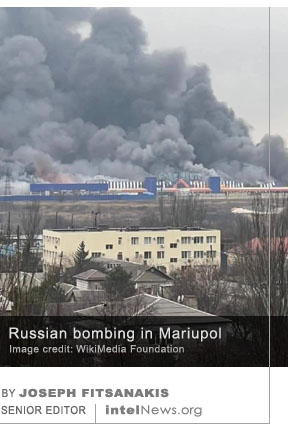 A NEW REPORT PUBLISHED by a London-based security think-tank concludes that Russia has employed unconventional operations effectively to subdue the population in occupied areas of Ukraine. These successes contrast sharply with the inferior performance of Russia’s conventional military forces, as revealed last week in a series of leaked documents belonging to the United States Department of Defense.
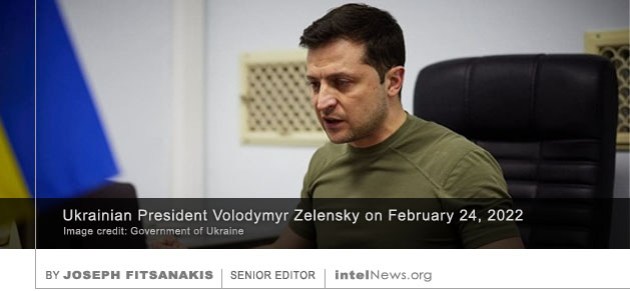 INFORMATION PROVIDED BY THE United States Central Intelligence Agency helped Kyiv foil two Russian plots against the life of Ukraine’s President, Volodymyr Zelenskyy, in the crucial early stages of the Russo-Ukrainian war, according to a new book. The claim is made in
 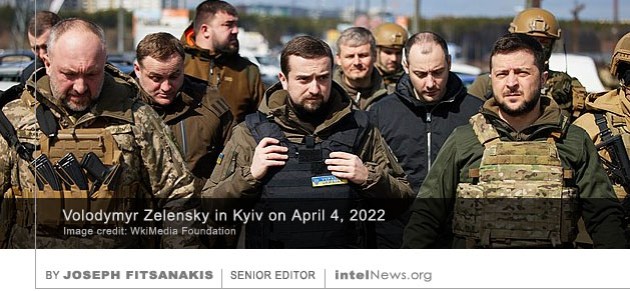 ON SUNDAY, JULY 17, the Ukrainian administration of President Volodymyr Zelenskiy announced the most extensive shake-up of the nation’s security leadership since the Russian military invasion. Two key members of Zelenskiy’s inner circle, Ukraine’s Prosecutor General Iryna Venediktova and domestic security chief Ivan Bakanov, were
  invariably, no. In fact, even the Ukrainians themselves are not in a position to trust their own intelligence services.
 IN THE OPENING STAGES of the Russian invasion of Ukraine, there was a widespread
  related legislation” with Western standards, as well as aligning them with NATO standards, so that Ukrainian cyber-warfare units can make use of advanced technologies and systems. Could it be, therefore, that Ukraine has improved its cyber-security posture enough to be able to defend itself against relentless Russian cyber-attacks?
 RUSSIAN STATE COMPANIES, BUSINESSES and individuals are being targeted in an unprecedented wave of attacks by digital assailants, according to observers, who say they are surprised by its ferocity. Since February of this year, hackers have accessed the personal financial data of pro-Kremlin oligarchs, stolen millions of internal emails stored on Russian government severs, and defaced high-profile websites across the nation. The Washington Post, which






 intelNews.org
Son of senior CIA official dies ‘fighting for Russia’ in Ukraine
April 28, 2025 by Joseph Fitsanakis 1 Comment
On April 25, the independent Russian media website Important Stories (known as iStories) claimed that Michael Gloss, 21, the son of CIA Deputy Director for Digital Innovation Gallina Gloss, had “died within the borders of Ukraine” while fighting for the Armed Forces of the Russian Federation. Although his death had occurred in April 2024, the information about his American citizenship and his connection to the CIA had been kept from the media until the iStories report disclosed it to the public.
Later on the same day, a spokesperson for the CIA told NBC News that the spy agency was aware of the incident, which had been treated “as a private family matter for the Gloss family, not a national security issue”. The CIA spokesperson added that Michael Gloss had “struggled with mental health issues” and relayed the Gloss family’s wish for “privacy at this difficult time”.
According to iStories, Michael Gloss voiced strong support for Ukraine early in the Russo-Ukrainian war. He eventually traveled to Europe on his own, joining the Rainbow Family, a modern-day hippie movement with roots in late-1960s counterculture. Gloss eventually traveled across Turkey, where he reportedly began posting increasingly pro-Russian messages and strong criticism of the United States on his social media accounts.
In the summer of 2023, Gloss began posting stories and images from Russia. In one instance, he stated in a social media post that he had decided to “defeat mortality and the military-industrial complex”. Shortly afterwards he enlisted in the Russian army and began posting photos and videos from his military training alongside other international volunteers. He also began participating on Russian social media platforms, such as VKontakte, where he expressed strong support for the Russian war effort and blasted what he referred to as “Western propaganda” about Ukraine and its government.
According to iStories, Michael Gloss “died within the borders of Ukraine”, though it is not known whether he participated in any fighting. An obituary published by his family in the United States makes no mention of his enlistment in the Russian military, stating only that he was “tragically killed in Eastern Europe on April 4, 2024”, while “forging his own hero’s journey”.
► Author: Joseph Fitsanakis | Date: 28 April 2025 | Permalink
Filed under Expert news and commentary on intelligence, espionage, spies and spying Tagged with 2022 Russian invasion of Ukraine, CIA, CIA Directorate of Digital Innovation, Michael Gloss, News, Russia, Ukraine, United States