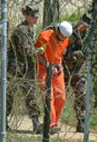
Obama administration denies UN access to Guantánamo, CIA prisons

Guantánamo

Guantánamo

By JOSEPH FITSANAKIS | intelNews.org |
The US government has turned down calls by United Nations human rights monitors for access to the US Pentagon’s Guantánamo Bay prison camp and to CIA prison sites around the world. It is the second time that Obama administration officials have declined this request by UN monitors, despite the administration’s rhetorical commitment to increasing its collaboration on human rights issues with the international agency. Commenting anonymously to The Washington Post, which is one of a handful of US news outlets that are running this story, US government officials said that the Obama administration “support[s] the work of the UN human rights researchers”, but is “constrained in releasing information on sensitive intelligence matters”. The news comes ten days after unconfirmed reports that the US Department of Justice is considering the appointment of a special prosecutor to investigate the use of torture by US intelligence agencies after September of 2001.

Bookmark and Share

News you may have missed #0037

  • Gambian Army chief accused of spying. A newspaper claims that the chief of Gambia’s armed forces, Lt. Colonel Sainey Bayo, who recently fled to the United States, did so while being “investigated for supplying sensitive state secrets to an unnamed Western country”.
  • US Secretary of State violates declassification statute. The latest historical records release of the Foreign Relations of the United States, which is the official record of US foreign policy, has failed once again to abide by a 1991 statute which requires the Secretary of State to publish records “not more than 30 years after the events recorded”.
  • Intelligence report says Canada is key cash source for Tamil Tigers. A Canadian intelligence report released under the country’s Access to Information Act claims that the Liberation Tigers of Tamil Eelam in Sri Lanka receive millions each year in backing from Canada’s Tamil diaspora.

Bookmark and Share

Judge accuses CIA of fraud in 15-year court case

Judge Lamberth

Judge Lamberth

By JOSEPH FITSANAKIS | intelNews.org |
A 15-year old lawsuit against the CIA unexpectedly resurfaced yesterday, after a US federal judge accused the CIA attorneys of fraud and warned the former and current CIA leadership of serious legal sanctions. US District Judge Royce Lamberth said the CIA misled him on several occasions by falsely claiming that the “state secrets” clause applied to the case, which three consecutive US administrations have tried to bury. The case was filed in 1994 by retired Drug Enforcement Agency (DEA) officer Richard A. Horn, who claimed that CIA agents illegally wiretapped his conversations while he was stationed in Burma. It appears that, at the time, the US diplomatic representation in Burma and the CIA station in Rangoon were at loggerheads with the DEA. Read more of this post

Wiretap whistleblower shunned by US Congress, media

Mark Klein

Mark Klein

By IAN ALLEN | intelNews.org |
Those of you who have been following the ongoing revelations about STELLAR WIND, the National Security Agency (NSA) warrantless wiretapping scheme authorized by the Bush Administration in the wake of 9/11, will know about Thomas M. Tamm. Tamm was the Justice Department official who in 2005 first notified The New York Times about the existence of the project. But Tamm was not the only whistleblower in the case. He was joined soon afterwards by another insider, Mark Klein. Klein had just retired from AT&T as a communications technician when he read The New York Times revelations about STELLAR WIND. As soon as he read the paper’s vague description of the NSA project, Klein realized he had in his possession AT&T documents describing exactly how the company shared its customers’ telephone communications with the NSA, through a secret room at the AT&T Folsom Street facility in San Francisco. To this day, Klein remains the only AT&T employee to have come forward with information on STELLAR WIND. But, apparently, nobody cares. Read more of this post

News you may have missed #0034

Bookmark and Share

Post-9/11 torture sparked internal dissent, rift between FBI and CIA

Abu Zubaida

Abu Zubaida

By IAN ALLEN | intelNews.org |
Citing interviews with almost “two dozen [anonymous] current and former US officials” The Washington Post has revealed crucial new background information on the CIA’s torture methodology after 9/11. The exposé, by reporters Joby Warrick and Peter Finn, helps piece together some of the complex puzzle of internal decisions that led US interrogators to resort to waterboarding and other forms of torture against “war on terrorism” detainees. The article focuses on Jim Mitchell and Bruce Jessen, two psychologists who were hired by the CIA to design an elaborate ten-stage harsh interrogation program (see previous intelNews report). According to The Washington Post, Mitchell, who was the program’s mastermind, told associates he had modeled it on the theory of “learned helplessness”, used by professional psychologists “to describe people or animals reduced to a state of complete helplessness by some form of coercion or pain, such as electric shock”. Read more of this post

News you may have missed #0033

Bookmark and Share

News you may have missed #0032

Bookmark and Share

News you may have missed #0031

Bookmark and Share

News you may have missed #0030

  • German intelligence denies Iran nuclear estimate. The BND has denied reports in the German press that it believes Iran is capable of producing and testing an atomic bomb within six months. A BND spokesperson said that the agency’s view is that Iran would not be able to produce an atomic bomb for “several years”.
  • Ex-CIA Director Woolsey defends CIA assassination plan. James Woolsey, the Director of the CIA during the Clinton administration has defended the principle, as well as secrecy, behind the rumored post-9/11 CIA plan to set up assassination squads and unleash them after al-Qaeda’s leadership.
  • India and Pakistan to share more intelligence. India and Pakistan said yesterday that they agreed to increase communication- and information-sharing. But soon afterwards India announced there would be no resumption of formal normalization talks with Pakistan until Islamabad brings those behind last year’s Mumbai attacks to justice.

Bookmark and Share

Analysis: Why were CIA assassination squads canceled?

CIA HQ

CIA HQ

By IAN ALLEN | intelNews.org |
Despite all the razzmatazz surrounding the rumored secret CIA plan to set up assassination squads, several questions remain unanswered. IntelNews is among a number of websites that believe that something in the entire controversy doesn’t add up. The fact is, as I have mentioned before, the ongoing strikes by US unmanned drones in Afghanistan and Pakistan effectively amount to

deliberate assassinations of suspected terrorists, which are planned and implemented outside the framework of even elementary judicial oversight. Regardless of one’s feelings about terrorism, the democratic process […] explicitly forbids the circumvention of longstanding legal norms, which specify concrete judicial means of arrest, detention, trial and punishment of accused criminals.

So, if it is the case that the CIA is already following a policy of targeted assassinations –which often result in indiscriminate murder of civilians– then why all the fuss about the CIA assassination squad revelations? Moreover, why was the project reportedly canceled? Writing for The Los Angeles Times, Greg Miller provides a possible explanation. Read more of this post

Attorney behind NSA domestic wiretapping defends his views

John Yoo

John Yoo

By JOSEPH FITSANAKIS | intelNews.org |
The former US Justice Department lawyer who authored legal memos sanctioning the legality of the Bush administration’s secret wiretapping program has defended his views. John Yoo, who on 9/11 was a deputy assistant attorney general in the Justice Department’s Office of Legal Counsel, has penned an article in The Wall Street Journal, in which he voices disagreement over a recently published US government report that criticizes the wiretap program’s secrecy and dubious legal basis. The report was authored by the Offices of Inspectors General of the Department of Defense, Department of Justice, CIA, NSA, and Office of the Director of National Intelligence. It says that the Bush administration’s decision to keep NSA’s domestic wiretap program secret even from senior Department of Justice and intelligence officials hampered the broader intelligence community’s ability to use the program’s output, and subverted the government’s ethical standing in the so-called “war on terrorism”. Read more of this post

News you may have missed #0029

  • Iranians revolting against Nokia for alleged spying complicity. Consumer sales of Nokia handsets in Iran have allegedly fallen by up to 50%, reportedly because of the company’s membership in the Nokia Siemens Networks (NSN) partnership. As intelNews has been pointing out since last month, NSN allegedly helped supply the Iranian government with some of the world’s most sophisticated communications surveillance systems.
  • Analysis: Why NSA’s Einstein 3 project is dangerous. This editorial argues that US President Barack Obama’s decision to proceed with a Bush administration plan to task the National Security Agency with protecting government computer traffic on private-sector networks is “antithetical to basic civil liberties and privacy protections” in the United States.
  • New US government report says Bush secrecy hampered intelligence effectiveness. A new report from the Offices of Inspectors General of the Department of Defense, Department of Justice, CIA, NSA, and Office of the Director of National Intelligence, says that the Bush administration’s decision to keep NSA’s domestic wiretap program secret seriously hampered the broader intelligence community’s ability to use the program’s output.

Bookmark and Share

News you may have missed #0028

  • Iran could have the bomb in six months, says German intelligence. Germany’s Federal Intelligence Service (BND) alleges that if the Iranians “wanted to they could test a nuclear bomb within half a year.”
  • Australian PM threatens China over Rio Tinto spy case. Kevin Rudd warned China it has “economic interests at stake”, less than a week after Beijing arrested the Australian chief of the Anglo-Australian mine company’s iron ore operations in China.
  • 12 Mexico intelligence officers mutilated and killed. The mutilated bodies of the one female and 11 male federal intelligence officer were left in a heap beside a road in rural Michoacan state. Drug gangsters launched a brutal offensive against the Mexican government last Saturday, after the capture of their senior leader, Arnaldo “La Minsa” Rueda. “We’re waiting for you,” read a taunting sign left with the bodies.
  • NRO releases unclassified portions of 2009 budget. The super-secretive US National Reconnaissance Office, which is in charge of US satellite spying, has released fragments of its FY2009 Congressional Budget Justification Book. Incidentally, a couple of weeks ago there were rumors circulating in Washington that NRO may be broken up into several smaller agencies.

Bookmark and Share

Comment: Not So Fast, Cyberwarriors! [updated]

Hoekstra

Hoekstra

By JOSEPH FITSANAKIS | intelNews.org |
Rep. Peter Hoekstra wants to launch a cyberwar against North Korea. The Republican from Michigan, who heads his party’s delegation on the US House Permanent Select Committee on Intelligence, urged the US government last Thursday to “launch a cyber attack” or at least increase international sanctions on Pyongyang. Hoekstra urged this in response to a series of mysterious cyber-attacks that paralyzed major South Korean and US government websites for three days earlier this month. And he’s not alone. Last Friday, ABC News technology pundit Michael Malone effectively echoed Hoekstra and warned that “enemies of freedom everywhere” could use cyberterrorism to kill untold numbers of Americans by remotely controlling “fetal monitoring systems, surgical equipment, robotic bomb demolition equipment and ICBMs”. But South Korean cybersecurity specialists, who intensely monitor North Korean information systems, and were the ones who actually informed their US counterparts of the unfolding cyber-attacks on July 4, are not so sure that Pyongyang was behind the attacks. Read more of this post