Jonathan Pollard, US spy for Israel, complains of neglect by Israeli state

Jonathan PollardJonathan Pollard, an American who spied on his country for Israel in the 1980s, and is now free after spending 30 years in prison, has spoken of his frustration with the Israeli government, which it claims has forgotten about him. Pollard, a former intelligence analyst for the United States Navy, was released from an American prison in 2015, after serving a lengthy sentence for selling US government secrets to Israel. Throughout Pollard’s time in prison, the government of Israel lobbied for his release, claiming that the convicted spy did not harm American interests, but was simply trying to help Israel. But the US Intelligence Community and successive American presidents consistently rejected Israel’s claims, arguing that Pollard’s activities were severely detrimental to US interests. Pollard was eventually released after serving the entirety of his sentence. Ever since his release, Pollard has been required to wear an ankle monitor at all times. His Internet browsing is strictly regulated by the US government and he is not permitted to leave his New York home after sunset. He is also not permitted to leave the US, and Washington has refused to allow him to move to Israel.

Last week, Israel’s Channel 12 television station aired a rare interview with Pollard, in which the former spy claimed he had been “forgotten” by the Israeli government. Speaking from a restaurant in New York with his wife Esther by his side, Pollard told Channel 12 that no officials from the Israeli government had made contact with him since his release. He added that he felt “there is always something more urgent than me” for the government of Israel, whether it is “the [nuclear] deal with Iran or the [US] embassy’s move to Jerusalem, or the sovereignty of the Golan Heights”. When the Channel 12 reporter asked him whether he was disappointed by Israel’s perceived lack of efforts to bring him to Israel, Pollard replied that he would be “very depressed” if his “faith in God and [his] love for Israel and its people [was not] so strong”. At another point in the interview, Pollard appeared to criticize the Israeli government of Prime Minister Benjamin Netanyahu. “I am very concerned about what this entails for the [government’s] commitment and for [Israel’s] security”, he said. “If you do not care about someone like me, who spent 30 years in prison for the land of Israel and its citizens, how much concern is there for others in the country, [whether they are] soldiers or civilians?”.

In November of 2017, Israel’s Channel 2 television reported that Israeli Prime Minister Netanyahu had asked the United States President Donald Trump to allow Jonathan Pollard to move to Israel. However, despite the popular perception of the Trump administration as strongly pro-Israel, there are no indications that such a move may be taking place any time soon.

Author: Joseph Fitsanakis | Date: 27 May 2019 | Permalink

Star on CIA’s memorial wall honors employee who took her own life

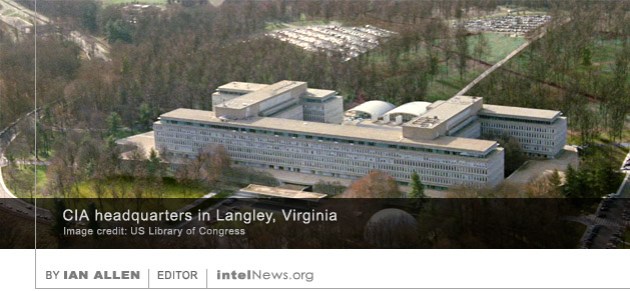
CIA memorial wallA new star that was recently added to the United States Central Intelligence Agency’s memorial wall is seen by some as a way to draw attention to the mental pressures that come with the job, while others view it as disrespectful to the Agency’s mission. The specially designated wall is located at the main entrance lobby of the CIA’s headquarters in Langley, Virginia. It was created in 1974 and displays a star for each of the CIA’s personnel who have perished in the line of duty while working for the Agency. Today it displays nearly 130 stars, which span the CIA’s 72-year history.
The CIA holds an annual ceremony in recognition of its fallen members, at which time new stars are usually added to the memorial wall. Among them there is a star for Ranya Abdelsayed, who died on August 28, 2013, while employed by the CIA in Kandahar, Afghanistan. However, unlike the other 19 known deaths of CIA personnel in Afghanistan since 2001, Abdelsayed reportedly died by suicide. Her lifeless body was found by a colleague after she shot herself to death at Firebase Gecko, an International Security Assistance Force base in Afghanistan, which is commanded by the North Atlantic Treaty Organization. It is believed that Abdelsayed’s star is the only star on the CIA’s memorial wall that recognizes a CIA employee who took her own life.

In an article published on Sunday, The Washington Post’s Ian Shapira reports that not everyone at CIA agrees that Abdelsayed deserves to have a star on the Agency’s memorial wall. Shapira spoke to Nicholas Dujmovic, a recently retired CIA historian, who claims that Abdelsayed’s star “must absolutely come off the wall” because it violates the CIA’s own criteria for this highest of honors. Dujmovic opines that the memorial wall is reserved for deaths of CIA personnel that are “of an inspirational or heroic character”, typically deaths that are caused by hazardous conditions or violent actions by adversaries. The CIA historian tells The Washington Post that he has researched past deaths of CIA personnel and fears that “there has been an erosion of understanding in CIA leadership for at least two decades about what the wall is for and who is it that we’re commemorating”.

The paper reports that Dujmovic made his views known to CIA officials when the Agency’s Merit Awards Board decided to include a star in honor of Abdelsayed. But the Board upheld its decision, and so did the CIA’s director at the time, John Brennan. He told The Post that he stands by that decision today, arguing that Abdelsayed’s death was “something the Agency needed to recognize as being one of those unfortunate consequences of the global challenges the CIA addresses”.

Author: Joseph Fitsanakis | Date: 21 May 2019 | Permalink

US-Iran tensions may have been sparked by ‘misread intelligence’, claims report

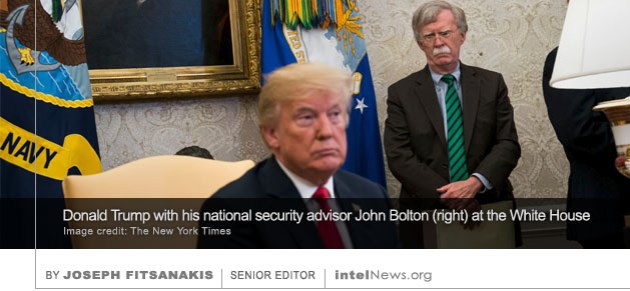
Trump BoltonThe escalating tension between the United States and Iran, and the ensuing military buildup in the Persian Gulf, may have resulted from a misreading of intelligence by both sides, according to a new report in The Wall Street Journal. Reports from the Middle East continue to describe the situation there as tense, while the political rhetoric by both Washington and Tehran remains heightened. Last week, the White House ordered the USS Abraham Lincoln carrier strike group to sail to Middle Eastern waters, following intelligence showing that “Iran or its proxies were planning attacks against US forces in Iraq, Syria and at sea”. Washington also evacuated all non-essential personnel from its embassy in Iraq. Meanwhile Iranian officials stated on Thursday that they were “prepared for war”, while the head of Iran’s Revolutionary Guard Corps, Major Genreal Hossein Salami, described the escalating crisis as “the most decisive moment in the [40-year history] of the Islamic Revolution”.
But a new report in The Wall Street Journal claimed on Thursday that the crisis between the two countries may have been caused by a misinterpretation of intelligence on each other’s moves. The paper said that new intelligence collected by American spy agencies appears to show that Tehran was under the impression that the US was about to launch attacks against it. There is no information about what precisely led the Iranians to draw that conclusion. But it is believed that Iran responded to the perceived threat from Washington by abruptly bolstering its military posture and placing its allies in the region —including Hezbollah in Lebanon and numerous Shiite militias in Iraq and Syria, on high alert. Those actions were interpreted by Washington as evidence that Iran was planning to launch an attack against American interests in the region, thus prompting the White House to send the USS Abraham Lincoln strike group to sail to the area, and to partially evacuate its embassy in Iraq. Citing “people familiar with the matter”, the Journal said that new intelligence that has been collected “in recent days” points to the initial actions taken by Tehran as “defensive in nature”.

However, said that paper, there continue to be “sharply differing views” about the situation among officials in the administration of US President Donald Trump. Specifically, some administration officials continue to argue that the available intelligence indicates that Iran “was planning to strike first”, and some even believe that Tehran is still “planning imminent attacks” on the US and its interests in the region. The paper also noted that President Trump is believed to have told senior officials in his administration —including the Secretary of Defense Patrick Shanahan— that he does not want to see a military confrontation with Iran.

Author: Joseph Fitsanakis | Date: 17 May 2019 | Permalink

British commander in Iraq contradicts US assessment of increased Iranian threat

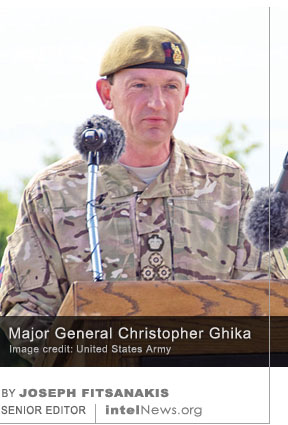
Christopher GhikaThe most senior British military officer in the war against the Islamic State contradicted American assessments of a heightened threat from Iran, prompting an unusually strong rebuke from Washington. Last week, the White House ordered the USS Abraham Lincoln carrier strike group to sail to Middle Eastern waters, following intelligence showing that “Iran or its proxies were planning attacks against US forces in Iraq, Syria and at sea”.
On Tuesday, however, this view appeared to be challenged by Major General Christopher Ghika, Britain’s most senior military official in the Middle East, who is deputy commander of Operation Inherent Resolve (OIR). The OIR umbrella brings together all pro-Western forces that are fighting the Islamic State in Iraq and Syria. General Ghika spoke to American reporters at the US Department of Defense via a live video-link from Baghdad, where he is currently stationed as OIR deputy commander. In responding to questions by reporters about alleged threats to Western forces from Iran or its proxies, General Ghika said that the OIR forces were “aware of that presence [or Iranian-led Shia militia groups in Iraq and Syria], clearly. And we monitor them along with a whole range of others because that’s the environment we are in”. However, added the general, “no, there has been no increased threat from Iranian-backed forces in Iraq and Syria”.

British newspaper The Guardian, which published General Ghika’s comments on Tuesday, noted that his statements appeared to directly contradict Washington’s claims of a heightened Iranian threat in the region. But in a statement released on Tuesday night local time, the US Central Command CENTCOM, whose responsibilities include the Middle East and Central Asia theaters, rejected General Ghika’s comments. “Recent comments from OIR’s Deputy Commander run counter to the identified credible threats available to intelligence from U.S. and allies regarding Iranian backed forces in the region”, said the statement. The Guardian described CENTCOM’s statement as “particularly striking” and “an extraordinary rebuke of an allied senior [military] officer”. The British Ministry of Defense had not responded to CENTCOM’s statement by Wednesday morning.

Author: Joseph Fitsanakis | Date: 15 May 2019 | Permalink

‘Unusual’ high-level meeting held at CIA headquarters to discuss Iran, say sources

CIA headquartersAn untypical high-level meeting was convened at the headquarters of the United States Central Intelligence Agency last week to discuss Iran, according to NBC News. The meeting, which NBC described as “highly unusual” was convened by President Donald Trump’s National Security Adviser John Bolton. Participants allegedly included Secretary of State Mike Pompeo, Acting Secretary of Defense Patrick Shanahan, Director of National Intelligence Dan Coats, CIA Director Gina Haspel, and Chairman of the Joint Chiefs of Staff General Joe Dunford. Citing “six current US officials”, NBC said the meeting was held at 7 a.m. on Monday, April 29, in Langley, Virginia.

The list of participants refers to a high-level national security meeting. These are almost always held at the White House —typically in the Situation Room— says NBC. In general, it is extremely rare for senior White House officials, like Bolton, or members of the Cabinet, like Pompeo, to participate in meetings at CIA headquarters. It is also worth noting that, according to NBC’s sources, the meeting was not related to Washington’s recent decision send the USS Abraham Lincoln carrier strike group to the Middle East. This leaves two options, according to the NBC report: first, that the meeting concerned a “highly sensitive covert action” involving Iran or an Iranian proxy, such as the Lebanese Hezbollah. It could have been an update on an existing CIA operation, or a description of options for an impending operation. Alternatively the meeting could have been called due to a disagreement between the CIA and the White House about the results of an intelligence assessment or estimate about Iran.

NBC said it contacted the National Security Council to inquire about the April 29 meeting, but a spokesperson refused to comment. Meanwhile, Pompeo abruptly canceled the final leg of a four-nation tour of Europe on Thursday and returned to Washington, reportedly in light of heightening tensions between Washington and Tehran. Also on Thursday, the Iranian government described the Trump administration’s decision to deploy the USS Abraham Lincoln carrier strike group to the Middle East as “an action of psychological warfare” against the Iranian people. Late on Thursday, President Trump urged Iran to reach out to him: “What I would like to see with Iran, I’d like to see them call me”, said the US leader during a press conference at the White House. Iranian officials did not immediately respond to his comments.

Author: Ian Allen | Date: 10 May 2019 | Permalink

Intel that prompted US to deploy aircraft carrier to Middle East ‘came from Israel’

USS Abraham LincolnThe sudden decision by the United States to deploy significant firepower to the Middle East was partly in response to intelligence that was given to Washington by Israeli officials, according to a report. On Wednesday, the US announced that the USS Abraham Lincoln carrier strike group had received instructions to sail to the Middle East. The aircraft carrier is reportedly sailing alongside a cruiser and four destroyers, while an unspecified number of B-52 heavy long-range bombers have been ordered to fly to a US military base in Qatar.

Commenting on this last-minute development, US National Security Adviser John Bolton warned Iran that it would face “unrelenting force” if it threatened American interests in the Middle East and beyond. The Chairman of the Joint Chiefs of Staff, General Joseph Dunford, said that the move aimed to “deter Iran […] so that there would be no ambiguity about our preparedness to respond to any threat against our people or partners in the region”. Speaking in Congress, the US Acting Secretary of Defense Patrick Shanahan said that the decision to move a significant amount of firepower to the Middle East came in response to intelligence showing that Iran had “made plans to target US forces in Iraq and elsewhere in the Middle East”. According to ABC News, the intelligence suggested that “Iran or its proxies were planning attacks against US forces in Iraq, Syria and at sea”. But there was no further information reported about the precise nature of the alleged warnings.

Meanwhile, the American news and information website Axios said on Monday that the intelligence that caused Washington’s response was given to the US by Israeli officials. Citing “senior Israeli officials”, the website said that the intelligence given to the US had been gathered “primarily by the Mossad”, Israel’s main external intelligence agency. It added that the information about possible Iranian attacks against the US or its allies in the Middle East was “raised two weeks ago” during closed-door talks at the White House between a US team led by Bolton and an Israeli delegation headed by his Israeli counterpart, Meir Ben Shabbat. The intelligence, said Axios, showed that the US or its allies, including the United Arab Emirates or Saudi Arabia, would be targeted by Iran. The information is “understood to be part of the reason for Bolton’s announcement” this week, said Axios.

Author: Joseph Fitsanakis | Date: 09 May 2019 | Permalink

US lifts sanctions on Venezuelan ex-spy chief, calls on others to defect

SEBIN VenezuelaIn an effort to persuade senior members of the Venezuelan government to defect, the United States has lifted punitive financial sanctions on the country’s intelligence director, who left his post on April 30. General Christopher Figuera became director of the Bolivarian National Intelligence Service (SEBIN) in October 2018. SEBIN is Venezuela’s primary intelligence agency and has a dual domestic and international role. Much of its domestic mission is to protect and defend the Bolivarian Revolution, which forms the ideological framework of the government headed by President Nicolás Maduro. It follows that SEBIN’s employees are all trusted supporters of Venezuela’s embattled President.
On February 15 of this year, the United States government included General Figuera on a financial sanctions list of Venezuelan government officials who held senior posts in the Maduro government. But on April 30, General Figuera appeared to be one of relatively few senior Venezuelan officials to respond favorably to an open call by Juan Guaidó, the United States-supported President of the Venezuelan National Assembly, to remove Maduro from power. Figuera was reportedly denounced by Venezuelan government officials and summarily replaced by Gustavo Gonzalez Lopez, who was director of SEBIN until he was replaced by Figuera in 2018.

On Tuesday, the United States government said that it had removed General Figuera from its financial sanctions list. Speaking before reporters in Washington, US Vice President Mike Pence said that Figuera was “an example to follow” for other senior Venezuelan government officials and urged more of them to follow Figuera’s example. Pence added that the US government wanted to reward Figuera for abandoning his post and denouncing Maduro. In a subsequent statement given to the media, the US Department of the Treasury said that removal of sanctions “may be available” for all senior Venezuelan officials “who take concrete and meaningful actions to restore democratic order” in the Latin American country. The statement did not elaborate on the meaning of taking “concrete and meaningful actions”.

In a potentially related development, the Venezuelan government said on Tuesday that it had taken control of three private airfields in the vicinity of the capital city of Caracas, in order “to prevent illicit acts which would compromise the safety of civil aviation”. It is believed that General Figuera left the country with his family using a private airfield, and that the Maduro government is trying to stop others from following his example.

Author: Joseph Fitsanakis | Date: 08 May 2019 | Permalink

Malaysia is helping Iran evade US economic sanctions, intelligence sources claim

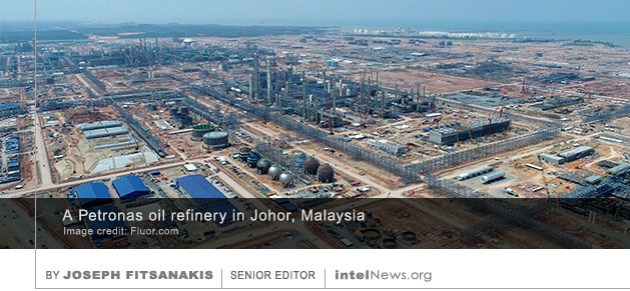
Petronas MalaysiaCiting “Western intelligence officials”, Israeli newspaper Haaretz said on Thursday that a deepening alliance between Malaysia and Iran is expected to enable Tehran evade some of the economic sanctions imposed on it by the United States. In the past, every time Washington has imposed economic sanctions on Iran, it has issued renewable waivers for a number of countries whose economies have historically depended on substantial Iranian energy imports. This is done in order to prevent these economies from entering a recession due to lack of access to sufficient energy supplies. This week, however, US President Donald Trump said that Washington would not renew waivers for these countries, which include Italy, India, Turkey, South Korea and China. These waivers are now expected to run out on May 2, 2019, after which date the US has threatened to impose economic sanction on all countries that have substantial financial dealings with Tehran.
Many observers believe that these new sanctions will have a deep and immediate impact on the Iranian economy. But, according to Haaretz, the American sanctions are bringing Iran closer to Malaysia. Throughout the past month, says the Israeli newspaper, “atypical numbers” of oil tankers have been sailing between the two countries —a sign of trying to move as much oil as possible out of Iran before the US sanctions hit. Citing “Western intelligence officials”, Haaretz claims that Iran plans to continue to funnel funds from oil and natural gas sales through Malaysian banks. Much of that assistance, which sources claim will grow in the next month, is facilitated through Petronas, Malaysia’s state-owned oil company. As one of the world’s largest companies and the most powerful corporate entity in Malaysia, Petronas has immense political power. Much of the country’s political elite connected with Petronas —including the country’s current Prime Minister, Mahathir Mohamad, who was a senior advisor to the company in the early 2000s. In 2017, Petronas signed a cooperation agreement with an Iranian refinery facility and announced its intention to develop an emerging oilfield in the Middle Eastern country. Then in late 2018, Petronas officials traveled to Iran to sign a memorandum of understanding on mutual cooperation between the Malaysian company and Iran’s state-owned energy producer and distributor, the National Iranian Oil Company.

Haaretz notes that cultural and political ties between Malaysia and Iran run deep. The Southeast Asian country is one of a handful of nations that allow Iranians to visit without first having to obtain a visa. If fails to note, however, that in recent times there have been tensions between the two countries, due to concerns in Kuala Lumpur that Iran is trying to spread a militant version of Shia Islam in Malaysia.

Author: Joseph Fitsanakis | Date: 26 April 2019 | Permalink

British spy agency calls Trump’s espionage claim ‘utterly ridiculous’

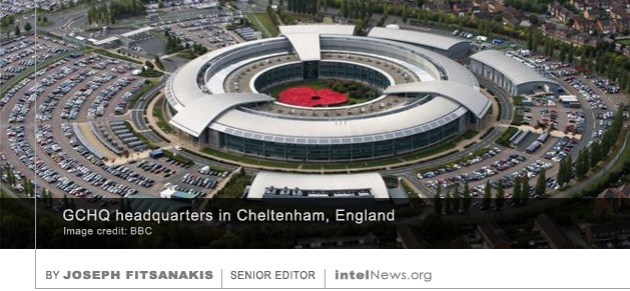
GCHQThe Government Communications Headquarters (GCHQ), Britain’s primary signals-intelligence agency, has called claims by United States President Donald Trump that it spied on his election campaign “utterly ridiculous”. President Trump’s allegations are not new. They apparently rest on claims made in March 2017 by a Fox News commentator, that the GCHQ spied on Trump on orders of then-US President Barack Obama. The claim was repeated on March 17 at the White House by Sean Spicer, Trump’s then-press secretary, who said that Obama had used the GCHQ to spy on Trump so as to evade American privacy laws. At the time, Spicer’s claim prompted an angry response from the British government in London and from the British spy agency itself. In a rare public comment, GCHQ called the allegations “utterly ridiculous”.
This past Wednesday, the US president appeared to repeat his claim that GCHQ had spied on his election campaign, via a post on the popular social networking platform Twitter. Responding to a reiteration of the claim on the conservative cable television channel One America News Network, Trump tweeted “WOW! It is now just a question of time before the truth comes out, and when it does, it will be a beauty!”. The president’s tweet appeared just hours after the British government confirmed that Trump had been invited for a four-day state visit to the United Kingdom in June. The visit is believed to include a meeting with British Prime Minster Theresa May and dinner with Queen Elizabeth II at Buckingham Palace.

Following Trump’s tweet, the US newsmagazine Newsweek contacted GCHQ with a request for a response to the US president’s allegation. A GCHQ spokesperson referred the newsmagazine to the agency’s 2017 statement, and repeated: “The allegations that GCHQ was asked to conduct ‘wire tapping’ against the then president-elect are nonsense. They are utterly ridiculous and should be ignored”. It is extremely rare for GCHQ —one of Britain’s most secretive and publicity-shy agencies— to respond publicly to stories in the media. Late on Wednesday, British Foreign Affairs Secretary Jeremy Hunt said that the invitation to President Trump to visit London would not be rescinded, and insisted that Britain’s “special relationship” with the US remained “intact”.

Author: Joseph Fitsanakis | Date: 25 April 2019 | Permalink

German spies dismiss US warnings about Huawei threat to 5G network

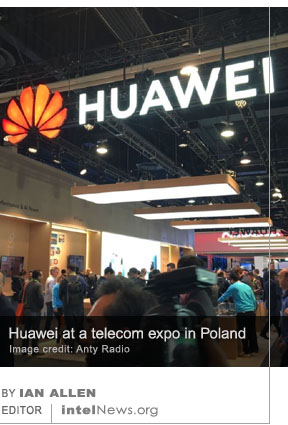
Huawei 2German intelligence officials appear to be dismissing Washington’s warning that it will limit security cooperation with Berlin if China’s Huawei Telecommunications is allowed to build Germany’s 5G network. The company, Huawei Technologies, is a private Chinese venture and one of the world’s leading telecommunications hardware manufacturers. In recent years, however, it has come under scrutiny by some Western intelligence agencies, who view it as being too close to the Communist Party of China. More recently, Washington has intensified an international campaign to limit Huawei’s ability to build the infrastructure for 5G, the world’s next-generation wireless network. Along with Britain, Australia and Canada, the US is concerned that the Chinese telecommunications giant may facilitate global wiretapping on behalf of Beijing’s spy agencies.
In the past several months the United States has repeatedly warned Germany that intelligence sharing between the two countries will be threatened if the Chinese telecommunications giant is awarded a 5G contract by the German government. In March, Washington informed German officials that intelligence cooperation between the two allies would be severely impacted if Chinese telecommunications manufacturers were given the green light to build Germany’s 5G infrastructure. The warning was allegedly included in a letter to Peter Altmaier, Germany’s Minister of Economic Affairs and Energy, written by Ambassador Richard Grenell, America’s top diplomat in Germany. The letter urged the German government to consider rival bids by companies belonging to American allies, such as the Swedish telecommunications equipment manufacturer Ericsson, Finland’s Nokia Corporation, or the South Korean Samsung Corporation.

But a report by Bloomberg on Wednesday said that German authorities were not convinced by Grenell’s argument. Citing “four people with knowledge on the matter”, the news agency said that Germany’s intelligence community see Washington’s warnings as “political grandstanding”. The US and Germany “need each other’s resources to tackle global conflicts” and “rely on each other too much to risk jeopardizing crucial data sharing”, said the report. The anonymous officials told Bloomberg that Germany does benefit from America’s “vast array” of intelligence. However, German spy agencies also provide their American counterparts with crucial intelligence from several regions of the world, they said. The US Department of State did not comment on the Bloomberg report. The Chinese government has repeatedly dismissed allegations that Huawei poses an espionage threat to Western nations.

Author: Ian Allen | Date: 18 April 2019 | Permalink

Venezuelan ex-spy chief with ‘treasure trove of intel’ on Maduro arrested in Spain

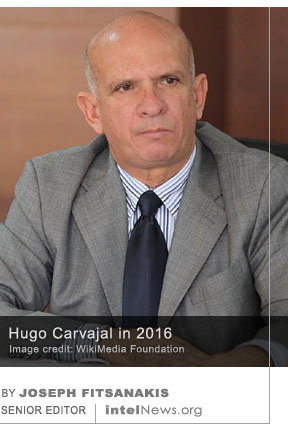
Hugo CarvajalThe former director of Venezuela’s military spy agency, who is wanted in the United States for facilitating international drug trafficking, has been arrested in Spain and may be extradited to Washington. Hugo Carvajal is a retired general and former diplomat, who was a member of the late Venezuelan President Hugo Chávez’s inner circle. From 2004 to 2011, under Chávez’s tutelage, Carvajal headed the Directorate General of Military Counterintelligence (DGCIM). But in 2008, the US named Carvajal as a major facilitator of international drugs trafficking and imposed financial sanctions on his assets around the world. Washington accused Carvajal of assisting the paramilitary group known as the Revolutionary Armed Forces of Colombia (FARC) transport drugs from Latin America to Mexico and from there to the US.

In 2014, the US government officially charged Carvajal with orchestrating a shipment of 1,200lbs of cocaine from Venezuela to Mexico. Washington also charged Carvajal with supplying FARC drug traffickers with Venezuelan passports bearing fake names, which they used to travel internationally to avoid detection. In 2014, Carvajal was arrested by authorities in Aruba, a Dutch overseas territory in Latin America, where he was serving as Venezuela’s consul general. But, to Washington’s dismay, he was released after the Dutch government ruled that his diplomatic immunity gave him immunity from prosecution. Following his release, Carvajal returned to Venezuela, where he was given a hero’s welcome by Chávez’s successor, President Nicolás Maduro. It came as a shock, therefore, when in February of this year Carvajal posted a video on social media in which he denounced Maduro and sided with his arch-nemesis, Juan Guaido, the President of the National Assembly of Venezuela. Carvajal’s issued his video a few weeks after Guaido declared himself president of Venezuela, citing powers afforded to him by the country’s constitution. He has since been openly supported by the United States and dozens of other Western countries. In his video, Carvajal urged the Venezuelan armed forces to stop siding with Maduro and support Guaido as Venezuela’s acting president.

The BBC reported that, shortly after Carvajal’s arrest in Spain, the US Department of Justice filed a formal request for the former spy chief’s extradition to the US. But the Reuters news agency cited an unnamed US government official who said that Carvajal was in possession of a “treasure trove” of intelligence about Maduro’s administration. The US official hinted that Carvajal may have willingly given himself up to Spanish police to express his desire to cooperate with the US. He is scheduled to appear before Spain’s High Court on Saturday. The court has 24 hours following Carvajal’s arrest to rule whether he will be extradited or freed from detention.

Author: Joseph Fitsanakis | Date: 15 April 2019 | Permalink

US prosecutors to use secret surveillance evidence in Huawei lawsuit

Huawei 2Prosecutors in the United States have informed lawyers representing the Chinese telecom- munications firm Huawei that they intend to use evidence obtained through secret surveillance in a lawsuit against the company. The case involves the arrest of Meng Wanzhou by Canadian authorities in December of last year. Meng, 47, is Huawei’s deputy chair and chief financial officer, and is the daughter of Ren Zhengfei, a former officer in the Chinese People’s Liberation Army, who founded the telecommunications giant in 1988. She was detained on December 1 in Vancouver at the request of the US, which claims it has evidence that she “tried to evade the American embargo against Iran”. On March 1, the Canadian Department of Justice formally commenced Meng’s extradition process to the US, which Huawei’s lawyers are currently seeking to prevent.

In a lawsuit brought by US government prosecu- tors against Huawei, the Chinese telecom- munications firm is accused of having conspired to defraud several multinational banks by misrepresenting its relationship with a company called Skykom Tech. Washington says that the company is in fact a front used to conceal illicit activities conducted by the Islamic Republic of Iran. American government prosecutors claim that Huawei worked with Skykom Tech to evade US-imposed economic sanctions on Iran. At a Thursday morning hearing in a federal court in Brooklyn, New York, Assistant US Attorney Alex Solomon said that US authorities had used “secret surveillance” to collect evidence against Huawei. He also said that the evidence had been obtained under a US Foreign Intelligence Surveillance Act (FISA) warrant, which is issued by a secret court and usually pertains to counterintelligence investigations —i.e. when a target is suspected of spying against the US.

Solomon said that the evidence against Huawei was “obtained […] from electronic surveillance and physical search”. He did not elaborate, but added that US government’s legal team had notified Huawei that it planned to use the FISA evidence in court. Last month Huawei rejected all charges filed against it. The company has not yet commented on the FISA evidence. The next date in the court case has been scheduled for June 19, 2019.

Author: Ian Allen | Date: 05 April 2019 | Permalink

US Homeland Security Department accused of disbanding homegrown terrorism unit

Department of Homeland Security DHSSome employees of the United States Department of Homeland Security claim that a unit specializing on homegrown and domestic terrorism was inexplicably disbanded, leaving America vulnerable to attack. The allegations were published on Tuesday on the website of The Daily Beast, an investigative news and opinion website. In a leading article published on the site, reporter Betsy Woodruff cites “current and former DHS officials” with knowledge about the Office of Intelligence and Analysis (I&A), which is the intelligence wing of the DHS.
Woodruff claims that, until recently, I&A employoed a team of analysts that worked on potential threats from domestic terrorism activity and homegrown violent extremist individuals or groups. They then shared their reports with law enforcement on the state and local level, which is DHS’s mission. But in August of 2017, when David Glawe assumed the post of Under Secretary of Homeland Security for Intelligence and Analysis, I&A experienced a major reorganization. The article alleges that Glawe —who was appointed by President Donald Trump— did away with the I&A unit that monitors domestic militancy, including far-right radicalization. Ever since that move, I&A have “significantly reduced their production [of analysis] on homegrown violent extremism and domestic terrorism”, according to a DHS official quoted in The Daily Beast piece. The I&A’s reduction in output has “generated significant concern at headquarters given the growth in right-wing extremism and domestic terrorism we are seeing in the US and abroad”, said another DHS official.

But in a written response to the website’s allegations, Glawe dismissed the claims as “patently false and the exact opposite of what we have done”. He went on to state that I&A has “significantly increased tactical intelligence reporting on domestic terrorists and homegrown violent extremists since 2016”. Referring to The Daily Beast’s claims, Glawe said that “those pushing such a narrative either do not understand intelligence collection efforts or don’t care about the truth”.

Author: Ian Allen | Date: 04 April 2019 | Permalink

Moscow confirms arrival of Russian troops in Venezuela

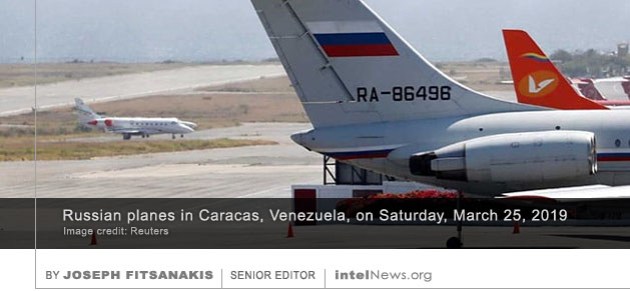
Russian planes CaracasRussian media reports have confirmed that an airplane carrying 100 Russian troops arrived in Caracas on Saturday, causing tensions to rise between Washington and Moscow over the deepening crisis in Venezuela. The arrival of the Russian troops in the Venezuelan capital was first reported on Saturday morning by Venezuelan reporter Javier Mayorca, who said on Twitter that two Russian military airplanes had landed in Caracas. The reporter said that an Antonov An-124 Ruslan cargo plane belonging to the Russian Air Force could be seen on the tarmac of the Simón Bolívar International Airport in the Venezuelan capital. Another, smaller aircraft, also bearing the Russian flag on its fuselage, landed shortly afterwards, said Mayorca.


Within hours, several Venezuelan media reports appeared to confirm Mayorca’s claims, some even posting photographs of the two Russian planes surrounded by what appeared to be uniformed Russian soldiers. The BBC reported that the Russian cargo plane had delivered 100 Russian troops and 35 tons of military equipment. The force was led by General Vasily Tonkoshkurov, commander of the General Staff of Russia’s Armed Forces, according to the BBC. Later on Saturday, the Russian government-owned news agency Sputnik confirmed that Russian troops had arrived in Caracas. Citing anonymous “diplomatic sources”, Sputnik said the Russian troops had been sent to Caracas in order “to fulfil technical military contracts” and “to take part in consultations […] on defense industry cooperation” with Venezuelan officials. It added that there was “nothing mysterious” about the visit and that it was “related to [military] contracts that had been signed by the two countries years ago”.

Russia has supported Venezuela militarily, economically and diplomatically ever since 1999, when Hugo Chávez became president. The recent political crisis in the Latin American country, which has prompted a direct diplomatic intervention by Washington, has brought Caracas and Moscow closer together, as Russia has strongly opposed efforts by the United States to bring down the government of Nicolás Maduro. Earlier this year, Russia sent two Tu-160 long-range bomber aircraft to take part in a military exercise organized by the Venezuelan government.

On Monday, Washington said that the United States Secretary of State Mike Pompeo had a telephone conversation with Russian Foreign Affairs Minister Sergei Lavrov. Pompeo told his Russian counterpart that Moscow should “cease its unconstructive behavior” and warned him that the United States would “not stand idly by as Russia exacerbated tensions” in Venezuela. Late on Monday, Sputnik quoted a “diplomatic source” as saying that that the “visit of Russian military personnel to Venezuela [was] in no way connected to the statements of the United States on potential intervention in Venezuela”.

Author: Joseph Fitsanakis | Date: 26 March 2019 | Permalink

Putin’s ex-adviser found dead in Washington had broken neck, say medical examiners

Mikhail LesinA former senior adviser to Russian President Vladimir Putin, who died allegedly by falling while intoxicated in a luxury hotel room in Washington, may in fact have been strangled to death, according to a newly released medical examination. The body of Mikhail Yuriyevich Lesin, a well-known Russian media mogul, was found in the luxury Dupont Circle Hotel on November 5, 2015. He became famous in Russia soon after the collapse of the communist system, when he founded Video International, an advertising and public-relations agency that was hired by Russian President Boris Yeltsin to run his reelection campaign in 1995.

Yeltsin’s electoral success was partly attributed to the well-tailored media message projected by Lesin’s company. The media magnate was rewarded by Yeltsin, who offered him influential government posts, including that of director of Russia’s state-owned news agency Novosti. Meanwhile, Lesin became a media personality and frequently gave interviews espousing a free-enterprise model for the Russian media industry. But soon after Vladimir Putin’s ascendance to the presidency, Lesin saw the writing on the wall and began advocating for increased government regulation of media and telecommunications conglomerates. In 1999, Putin made him Minister of Press, Broadcasting and Mass Communications, a post he held for nearly six years, until 2004. In 2006, Lesin was awarded the Order for Merit to the Fatherland, one of the most prestigious civilian decorations in Russia.

But in late 2009, Putin abruptly fired Lesin from his post in the Kremlin’s Media Advisory Commission, allegedly because the media mogul had developed close contacts with Russian organized crime. Lesin’s ties with Putin’s inner circle were further strained in 2014, when he resigned from his position as head of Gazprom Media, after he clashed with pro-Putin executives on the board. When Lesin’s body was found in his hotel room by a member of the hotel staff, some suggested that he may have been killed by the Kremlin. Read more of this post


