Philippines summons US ambassador to protest negative intelligence report

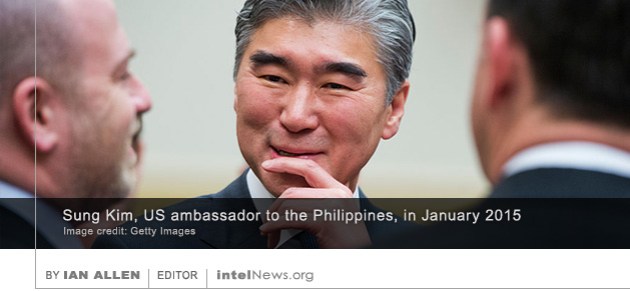
Sung KimThe United States ambassador to the Philippines has been summoned by Manila in response to the publication of an American intelligence report that described President Rodrigo Duterte as a threat to democracy. The report, published on February 13, represents a joint assessment of worldwide challenges to the interests of the United States. It is compiled annually by all 16 member agencies that make up the US Intelligence Community. This year’s report focused on the administration of President Duterte, who has led a self-styled “war on drugs, corruption and crime” in the Philippines since he assumed office in June 2016.

By the government’s own account, Duterte’s war has left more than 4,000 people dead in the past 18 months. But some human rights groups estimate the number of deaths at 11,000 or even higher. The US intelligence report notes that Duterte declared martial law in the Philippines’ southern region of Mindanao, which is expected to remain in place for most of 2018. It expresses concerns about rumors that the government may continue to impose martial law indefinitely and that it may extend it nationwide. It also expresses concern about Duterte’s prior statements that he intends to turn his government into a “revolutionary regime”.

At a press conference in Manila, President Duterte’s spokesman Harry Roque said that the US ambassador to the Philippines capital, Sung Kim, met with Salvador Medialdea on Tuesday. Medialdea is the president’s executive secretary, who is the highest-ranking official in Duterte’s office. According to Roque, Medialdea told the US ambassador that the Philippine embassy in Washington was prepared to “give US intelligence accurate information about the reality” of the political situation in the Philippines. He also informed Ambassador Kim that the Philippines president had respect for the rule of law. A statement issued by the US embassy in Manila said that Ambassador Kim informed Medialdea about “the nature of the […] report, which is based on widely available information”.

The meeting ended with the two officials reaffirming “the strength of the broad and deep bilateral relationship” between Washington and Manila. They also said that the US would continue to cooperate with the Philippines on political, economic and security issues. However, tensions between the two countries have been high all week. On Thursday, President Duterte accused the Central Intelligence Agency of funding Rappler.com, a very popular news and information website based in the Philippines and Indonesia, which he said was engaged in a systematic effort to undermine his administration.

Author: Ian Allen | Date: 27 February 2018 | Permalink
US intelligence assessment describes Philippines leader as threat to democracy

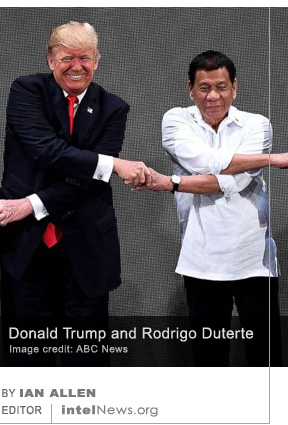
Trump and DuterteA wide-ranging assessment by the United States Intelligence Community views the President of the Philippines, Rodrigo Duterte, as a major threat to democracy and human rights in Southeast Asia. The report, published on February 13, represents a joint assessment of worldwide challenges to the interests of the United States. It is compiled annually by all 16 member agencies that make up the US Intelligence Community. This year’s report warns that democratic governance and human rights would continue to be “fragile” in 2018, because of the autocratic governing style of several national administrations. Many Southeast Asian governments were also corrupt and displayed nepotistic tendencies, says the report. It singles out the government of Myanmar, which has been widely criticized for its inhuman treatment of the country’s Muslim Rohingya minority. It also mentions the autocratic government of Thailand, which recently changed the country’s constitution, giving increased legislative powers to the country’s armed forces.
But much of the criticism in the report focuses on the administration of President Duterte, who has led a self-styled “war on drugs, corruption and crime” in the Philippines since he assumed office in June 2016. His critics in the Philippines and abroad have voiced strong objections to his aggressive tactics, which, by the government’s own account, have left more than 4,000 people dead in the past 18 months. Some human rights groups estimate the number of deaths at 11,000 or even higher. The US intelligence report notes that Duterte declared martial law in the Philippines’ southern region of Mindanao, which is expected to remain in place for most of 2018. It expresses concerns about rumors that the government may continue to impose martial law indefinitely and that it may extend it nationwide. It also expresses concern about Duterte’s prior statements that he intends to turn his government into a “revolutionary regime”.

On Tuesday, opposition lawmakers in the Philippines expressed concern about the US intelligence report and advised the Duterte administration to take its contents into consideration. But government representatives in Manila dismissed the US assessment as “myopic” and “speculative at best”. They insisted that the Philippines president “adheres to the rule of law” and would “remain loyal to the constitution” of the country. In November of last year, US President Donald Trump met Duterte during the Asia-Pacific Economic Cooperation summit in Danang, Vietnam. Earlier in the year, the two men spoke on the phone. During that conversation, the American leader reportedly praised his Philippine counterpart for doing an “unbelievable job” in combating the drug trade in his country. Duterte is expected to visit the White House later this year.

Author: Ian Allen | Date: 22 February 2018 | Permalink

Conflicting reports of Russian fighters killed by US forces in Syria

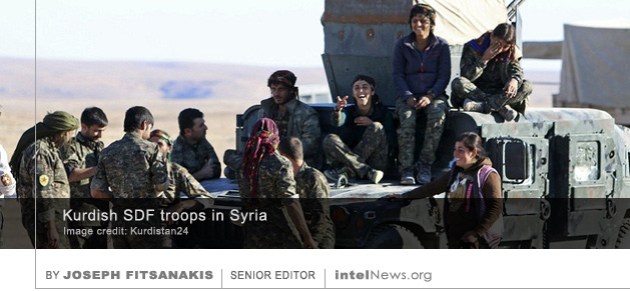
Kurdish SDF There are conflicting reports of Russian and Ukrainian fighters having been killed by American forces in northeastern Syria, with some sources claiming that up to 200 Russians and Ukrainians, most of them private contractors working for the Syrian government, were left dead in clashes last week. If such reports are accurate, they could point to the most lethal American-Russian confrontation since the end of World War II.

According to the United States Department of Defense, the armed confrontation took place on February 7. On that day, a 500-strong Syrian government force crossed the Euphrates River and entered Kurdish-controlled territory in northeastern Syria. A Pentagon spokesman, Colonel Thomas F. Veale, told reporters last week that the pro-government forces crossed the Euphrates near the town of Khursham, in Syria’s Deir al-Zour region. The town is firmly held by the Syrian Democratic Forces (SDF), a Kurdish armed faction that is supported by the US. Veale said that the Syrian government forces advanced in a “battalion-sized formation supported by artillery, tanks, multiple-launch rocket systems and mortars”. The SDF force in the area, which includes embedded American troops, responded with artillery fire, while US military aircraft also launched strikes on the government forces. The latter withdrew across the Euphrates after suffering heavy losses. The US side estimates that over 100 attackers were left dead, with another 200-300 injured. There were allegedly no SDF fatalities during the clash.

On February 8, CBS News cited an unnamed US Pentagon official, who claimed that Russians were among the dead in Deir al-Zour. The BBC said that “at least two Russians” were killed in the attack, while The New York Times raised the toll to “perhaps dozens”. But US news network Bloomberg claimed that over 200 Russians and pro-Russian Ukrainian mercenaries were among the dead. Citing anonymously “three Russians [and] one US official […] familiar with the matter”, the network said that most of the fatalities were Russian and Ukrainian private contractors who were fighting in Syria in support of the government of President Bashar al-Assad. These reports mark the first known instance of Russian citizens killed by American forces in Syria. If the Bloomberg account is accurate, the Deir al-Zour clash could be the most extensive armed confrontation between Americans and Russians since the end of World War II.

Bloomberg said that it spoke by phone to one Russian military contractor who said that “dozens of his wounded men” were still receiving treatment at military hospitals in Russia. On February 8, the Syrian government accused Washington of carrying out a “brutal massacre” in Deir al-Zour, but said nothing about foreign fighters. A statement by the Russian Ministry of Defense said that 25 Syrian troops were hurt in the attack, but denied that Russian soldiers had participated in the February 7 clashes. Speaking on behalf of the Kremlin, Russian government spokesman Dmitry Peskov said that Moscow only tracked casualty data about its official military forces stationed in Syria. He added that no Russian forces were stationed in Deir al-Zour. At a press conference last week, US Secretary of Defense James Mattis refused to discuss the matter, which he referred to as “perplexing”. Bloomberg said that American officials were “in talks” with Russian counterparts “in search of an explanation for what happened”.

Author: Joseph Fitsanakis | Date: 14 February 2018 | Research credit: N.L. | Permalink

US immigration and customs agency seeks to join Intelligence Community

Immigration and Customs Enforcement ICEThe United States Immigration and Customs Enforcement (ICE) is reportedly seeking to join the Intelligence Community, which includes the Central Intelligence Agency, the Defense Intelligence Agency, and other intelligence-focused arms of the federal government. Currently, ICE is a federal law enforcement that operates under the umbrella of the Department of Homeland Security. It consists of two components: Homeland Security Investigations, which probes cross-border criminal activity, including drugs and weapons trafficking, money laundering and cybercrime; and Enforcement and Removal Operations, whose mission is to find and capture undocumented aliens.
But some senior ICE officials have been exploring the possibility of joining the US Intelligence Community. According to The Daily Beast, which reported the alleged plans, the officials believe that by joining the Intelligence Community, ICE will become privy to intelligence that will assist in its mission. They also claim that membership in the Intelligence Community would afford ICE “greater prestige, credibility and authority” within the federal government. The Daily Beast reports that ICE’s effort to join the Intelligence Community began during the administration of US President Barack Obama. However, it has picked up steam following the election of President Donald Trump. Some believe that President Trump would be willing to sign an executive order that would incorporate ICE in the Intelligence Community.

Some civil liberties watchdogs, however, are weary of such plans. They claim that ICE is a domestic law enforcement agency and should not have access to practices and techniques used by spy agencies like the CIA or the National Security Agency. The latter frequently break the laws of foreign countries in pursuit of their mission, which is to steal foreign intelligence. These agencies are characterized by a different culture, say critics, which is not respectful of legal constraints. But supporters of ICE’s proposed inclusion into the Intelligence Community argue that there are several law enforcement agencies that are already members of the Intelligence Community. Notably, the Federal Bureau of Investigation and the Drug Enforcement Administration —both law enforcement agencies— belong to the Intelligence Community.

The Daily Beast said it contacted ICE but a spokesperson refused to comment on the story. The Department of Homeland Security did not return emails and phone calls about the proposal to include ICE in the Intelligence Community.

Author: Joseph Fitsanakis | Date: 08 February 2018 | Permalink

Ex-spy chief claims Palestinian officials worked with CIA to wiretap opponents

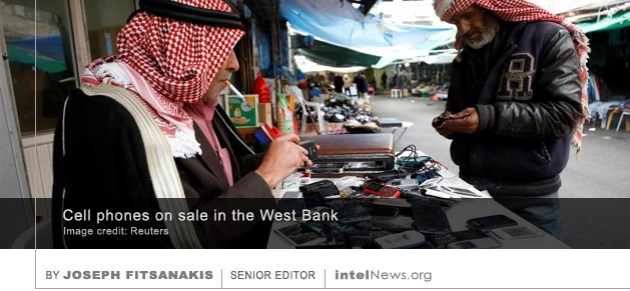
Telephones PalestineThe former head of the Palestinian Authority’s spy agency claims that the Palestinian government in the West Bank worked with the United States Central Intelligence Agency to wiretap thousands without court authorization. Tawfiq Tirawi, who headed the Palestinian General Intelligence from its founding in 1994 to 2008, has filed an official complaint against the Palestinian Authority and is calling for a criminal investigation into the alleged wiretaps. The complaint has also been signed by Jawad Obeidat, who is the president of the West Bank’s Bar Association. It is based on a leaked 37-page document that surfaced last month on the social networking application WhatsApp. The document was leaked by an anonymous individual who claims to have worked for a surveillance unit in the Palestinian Preventive Security Service, the Palestinian Authority’s domestic security service.

The leaked document appears to show that the Palestinian Preventive Security Service reached out to the CIA in 2013 asking for assistance with installing a communications surveillance system in the West Bank. The CIA agreed to provide the system in exchange for access to the intercepted data. The two agencies installed the interception system in the summer of 2014 and initiated what appears to have been a large-scale operation that included thousands of telephone subscribers. Initial targets of the operation included members of Hamas —the Palestinian group that controls the Gaza Strip— as well as members of the Iran-supported Islamic Jihad Movement in Palestine. But, according to the Associated Press, over time the targets of the program expanded to include “thousands of Palestinians, from senior figures in militant groups to judges, lawyers, civic leaders and political allies of Abbas”. The list of targets included Tirawi and Obeidat, who filed the official complaint on Tuesday.

The anonymous leaker of the document said he decided to quit his job and reveal the information about the intercepts after US President Donald Trump shifted Washington’s policy on Israel’s capital, by officially recognizing Jerusalem as the capital of the Jewish state. Earlier in February, the Palestinian Authority dismissed the leaked document as “nonsense” and said it was part of a large conspiracy that sought to harm Palestinian interests. The CIA refused to comment on the allegations.

Author: Joseph Fitsanakis | Date: 07 February 2018 | Permalink

Dutch spies identified Russian hackers who meddled in 2016 US election

Cozy BearDutch spies identified a notorious Russian hacker group that compromised computer servers belonging to the Democratic Party of the United States and notified American authorities of the attack, according to reports. In 2016, US intelligence agencies determined that a Russian hacker group known as Cozy Bear, or APT29, led a concerted effort to interfere in the US presidential election. The effort, which according to US intelligence agencies was sponsored by the Russian government, involved cyber-attacks against computer systems in the White House and the Department of State, among other targets. It also involved the theft of thousands of emails from computer servers belonging to the Democratic National Committee, which is the governing body of the Democratic Party. The stolen emails were eventually leaked to WikiLeaks, DCLeaks, and other online outlets. Prior descriptions of the Russian hacking in the media have hinted that US intelligence agencies were notified of the Russian cyber-attacks by foreign spy agencies. But there was no mention of where the initial clues came from.
Last Thursday, the Dutch current affairs program Nieuwsuur, which airs daily on Holland’s NPO 2 television, said that the initial tipoff originated from the AIVD, Holland’s General Intelligence and Security Service. On the same day, the Dutch newspaper De Volkskrant published a detailed account of what it described as AIVD’s successful penetration of Cozy Bear. According to these reports, AIVD was able to penetrate Cozy Bear in mid-2014, before the hacker group intensified its campaign against political targets in the US. Citing “six American and Dutch sources who are familiar with the material, but wish to remain anonymous”, De Volkskrant said that the AIVD was able to detect the physical base of the Cozy Bear hackers. The latter appeared to be working out of an academic facility that was adjacent to Moscow’s Red Square. The AIVD team was then able to remotely take control of security camera networks located around the facility. Eventually, the Dutch team hacked into another security camera network located inside the buildings in which the hackers worked. They soon began to collect pictures and footage of Cozy Bear members, which they then compared with photos of “known Russian spies”, according to De Volkskrant.

The paper said that the AIVD team continued to monitor Cozy Bear’s activities until at least 2017, while sharing intelligence with the Central Intelligence Agency and the National Security Agency in the US. The intelligence was allegedly instrumental in alerting US spy agencies about Russian government-sponsored efforts to meddle in the 2016 presidential election. Several newspapers, including The Washington Post in the US and The Independent in Britain, contacted the AIVD and the MIVD —Holland’s military intelligence agency— over the weekend. But the two agencies said they would not comment on reports concerning Cozy Bear.

Author: Joseph Fitsanakis | Date: 29 January 2018 | Research credit: E.J. & E.K. | Permalink

Ex-CIA case officer was arrested after being lured back to US at least once

FBIA former case officer in the Central Intelligence Agency, who was arrested this week for violating the United States Espionage Act, was lured back to America from Hong Kong at least once by counterintelligence investigators, according to reports. Jerry Chun Shing Lee, 53, served in the CIA from 1994 to 2007. He was arrested by Federal Bureau of Investigation officers on Monday, as soon as he arrived in the US from Hong Kong. He is accused of carrying with him top-secret information about CIA agents and operations, which he was not authorized to possess. It now appears that the FBI had been investigating Lee since 2010, and that he was lured to the US in 2012 so that he could be investigated. It is also possible that he was lured back to the US from his home in Hong Kong on Monday, so that he could be arrested by the FBI.
The New York Times said on Wednesday that a consortium of FBI agents and CIA officers identified Lee as a suspect in a counterintelligence case involving the loss of over a dozen CIA assets in China between 2010 and 2012. By that time, Lee had left his job as a case officer —essentially a spy handler— in the CIA and was living in Hong Kong. According to NBC, the FBI decided to lure Lee back to American soil by creating a job for him in the nation’s capital. That was the reason why Lee traveled with his family back to the US in August of 2012. The family stopped in Hawaii, where, according to court documents, the FBI surreptitiously searched Lee’s possessions in a Honolulu hotel. FBI officers also searched Lee’s belongings in a hotel in Virginia a few days later. Lee was found to have with him two notebooks containing “operational notes from asset meetings”, “operational phone numbers” and even “the addresses of CIA covert facilities” —safe houses where CIA case officers meet their assets in privacy.

According to The Times, the FBI confronted Lee five times in subsequent months, but did not inform him that his belongings had been surreptitiously searched or that he had been found to possess classified information without authorization. But the FBI did not press charges against Lee, nor did it prevent him from returning to Hong Kong with his family in the summer of 2013. Instead, it focused on establishing a connection between Lee and the catastrophic loss of CIA assets in China. It was only this week, when Lee returned to the US, that authorities decided to arrest him. The reason why Lee decided to return to the US remains unknown. The possibility that he may have been lured back to the US by the FBI, just as he was in 2012, should not be excluded.

It appears that investigators have not at this point connected Lee with the more serious charge of conveying the classified information to foreign agents. Instead, the former CIA officer is charged simply with possessing top-secret information, but not with communicating it. The charge is believed to be “the same single charge that could have been brought years ago”, namely when Lee was found to be carrying classified information with him in Hawaii.

Author: Joseph Fitsanakis | Date: 18 January 2018 | Permalink

Ex-CIA case officer arrested in New York for violating Espionage Act

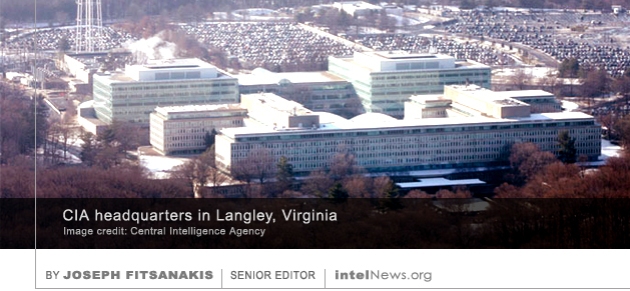
CIAA former operations officer in the United States Central Intelligence Agency has been arrested on charges of illegally possessing top secret information, including lists of real names of foreign assets and addresses of CIA safe houses. The news emerged on Tuesday, as the US Department of Justice announced that the Federal Bureau of Investigation had filed a criminal complaint over the weekend. The complaint identifies the former case officer as Jerry Chun Shing Lee, also known as Zhen Cheng Li. Lee, a 53-year-old naturalized American, served in the CIA from 1994 to 2007 “in various overseas positions and locations”, according to court documents. Lee has reportedly been living in Hong Kong since his retirement from the CIA. He was arrested by FBI officers on Monday, as he arrived on a flight that landed at the John F. Kennedy International Airport in New York.
The FBI criminal complaint alleges that Lee kept on his person a number of notebooks that contained classified details of his CIA work. These included the real names of covert CIA personnel and the real names of foreign assets —providers of intelligence information that are recruited by CIA case officers. The notebooks also contained “operational notes from asset meetings” (presumably meetings between Lee and the assets he handled during his CIA career), “operational phone numbers” and even “the addresses of CIA covert facilities” —safe houses where CIA case officers meet their assets in privacy. From the court documents it appears that the FBI has been investigating Lee since at least 2012. In August of that year, the FBI surreptitiously searched Lee’s possessions in a hotel in Hawaii, where he was staying while on holiday with his family. A few days later, FBI officers also searched Lee’s possessions in a hotel in Fairfax, Virginia, and photographed them.

According to The New York Times, Lee’s arrest is connected with reports last May that the Chinese intelligence services had arrested or killed over a dozen CIA assets in China between 2010 and 2012. There is intense speculation that the Chinese acted on information they received from a mole inside a US intelligence agency, possibly the CIA. But the court documents in Lee’s case do not mention any connection to foreign intelligence and do not accuse Lee of sharing classified information with unauthorized users. As of yesterday evening, the CIA was referring all media inquiries to the Department of Justice.

Author: Joseph Fitsanakis | Date: 17 January 2018 | Research Credit: C.B. | Permalink

Syrian rebels visit Washington to request resumption of CIA assistance

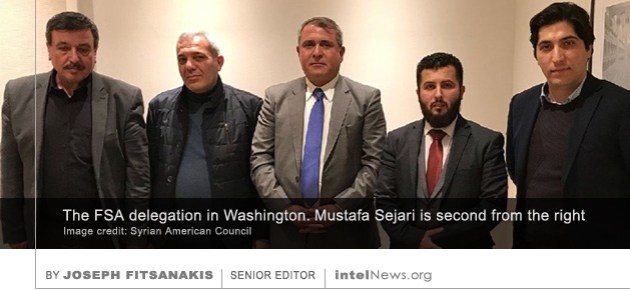
Free Syrian Army delegationA delegation of Syrian rebels is currently in Washington to ask that that United States President Donald Trump authorizes the Central Intelligence Agency to resume giving them military assistance. In 2013, the then-US President Barack Obama instructed the CIA to provide covert support to fighters in Syria. The CIA promptly began to assist fighters affiliated with the Free Syrian Army (FSA), whose goal was to topple the regime of Syrian President Bashar al-Assad. Under the project, which was codenamed TIMBER SYCAMORE, CIA personnel trained FSA fighters and gave them light weaponry. But in July of last year, President Trump abruptly terminated the CIA program, which he called “dangerous and wasteful”.
Now the FSA has sent a delegation to Washington to argue that, if the CIA does not help them, Iranian-backed militias will dominate much of Syria. On Monday, the Reuters news agency quoted Mustafa Sejari, a senior representative of the FSA, who said that the Syrian delegation had met with US Congress members and White House officials. This week they were hoping to speak with representatives from the Departments of State and Defense, said Sejari. Members of the delegation, Sejari told Reuters, “asked for the resumption of aid and explained the dangers of leaving moderate FSA forces without support”. He added that, if the US “is serious about challenging growing Iranian influence in Syria” by Hezbollah and other Shiite militias, it should resume its support of the FSA. Sejari also described Mr. Trump’s decision to end TIMBER SYCAMORE as “damaging”. The FSA, he said “endorse[s] President Trump’s statements about the need to confront Iranian hegemony in the region. It is time to turn words into action”. We went on to claim that “until now on the ground it’s the Iranian militias that are expanding without serious resistance”.

Shortly after President Trump announced his decision to terminate CIA support for the FSA, some experts warned that the move could backfire by causing the suddenly unemployed fighters to join jihadist organizations, if only to secure sources of income. In late August, it was reported that US troops deployed in Syria had exchanged fire with former FSA rebels that were now led by Turkish-trained commanders. In a related development, the government of Turkey dismissed on Monday plans by the US military to train members of the Kurdish Syrian Democratic Forces (SDF) as “terror army” tactics. The US-led coalition in Syria said that it planned to train a 30,000-strong SDF force as a professional army that could maintain control of the territories captured last year from the Islamic State.

Author: Joseph Fitsanakis | Date: 16 January 2018 | Permalink

Pakistan halts intelligence cooperation with US, but US embassy denies knowledge

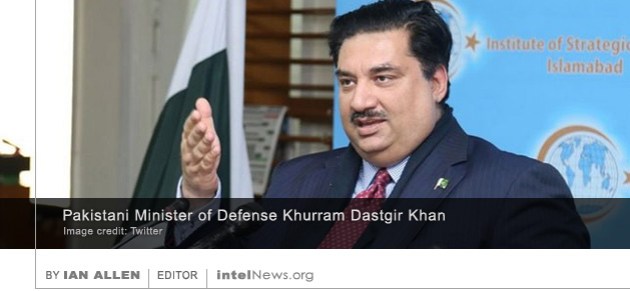
Khurram Dastgir KhanPakistan said on Tuesday that it had suspended military and intelligence cooperation with the United States in the wake of Washington’s decision to stop security assistance to Pakistan. On Tuesday, Pakistan’s Minister of Defense, Khurram Dastgir Khan, said that his country had terminated all cooperation with the US in the areas of defense and intelligence. He said that the move was a response to the announcement by US President Donald Trump last week that Washington would stop providing security assistance to Pakistan. American officials stated that the change in policy took place because Pakistan had allegedly deceived America in the global war on terrorism. On Thursday last week, the President Trump accused the Pakistani government of having given the US “nothing but lies and deceit”. Trump’s accusation was followed by an official statement by the Pentagon, which said that Pakistan should cease to provide “sanctuaries in its territory for Taliban and Haqqani network leaders and operatives”.

On Tuesday, while speaking at a conference in Islamabad, Defense Minister Khan said that Pakistan had suspended “a wide field of intelligence cooperation and defense cooperation”. He was speaking during a conference hosted by the Institute of Strategic Studies, which is a government-sponsored think-tank based in the Pakistani capital. Khan accused the US of treating Pakistan as a “scapegoat” for its military and political failures in neighboring Afghanistan. He also warned Washington that Pakistan would not allow America’s war in Afghanistan to be fought on Pakistan’s territory. He ended his talk, entitled “Contours of Security Environment of Pakistan”, with what he described as “a reminder”, saying that Washington needs Pakistan’s support in its efforts against the Taliban and the Islamic State in Afghanistan: “Logistics trumps strategy”, he said.

But the Voice of America news service reported on Tuesday that the US embassy in Islamabad had no information about Khan’s announcement concerning Pakistan’s termination of military and intelligence cooperation with Washington. A spokesman at the embassy told the news service that the embassy had “not received any formal communication regarding a suspension” of military and intelligence cooperation by Islamabad. Last week, the US Secretary of Defense James Mattis insisted that his department kept open lines of communications with the Pakistani military leadership despite the suspension of security assistance by Washington. Islamabad said that communication lines with North Atlantic Treaty Organization forces remained open, but military cooperation with Washington had been terminated.

Author: Ian Allen | Date: 10 January 2018 | Permalink

Man who attended Charlottesville far-right rally tried to derail passenger train

Amtrak trainA man who attended the “Unite the Right” rally in Charlottesville, Virginia, with members of a neo-Nazi organization, has been charged with terrorism offences after he tried to derail a passenger train. Taylor M. Wilson, of St. Charles, Missouri, was arrested by federal law enforcement officials on October 22, after he attempted to sabotage a passenger train with 175 people aboard in rural Nebraska. According to the Federal Bureau of Investigation, Wilson entered the train’s engine room and pulled the emergency brakes, thus bringing the train to a sudden halt. He was eventually subdued by a train conductor and other railway employees, who successfully prevented him from reaching for a loaded revolver that he had with him. Following his arrest, police found in his backpack a box of ammunition, a knife, a hammer, and a full-face respirator mask with a filter.
Now the FBI says that Wilson boarded the train intent on carrying out a terrorist assault, and that he pulled the train’s breaks “with intent to harm those aboard”. In court documents that were unsealed last week, FBI agents state that a search of Wilson’s property in Missouri uncovered a large weapons cache consisting of fifteen firearms, some of which were automatic. Nearly 1,000 rounds of ammunition were also confiscated from Wilson’s house, where federal officers also found literature published by American white supremacist organizations like the National Socialist Movement. According to the indictment, some of the weapons and white nationalist literature had been hidden inside a concealed compartment located behind a refrigerator unit.

It appears that Wilson obtained most of his firearms legally and that he had been issued a concealed carry permit. However, the FBI claims that Wilson’s firearms “have been used for, or obtained in anticipation of engaging in, or planning to engage in, criminal offenses against the United States”. In addition to this claim, the FBI indictment states that Wilson traveled to Charlottesville, Virginia, in August of last year to attend the “Unite the Right” rally, which was organized by various white supremacist, white nationalist, neo-Nazi and militia groups. The FBI says that it has statements from Wilson’s associates and at least one family member, who claim that the accused traveled to Charlottesville as part of a contingent of a neo-Nazi group.

Author: Ian Allen | Date: 08 January 2018 | Permalink

Tony Blair denies he warned Donald Trump British spies were after him

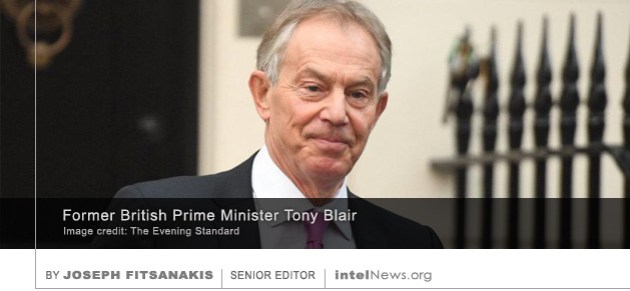
Tony BlairA spokesman for Tony Blair has dismissed as “categorically absurd” allegations that the former British Prime Minister warned the White House that President Donald Trump was targeted by British spy agencies. The claims are made in the book Fire and Fury: Inside the Trump White House, which is due to be published next week. Its author, Michael Wolf, says he based the information in the book on more than 200 interviews that he held with President Trump and members of his inner circle during the past year.
Wolf alleges that Blair, who was Britain’s prime minister from 1997 to 2007, visited the White House in secret in February of 2017. He allegedly did so as a private citizen, as he has held no public position since 2015, when he stepped down from his post as a Middle East envoy for the United Nations. While at the White House, Blair reportedly met with Jared Kushner, Trump’s son-in-law and senior aide. During that meeting, says Wolf, Blair told Kushner that Trump could have been under surveillance by British intelligence during his presidential election campaign. The former British prime minister allegedly said that any surveillance on Trump would have been carried out by the Government Communications Headquarters (GCHQ), Britain’s signals intelligence agency. Wolf further alleges that the administration of US President Barack Obama never asked London to spy on Trump. Instead, the White House “hinted” that intelligence collection about Trump would be “helpful”, says Wolf. The reason why Blair volunteered this information to Kushner, claims Wolf, was that he was hoping to gain the US president’s trust and be appointed as Washington’s envoy to the Middle East.

Blair’s revelation, which Wolf describes in his book as a “juicy nugget or information”, allegedly “churned and festered” in Trump’s mind. It was the basis for claims made on March 14, 2017, by a Fox News commentator that the GCHQ had spied on Trump on behalf of the White House. The claim was repeated on March 17 at the White House by Sean Spicer, Trump’s then-press secretary, who said that Obama had used the GCHQ to spy on Trump so as to evade American privacy laws. Spicer’s claim prompted an angry response from the British government in London and from the British spy agency itself. In a rare public comment, GCHQ called the allegations “utterly ridiculous”.

Late on Wednesday, a spokeswoman for the office of Tony Blair said in an email that Wolf’s claims in Fire and Fury were “a complete fabrication […], have no basis in reality and are simply untrue”. Last year, another spokesman for Blair dismissed claims that the former British prime minister had lobbied to be appointed Trump’s Middle East envoy. This claim was so “completely overblown” and “so far beyond speculation there isn’t a word for it”, said the spokesman. President Trump has not commented on Wolf’s claim about Blair’s alleged visit and subsequent meeting with Kushner.

Author: Joseph Fitsanakis | Date: 04 January 2018 | Permalink

US military intelligence staff allege ‘toxic’ work environment, lack of oversight

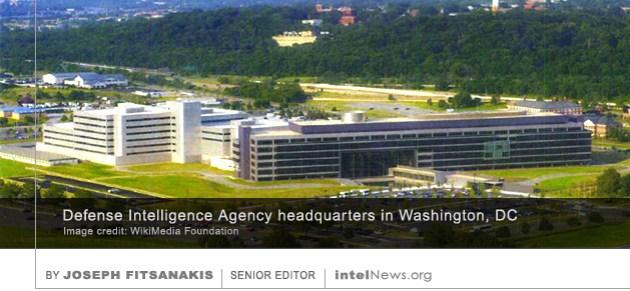
Defense Intelligence Agency DIACurrent and former employees of the United States’ primary military intelligence agency have publicly accused the agency’s senior watchdog of not doing her job and sabotaging the careers of her subordinates. According to Foreign Policy, which interviewed the disgruntled employees, “no one is policing” the US Defense Intelligence Agency (DIA) at the moment. The DIA is one of the largest institutions in the US Intelligence Community. It collects, analyzes and disseminates foreign military-related intelligence, and has active personnel stationed in over 140 countries. As is the case with every agency in the US Intelligence Community, the DIA’s activities are monitored by an internal office of the Inspector General. The office is tasked with investigating allegations of illegality, mismanagement, fraud, waste and abuse inside the DIA.

However, two former employees allege that the DIA Inspector General’s office has effectively been disbanded, with most of its personnel having been fired, reassigned or pressured to leave in recent years. They also claim that the current dysfunctional state of the office is due to the “toxic” leadership style of the Inspector General herself, Kristi Waschull. Foreign Policy named the two former employees as David Steele, who has nearly 40 years’ experience in military intelligence, and Ron Foster, who until recently was head of investigations at the DIA’s office of the Inspector General. The two men claim that they were “fired or involuntarily reassigned” overnight “with no warning”, because they challenged Waschull’s leadership style and decisions. They told Foreign Policy that they could not discuss the details of specific cases, because they are classified. But they claimed that Waschull repeatedly sought to soften the language of inspection reports about problems in the DIA, and that she “retaliated against them and their colleagues” when they resisted her efforts.

In 2016, a Congressional investigation was carried out into allegations by as many as 50 DIA analysts that their reports about the Islamic State were being deliberately tweaked by officials at the US Central Command, the Pentagon body that directs and coordinates American military operations in Egypt, the Middle East and Central Asia. The Foreign Policy article did not mention whether the analysts’ allegations are included in the complaints launched against Waschull by Steele and Foster. The publication said that the two men filed complaints against the Inspector General in 2015, and that they are still awaiting resolution. The DIA refused to comment on the allegations, but denied that any wrongdoing had taken place in the office of the Inspector General.

Author: Joseph Fitsanakis | Date: 21 December 2017 | Permalink

Turkey issues warrant for ex-CIA officer over alleged role in 2016 coup

Recep Tayyip ErdoğanThe Turkish government has issued a warrant for the arrest of a former officer in the United States Central Intelligence Agency, which Ankara claims was instrumental in the failed July 2016 attempt to topple the government of Turkish President Recep Tayyip Erdoğan. The move comes amidst heightened tensions in relations between Ankara and Washington. The two NATO allies have partially revoked entry visas for each other’s citizens, while it is alleged that Michael Flynn, US President Donald Trump’s former national security advisor, had an illegal agreement with Turkey to help abduct a Turkish dissident cleric living in Pennsylvania and help transport him to Turkey.

The warrant was issued on December 1 by the Office of the Chief Public Prosecutor in Istanbul. It seeks the arrest of Graham Fuller, an 80-year-old former analyst in the CIA, who lives in Canada. The warrant identifies Fuller as a “former CIA official” and claims that he attempted to “overthrow the government of the Republic of Turkey” and obstruct “the missions” of the Turkish government. The reference here is to the July 2016 coup, which the Turkish government claims was carried out by the so-called Gülen movement. The Gülen movement consists of supporters of Muslim cleric Fethullah Gülen, who runs a global network of schools, charities and businesses from his home in the United States. The government of Turkey has designated Gülen’s group a terrorist organization and claims that its members have stealthily infiltrated Turkish state institutions since the 1980s. Ever since the failed coup, Ankara has engaged in a controversial campaign to remove so-called Gülenists from prominent posts in government and the private sector. More than 50,000 people have been arrested on terrorism charges and are awaiting trial. Another 150,000 public and private sector employees have been summarily fired from their job.

Many in Turkey accuse the CIA of having colluded with Gülenists to topple Erdoğan’s pro-Islamist government. Fuller is accused of having strong links with Gülen and of having been instrumental in helping the exiled cleric receive permanent residency in the US. Some Turkish media claim that Fuller acted as a “CIA handler” of Gülen, who is accused of being a CIA agent. Fuller’s CIA career involved a tour in Turkey in the 1960s. He concluded his career as a member of the US National Intelligence Council, a body that helps coordinate the US Intelligence Community’s broad and long-term strategic planning. In 1988, Fuller joined the RAND Corporation, a research think-tank with close links to the US Department of Defense. After 2006, he taught history at Simon Fraser University in Vancouver, Canada, where he lives today.

Fuller emailed a statement to major news agencies on Friday, rejecting the Turkish government’s allegations and saying that Ankara was using him as “a choice target”. The former CIA officer said he had not been to Turkey in over five years, and that he had only met Gülen once in 2002 in Istanbul. At that time, said Fuller in his statement, he had been out of the CIA for 15 years. Further on in his statement, Fuller said that he understood why some Turks accused the CIA of having planned the 2016 coup, given the agency’s history of meddling in domestic Turkish politics. However, he said he had nothing to do with the coup attempt, which he described as “pathetic, ill-conceived and amateurish”. The CIA has not commented on Ankara’s allegations.

Author: Joseph Fitsanakis | Date: 04 December 2017 | Permalink

Trump administration allegedly considering plan to privatize CIA operations

Trump CIAThe United States Central Intelligence Agency and the White House are considering several proposals to hire private companies to carry out covert operations abroad, according to a report. BuzzFeed News said on Thursday that the proposals were communicated to the White House in the summer. The news site, which described the proposed plans as “highly unusual”, quoted “three sources who have been briefed on or have direct knowledge of the proposals”. The sources told BuzzFeed that, if approved, the plans would include the establishment of large intelligence networks in so-called “denied areas” —namely foreign environments deemed hostile. The networks would recruit and handle local agents, carry out psychological operations, capture terrorism suspects and rendition them to the US or third countries. “Islamic extremism” is mentioned as the primary target of the proposals.

According to BuzzFeed, one of the proposals involves Amyntor Group, a private company headquartered in the remote town of Whitefish, in northwestern Montana. The company is staffed by former members of the US Intelligence Community who have security clearances. It specializes in intelligence training and risk assessment. But it also collects and analyzes intelligence and provides counterintelligence services for government agencies in America and what it calls “friendly foreign governments” abroad. The company has reportedly been holding discussions with senior officials in the administration of President Donald Trump in recent weeks, according to two of BuzzFeed’s sources. The same sources say that the move toward privatization of some intelligence operations is being led by a feeling in the Trump administration that the CIA has a negative view of the White House. They claim that the CIA is not prepared to go along with the Trump administration’s efforts to make the agency’s operations more aggressive and, in the words of its new director, Mike Pompeo, “much more vicious”. They therefore see privatization as a way to bypass the resistance and skepticism of the CIA’s upper management.

BuzzFeed said it contacted the CIA about the Amyntor Group proposal, but the agency preferred not to comment. A press officer for the National Security Council, which is chaired by President Trump, said that its members were not aware of the privatization proposals. Amyntor Group commented through one of its lawyers, who told BuzzFeed that any contract signed between the company and the US government would be directed and controlled “by the proper government authority”.

Author: Joseph Fitsanakis | Date: 01 December 2017 | Permalink