Morton Sobell, convicted of conspiracy in the Rosenberg espionage case, dies at 101
January 31, 2019 1 Comment
 Morton Sobell, an American radar engineer who in 1951 was convicted of conspiracy alongside Julius and Ethel Rosenberg in one of the Cold War’s most prominent espionage cases, has died at 101 years old. His death was announced yesterday by his son, Mark, who also said that his father died on December 26 last year at a nursing home, but that the family had not alerted the media.
Sobell was born in New York’s Manhattan Island in 1917 and worked on radar tracking systems for defense contractors. During college, he and several of his friends, including fellow-engineer Julius Rosenberg, joined the United States Communist Party, partly in reaction to the Great Depression. When the Federal Bureau of Investigation began to arrest members of what the United States government claimed was a Soviet atomic spy ring led by Rosenberg, Sobell escaped with his family to Mexico, where he used a fake identity to evade the authorities. But he was dramatically abducted by a paramilitary force and surrendered to the FBI.
He was then tried alongside Rosenberg and his wife Ethel for conspiracy to commit acts of espionage. The Rosenbergs refused to cooperate with the FBI and were sentenced to death. Both were executed in 1953 and remain to this day the only American citizens to have been executed for espionage after the Civil War. Sobel was found guilty of the lesser charge of conspiracy and no evidence was presented in court that connected him to atomic espionage. He was therefore sentenced to 30 years in prison and served 18 of those, following a successful public-relations campaign organized by his wife, Hellen. He was released from prison in 1969 and continued to insist that he had never been a spy and had been wrongly convicted of conspiracy.
But in 2008, at the age of 91, Sobell spoke to The New York Times and publicly admitted for the first time that he had been a spy for the Soviet Union. He said that he had worked systematically to provide Moscow with information on weapons systems and other classified technologies. However, he had “never thought of it” as spying, he said. He also told The Times that he had developed a favorable impression of Soviet communism during the Great Depression, when he and many others saw the Soviet economic system as an antidote to crisis-ridden capitalism. “Now I know it was an illusion”, he told the paper.
► Author: Joseph Fitsanakis | Date: 31 January 2019 | Permalink
 Police in the Australian state of Queensland have offered a $250,000 (US $182,000) reward for information that can help solve the murder of a former Soviet KGB colonel 18 years ago. The victim, Gennadi Bernovski, worked in the domestic wing of the Soviet KGB, until his retirement, which coincided with the dissolution of the USSR. In 1996, he moved to Australia with his family and bought a house in Benowa Waters, a luxury suburb of Gold Coast, a city located south of Brisbane on the country’s east coast. But on the evening of July 24, 2000, Bernovski was shot to death outside his home by what witnesses said were two men in combat diver suits. They
  The leadership of the Labour Party in Britain has reacted with disdain after a new book by a leading author and columnist claimed that Michael Foot, who led the Party in the early 1980s was paid agent of the Soviet KGB. Foot, a staunch and vocal representative of the postwar British left, was a member of parliament for over 40 years, eventually serving as leader of the House of Commons. He rose to the post of deputy leader of the Labour Party and in 1980 succeeded Jim Callahan as head of the Party. But he stepped down in 1983 in the aftermath of Labour’s largest electoral defeat in over half a century.
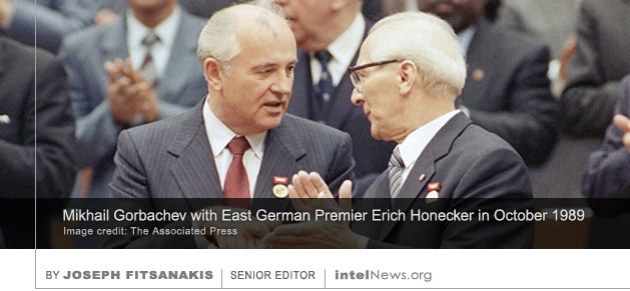 A group of German radicals planned to assassinate Soviet Premier Mikhail Gorbachev in East Germany in 1989, thus triggering a Soviet military invasion of the country, according to a new book written by a former British spy. The
  Files released on Monday by the British government reveal new evidence about one of the most prolific Soviet spy rings that operated in the West after World War II, which became known as the Portland Spy Ring. Some of the members of the Portland Spy Ring were Soviet operatives who, at the time of their arrest, posed as citizens of third countries. All were non-official-cover intelligence officers, or NOCs, as they are known in Western intelligence parlance. Their Soviet —and nowadays Russian— equivalents are known as illegals. NOCs are high-level principal agents or officers of an intelligence agency, who operate without official connection to the authorities of the country that employs them. During much of the Cold War, NOCs posed as business executives, students, academics, journalists, or non-profit agency workers. Unlike official-cover officers, who are protected by diplomatic immunity, NOCs have no such protection. If arrested by authorities of their host country, they can be tried and convicted for engaging in espionage.
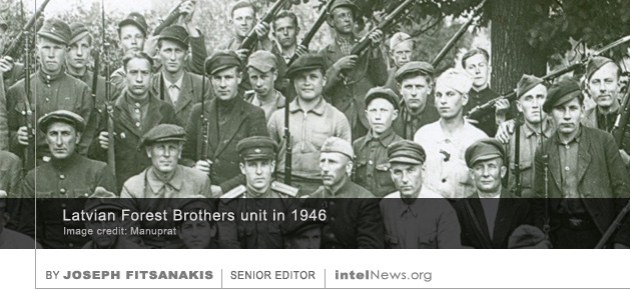 The role of the CIA in funding and helping to organize anti-Soviet groups inside the USSR has been known for decades. But, as intelNews explained in
 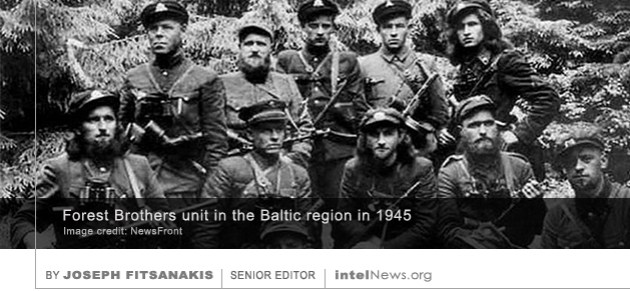 Recently declassified documents from the archive of the Central Intelligence Agency detail financial and material support given by the United States to groups of armed guerrillas in Soviet Latvia in the 1950s. The documents, initially marked ‘Top Secret’ but now declassified, show that the CIA was aware and supported the activities of an anti-Soviet guerrilla army known as ‘the Forest Brothers’. Known also as ‘the Forest Brethren’, the group was formed in the Baltic States in 1944, as the Soviet Red Army established Soviet control over the previously German-occupied states of Estonia, Latvia and Lithuania. The Soviet Union had previously occupied and annexed the three Baltic countries, in a failed attempt to pre-empt Germany’s eastward military expansion. Groups like the Forest Brothers consisted of the most militant members of anti-Soviet groups in the Baltic States, many of whom were ideologically opposed to Soviet Communism.
 General Yuri Ivanovich Drozdov, who held senior positions in the Soviet KGB for 35 years, and handled a global network of Soviet undercover officers from 1979 until 1991,
 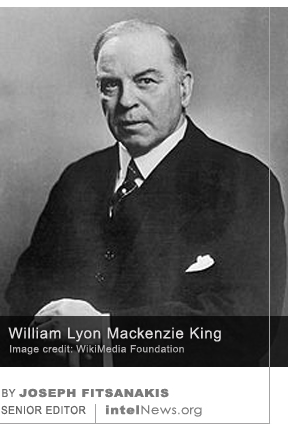 Canadian officials speculated that Soviet spies stole a missing volume from the private diary collection of William Lyon Mackenzie King, Canada’s longest-serving prime minister, who led the country in the run-up to the Cold War. A liberal anticommunist, Mackenzie King was Canada’s prime minister from 1925 to 1948, with a break from 1930 to 1935. He is known for having led the establishment of Canada’s welfare state along Western European standards.
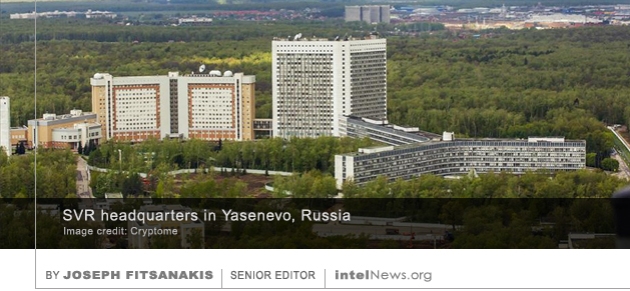 Last week, following the results of Russia’s parliamentary election, Russian media run a story suggesting that the Kremlin is planning to implement far-reaching changes to the country’s intelligence apparatus.
 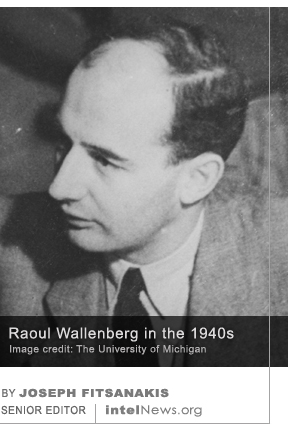 The recently discovered memoirs of a former director of the Soviet KGB suggest that a senior Swedish diplomat, who disappeared mysteriously in the closing stages of World War II, was killed on the orders of Joseph Stalin. The fate of Swedish diplomat Raoul Wallenberg is one of the 20th century’s unsolved espionage mysteries. In 1944 and 1945, the 33-year-old Wallenberg was Sweden’s ambassador to Budapest, the capital of German-allied Hungary. During his time there, Wallenberg is said to have saved over 20,000 Hungarian Jews from the Nazi concentration camps, by supplying them with Swedish travel documents, or smuggling them out of the country through a network of safe houses. He also reportedly dissuaded German military commanders from launching an all-out armed attack on Budapest’s Jewish ghetto.
 Recently uncovered documents shed further light on an ultra-secret plan, devised by the British and American governments, to destroy oil facilities in the Middle East in the event the region was invaded by Soviet troops. The
  A videotaped lecture by Kim Philby, one of the Cold War’s most recognizable espionage figures, has been unearthed in the archives of the Stasi, the Ministry of State Security of the former East Germany. During the one-hour lecture, filmed in 1981, Philby addresses a select audience of Stasi operations officers and offers them advice on espionage, drawn from his own career. While working as a senior member of British intelligence, Harold Adrian Russell Philby, known as ‘Kim’ to his friends, spied on behalf of the Soviet NKVD and KGB from the early 1930s until 1963, when he secretly defected to the USSR from his home in Beirut, Lebanon. Philby’s defection sent ripples of shock across Western intelligence and is often seen as one of the most dramatic moments of the Cold War.






 intelNews.org
Russian security services honor members of the Cambridge spy ring with plaque
December 23, 2019 by Joseph Fitsanakis Leave a comment
In 1951, shortly before they were detained by British authorities on suspicion of espionage, Burgess and Maclean defected to the Soviet Union. They both lived there under new identities and, according to official histories, as staunch supporters of Soviet communism. Some biographers, however, have suggested that the two Englishmen grew disillusioned with communism while living in the Soviet Union, and were never truly trusted by the authorities Moscow. When they died, however, in 1963 (Burgess) and 1983 (Maclean), the Soviet intelligence services celebrated them as heroes.
On Friday, the Soviet state recognized the two defectors in an official ceremony in the Siberian city of Samara, where they lived for a number of years, until the authorities relocated them to Moscow. Kuibyshev, as the city was known during Soviet times, was technically a vast classified facility where much of the research for the country’s space program took place. While in Kuibyshev, Burgess and Maclean stayed at a Soviet intelligence ‘safe house’, where they were debriefed and frequently interrogated, until their handlers were convinced that they were indeed genuine defectors.
At Friday’s ceremony, officials unveiled a memorial plaque at the entrance to the building where Burgess and Maclean lived. According to the Reuters news agency, the plaque reads: “In this building, from 1952-1955, lived Soviet intelligence officers, members of the ‘Cambridge Five’, Guy Francis Burgess and Donald Maclean”. On the same day, a letter written by Sergei Naryshkin, head of Russia’s Foreign Intelligence Service (SVR), one of the institutional descendants of the Soviet-era KGB, appeared online. In the letter, Naryshkin said that Burgess and Maclean had made “a significant contribution to the victory over fascism [during World War II], the protection of [the USSR’s] strategic interests, and ensuring the safety” of the Soviet Union and Russia.
Last year, Russian officials named a busy intersection in Moscow after Harold Adrian Russell Philby. Known as ‘Kim’ to his friends, Philby was a leading member of the Cambridge spies. He followed Burgess and Maclean to the USSR in 1963, where he defected after a long career with the British Secret Intelligence Service (MI6).
► Author: Joseph Fitsanakis | Date: 22 December 2019 | Permalink
Filed under Expert news and commentary on intelligence, espionage, spies and spying Tagged with Cambridge Five, Cold War, defectors, Donald Maclean, espionage, Guy Burgess, history, News, SVR (Russia), UK, USSR