Venezuelan government quells armed uprising by National Guard troops in Caracas
January 23, 2019 1 Comment
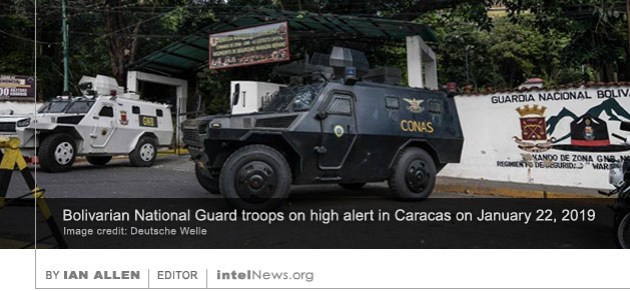 The government of Venezuela said on Tuesday that it had quelled an armed uprising by nearly 30 members of the Bolivarian National Guard (GNB) in Caracas, which sparked an all-night riot in the Venezuelan capital. On Tuesday government officials announced the arrest of 27 members of the GNB who allegedly revolted against the government of President Nicolás Maduro. Several videos were posted in pro-opposition social media accounts the night before. They showed young men in military uniforms brandishing weapons and calling on all Venezuelans to rise up against the country’s government. In one video posted on Twitter, a man wearing a GNB uniform said that he and his comrades in arms were speaking out “on behalf of the people of Venezuela”. He then urged viewers to “take to the streets” and bring down the government.
Early on Tuesday, officials in the Venezuelan Ministry of People’s Defense said that the officers had raided a GNB command post in Petare, a neighborhood in northwestern Caracas. They allegedly immobilized the command post guards and stole several weapons. The rebels then made their way to Cotiza, a neighborhood that is adjacent to Petare, and is considered a stronghold of anti-government sentiment. Late on Monday a number of videos emerged on social media that showed young men clashing with riot police in Cotiza. Police forces were seen using tear gas and noise grenades, while some of the rioters built makeshift barricades using cars, dumpsters and other large objects. However, no gunshots were heard coming from either side.
By noon on Tuesday the riot had ended and it appeared that all GNB rebels had been neutralized or gone into hiding. Government sources said that all 27 rebels had been arrested and were alive, but shared no information about the precise circumstances of their capture. It is not known whether they voluntarily surrendered to the police or whether they were somehow overpowered. Defense Ministry officials said that all stolen weapons had been retrieved and described the rebels as people representing “the shadowy interests of the far right”. All 27 GNB rebels were being questioned on Tuesday and Venezuelan officials said that they would be subjected to “the full force of the law”.
► Author: Ian Allen | Date: 23 January 2019 | Permalink
 Authorities in Colombia said that three Venezuelans, who were arrested in Colombia’s Caribbean coast with submachine guns and explosives, were planning to assassinate President Iván Duque. The claim was aired in a
  A leading suspect in a failed attempt to kill Venezuelan President Nicolas Maduro using drones, has died in mysterious circumstances while being held by the country’s intelligence agency. The
 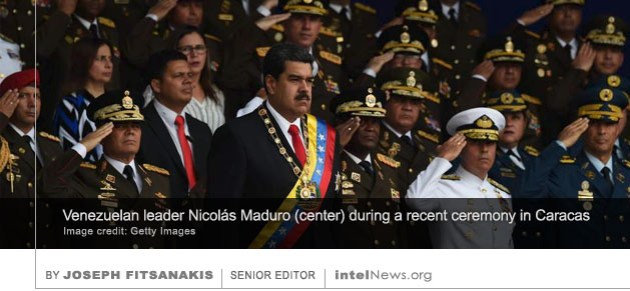 United States President Donald Trump authorized American officials to attend secret meetings held by Venezuelan military officers who conspired to launch a military coup against President Nicolás Maduro. The claim was made on Saturday by The New York Times, which










 intelNews.org
US to shut down its embassy in Venezuela as national blackout enters 6th day
March 13, 2019 by Joseph Fitsanakis Leave a comment
The precise cause of the blackout remains unknown, though a number of experts point to a massive outage of the Simón Bolívar Hydroelectric Plant, located in northeastern Venezuela’s Necuima Canyon, as the root of the problem. Known also as the Guri dam, the facility generates more than four fifths of Venezuela’s electricity output, and may be responsible for the nationwide blackout. The continuing crisis has exacerbated the already adversarial relationship between Washington and Caracas, as the Venezuelan government blames the US and the local opposition leader Juan Guaidó for the blackout. The government said on Monday that it would investigate Guaidó in connection with rumors of sabotage of the Guri dam facility. The announcement prompted the White House to warn that “a lot of countries would react very quickly” if Guaidó was incarcerated. On Tuesday, Washington said that the remaining 20 members of staff of its embassy in the Venezuelan capital would be evacuated by Friday. Soon afterwards, the Venezuelan government said that it had ordered the American diplomats to leave the country, so that their presence there would not be used as a pretext by Washington to launch a military invasion of the country.
Meanwhile, the blackout continued as of Tuesday night, with experts warning that the aging infrastructure of Venezuela’s energy network, coupled with the lack of specialists on the ground, made it difficult to overcome the crisis. The US-based Wired magazine explained on Tuesday that restoring the integrity of the energy grid following a large-scale blackout —a process known as a “black start”— will depend on being able to identify the root of the problem. But the absence of spare equipment and up-to-date monitoring software and hardware means that the Venezuelan state operator lacks the ability to visualize the grid and “understand the state of the system in real time”. At the same time, supporters of the Venezuelan government accuse Washington of sabotaging its oil-export sector by refusing to buy Venezuelan oil and threatening to impose sanctions on foreign states that purchase oil from Venezuela. That, they say, has deprived the country of its main source of hard currency and is makes it exceedingly difficult for Caracas to sustain the nation’s energy and food-supply networks.
► Author: Joseph Fitsanakis | Date: 13 March 2019 | Permalink
Filed under Expert news and commentary on intelligence, espionage, spies and spying Tagged with Caracas (Venezuela), energy networks, News, US embassy in Venezuela, Venezuela