Guest Comment: Radio Still Medium of Choice for Many Spies
August 2, 2012 7 Comments
 By PAUL BEAUMONT* | intelNews.org |
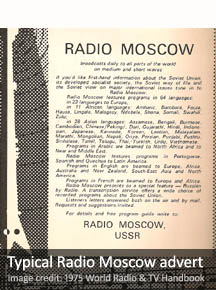
In 1975 whilst the Cold War was still being fought, short wave listeners were treated nightly to whatever stations they chose to listen to from wherever, propagation permitting. These broadcast stations carried a catholic mix of information, political views and insights, propaganda, religious ideology (usually with a political point) and music and other cultural statements of the government of the day. Broadcast stations with good signals were the BBC World Service, Voice of America, and Radio Moscow. But not all was as it seemed. Radio Moscow used very high powers so that those furthest from their transmitters still received signals at good strength whilst the propagation conditions ensured the frequencies were selected for the most efficient transfer of radio programs. One could sit in one’s armchair with no more than a telescopic antenna raised from the radio set and hear news from a foreign station and quickly retuning, could hear the same news but with a totally different bent. Even the music was not what it seemed, especially for two particular British spies, one being Frank Clifton Bossard, an officer with Britain’s Ministry of Defence Missile Guidance Branch, the other John Symonds, an ex-Detective Sergeant wanted in connection with Operation COUNTRYMAN. Bossard was strapped for cash and approached the KGB, whilst finding himself overseas with no funds Symonds found himself working for the KGB as a ‘Romeo Spy’ seducing wives of diplomats for information. Interestingly MI5 denied that Symonds acted as he did and suggested such actions were a figment of John Symonds’ imagination. Read more of this post









 intelNews.org
Mystery surrounds CIA spy ‘of Cuban origin’ released last week
December 25, 2014 by intelNews Leave a comment
Almost nothing is known about a Cuban intelligence officer who spied for the United States and is now believed to be on American soil following his release from a Cuban prison last week. His release was part of a wider exchange between Washington and Havana of persons held in each other’s prisons on espionage charges. It included the release of Alan Gross, a contractor for the US Agency for International Development, who was imprisoned in the Caribbean island in 2009 on charges of political subversion. The deal also involved the release of the remaining three members of the so-called “Cuban Five”, a ring of Cuban intelligence officers operating on American soil, who were convicted in 1998 of spying on anti-Castro exile groups on behalf of Havana. But the ample media coverage has shied away from another prisoner who was exchanged as part of the deal, a spy for the Central Intelligence Agency who was described by US President Barack Obama as one of the most important intelligence assets that America has ever had in Cuba. The initial piece of information came from Cuban President Raul Castro himself, who on December 17 announced that an American spy “of Cuban origin” was to be released. Castro did not identify the spy. But later on that same day, Newsweek’s Jeff Stein said his name was “Rolando ‘Roly’ Sarraff Trujillo”, a former cryptographer in the Cuban Ministry of Interior’s Directorate of Intelligence. Trujillo was allegedly recruited by the CIA in the 1980s and spied for Washington until 1995, when he was arrested by Cuban counterintelligence, charged with espionage and sentenced to 25 years in prison. One source told Stein that the damage that Trujillo had caused Havana was so great that “the only thing that saved him from execution was the fact that both his parents were retired senior intelligence officers”. In a report published last Thursday, The Washington Post’s Adam Goldman said Trujillo’s release had been “a major priority for the [US] Intelligence Community” and would have been part of any spy swap with the Cuban government. Both Stein and Goldman claim that Trujillo was instrumental in the capture by the FBI of the Cuban Five, as well as in the 2009 arrest of State Department analysts Walter and Gwendolyn Myers, who spied on America for Cuba for 30 years. He is also said to have had a role in the capture of Ana Belen Montes, the top Cuba analyst in the Defense Intelligence Agency, who was convicted in 2002 of spying for Cuba. All this is speculative, however, as no official confirmation has been issued on Trujillo from either Washington or Havana. One former senior CIA official told The Post that the Agency had another spy in Cuba, alongside Trujillo, codenamed TOUCHDOWN. But, unlike Trujillo, he managed to defect to the US in the late 1980s, before getting captured by the Cubans.
Filed under Expert news and commentary on intelligence, espionage, spies and spying Tagged with Ana Belen Montes, Cuba, Cuban Five, Gwendolyn Steingraber Myers, imprisoned spy swaps, Jeff Stein, Rolando Sarraff Trujillo, Rolando Trujillo, Roly Trujillo, United States, Walter Kendall Myers