Investigation uncovers previously unknown Russian covert action unit
March 16, 2026 6 Comments
 A JOINT PROJECT BY the German newsmagazine Der Spiegel and the investigative website The Insider has uncovered the existence and inner workings of a previously unknown Russian intelligence and cover action unit. The unit’s formal name is Military Unit 75127, but it is known within Russia’s intelligence establishment as Center 795. The Russian government reportedly created the unit in December 2022—less than a year following the Kremlin’s full military invasion of Ukraine.
By mid-2023, Center 795 was “fully staffed”, with its ≈500 officers coming mostly from the Main Directorate of the Russian Armed Forces’ General staff (known as GU or GRU). Other Center 795 officers came from ALPHA and VYMPEL—covert action units belonging to the Special Purpose Center of the Russian Federal Security Service (FSB). A smaller number of officers came from the Russian Armed Forces, the Federal Protective Service, and from the ALPHA Group of the Belarussian security service, known as KGB.
The structure of Center 795 features three directorates: Intelligence, Combat Support, and Assault Operations. The Directorate of Intelligence consists of nine distinct departments tasked with—among other things—collecting and analyzing intelligence from social media platforms, conducting reconnaissance using satellite networks and drones, carrying out signals intelligence, as well as executing human intelligence and covert operations, including assassinations and abductions.
The Directorate for Combat Support is staffed with explosive, air defense, armored warfare, and artillery operatives. It also maintains combat units that conduct technical maintenance, logistics, fortification, and other specialized tasks. The Assault Operations Directorate consists of four departments, which appear to conduct strictly compartmentalized functions that include airborne tasks.
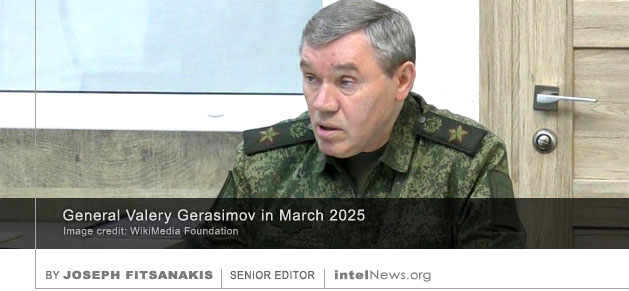
Notably, unlike other special activities units in Russia’s intelligence arsenal, Center 795 does not appear to reside within the GRU. Instead, it appears to operate independently of military intelligence oversight and to report directly to General Valery Gerasimov (pictured), Chief of the Russian Armed Forces’ General Staff of and First Deputy Minister of Defense, or to one of his subordinate deputy defense ministers.
According to the investigative reports, the existence of Center 795 was revealed when one of its officers, Denis Alimov, used Google to translate a message sent to him by a Serbian operative living in the United States. This allowed the United States Federal Bureau of Investigation to use a Foreign Intelligence Surveillance Court (FISA) warrant and access the Google Translate transcripts. Alimov was eventually arrested in Bogotá, Colombia, on February 24, 2026, after arriving there on a Turkish Airlines flight from Istanbul, Turkey. He is currently awaiting extradition to New York.
► Author: Joseph Fitsanakis | Date: 16 March 2026 | Permalink
 A CLASSIFIED REPORT ISSUED two weeks ago by the United States National Intelligence Council (NIC) found that even a full-scale interstate war against Iran would be unlikely to dislodge or drastically alter the current regime. A summary of the report
 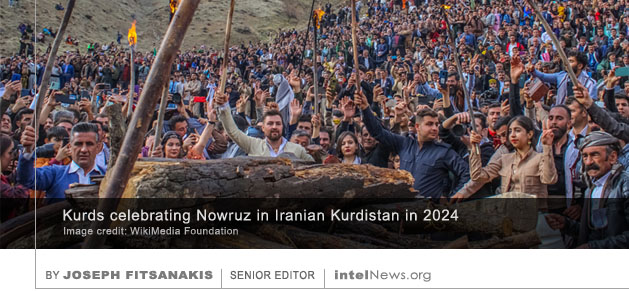 THE UNITED STATES CENTRAL Intelligence Agency (CIA) is arming and training ethnic separatists in northwestern Iran with the goal of fomenting an armed rebellion against Tehran in the coming weeks, according to reports. Several news outlets,
  THE ONGOING CONFRONTATION BETWEEN Iran and its adversaries unfolds against the backdrop of a regime that is strategically depleted yet politically combustible. Yet strategic exhaustion does not equate to imminent collapse. Indeed, the potential degradation of Iran’s coercive institutions raises a more complex question: what follows tactical success? Thus, while Iran appears weakened and vulnerable, the longer-term trajectory of the conflict remains uncertain, fraught with the risk of protracted instability and regional spillover at a level that could make Libya and Syria seem mild by comparison.
 FOUR MEN HAVE BEEN arrested in France on suspicion of spying for China using a system of parabolic antennas and computers installed at a rented property in the French countryside. The men were arrested last Saturday and Sunday by the General Directorate for Internal Security (DGSI), which focuses on counterterrorism and counterespionage.
 AT LEAST THREE EUROPEAN Union members states now require Russian diplomats who are not accredited in their territories to notify them prior to entering their borders. According to the new requirement, Russian diplomats must provide advance notification if they intend to travel to, or transit through, a European Union country in which they are not accredited.
 INTELLIGENCE PARTNERS IN THE North Atlantic Treaty Organization (NATO) are “not talking openly” anymore, while authorities in Denmark have advised government officials to disable Bluetooth functions on their devices due to spying concerns. According to reports in British news outlets, intelligence-sharing functions inside NATO are at a breaking point following a series of actions by the United States that one source
  EARLIER THIS MONTH, FRANCE-based British reporter Chris Bockman was given rare access to a training course designed collaboratively by a leading French university and France’s intelligence services. The course is part of the Diplôme sur le Renseignement et les Menaces Globales (Diploma of Intelligence and Global Threats), which is offered by the Institut d’études politiques de Saint-Germain-en-Laye (known as Sciences Po Saint-Germain), located on the northwestern outskirts of Paris.
 A FORMER DEEP COVER Russian intelligence officer, whose cover was blown in 2010 when he was arrested in the United States, is spearheading efforts by the Kremlin to secure investments by India’s technology sector. The spy, Andrei Bezrukov, was recruited by the Soviet Committee for State Security (KGB) in the late 1970s or early 1980s—most likely alongside his wife, Elena Vavilova. For several years, the married couple lived in several countries, including Canada and France, before arriving in the United States in 1999 using fraudulently obtained Canadian passports.
 IN A RARE MEDIA interview, the chief of Colombia’s National Intelligence Directorate (DNI) has said that his agency’s collaboration with the Central Intelligence Agency (CIA) and other American spy organizations continues unabated. This statement appears to contradict a prior statement by the president of Colombia, who said his country had stopped all intelligence-sharing with the United States in protest against the lethal targeting of civilian vessels in the Caribbean.
 A BRITISH MAN WANTED by American authorities for spying for China, who disappeared along with his Chinese handler while under house arrest, may have managed to escape to China using a private jet, a report claims. John Miller, 63, from Tunbridge Wells in the United Kingdom, was arrested alongside his alleged Chinese handler, Cui Guanghai, in April of this year.
 THE MOSSAD, ISRAEL’S PRIMARY covert action agency, had “some 100 agents” on the ground in Iran at the start of the Twelve-Day War, according to senior Israeli government officials who participated in a television documentary. The
  PROSECUTORS IN VIENNA HAVE charged a former intelligence officer with spying for Russia in a high-profile case that has had broad political ramifications in Austria and abroad. The criminal case centers on Egisto Ott, a former employee of Austria’s Federal Office for the Protection of the Constitution and Counterterrorism (BVT). The BVT operated as Austria’s primary domestic intelligence agency from 2002 until its dissolution in 2021.
 A DISAFFECTED SOLDIER, WHO tried to commit espionage against New Zealand for a foreign government, has become the first convicted spy in the Pacific Island nation’s history. The only other time New Zealand prosecuted an individual for espionage was in 1974, when the government accused






 intelNews.org
The Real War Is About To Begin: Iran Transitions to Full-Scale Insurgency
March 30, 2026 12 Comments
And yet, as Carl von Clausewitz cautioned centuries ago, the outcome of war is not governed by formulaic calculus. No matter how astounding, operational sophistication and technological prowess do not guarantee success. Instead of an immediate collapse, the decapitation of the Iranian regime appears to have produced a series of unpredictable second-order effects. At the very least, it physically eliminated Iran’s few pragmatic leaders who have historically favored restraint. Their demise effectively handed over power to the hardliners of the Islamic Revolutionary Guard Corps. Moreover, the war appears to have paralyzed Iran’s domestic opposition, whose adherents may despise the regime but—unlike the U.S. and Israel—do not want to see their country break up into ethnic statelets.
Most importantly, the February 28 decapitation strike convinced Iran’s surviving leaders that this is an existential fight—not a limited confrontation like the Twelve-Day War. Today’s ruling Principalists in Iran differ sharply from the cosmopolitan, Western-educated elite of the 1960s and 1970s. They are largely provincial in origin, domestically rooted, and lack the international ties that once offered pathways of exit. They do not hold dual citizenships, do not maintain foreign residences, and few of them possess the linguistic or social capital to relocate abroad. Simply put, they have no viable exit. For them, defeat is not exile—it is annihilation. Under such conditions, the expectation is not capitulation, but resistance to the very end.
Activating the Iranian Asymmetric Doctrine
Starting in 2001, the campaigns in Afghanistan and Iraq offered Iranian war planners a prolonged and unusually comprehensive vantage point from which to study the American way of war in their immediate neighborhood. For over two decades, the Iranians analyzed these methods, learned from them, and internalized their logic into their own asymmetric warfare doctrine. And now, having survived the February 28 decapitation attack, the Iranian regime has put that doctrine into operation. Iran’s asymmetric doctrine channels the state’s military, civilian, economic, and informational assets into a multi-domain, protracted insurgency campaign designed to inflict maximum pain on its enemies. In doing so, it rests on what is perhaps the Islamic Republic’s greatest asset: its asymmetric patience—i.e., its capacity to endure more physical and emotional torment than its Western opponents and their allies.
The Iranians refined their asymmetric patience skills during what they refer to as the “War of Holy Defense” (1980-1988), one of the 20th century’s longest conflicts and the deadliest conventional war ever fought in the developing world. The then-newly formed Islamic Republic suffered over 500,000 casualties—many of those due to exposure to chemical warfare—but managed to bring Saddam Hussein’s Western-backed Iraq into a standstill and force it into a truce. To do so, they even resorted to so-called “human wave assaults”, large masses of mostly unarmed youth who swarmed enemy positions and overwhelmed them by the sheer power of their number. That was largely how the Basij, the Iranian regime’s paramilitary street gangs that continue to operate in modern-day Iran, were initially formed.
Iran’s “Economy of Resistance”
On March 28, the Telegram channel belonging to the Iranian Supreme Leader Mojtaba Khamenei issued an infographic titled “The Path to Defeating the Enemy in the Economic War”. The infographic reflects the Islamic Republic’s concept of “economy of resistance”, which was first developed in 2014 by Mojtaba Khamenei’s father, the late Supreme Leader Ali Khamenei. The central idea behind this concept is restructuring the Iranian economy, not simply to reduce its susceptibility to Western-imposed sanctions, but to allow it to stabilize and even develop. The goal of the economy of resistance is to prevent the destruction of the Islamic Republic and the Westernization of Iranian society. Through the economy of resistance doctrine, and with crucial help by China and Russia, Iran has largely managed to insulate its economy from the global economic system that is now reeling under Iran’s own asymmetric attacks. Read more of this post
Filed under Expert news and commentary on intelligence, espionage, spies and spying Tagged with 2026 Iran War, Analysis, Iran, Joseph Fitsanakis, Newstex