North Korea is now robbing banks, says US intelligence official

North KoreaComments made by a senior American intelligence official on Tuesday appeared to suggest that the North Korean government was behind an attempt to steal nearly $1 billion from a Bangladeshi bank last year. The heist took place in February of 2016, when a computer malware was used to issue several requests to transfer funds from Bangladesh Bank —the state-owned central bank of Bangladesh— using the SWIFT network. The hackers were able to transfer five separate sums of $101 million each to a linked Bangladesh Bank account at New York’s Federal Reserve Bank. However, when further requests were issued, Federal Reserve Bank employees contacted Bangladesh Bank and blocked further transactions. Eventually, most of the transferred funds, which neared $1 billion, were recovered; but the hackers managed to get away with approximately $81 million worth of funds.

Forensic investigators described the heist as technically advanced. The antivirus company Symantec said it identified a piece of code in the malware that is known to have been used by North Korean government hackers in the past. Not everyone agreed with the claim that Pyongyang was behind the bank heist. But those who did, said that it was unprecedented in scope and aggressiveness. Some even said that the heist showed that North Korea’s cyber capabilities were among the most sophisticated and powerful in the world.

Meanwhile the United States government did not comment on the matter. However, this past Tuesday the deputy director of the National Security Agency appeared to confirm reports that North Korea was behind the Bangladesh Bank heist. Rick Ledgett, a 30-year veteran of the NSA, who is due to retire in 2018, was speaking at a public event hosted by the Aspen Institute in Washington, DC. He reminded the audience that private researchers had connected the malware code used in the Bangladesh Bank heist with that used in previous hacking attempts launched by North Korea. “If that linkage […] is accurate”, said Ledgett, it “means that a nation state is robbing banks”. When asked by the moderator whether he believes that to be the case, Ledgett responded “I do. And that’s a big deal”. Foreign Policy magazine reached out to Ledgett following his talk and asked him for clarification about his comments regarding the Bangladesh Bank heist. But the NSA official simply said that “the public case [about the heist] was well-made”. Foreign Policy also contacted the NSA, but the agency said it preferred not to comment on the matter.

Author: Joseph Fitsanakis | Date: 23 March 2017 | Permalink

FBI launches criminal investigation into WikiLeaks’ CIA disclosures

WikiLeaksThe United States federal government has launched a criminal investigation into the public disclosure of thousands of documents that purportedly belong to the Central Intelligence Agency. The documents were released on Tuesday by the anti-secrecy website WikiLeaks. They reveal what appear to be technical collection methods used by the CIA to extract information from digital applications and electronic devices, ranging from flash drives to smart screen televisions. WikiLeaks named the collection “Vault 7”, and said that it consists of nearly 8,000 web pages and 1,000 attachments. It also said that its editors redacted hundreds of pages of computer code, in order to prevent the public release of advanced cyberweapons allegedly used by the CIA to sabotage electronic devices and systems.

On Wednesday, former director of the CIA Michael Hayden told the BBC that the disclosure appeared “incredibly damaging”, because it revealed some of the methods that the CIA uses to acquire information. But some cybersecurity experts said that the techniques contained in the leaked documents did not appear to be uniquely advanced, and most focused on exploiting technical vulnerabilities that were generally known. Still, The New York Times reported on Wednesday that the CIA had begun to assess the damage caused by the release. The agency was also trying to contain the extent of the damage, and had even “halt[ed] work on some projects”, said The Times. Officials from the CIA are reportedly in communication with the Federal Bureau of Investigation, which on Wednesday launched a criminal investigation into the “Vault 7” release.

The main purpose of the FBI investigation is to find out how WikiLeaks acquired the files. The website said that the documents were leaked by a CIA contractor, which would imply that they were accessed from a server outside the CIA’s computer network. However, federal investigators are not excluding the possibility that the leaker of the information may be a full-time CIA employee. Reports suggest that the FBI is preparing to conduct hundreds, and possibly thousands, of interviews with individuals who are believed to have had access to the documents that were released by WikiLeaks. Meanwhile, neither the FBI nor the CIA have commented on the authenticity of the information contained in “Vault 7”. WikiLeaks said that Tuesday’s release, which it codenamed “Year Zero”, was the first part of several installments of documents that will be released under its Vault 7 program.

Author: Joseph Fitsanakis | Date: 09 March 2017 | Permalink

Files released by WikiLeaks show advanced CIA technical collection methods

Julian AssangeThousands of documents belonging to the United States Central Intelligence Agency, which were released on Tuesday by the international anti-secrecy website WikiLeaks, are almost certainly genuine. They reveal an entire universe of technical intelligence collection methods used by the CIA to extract information from digital applications and electronic devices, ranging from flash drives to smart screen televisions. WikiLeaks named the collection Vault 7, and said that it consists of nearly 8,000 web pages and 1,000 attachments. It also said that its editors redacted hundreds of pages of computer code, in order to prevent the public release of advanced cyberweapons that are allegedly used by the CIA to sabotage electronic devices and systems.

The information contained in the leaked documents is almost certainly genuine, and most likely belongs to the CIA —though many of the programs listed may be jointly run by the CIA and the National Security Agency (NSA). These programs, with names such as McNUGGET, CRUNCHYLIMESKIES, ELDERPIGGY, ANGERQUAKE and WRECKINGCREW, appear to be designed to compromise computer systems using a series of sophisticated methods that force entry or exploit built-in vulnerabilities or systems. Targets include popular communications systems like Skype and WhatsApp, smartphones produced by Google and Apple, commercial software like PDF and Microsoft Windows, and even so-called smart televisions that connect to the Internet.

The WikiLeaks revelations are most likely related to operations conducted under the auspices of the Special Collection Service (SCS), a joint CIA/NSA program that dates to the earliest days of the Cold War. The program was started by the United States Armed Forces but was eventually transferred to civilian hands and monitored by the CIA. It used advanced communications-interception facilities around the world to collect information. Over the years, the CIA collaborated with the NSA and developed many SCS projects targeting several foreign countries using technical and human means. In recent years the SCS has been primarily operated by the NSA, which oversees the program’s technical platforms.

WikiLeaks did not reveal the source of the documents. But it said that they had been “circulated [by the CIA] among former US government hackers and contractors” and that it was one of the latter that leaked them to the anti-secrecy website. A statement by WikiLeaks said that Tuesday’s release, which it codenamed “Year Zero”, was part one of several installments of documents that will be released under its Vault 7 program. The site also claimed that the information in “Year Zero” has “eclipsed the total number of pages published over the first three years of the Edward Snowden NSA leaks”. The CIA, the NSA and the White House have not commented on this development.

Author: Joseph Fitsanakis | Date: 08 March 2017 | Permalink

US, British intelligence agencies spied on Israelis and Palestinians, files show

Israel’s Ministry of Foreign AffairsDocuments accessed by a French newspaper show that American and British intelligence agencies worked together to spy on diplomats, academic researchers and defense contractors in Israel and the Palestinian territories. Last year, the German newsmagazine Der Spiegel and the American newspaper The Wall Street Journal reported that the United States National Security Agency spied on senior Israeli politicians throughout the last decade, including Prime Minister Ehud Olmert and his successor, Benjamin Netanyahu. Now French daily Le Monde has alleged that the NSA teamed up with its British equivalent, the Government Communications Headquarters to spy on Israeli foreign service officials and diplomats, academic researchers and defense contractors. The newspaper also alleged that British and American spies targeted Palestinian government officials.
According to Le Monde, the information came from documents leaked by Edward Snowden, a former employee of the NSA and the Central Intelligence Agency, who is currently living in Russia. Snowden defected there in June 2013, after initially fleeing to Hong Kong with millions of stolen US government documents in his possession. In a leading article on Wednesday, the newspaper claimed that British and American spy agencies have systematically targeted senior officials in Israel’s Ministry of Foreign Affairs in Jerusalem. Several Israeli foreign service officials stationed abroad have also been targeted, said Le Monde, including Israel’s ambassadors to Nigeria and Kenya. But the Anglo-American intelligence alliance has also targeted Palestinian government institutions, including the Office of the Secretary General of the Palestinian Liberation Organization. Senior Palestinian officials that have been spied on include Ahmed Qurei, a former prime minister of the Palestinian National Authority, and Ahmad Tibi, a member of the Israeli Knesset who served as an advisor to Palestinian leader Yasser Arafat in the 1990s.

Palestinian diplomats stationed around the world have also been targeted by the NSA and the GCHQ, said Le Monde, in cities such as Paris, Brussels, Lisbon, Islamabad, Pretoria, and Kuala Lumpur. The documents also show that the two intelligence agencies have spied on Israeli defense contractors, including a company named Ophir Optronics, which works in the areas of laser and fiber optic technologies. Finally, the French newspaper said that research centers throughout Israel had been targeted, including scientific laboratories located at the Jerusalem-based Hebrew University.

Author: Joseph Fitsanakis | Date: 08 December 2016 | Permalink

NSA chief preempts move to fire him by entering talks with Trump

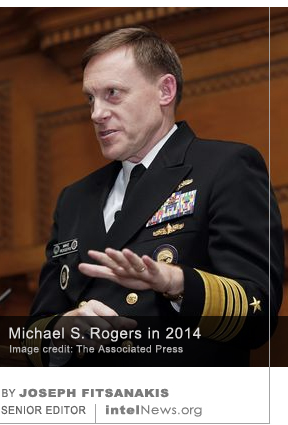
Michael S. RogersThe director of the United States National Security Agency has taken the unprecedented step of entering talks with president-elect Donald Trump, amidst reports that President Barack Obama may fire him. Admiral Michael S. Rogers, 57, a US Navy cryptologist with a military career that spans over three decades, has been at the helm of the NSA since April of 2014. Last weekend, however, The Washington Post alleged that senior US military and intelligence officials urged President Obama to fire him. Citing “several US officials familiar with the matter”, The Post said on Saturday that a recommendation to fire Admiral Rogers was delivered to the President in October by Secretary of Defense Ashton B. Carter and the Director of National Intelligence James R. Clapper.
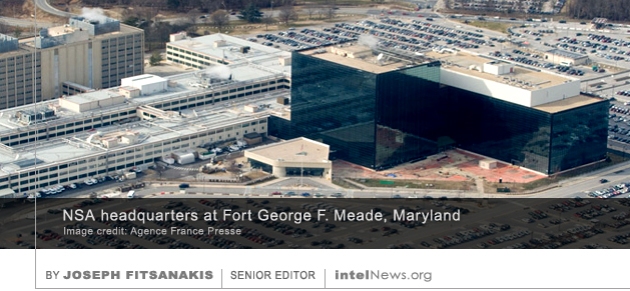
Secretary Carter is allegedly displeased with the NSA director’s performance, following what The Post said were “persistent complaints from NSA personnel” that Admiral Rogers is “aloof, frequently absent” from his duties, and tends to disregard input from his advisors at NSA. DNI Clapper added to Rogers’ list of concerns, while also proposing that the NSA should be led by a civilian administrator. The paper alleged that the president agreed with the recommendations and had planned to replace Admiral Rogers with an acting NSA director shortly before the election of November 8. That would reportedly allow the incoming president to appoint a new director of their preference in the new year. However, the move was delayed due to ongoing discussions about balancing the NSA’s military and civilian roles.

In the meantime, it appears that the NSA director preempted his impending firing by entering negotiations with president-elect Donald Trump about joining the new administration. According to The Post, Trump is considering appointing Admiral Rogers to the post of DNI, to replace Clapper. The paper described the Admiral’s move to meet with Trump without notifying his superiors —including the president— as “unprecedented for a military officer”. The NSA director’s move has allegedly displeased the Obama administration, but it is unclear how the president will respond. During a press conference in Lima, Peru, on Sunday, President Obama declined to answer questions about Admiral Rogers’ rumored replacement. He described the NSA director as “a terrific patriot”, but added that it was not his practice to comment on matters relating to personnel appointments. The Department of Defense, Office of the DNI, and the NSA have all declined to comment on the matter.

Author: Joseph Fitsanakis | Date: 21 November 2016 | Permalink

NSA contractor accused of spying stole real names of US undercover officers

NSAClassified information stolen by a United States federal contractor, who was charged with espionage last month, includes the true identities of American intelligence officers posted in undercover assignments abroad, according to court documents. In August of this year, Harold Thomas Martin III, was arrested by the Federal Bureau of Investigation on charges of stealing government property and illegally removing classified material. Martin, 51, served as a US Navy officer for over a decade, where he acquired a top secret clearance and specialized in cyber security. At the time of his arrest earlier this year, he was working for Booz Allen Hamilton, one of the largest federal contractors in the US. Some media reports said Martin was a member of the National Security Agency’s Office of Tailored Access Operations, described by observers as an elite “hacker army” tasked with conducting offensive cyber espionage against foreign targets.

Last week, after prosecutors alleged that the information Martin removed from the NSA was the equivalent of 500 million pages, a judge in the US state of Maryland ruled that the accused might flee if he is released on bail. Soon afterwards, Martin’s legal team filed a motion asking the judge to reconsider his decision to deny him bail. That prompted a new filing by the prosecution, which was delivered to the court on Thursday. The document alleges that the information found in Martin’s home and car includes “numerous names” of American intelligence officers who currently “operate under cover outside the US”. The court filing adds that Martin’s removal of the documents from secure government facilities constitutes “a security breach that risks exposure of American intelligence operations” and “could endanger the lives” of undercover intelligence officers and their agents abroad.

It is alleged that Martin told the FBI he never shared classified information with anyone, and that he removed it from his office at the NSA in order to deepen his expertise on his subject. His legal team argues that Martin suffers from a mental condition that compels him to be a hoarder. But prosecutors for the government argue in court documents that Martin appears to have communicated via the Internet with Russian speakers, and that he was learning Russian at the time of his arrest. The case is expected to be tried later this year.

Author: Joseph Fitsanakis | Date: 28 October 2016 | Permalink

NSA contractor charged with spying removed both electronic and printed files

NSAA United States federal contractor, who was charged with espionage after he was found to have stolen classified documents, was able to remove both electronic and printed files from his office at the National Security Agency, according to a report. The man was identified by The New York Times last week as Harold Thomas Martin III, a 51-year-old employee of Booz Allen Hamilton, one of the largest federal contractors in the US. Last August, agents of the Federal Bureau of Investigation raided Martin’s house in Maryland and arrested him on charges of stealing government property and illegally removing classified material.

In reporting on the disclosure earlier this week, we noted that the FBI found classified information “on a variety of electronic devices that Martin had stored —though apparently not hidden— in his house and car”. It turns out, however, that at least some of the classified files in Martin’s possession were in printed format. According to The Washington Post, which revealed this information on Wednesday, this means that Martin extracted the information from his office at the NSA “the old-fashioned way, by walking out of the workplace with printed-out papers he had hidden”. The paper cites unnamed US government officials who claim that Martin was repeatedly able to walk out the front door of the NSA with what one anonymous congressional aide described as “a whole bunch of stuff”. The paper alleged that printed classified material found in Martin’s possession amounts to “thousands of pages”.

It appears that Martin extracted most of the documents before the fall of 2013, when the NSA and other US intelligence agencies imposed strict security controls on data access following the defection of Edward Snowden, another federal contractor who worked for the NSA and is today living in Russia. But the revelation will undoubtedly raise further questions about the ability of US intelligence agencies to scrutinize the activities of hundreds of thousands of employees who have access to classified information. The Post notes that the NSA and other US intelligence agencies do not employ universal searches of personnel that enter or exit government facilities. Instead they prefer random checks for reasons of convenience and to foster a sense of trust among employees. That, however, may change if more cases like those of Snowden and Martin become known.

Author: Joseph Fitsanakis | Date: 14 October 2016 | Permalink

Arrested contractor may have worked for NSA’s elite cyber spy unit

NSAA United States federal contractor, who remains in detention following his arrest last summer for stealing classified documents, may have worked for an elite cyber espionage unit of the National Security Agency. The man was identified by The New York Times last week as Harold Thomas Martin III, a 51-year-old employee of Booz Allen Hamilton, one of the largest federal contractors in the US. The paper said that, prior to joining Booz Allen Hamilton, Martin served as a US Navy officer for over a decade, where he specialized in cyber security and acquired a top secret clearance. But last August, agents of the Federal Bureau of Investigation raided Martin’s house in Maryland and arrested him on charges of stealing government property and illegally removing classified material.

Media reports suggest that the FBI discovered significant quantities of classified information, some of it dating back to 2006, on a variety of electronic devices that Martin had stored —though apparently not hidden— in his house and car. Another interesting aspect of the case is that there is no proof at this point that Martin actually shared the classified information with a third party. There is some speculation that he may be behind a disclosure of a collection of NSA hacking tools, which were leaked in August of this year by a previously unknown group calling itself “the Shadow Brokers”. But some speculate that Martin may have taken the classified material home so he could write his dissertation for the PhD he is currently undertaking at the University of Maryland’s Information Systems program.

A few days ago, The Daily Beast quoted an unnamed former colleague of Martin who said that the NSA contractor was a member of one of the agency’s elite cyber spy units. The existence of the secretive unit, which is known as the NSA’s Office of Tailored Access Operations, was revealed in June 2013 by veteran NSA watcher Matthew M. Aid. Writing in Foreign Policy, Aid cited “a number of highly confidential sources” in alleging that the NSA maintained a substantial “hacker army” tasked with conducting offensive cyber espionage against foreign targets. More information on NSA’s TAO was provided in January 2014 by German newsmagazine Der Spiegel. If The Daily Beast’s allegations about Martin are accurate, they would explain why anonymous government sources told The Washington Post last week that some of the documents Martin took home “could be expected to cause exceptionally grave damage to the national security of the United States”. The case also highlights the constant tension between security and the privatization of intelligence, which was also a major parameter in the case of Edward Snowden, another Booz Allen Hamilton contractor who defected to Russia in 2013.

Meanwhile, Martin remains in detention. If he is convicted, he will face up to 11 years behind bars.

Author: Joseph Fitsanakis | Date: 10 October 2016 | Permalink

German cabinet approves spy service reform in wake of NSA controversy

BND - IAThe senior executive body of the German government has approved draft legislation that reforms the country’s intelligence services, following revelations that Germany helped the United States spy on European states. The legislation is seen as a response by the German government to a number of recent public controversies involving the Bundesnachrichtendienst, Germany’s Federal Intelligence Service, known as BND.
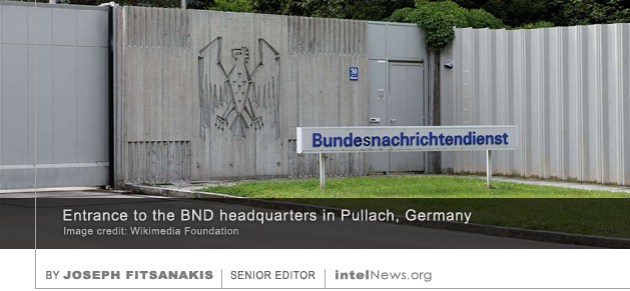
In 2015, the BND was found to have secretly collaborated with the US National Security Agency (NSA) in spying on several European governments and private companies. According to German investigative magazine Der Spiegel, the BND used its facilities at Germany’s Bad Aibling listening station to help the NSA spy on, among other targets, the palace of the French president in Paris, the headquarters of the European Commission in Brussels, and the France-based European conglomerate Airbus. In response to the revelations, Airbus filed a criminal complaint against the German government, while Belgium and Switzerland launched official investigations into the joint BND-NSA activities.

The extent of the BND-NSA collaboration prompted widespread public criticism in Germany. In response to the criticism, German Chancellor Angela Merkel promptly fired the director of the BND in April of this year, in a move that surprised many. Gerhard Schindler, who had headed the BND since 2012, was replaced by Bruno Kahl, a senior official in the German Federal Ministry of Finance, who did not come from within the ranks of the BND. Additionally, the German chancellor authorized a parliamentary inquiry into the operations of the BND, which was completed last spring. The resulting 300-page report forms the basis of the draft legislation that was approved on Tuesday by the German cabinet.

The new legislation bans the BND from spying on foreign governments or corporations for the benefit of German companies. It also prevents it from spying on targets within the European Union, unless the operation pertains to “information to recognize and confront threats to internal or external security”. This is taken to mean operations relating to suspected terrorist activity that directly threatens German national security. The legislation also calls for the establishment of a new independent oversight body consisting of senior judges and representatives of the Office of the Federal Prosecutor, whose job will be to evaluate and approve the BND’s proposed espionage activities against foreign targets.

The legislation will need to be finalized through its approval by the German Federal Parliament, known as the Bundestag. The body is expected to approve the legislation before the beginning of its official summer break in mid-July.

Author: Ian Allen | Date: 29 June 2016 | Permalink

German intelligence chief fired in surprise move

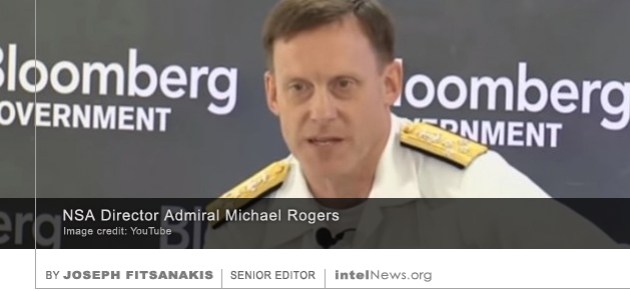
BND GermanyThe head of Germany’s foreign intelligence agency has been removed from his post in a move described by observers as surprising. Gerhard Schindler, 63, had led Germany’s Federal Intelligence Service, known as Bundesnachrichtendienst, or BND, since 2012. Founded 60 years ago with direct input from the United States Central Intelligence Agency, the BND is today responsible for collecting intelligence abroad in the service of German national interests. Headquartered in the southern German city of Pullach, near Munich, the BND is directly subordinate to the office of German Chancellor Angela Merkel.
On Tuesday, the Munich-based Süddeutsche Zeitung newspaper said that Chancellor Merkel had ordered Schindler’s removal from the BND. Several regional television stations followed with similar reports. The Süddeutsche Zeitung cited unnamed government sources as saying that Schindler’s sudden removal from his post was unexpected, as the career intelligence officer was scheduled to retire in two years.

However, intelNews readers will recall that last year Schindler was severely criticized in Germany, after the BND was found to have secretly collaborated with the US National Security Agency in spying on several European governments and private companies. According to German newsmagazine Der Spiegel, the BND used its Bad Aibling listening station to help the NSA spy on, among other targets, the palace of the French president in Paris, the headquarters of the European Commission in Brussels, as well as French-based European conglomerate Airbus. In response to the revelations, Airbus filed a criminal complaint against the German government, while Belgium and Switzerland launched official investigations into the joint BND-NSA activities.

In the months that followed the revelations, Schindler appeared to have convinced the Chancellery that he was not personally responsible for the BND-NSA collaboration, which many political figures in Germany said had subverted Germany’s national interest. In response to criticism, Schindler said that some departments inside the BND had taken on “a life of their own” and promised to reform the agency. On Tuesday, however, his tenure came to an end. It is believed that he will be replaced by Bruno Kahl, a senior civil servant in Germany’s Federal Ministry of Finance, who is a close associate of the country’s Minister of Finance, Wolfgang Schäuble.

Author: Joseph Fitsanakis | Date: 27 April 2016 | Permalink

NSA director made secret visit to Israel last week

Michael RogersThe head of the United States’ largest intelligence agency secretly visited Israel last week, reportedly in order to explore forging closer ties between American and Israeli cyber intelligence experts. Israeli newspaper Ha’aretz said on Sunday that Admiral Michael Rogers, who directs the United States National Security Agency (NSA), was secretly in Israel last week. The NSA is America’s signals intelligence (SIGINT) agency, which is responsible for electronic collection, as well as protecting US government information and communication systems from foreign penetration and sabotage.
According to Ha’aretz, Rogers was hosted in Israel by the leadership of the Israel Defense Forces’ SIGINT unit, which is known as Intelligence Corps Unit 8200. The secretive group, which is seen as Israel’s equivalent to the NSA, is tasked with collecting SIGINT from Middle Eastern locations and protecting Israel’s electronic information infrastructure from adversaries. According to the Israeli newspaper, Rogers’ visit was aimed at exploring ways in which the NSA and Unit 8200 can enhance their cooperation, especially against regional Middle Eastern powers like Iran or non-state groups like Hezbollah.

IntelNews readers will recall that the IDF’s Unit 8200 is viewed by some Middle East observers as the creator of the Stuxnet virus. Stuxnet is a sophisticated malware that is believed to have been designed as an electronic weapon against Iran’s nuclear program. Among these observers is New York Times correspondent David Sanger; in his 2012 book, Confront and Conceal, Sanger claimed that Stuxnet was designed by NSA and Unit 8200 programmers as part of a joint offensive cyber operation codenamed OLYMPIC GAMES. According to Sanger, the two agencies collaborated very closely between 2008 and 2011 in order to bring about Stuxnet and other carefully engineered malware, including Flame.

Ha’aretz said that Rogers’ visit was meant to solidify US and Israeli cooperation on offensive cyber operations, based on the legacy of Stuxnet and Flame. During his visit to Israel, the US intelligence official also met with the heads of other Israeli intelligence agencies, said Ha’aretz.

Author: Joseph Fitsanakis | Date: 28 March 2016 | Permalink

Joint British-American operation hacked Israeli drones, documents show

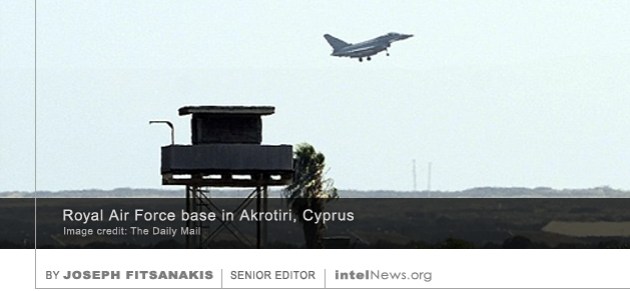
RAF base CyprusBritish and American intelligence services worked together to hack Israeli unmanned aerial vehicles in order to acquire information on the Jewish state’s military intentions in the Middle East, according to documents leaked last week. Online publication The Intercept, said the operation was code-named ANARCHIST and was a joint project of Britain’s General Communications Headquarters (GCHQ) and America’s National Security Agency (NSA). The publication said it acquired documents about the operation from former NSA contractor Edward Snowden, who defected to Russia in 2013 and was offered political asylum by Moscow.
In an article published on Thursday, The Intercept said the joint GCHQ-NSA operation was headquartered in a Royal Air Force military facility high on the Troodos Mountains in the Mediterranean island of Cyprus. The documents provided by Snowden suggest that British and American spies were able to collect footage captured by the Israeli drone for at least two years, namely in 2009 and 2010. It is not clear whether that period included the first three weeks of January 2009, when the Gaza War was fought between Israel and Hamas. During that time, there were persistent rumors that Tel Aviv was seriously considering launching air strikes against Iran.

According to The Intercept, the main goal of operation ANARCHIST was to collect information about Israeli “military operations in Gaza” and watch “for a potential strike against Iran”. Additionally, the UK-US spy program “kept tabs on the drone technology Israel exports around the world”, said the article. According to one GCHQ document cited by The Intercept, the access to Israeli drone data gained through ANARCHIST was “indispensable for maintaining an understanding of Israeli military training and operations”.

Speaking on Israel’s Army Radio on Friday, Israel’s Minister for National Infrastructure, Energy and Water, Yuval Steinitz, said he was not surprised by the revelations. “We know that the Americans are spying on the whole world, including their friends”, said Steinitz. But it was “disappointing”, he said, given that Israel had “not spied” on the US “for decades”. Israeli intelligence agencies had “not collected intelligence or attempted to crack the encryption of the United States”, said the Minister, implying that recent revelations of US spying on Israel may cause a change of strategy in Israeli intelligence policy.

Author: Joseph Fitsanakis | Date: 01 February 2016 | Permalink

German spy agency tapped Finnish phone lines in early 2000s

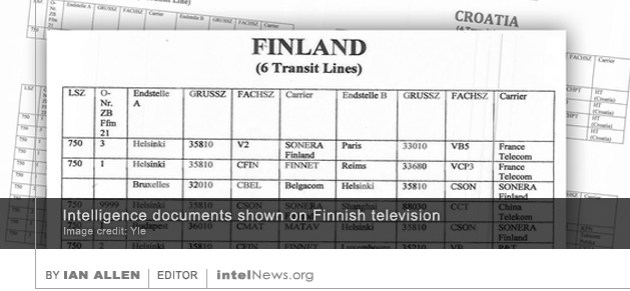
FinlandGerman intelligence, possibly with the collaboration of the United States, monitored communications lines connecting Finland with at least five countries in the early 2000s, according to leaked documents. The documents, aired this week by Yle Uutiset, the main news program of the Finnish Broadcasting Company (Yle), is based on information contained in “leaked German intelligence documents” that were first made public in May 2015. As intelNews reported at the time, the intelligence collection was described as a secret collaboration between Germany’s BND (Bundesnachrichtendienst) and America’s National Security Agency (NSA). According to Austrian politician Peter Pilz, who made the initial allegations, the BND-NSA collaboration was codenamed EIKONAL and was active from 2005 to 2008. Pilz said at the time that many European phone carriers and Internet service providers were targeted by the two agencies. Belgium and Switzerland have already launched investigations into EIKONAL.

Now new information provided by Yle seems to show that the secret BND-NSA collaboration targeted Finnish communications as well, focusing on at least six separate communications transit lines. The lines are believed to carry telephone call and possibly Internet traffic from Finnish capital Helsinki to a number of cities in France, Belgium, Hungary, Luxemburg, and China, said Yle Uutiset. Although the targeted lines are known to carry telephone and Internet traffic, it is unknown at this time whether EIKONAL targeted both kinds. But Yle said the interception lasted for most of the first part of the 2000s and involved large amounts of communications data.

The station contacted Tuomas Portaankorva, Inspector General of SUPO, the Finnish Security Intelligence Service. He told Yle that, speaking broadly, he was not surprised to be told that Finnish telecommunications lines had been monitored by foreign intelligence agencies, Western or otherwise. He went on to caution that, even though Finnish lines had been targeted, it was not possible to conclude that Finland was indeed the target of the surveillance operation. Yle also spoke to Vesa Häkkinen, spokesman for the from Finland’s Ministry of Foreign Affairs, who told the station that SUPO, and not the ministry, was the proper official body to be consulted about EIKONAL. “If there is reason to suspect that these actions were directed at the Finnish state”, said Häkkinen, “we would undertake appropriate action”.

Author: Ian Allen| Date: 20 January 2016 | Permalink | News tip: Matthew Aid

US ‘spied on Israeli prime minister’ during Iran nuclear talks

Netanyahu and ObamaAmerican intelligence agencies spied on Israeli Prime Minister Benjamin Netanyahu during the negotiations between the United States and Iran over the Islamic Republic’s nuclear program, according to officials. Tehran entered a deal, referred to as ‘the Geneva pact’, following drawn-out negotiations with a group of nations that came to be known as P5+1, representing the five permanent members of the United Nations Security Council plus Germany. The government of Israel, however, strongly criticized the negotiations. Prime Minister Netanyahu called the pact a “historic mistake” that would enable “the most dangerous regime in the world” to get closer to “attaining the most dangerous weapon in the world”. Israel’s strong reaction, which included open criticism of US President Barack Obama, caused some in the US to accuse Tel Aviv of trying to “manipulate American institutions”, while the White House did not hide its frustration with the Israeli leader.
Last week, The Wall Street Journal said in a leading article that the Obama administration spied systematically on Prime Minister Netanyahu, whom it suspected of actively trying to kill the Geneva pact. Citing interviews with “over two dozen past and present US officials”, The Journal claimed that the National Security Agency, America’s leading signals-intelligence collector, intercepted the communications between the Israeli prime minister and his senior advisors. The main purpose of the spy program was to find out whether the government of Israel was considering launching military strikes on Iran without first notifying Washington. Such a possibility was eventually ruled out. But in the process the NSA was able to listen in to private conversations between a number of senior Israeli government officials and American lawmakers. The latter were critical of the White House’s efforts to strike a deal with Iran, and were specifically asked by Israeli officials whether Israel could count on them to vote against the Geneva pact in Congress.

The NSA was also able to intercept conversations between Israeli leaders and American members of pro-Israel groups operating in the US. The newspaper implies that the Israeli leaders coached the Americans on how to campaign against the Geneva pact. Ironically, the NSA intercepts showed that Israel was itself spying on America in an effort to access inside information on the negotiations with Iran. The paper said that the Israelis would then regularly leak the information they acquired through espionage, in an effort to sabotage a possible deal. The Journal said it contacted the US National Security Council for a comment, and was told by a media representative that the US does “not conduct any foreign intelligence surveillance activities unless there is a specific and validated national security purpose. This applies to ordinary citizens and world leaders alike”, said the spokesman, refusing to elaborate.

Author: Joseph Fitsanakis | Date: 04 January 2016 | Permalink

US spied on 143-member Iran delegation to 2007 UN summit

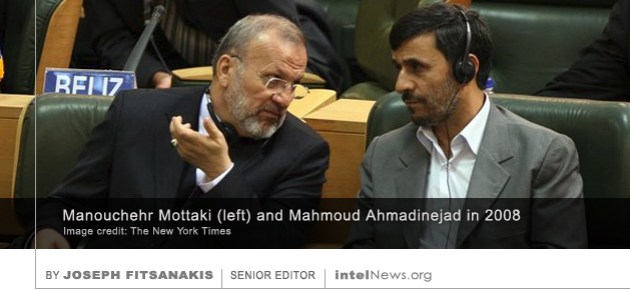
Manouchehr Mottaki and Mahmoud AhmadinejadThe United States National Security Agency spied on the Iranian president, foreign minister, and over 140 Iranian dignitaries who visited New York in 2007 to participate in the United Nations General Assembly. The allegation was aired on Wednesday by American television station NBC, which cited former intelligence officials and a top-secret report on the espionage operation. The original report was included in an October 2007 issue of SID Daily, an internal NSA newsletter published by the spy agency’s Signal Intelligence Division. The report, which is entitled “Tips for a Successful Quick Reaction Capability”, commends the espionage operation against the Iranian UN delegation as an exemplary illustration of a collaborative effort between managers, technical experts, and analysts.

The operation appears to have been directly initiated in early 2007 by the George W. Bush White House, which asked the NSA to spy on Iran’s UN delegation. The blanket permission included espionage conducted against the then Iranian President Mahmoud Ahmadinejad and Minister of Foreign Affairs Manouchehr Mottaki, who were scheduled to be in New York in September of that year to attend the 62nd session of the UN General Assembly. In response to the White House authorization, the NSA deployed a small army of technical experts and analysts to spy on the entire 143-member Iranian delegation for 19 hours a day during the summit.

The NSA teams were allegedly able to record, transcribe and analyze 2,000 conversations of various lengths per day. According to NBC, the NSA was able to intercept the personal conversations of President Ahmadinejad, a number of video conferences involving members of the Iranian delegation, as well as calls made using Skype. The latter were intercepted using a secret technology codenamed BLARNEY by NSA, while the agency also relied on bugs installed in hotel and conference rooms used by the Iranians, said NBC. The intercepted communications were subsequently examined by the NSA’s Social Network Analysis Office in an effort to map the “social networks” of the Iranian government’s senior echelons.

The Iranian government did not respond to NBC’s requests for comment. Iranian President Hassan Rouhani is scheduled to arrive in New York today to attend the 70th UN General Assembly debate.

Author: Joseph Fitsanakis | Date: 24 September 2015 | Permalink



