Extraordinary lecture by Soviet spy Kim Philby surfaces on videotape
April 5, 2016 Leave a comment
 A videotaped lecture by Kim Philby, one of the Cold War’s most recognizable espionage figures, has been unearthed in the archives of the Stasi, the Ministry of State Security of the former East Germany. During the one-hour lecture, filmed in 1981, Philby addresses a select audience of Stasi operations officers and offers them advice on espionage, drawn from his own career. While working as a senior member of British intelligence, Harold Adrian Russell Philby, known as ‘Kim’ to his friends, spied on behalf of the Soviet NKVD and KGB from the early 1930s until 1963, when he secretly defected to the USSR from his home in Beirut, Lebanon. Philby’s defection sent ripples of shock across Western intelligence and is often seen as one of the most dramatic moments of the Cold War.
The videotaped lecture, which was never intended for public consumption, was found recently by the BBC in the archives of the BStU, the Federal Commissioner for Stasi Records in Berlin, Germany. Excerpts can now be viewed publicly for the first time.
The recording begins with an introduction by Markus Wolf, one of the most high-profile intelligence operatives of the Cold War, who was head of East Germany’s Main Directorate for Reconnaissance, the foreign intelligence division of the Stasi. Then Philby takes the stand and for about 15 minutes recounts his recruitment by the Soviet NKVD, the forerunner of the KGB. He tells his audience that the Soviets recruited him despite his extremely young age and joblessness, seeing him as “a long range project”. They did so, he says, because they knew he was part of “the ruling class of the British Empire” and was thus bound to end up in a position of power. His NKVD handler was clear as to his agent’s task, says Philby: his mission was to join the Secret Intelligence Service, known as MI6, Britain’s external intelligence agency. The young Philby then spent years trying to work his way into the intelligence agency, and did so successfully.
With extreme candidness, Philby proceeds to tell his East German audience about his mission, given to him by his NKVD handler in the late 1940s. It was to unseat Felix Cowgill, his boss in MI6’s Soviet counterespionage division, and take his place. He achieved that, he says, even though Cowgill was a man he “rather liked and admired. It was a very dirty story”, admits Philby, “but after all our work does imply getting dirty hands form time to time, but we do it for a cause that is not dirty in a way”.
Of particular interest to intelligence observers is Philby’s justification of his role in Operation VALUABLE/FIEND, in which the Central Intelligence Agency, in association with MI6 and other Western European intelligence agencies, secretly sent Western-trained Albanian agents into communist-controlled Albania. The agents were tasked with organizing an armed popular revolt against Albania’s communist rulers. But Philby, who had been given the job of overseeing the operation on behalf of MI6, betrayed the entire program to the Soviets, thus ensuring its complete failure. In his lecture, he justifies his betrayal by arguing that it helped prevent World War III. Had VALUABLE/FIEND succeeded, claims Philby, it would have been expanded to Bulgaria, at which point the USSR would have intervened, causing World War III.
Following the end of his prepared remarks, Philby takes a series of questions from his audience, including one about how he managed to “stay ideologically pure” while living in a capitalist society. In responding, the British defector praises his Soviet handler, who looked after his “political as well as physical health”, and advised his audience, which presumably included dozens of Stasi case officers, to do the same. A summary report of the recently unearthed videotape can be read on the BBC’s website, here. There is also an audio podcast on Philby’s lecture, which includes commentary from Professor Christopher Andrew, of Cambridge University, and Hayden B. Peake, most recently curator of the CIA’s Historical Intelligence Collection.
► Author: Ian Allen and Joseph Fitsanakis | Date: 05 April 2016 | Permalink
 Ever since 2008, when we launched intelNews, we have monitored daily developments in the highly secretive world of intelligence while providing an expert viewpoint removed from sensationalism and conspiratorial undertones. As 2015 is about to conclude, we take a look back at what we think are the ten most important intelligence-related developments of the past 12 months. Regular readers of this blog will surely agree that we witnessed our fair share of significant intelligence-related stories this year. Some of them made mainstream headlines, while others failed inexplicably to attract the attention of the news media. In anticipation of what 2016 may bring, we present you with our selection of stories, which are listed below in reverse order of significance. This is part two in the series;
  Ever since 2008, when we launched intelNews, we have monitored daily developments in the highly secretive world of intelligence while providing an expert viewpoint removed from sensationalism and conspiratorial undertones. As 2015 is about to conclude, we take a look back at what we think are the ten most important intelligence-related developments of the past 12 months. Regular readers of this blog will surely agree that we witnessed our fair share of significant intelligence-related stories this year. Some of them made mainstream headlines, while others failed inexplicably to attract the attention of the news media. In anticipation of what 2016 may bring, we present you with our selection of stories, which are listed below in reverse order of significance. This is part one in the series; part two is available
 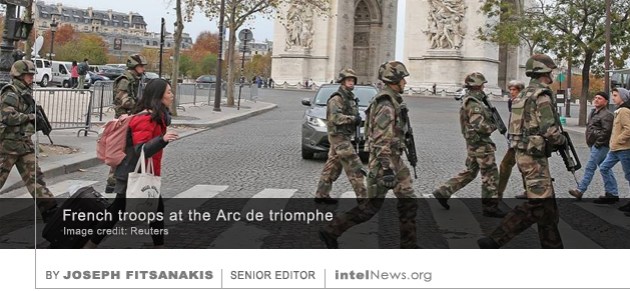 Paris is still reeling from Friday’s unprecedented carnage, which left at least 130 people dead and over 350 wounded. The six separate incidents included the first known suicide bombings in the country’s history and marked the deadliest coordinated attacks on French soil since World War II. The magnitude of the attacks prompted the French government to close the country’s borders and declare a nationwide state of emergency —the first since 1961. The shock from the mass killings is today reverberating throughout Europe, a continent that had not seen such a deadly incident since the Madrid train bombings of 2004, when a group of al-Qaeda-inspired militants killed 191 people in the Spanish capital. A response from France and its Western allies is to be expected. However, the West should pause and think very carefully before deepening its engagement in a chaotic and unpredictable war that is like nothing it has ever experienced. Specifically, Western leaders should consider the following:
 a venue where “a party of perversity” was taking place. Europe’s response to this phenomenon is dismissal and indifference. Most Westerners are still at a loss trying to understand the basic differences between Sunni and Shia Islam, let alone the ideological and spiritual underpinnings of groups like the Islamic State, Jabhat al-Nusra, and others. The idea that radical Islam can be defeated before it is understood is naïve and dangerous.
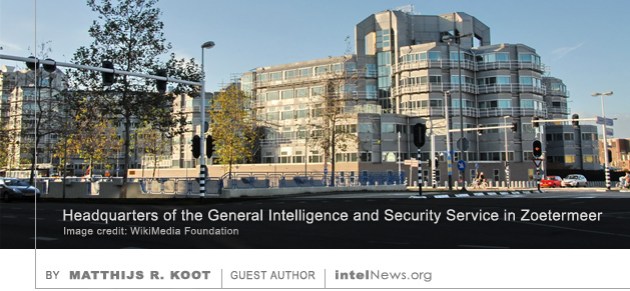 A 28-year-old criminal investigator of the Dutch National Crime Squad was arrested by Dutch police on September 29 over allegations of corruption, neglect of duty, and money laundering. The man, named as Mark M., applied for a job at the Dutch police in 2009. According to an online résumé, M. dropped out of professional college in journalism after several years of being self-employed as a freelance reporter covering crime issues.
 Officials in China think that United States spy agencies are using casinos in Macau to entrap Chinese government employees, according to a report produced on behalf of an American-owned casino chain in the former Portuguese colony. The report was produced by a private investigator and was commissioned by Sands China, the Macau branch of a casino venture owned by American gambling magnate Sheldon Adelson. Its goal was to investigate why the Chinese-appointed authorities in Macau were hostile to the gambling industry in general and Sands China in particular.
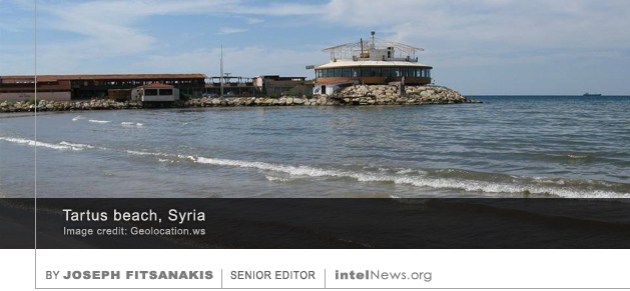 A leaked document from an American intelligence agency appears to confirm that Israeli commandos were behind the assassination of a top Syrian government official, who was shot dead outside his luxury villa on the Syrian coast in 2008. Muhammad Suleiman had been a close aide of current Syrian President Bashar al-Assad even before the latter rose to power in 2000. Once al-Assad became ruler of Syria, Suleiman was appointed special presidential advisor in the areas of arms procurement and strategic weapons. He handled intelligence affairs for the Assad regime and he was involved in weapons transfers from Iran to the Lebanese militant group Hezbollah, while also helping train Hezbollah operatives. He was also rumored to have a senior administrative role in the Syrian nuclear weapons program.
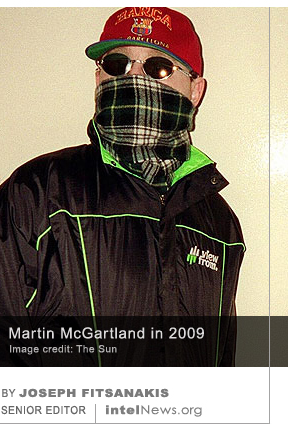 A lawsuit against Britain’s Security Service (MI5) by a former spy, who in the 1980s infiltrated the Provisional Irish Republican Army, commonly known as IRA, is to be judged in secret, a court in London has decided. The spy, Martin McGartland, of Belfast, Northern Ireland, was recruited by the Special Branch of the Royal Ulster Constabulary in the mid-1980s. The information he supplied to the security agencies over several years is widely credited with having saved the lives of at least 50 British police officers and soldiers. His autobiographical experiences formed the basis of the 2008 motion picture 50 Dead Men Walking.
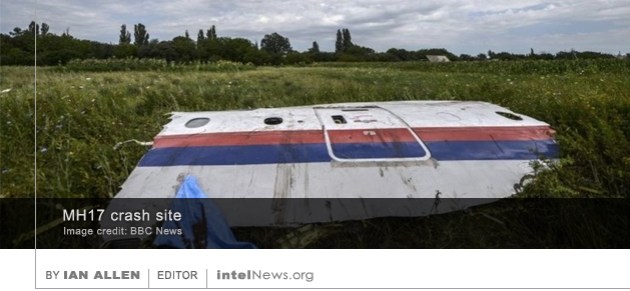 A German investigator, who is probing the downing of a civilian airliner over Ukraine nearly a year ago, says that an informant has claimed a multimillion reward for information pointing to those responsible for the attack. The investigator, Josef Resch, of Lübeck, Germany, says that a binding non-disclosure agreement does not allow him to reveal his client, who offered the $47 million reward. But he told German business magazine Capital that he is hopeful his client will soon reveal the details, since “people who pay that kind of money in exchange for information do not keep it for themselves”. However, he also hinted that his client may be an intelligence agency, who may decide to “deal with the matter without fanfare”.
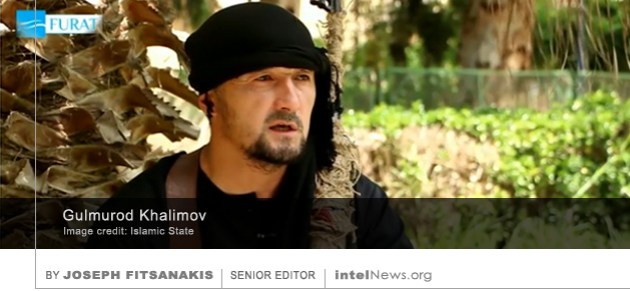 A former army colonel and police commander in Tajikistan, who features in a new Islamic State propaganda video, was trained in counterterrorism by the United States government, according to officials. Until earlier this year, Colonel Gulmurod Khalimov was a commander in Tajikistan’s Special Purpose Mobile Units. Known commonly as OMON, these elite units are a cross between anti-riot corps and counterterrorism forces. They date from the Soviet era and are common features of the law enforcement architecture of most former Soviet republics, including Tajikistan, whose population is 98 percent Muslim.







 intelNews.org
US Congressional probe finds DoD intelligence on Islamic State was altered
August 11, 2016 Leave a comment
The allegations prompted two separate investigations, one by the Department of Defense and one by a task force consisting of Republican members of three committees in the US House of Representatives —namely the Committee on Armed Services, the Permanent Select Committee on Intelligence, and the Defense Subcommittee of the Committee on Appropriations. According to The Daily Beast, the committees have now concluded their five-month investigation and are preparing to release a 10-page report before the end of August. Citing three unnamed US officials, the website claims that the soon-to-be-released report will corroborate claims by DIA analysts that their intelligence reports were deliberately doctored in order to make American efforts against ISIS seem more successful than they have been.
According to the three officials, who are reportedly “familiar with the task force’s findings”, the 10-page document will not corroborate claims that the pressure on the intelligence analysts was exercised by senior sources inside the White House. But they told the website that the Congressional investigation could continue after the release of the report. The Daily Beast said it contacted CENTCOM for a comment on the story, but was told that the Pentagon body has yet to receive the task force report. Meanwhile, the Pentagon’s own investigation into the analysts’ allegations continues and expected to release its findings by the end of 2016.
► Author: Joseph Fitsanakis | Date: 11 August 2016 | Permalink
Filed under Expert news and commentary on intelligence, espionage, spies and spying Tagged with CENTCOM, DIA, DoD Inspector General, intelligence analysis, Islamic State, News, United States, US House of Representatives, US House of Representatives Committee on Appropriations, US House of Representatives Committee on Armed Services, US House of Representatives Permanent Select Committee on Intelligence