British spy agency to scrap $140m IT system over security fears

DeloitteBy IAN ALLEN | intelNews.org |
Britain’s domestic intelligence agency, MI5, has decided to “accept defeat” and scrap a multimillion digital records management program over fears it could create a dangerous “intelligence vacuum”. The program, which has so far cost the British taxpayer over £90 million ($140 million) in payments to private consultants, was first conceived in the run-up to the London 2012 summer Olympic Games. While evaluating terrorist-related threats posed by the hosting of the Games in the United Kingdom, British security officials decided that the government-wide intelligence-sharing system in place was archaic and in need of serious overhaul. They hired a group of senior IT management consultants from Deloitte, one of the world’s largest professional services firm, headquartered in New York, NY. The pricey corporate experts were tasked with helping MI5 digitally collate intelligence data collected or produced by all departments of the British government. Deloitte’s planning team had projected that the multi-million dollar system would be in place and operational by the summer of 2012, before the Olympic Games were held in London. This, however, proved wildly optimistic; Deloitte barely managed to scrape together a watered-down version of the promised records management program in late 2012. When the program was tested by MI5’s intelligence collection managers, it was found to contain serious errors that, according to British newspaper The Independent, could leave the country’s intelligence agencies “vulnerable and struggling with an intelligence vacuum”. When initially questioned about the Deloitte debacle by British lawmakers, MI5’s (now retired) Director, Sir Jonathan Evans, told the frustrated members of the British House of Commons Intelligence and Security Committee not to worry. Read more of this post

News you may have missed #836

Investigating the Boston bombingsBy IAN ALLEN | intelNews.org |
►►NSA guide explains how to access private info on Google. In 2007, the US National Security Agency produced a book to help its spies uncover intelligence hiding on the World Wide Web. The 643-page tome, called Untangling the Web: A Guide to Internet Research (.pdf), has just been released by the NSA following a FOIA request filed in April by MuckRock, a site that charges fees to process public records for activists and others. Although the author’s name is redacted in the version released by the NSA, Muckrock’s FOIA indicates it was written by Robyn Winder and Charlie Speight.
►►Are the EU’s unofficial spy services growing out of control? Since its founding, the European Union has been building its own spy programs, often triggered by specific needs, in an ad-hoc manner, without strategy and without a coherent concept about their structure, methods, and people. Unofficially, the has been building an intelligence apparatus of six services so far, some of them brand new, populated already by 1,300 specialists. But because they are technically not conducting covert operations, they simply deny being intelligence services.
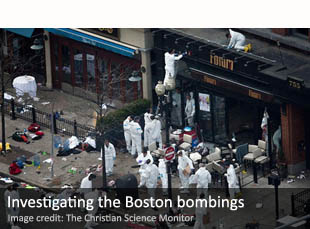
►►Hearing on Boston bombings exposes intelligence failures. The US House Committee on Homeland Security’s hearing on the Boston Marathon bombings on Thursday amounted to more than the usual political posturing: it exposed clear deficiencies in communications among intelligence- and law-enforcement agencies. whatever the cause of the intelligence breakdown, the failure to share vital information —and the continued finger-pointing between agencies yesterday— shows the need to improve coordination.
News you may have missed #835 (Americas edition)

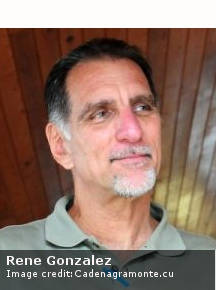
Rene GonzalezBy IAN ALLEN | intelNews.org |

►►‘Cuban Five’ spy member renounces US citizenship. Cuban intelligence officer Rene Gonzalez, who was a member of the “Cuban Five” spy group in South Florida, was released from a US prison in 2011, after serving 10 years for espionage. He was required to serve three years’ probation in the US. But on Friday US District Judge Joan Lenard ruled that Gonzalez, who had already been allowed to temporarily return to Cuba for his father’s funeral, could stay there if he renounced his US citizenship. Gonzalez is the first of the Cuban Five to return to the island. The other four men continue to serve lengthy sentences in US federal prisons.
►►US Defense Intelligence Agency contemplates austerity. Since 2001, intelligence agencies have had just about all money they wanted, but not anymore, as the cuts mandated by the Budget Control Act are hitting even previously inviolable spook accounts. In a reflection of this new reality, the Defense Intelligence Agency plans a conference with industry at its headquarters on June 27, 2013. Agency leaders will focus on “current and emerging challenges in the context of an increasingly austere fiscal posture”.
►►Report says Canada spies caught off guard by Arab Spring. The 2011 Arab Spring uprising in the Middle East came as a surprise to the Canadian government, which risks getting caught off-guard again without a new approach to gathering intelligence. This is according to a new report by Canada’s Intelligence Assessment Secretariat, a unit of the Privy Council’s Office, the bureaucratic arm of the Office of the Canadian Prime Minister. On the other hand, the report states, “there is no reason to believe that [Canadian intelligence agencies] did any worse than other allied agencies in its analysis of the Arab Spring, and in a few areas it appears to have done somewhat better”.

News you may have missed #834

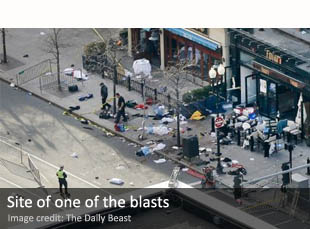
Site of one of the Boston Marathon blastsBy IAN ALLEN | intelNews.org |
►►Why FBI and CIA didn’t connect the dots on Boston bombers.  The FBI and the CIA are being criticized for not keeping better track of Tamerlan Tsarnaev in the months before the Boston Marathon bombings. How could they have ignored such a dangerous person? How do we reform the intelligence community to ensure this kind of failure doesn’t happen again? Legendary security expert Bruce Schneier says the idea of connecting the dots is a bad metaphor, and focusing on it makes us more likely to implement useless reforms.
►►Korean spy’s deportation reveals web of intrigue. Relations between Australia and South Korea have been strained after the East Asian economic powerhouse was caught soliciting sensitive information from public servants, and the deportation of a South Korean spy for espionage in 2009 was disclosed. New details of South Korean espionage in Australia were revealed in an unfair dismissal case before the Fair Work Commission brought by a former intelligence officer with the Australian Federal Police, Bo-Rim “Bryan” Kim.
►►Secret US court approved all domestic spying requests in 2012. The United States Foreign Intelligence Surveillance Court (also known as FISA court) quietly rubber-stamped nearly 2,000 government requests to search or electronically monitor people in the United States last year, according to a Justice Department report. The agency, which oversees requests for surveillance warrants against suspected foreign intelligence agents on US soil, released the report to Senate majority leader Harry Reid (D-Nevada), showing that by approving the 1,856 inquiries “for foreign intelligence purposes”, it had granted every single government request in 2012.

News you may have missed #833

Dawn MeyerriecksBy IAN ALLEN | intelNews.org |

►►Report states Switzerland increasingly targeted by spies. Cyber attacks and abductions of Swiss abroad were two of the main security challenges faced by Switzerland last year, according to report released on Tuesday by the alpine country’s Federal Intelligence Service (FIS). “Switzerland continues to be no priority for jihadist motivated attacks,” the report said. However, presenting the report, FIS head Markus Seiler said an Islamist attack on Swiss soil could not be ruled out. And Swiss nationals abroad were “more threatened than in the past by politically and terrorist motivated abductions”, he said.
►►Prosecutors raid South Korean spy agency. State prosecutors raided the headquarters of the National Intelligence Service of South Korea on Tuesday to investigate accusations that the spy agency used its agents and hired bloggers to influence the presidential election in December. The raid, which started in the morning and continued into the evening, was highly unusual, dealing a blow to the reputation of the spy agency. Such a raid would have been unthinkable decades ago when the agency had served as the main tool of political control for South Korea’s military dictators.
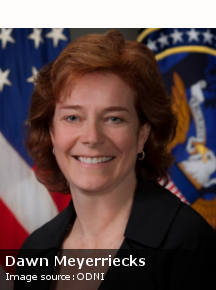
►►Former AOL VP to lead CIA tech and science division. The CIA has appointed Dawn Meyerriecks, former AOL Senior Vice President for Product Technology, as its new Chief of Science and Technology. According to Wired, Meyerriecks is the first internet executive to ever take a top-tiered position in the CIA. Some of the things Meyerriecks has done in the past include working as a Jet Propulsion Lab engineer for NASA, working as a Assistant Director of National Intelligence for Acquisitions and Technology, working as a Chief Technology Officer and Technical Director for the Joint Interoperabillity and Engineering Organization (JIEO), establishing an in-house app market for both spies and analysts, encouraging the US government to use open source software, and much more.

Second US government official indicted in Cuba espionage case

Ana Belen MontesBy IAN ALLEN | intelNews.org |

The United States has publicly unsealed for the first time the indictment of an American government official accused of spying for Cuba, in connection with former senior US military intelligence analyst Ana Belen Montes, who was jailed in 2002 for spying for Havana. Marta Rita Velazquez, a Puerto Rican-born American citizen, was originally indicted in 2004 for conspiracy to commit espionage as an unregistered agent of a foreign power. A graduate of Princeton University and Georgetown University Law School, Velazquez first met Montes while they were both studying at the Johns Hopkins University’s School of Advanced International Studies in Washington, DC. In 2002, when the Federal Bureau of Investigation ended Montes’ 17-year espionage career on behalf of Cuba, it was told that Velazquez helped the Cuban Intelligence Directorate recruit Montes. The military analyst told her FBI interrogators that Velazquez introduced her to a Cuban intelligence officer in New York; she then traveled with her to Cuba, where Montes received “operational training”, before helping her obtain a job with the US Defense Intelligence Agency. At the time, Velazquez was already working with for the US Department of State as a legal officer attached to the US Agency for International Development. In that position, which she held for over a decade, Velazquez had a top-secret security clearance; she also completed tours at the US embassies in Guatemala and Nicaragua. In 2004, a grand jury in Washington, DC, indicted Velazquez for espionage, accusing her of exchanging encrypted information with Cuban intelligence officers and traveling abroad to receive operational training while secretly in the service of Cuba. Read more of this post

News you may have missed #832 (foiled Canada terror plot)

Toronto, CanadaBy IAN ALLEN | intelNews.org |

►►Two arrested in Canada terror plot. Chiheb Esseghaier, 30, and Raed Jaser, 35, who live in Montreal and Toronto, were planning to derail a Via Rail passenger train in Toronto  with support from “al-Qaeda elements located in Iran”, Canadian police said Monday. “This is the first known al-Qaeda planned attack that we’ve experienced in Canada”, Superintendent Doug Best told a news conference. Police said the men did not receive financial support from al-Qaeda, but declined to provide more details. There was no apparent reason to think the planned attacks were state-sponsored.
►►Canada foils ‘al-Qaeda inspired’ terror attack on train. The Royal Canadian Mounted Police (RCMP) said the surveillance operation leading to the arrests of the two suspects was “a result of extensive collaborative efforts”. Chief Spt Jennifer Strachan said the two men had sought to target “a specific route, but not necessarily a specific train”. At the same time, the RCMP said they believed the plot was in the planning stage and “there was no imminent threat to the general public”.
►►Tip from Muslim community ‘helped foil’ al-Qaeda plot. Canadian lawyer Hussein Hamdani told CTV News Channel that a tip from the Muslim community helped investigators foil the alleged al-Qaeda plot. “This goes to show the partnership between the Muslim community in Canada and the RCMP and all the police services,” said Hamdani. It might not be well known but collaboration between Muslims and government agencies —like the RCMP, CSIS, Canadian Border Services Agency and the Department of Justice— is quite common, according to Hamdani.

News you may have missed #831 (Boston Marathon bombings)

Site of one of the Boston Marathon blastsBy IAN ALLEN | intelNews.org |
►►Russia had warned FBI Tsarnaev had radical links. The Russian FSB intelligence security service shared with the FBI in early 2011 information that Tamerlan Tsarnaev, one of the brothers suspected in the Boston marathon bombings, was a follower of radical Islam. The Russians allegedly told the FBI that Tsarnaev, 26,  had changed drastically since 2010 as he prepared to leave the US to join unspecified underground groups.
►►FBI interviewed dead Boston bombing suspect years ago. The FBI admitted Friday they interviewed the now-deceased Boston Marathon bombing suspect Tamerlan Tsarnaev two years ago but failed to find any incriminating information about him. The FBI probe culminated in a sit-down interview where they probably asked him a lot of questions about his life, his contacts, his surroundings. All of this was then written in a report.
►►Ex-CIA/FBI official says Boston bombings were not terrorism. Counterterrorism expert Philip Mudd, with experience in the CIA and the FBI, told Fox News: “What I fear is that people too quickly categorize this as terrorism. This looks more to me like Columbine than it does like al Qaeda. Two kids who radicalized between themselves in a closed circle and go out and commit murder. I would charge these guys as murderers, not terrorists”.
►►Ex-US Attorney General says Boston bombings were terrorism. Michael Mukasey, Attorney General of the United States from 2007 to 2009, says that the Boston attack “was obviously a suicide operation –not in the direct way of a bomber who kills all his victims and himself at the same time by blowing himself up, but in the way of someone who conducts a spree, holding the stage for as long as possible, before he is cut down in a blaze of what he believes is glory. Here, think Mumbai”.

Is Ana Montes ‘the most important spy you’ve never heard of’?

Ana Belen MontesBy IAN ALLEN | intelNews.org |
An extensive article published today in The Washington Post Magazine revisits the largely forgotten case of Ana Belen Montes, a senior United States military intelligence analyst who was convicted in 2002 of spying for Cuba. Montes, who was arrested by the Federal Bureau of Investigation in Washington, DC, on September 20, 2001, underwent trial and sentencing in the shadow of 9/11, which might help explain the relative obscurity of her case. Still, as The Post article by Jim Popkin states, many intelligence observers view her as one of the most damaging double spies in recent American history. She entered government work as a clerk typist at the Department of Justice, and quickly received top-security clearance. It was from there that she moved to the Defense Intelligence Agency, America’s premier military intelligence organization, in September 1985. She rose meteorically through the ranks of the DIA, eventually becoming the Agency’s top Cuba analyst. Montes’ former colleagues report that she was known as “the Queen of Cuba”, a witty label that rested on her indisputable reputation as one of America’s most capable intelligence analysts on Cuba. She also came from a family with strong conservative credentials and strong connections with the US counterintelligence community. Her brother and sister were both FBI agents, and her former long-term boyfriend was a Cuban intelligence specialist for the Department of Defense. Read more of this post

News you may have missed #830 (Boston bombings analysis)

Site of one of the Boston Marathon blastsBy IAN ALLEN | intelNews.org |
►►Despite WMD fears, terrorists still focused on conventional attacks. The United States has spent billions of dollars to prevent terrorists from obtaining a weapon of mass destruction even as the bombings in Boston further show that a nuclear weapon or lethal bioagent is not necessary for causing significant harm. However, experts warn that, even though there is a considerably lower probability of a WMD attack versus a conventional strike, the much higher consequences necessitate continued US investment in prevention and preparation.
►►Why isn’t terrorism in the US a whole lot more frequent? While the horrific bombing at the Boston Marathon has brought concerns about terrorism back to the forefront of national attention, it is worth remembering that terrorism inside the United States is exceedingly rare. Over the past 40 years, just over 3 people on average have been killed by acts of terrorism per year (remove 9/11, and the average is 1.4 deaths per year). After 9/11 or an event like the Boston attack, we often think “it would be so easy to [fill in the blank] and cause massive damage.” And it’s true. Then why doesn’t it happen more often?
►►Boston bomb investigators can’t decide: foreign or domestic? Even the most experienced investigators are still trying to decide whether the Boston marathon bombs were carried out at the hands of domestic or foreign attackers. The inability to settle that question is proving frustrating to investigators. Former FBI assistant director Tom Fuentes told CNN: “I’ve run bomb scenes in Iraq and also in the US”, adding that the attack in Boston “has the hallmarks of both domestic and international, and you can see either side of that”.
►►Smoke color is key clue to analyzing Boston Marathon bombs. As a team of investigators led by the FBI begins deciphering the bombs that killed three people and wounded 150 more in Boston this week, a key clue is already in plain sight on countless videos taken during the blasts: the color of the smoke. Analyzing the color of the smoke can provide information about the explosive that powered the bombs, which in turn provides clues about its sophistication —and, possibly, that of the people who made it.

Growing number of US officials believe al-Qaeda is finished

Al-Qaeda propaganda videoBy IAN ALLEN | intelNews.org |
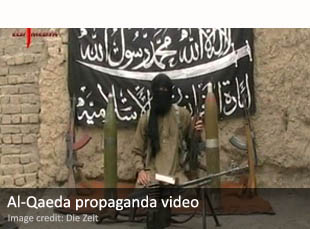
An increasing number of government officials in the United States believe that al-Qaeda is no longer a serious threat to the homeland and are turning their attention to the next chapter of America’s security posture. Citing American defense and intelligence insiders, The Los Angeles Times claims that the militant Islamist group has been virtually decimated following more than a decade of relentless pursuit by Washington. So extensive is al-Qaeda’s operational devastation, they say, that US intelligence agencies can no longer discern any meaningful operational structure at the group’s core. Aside from its reputed leader, Egyptian physician Ayman al-Zawahiri, and a handful of others, no senior al-Qaeda lieutenant is believed to be alive. For over four years, the group’s commanders have been killed by the Central Intelligence Agency almost as soon as they have been identified, claims the paper. Al-Qaeda’s collapsing structure has led to an inevitable process of decentralization, which has rendered its surviving senior leadership virtually irrelevant to the global Islamist movement. Instead, a host of al-Qaeda-inspired factions have assumed the role of torchbearer, operating in far-flung locations such as Iraq, Syria, Mali, Yemen and Somalia. However, says The Times, these groups are motivated by strictly local issues and have neither the ability nor the will to mount large-scale attacks on American targets. The article quotes former US Deputy Assistant Defense Secretary Rosa Brooks as saying: “to the best of our information, there is nobody out there with both the desire and the capabilities to cause any serious damage to the US in any way at this moment”. Read more of this post

News you may have missed #829

Raymond Allen DavisBy IAN ALLEN | intelNews.org |
Irish police responds to claims of IRA collusion. For nearly two years, the Smithwick Tribunal in Dublin, Ireland, has been hearing allegations that the Provisional Irish Republican Army had supporters inside the Garda Síochána, Irealand’s police force. This past week, the Garda’s Crime and Security Branch gave the Tribunal a 51-page response to the allegations. The tribunal said it “needed time to read the response” before holding another open session next week.
►►How CIA spy Raymond Davis helped turn Pakistan against the US. The New York Times‘ Mark Mazzetti has penned an excellent retrospective analysis of Raymond Allen Davis imbroglio. In 2011, the CIA contractor was arrested in Lahore for shooting dead two men who allegedly tried to rob him. Davis was only released after the US government offered monetary compensation to the families of the dead men. Mazzetti argues that the furor over the Davis incident threatened to shut down most CIA operations in Pakistan and derail the intelligence-gathering operation in Abbottabad.
►►New book explains CIA shift from spying to killing. Speaking of Mark Mazzetti, he has a new book out called The Way of the Knife: The CIA, a Secret Army, and a War at the Ends of the Earth. In it, he explores the post-9/11 transformation of the CIA from its original mission –spying– to a facilitator of targeted killings for the Pentagon. He told National Public Radio that “the CIA has become a machine for killing in many ways. The counterterrorism center has become […] the sort of beating heart of the agency that does man-hunting. And these question of ‘Should the CIA stay in the killing business?’ […] is something that is unresolved but is certainly being discussed”.

Ex-CIA analyst says North Korea will launch strikes against South

North and South KoreaBy IAN ALLEN | intelNews.org |
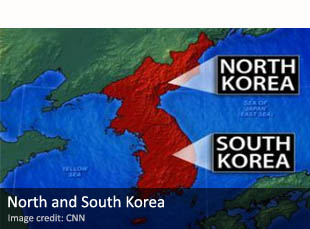
A former senior analyst on North Korea at the United States Central Intelligence Agency believes that the communist state will launch limited strikes against the South before moving to de-escalate the ongoing crisis in the Korean peninsula. On March 27, Pyongyang announced it was withdrawing from  the Korean Armistice Agreement, which it signed along with the United Nations and China at the end of the Korean War, in 1953. Shortly afterwards, North Korea closed all border connections with the South and disconnected the direct telephone line linking it with Seoul. It subsequently declared that it would not hesitate to launch a preemptive nuclear strike against South Korea and the United States. Pyongyang heightened its rhetoric in response to Key Resolve/Foal Eagle, a two-month-long military exercise involving US and South Koran armed forces, which includes the deployment of nuclear-armed airplanes and ships. Although some expert observers are worried, few believe that the rhetorical boxing-match between the two Koreas will result in an outbreak of hostilities. But Columbia University Professor Sue Mi Terry, who headed the CIA’s North Korea analysis unit from 2001 to 2008, believes that Pyongyang will launch military strikes against Seoul before de-escalating the tension. Speaking to Wired magazine’s Danger Room blog, Terry noted that the attack will not be nuclear, nor will it involve mass use of military force. Instead, it will be “a relative small attack” that “won’t leave many people dead”, she said. Read more of this post

News you may have missed #828

Abdullah ÖcalanBy IAN ALLEN | intelNews.org |
Chinese researcher charged with stealing US drug. Chinese cancer researcher Huajun Zhao, 42, who has been working in the United States since 2006, has been charged with stealing data and an experimental compound from the Medical College of Wisconsin. The federal complaint accuses Zhao of stealing the compound, C-25, which could potentially assist in killing cancer cells without damaging normal cells. An FBI investigation turned up evidence that Zhao hoped to claim credit in China for discovering C-25. He had already claimed on a research website that he had discovered an unnamed compound he hoped to take to China.
Turkish intelligence to ‘oversee PKK retreat’. Turkey’s National Intelligence Agency, MİT, will oversee the withdrawal of Kurdistan Workers Party (PKK) militants, according to Turkey’s Deputy Prime Minister, Bülent Arınç. Last month, Abdullah Öcalan, the leader of the armed Kurdish group that has battled Turkey for 30 years, proclaimed an immediate ceasefire in PKK’s conflict with the Turkish state, which has claimed about 35,000 lives. Speaking on Turkey’s state-run broadcaster, TRT, Arınç said no legislation would be introduced to facilitate the withdrawal, but “certainly MİT will oversee it; security forces will take part in it, too”, he added.
Analysis: Controversial Bush programs continue under Obama. During the George W. Bush years, two of the most controversial elements of what was then called the Global War on Terrorism were the CIA’s rendition, detention and interrogation (RDI) program and the creation of the prison camps at Guantanamo Bay. Guantanamo Bay and the RDI program are both back in the news now, each for their own unsavory reasons. The Pentagon is requesting nearly $200 million for Guantanamo Bay infrastructure upgrades, including $49 million for a new unit for ‘special’ prisoners. Meanwhile, participation in the CIA’s controversial RDI program has resulted —for at least one person— not in prosecution or professional sanctions, but rather in a promotion.

CIA officer who purged torture evidence is rewarded with promotion

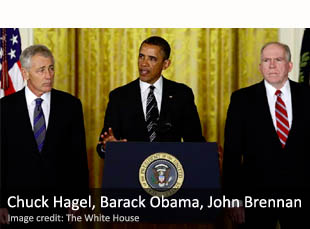
Chuck Hagel, Barack Obama, John BrennanBy IAN ALLEN | intelNews.org |
A United States Central Intelligence Agency officer who was personally involved in the illegal controversial destruction of videotapes showing CIA personnel torturing detainees, is now leading the Agency’s operations division. At the center of the affair are nearly 100 recordings of interrogation sessions of al-Qaeda suspects Abu Zubaydah and Abd al-Rahim al-Nashiri. The videotapes were made in 2002 at a CIA black site in Thailand and kept inside a safe at the Agency’s station in the Asian country. The CIA decided to destroy the videotapes soon after May of 2005, when the Judiciary Committee of the United States Senate demanded access to them. In 2007, after The New York Times revealed the destruction of the videotapes, the US Department of Justice ordered two separate investigations into the incident. However, under pressure from the administration of President Barack Obama, no criminal charges were ever pressed. The videotape affair is bound to resurface in the headlines, however, after The Washington Post revealed on Wednesday that a female CIA officer, who personally ordered the destruction of the videotapes, even though she knew that Congress had asked for them, was recently promoted to one of the CIA’s most senior posts. The officer, whose name cannot legally be revealed, because she remains undercover within the Agency, is currently in charge of the CIA’s National Clandestine Service (NCS), which is responsible for conducting covert action and espionage around the world. Many consider the NCS as the ‘heart and soul’ of the CIA, and it is the first time in the history of the CIA that a woman has led that secretive division. Citing “current and former intelligence officials”, The Post alleged that the officer entered the position in an acting capacity a few weeks ago, following the retirement of her boss. Read more of this post