Intelligence wars heat up in Lebanon amid regional instability

Lebanese-Israeli-Syrian borderBy JOSEPH FITSANAKIS | intelNews.org |
As the security situation in Syria and Egypt deteriorates, Lebanon is rapidly emerging as a major intelligence hub in the wider geopolitical power-struggle currently unfolding in the Middle East. On Monday, Lebanon’s leading Arabic-language newspaper, An-Nahar, reported the discovery last month of a foreign espionage network allegedly operating in Lebanese capital Beirut. The paper said that the clandestine network was spying on behalf of “a major Western country”, and was unearthed by forces loyal to Hezbollah, the Shiite group that controls large parts of southern Lebanon. The network allegedly consisted of at least three men, all Lebanese citizens, who lived in close proximity to each other in Beirut’s southern suburbs —a traditional Hezbollah stronghold. The three men were not Hezbollah members, said An-Nahar, but one was stoutly religious and all had good relations with local Hezbollah cells operating in their respective neighborhoods. The alleged head of the spy ring was an unnamed Lebanese citizen who had lived in the Ukraine for several years, where he operated a human smuggling network transporting Arab men into Europe. However, he was eventually arrested by French authorities in Paris and spent two years in prison. According to An-Nahar, the man was able to secure a deal with his captors, under which he would be allowed to return to Lebanon in exchange for informing them about the activities of a senior Hezbollah official wanted by Interpol. His ultimate mission was allegedly to lure the Hezbollah official, with whom he was friends, to Europe, where he could be arrested. Hezbollah has refused to comment on the newspaper’s claims. But the militant Shiite group did confirm on Tuesday the reported explosions of three alleged Israeli spy devices found in Southern Lebanon. Read more of this post

Analysis: The Danger in Ignoring Non-Muslim Religious Terrorism

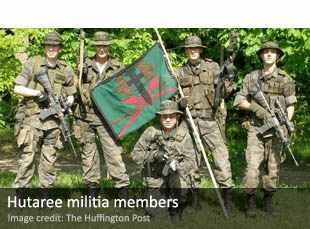
Hutaree militia membersBy JOSEPH FITSANAKIS | intelNews.org |
Even though over a decade separates us from the tragic events of September 11, 2001, Americans continue to be heavily preoccupied with terrorism. But what is the face of terrorism in our time? Too often, the term ‘terrorist’ conjures up the stereotypical image of an Arabic-speaking Muslim male from the Middle East —viewed by many Westerners as an abstract geopolitical notion that erroneously includes Afghanistan. There is no doubt that Islamic-inspired terrorism is both very real and very dangerous. However, consciously or subconsciously associating terrorism solely with Islam is not only flawed, but also potentially dangerous for our collective security. In reality, all religious dogmas contain extremist elements. This includes religious doctrines that are widely considered peace-loving, such as Anabaptism, or even Buddhism. A case in point that is often overlooked by Westernern observers is Aum Shinrikyo, the Japanese millenarianist cult inspired by Buddhist tenets. In 1995, Aum members used sarin gas in a large-scale terrorist attack on the Tokyo subway system, which killed 13 and injured close to a thousand commuters. In later years it was revealed that, prior to engaging in chemical terrorism, Aum had become history’s first known terrorist group to actively try to acquire nuclear material for tactical purposes. It was only after failing to obtain nuclear material that Aum’s leadership turned to sarin. This past Thursday, July 5, an interview of mine was aired on this very subject, namely the current state of homegrown, religiously-inspired terrorism in the United States. Read more of this post
Medical tests suggest Yasser Arafat may have been poisoned

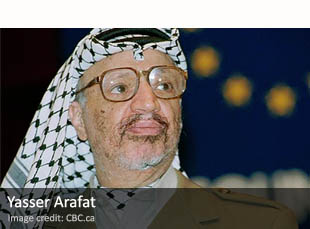
Yasser ArafatBy JOSEPH FITSANAKIS | intelNews.org |
A nine-month forensic toxicological investigation into the death of Yasser Arafat has raised the possibility that the Palestinian leader may have been poisoned with a radioactive substance. The Institut de Radiophysique (IRA) in Lausanne, Switzerland, has announced the discovery of significant traces of polonium-210 on the personal artifacts that Arafat used during his final days. Speaking at a press conference in Switzerland on Monday, IRA Director Dr. Francois Bochud said that the Institute could “confirm that we measured an unexplained, elevated amount of unsupported polonium-210 in the belongings of Mr. Arafat that contained stains of biological fluids”. According to the IRA, some of the Fatah founder’s personal belongings, including his underwear and his toothbrush, contained levels of polonium that were as many as ten times higher than those in random samples used as control subjects in the study. The findings of the investigation, which was sponsored by the Qatari news channel Al-Jazeera, may eventually shed light into the cause of Arafat’s death, which remains a medical mystery. Doctors in the West Bank and France have confirmed that the Palestinian leader was in sound health until he suddenly fell ill in mid-October 2004, and that his body showed no symptoms of any known disease. Polonium-210 made news headlines in a major way in November 2006, when it was identified as the poison used to kill Alexander Litvinenko. Read more of this post

Comment: Did Israel assassinate senior Hamas official in Syria?

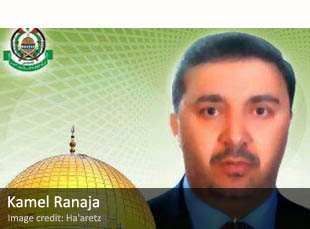
Kamel RanajaBy JOSEPH FITSANAKIS | intelNews.org |
The leadership of Hamas has accused Israel of assassinating one of its senior officials in Syria last Wednesday. The Palestinian militant group, which controls the Gaza Strip, announced late last week that the charred body of Kamel Ranaja had been found in his half-burned apartment in Syrian capital Damascus. Ranaja, known informally as Nizar Abu Mujhad, was said to have replaced the post of the late Hamas weapons procurer Mahmoud al-Mabhouh. Al-Mabhouh was killed in 2010 in Dubai, United Arab Emirates, most likely by Israeli intelligence agency Mossad. Citing French news agency Agence France Presse, Israeli newspaper Ha’aretz quoted an unnamed Hamas official as saying that “a group of people entered [Ranaja’s] home […] and killed him”, adding that “according to the information that we have gathered, the Mossad is behind the attack”. Reports from Reuters published in the British press suggest that Ranaja’s charred body “bore signs of torture” and that it had been dismembered. There are also suggestions that the group that attacked the Hamas official’s apartment took with them an unspecified volume of documents and computer files before setting the place on fire.

Read more of this post

Revealed: British government minister spied for Czechoslovakia

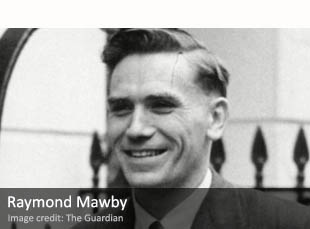
Raymond MawbyBy JOSEPH FITSANAKIS | intelNews.org |
The BBC has uncovered evidence that a Conservative Party minister was a longtime paid informant for Czechoslovakia’s Cold-War-era secret intelligence service. The discovery was made earlier this month by the BBC’s security correspondent, Gordon Corera, while visiting the declassified archives of the Czechoslovakian ŠtB to investigate an alleged attempt to blackmail British Conservative politician Edward Heath in the 1970s.  Corera’s discovery shows that Raymond Mawby, who was a Tory Member of Parliament from 1955 until 1983, spied for the ŠtB in return for money for nearly a decade, starting in 1961.  The BBC describes Mawby, who served as assistant Postmaster General from 1963 to 1964, and rose to the rank of junior minister in 1963, as “an unusual Tory”, since he was “a working class trade unionist” from Devon. Indeed, his extensive ŠtB file, uncovered by the BBC, shows that he was not as loyal to conservative values as one might think. Mawby was first approached by Czechoslovakian intelligence in November 1960, while attending a cocktail reception at the Czechoslovakian embassy in London. His contacts with his ŠtB handlers became more frequent during the following year when, operating under the codename Laval, he began providing them with political information from the British Houses of Commons, in exchange for regular payments of £100. By 1964, he was on a £400 monthly retainer by the ŠtB, in return for supplying the Czechoslovaks with documents from Parliament, details about the personal lives of his colleagues, and lists of Parliamentary committee members. In one instance, Mawby even supplied his foreign handlers with a hand-drawn floor plan of the office of the Prime Minister at 10 Downing Street. Read more of this post

Dutch diplomat arrested for spying for Russia

Anna ChapmanBy JOSEPH FITSANAKIS | intelNews.org |
Authorities in Holland have arrested a Dutch diplomat who is said to have worked for the same Russian intelligence unit that handled a group of Russian sleeper agents captured in the United States in 2010. The 60-year-old diplomat, who has been publicly identified only as Raymond P., was arrested over the weekend in The Hague following an extensive investigation by German counterintelligence. According to German newsmagazine Focus, which first aired the story on Saturday, the diplomat is believed to have given nearly 500 classified documents to Andreas and Heidrun Anschlag, two Russian intelligence officers operating in Germany. The Anschlags, who are married to each other, and are believed to be Mexican-born, were arrested in October of 2011 in the university town of Marburg in central Germany. They are thought to have moved to Germany from Mexico in 1990, using false Austrian passports supplied to them by the SVR, the Russian Foreign Intelligence Service. At the time of the Anschlags’ arrest, Russian media claimed that the couple had “effectively retired” from the SVR several years ago and were being utilized mostly as message couriers. It now appears that Raymond P. was one of their informants, and that the three operated as part of the same espionage ring in Germany. Interestingly, the Anschlags were also said to be in frequent contact with Russian intelligence agent Anna Chapman (pictured), who was arrested by the FBI in the US in 2010. Chapman was part of a group of 11 Russian sleeper agents who were arrested on the same day by the FBI, and were later expelled to Russia. Read more of this post

Did Czechoslovakian spies plan to blackmail British leader?

Ted HeathBy JOSEPH FITSANAKIS | intelNews.org |
In 1975, Czechoslovakian intelligence officer Josef Frolík, who had defected to the United States, published a book titled The Frolik Defection: The Memoirs of an Intelligence Agent. Among several revelations in the book was an alleged plot by the ŠtB, Czechoslovakia’s Cold-War-era secret intelligence service, to sexually blackmail British Conservative politician Edward “Ted” Heath. According to Frolík, the ŠtB had concluded that Heath, a lifelong bachelor and Britain’s Prime Minister from 1970 to 1974, was gay. Based on this —highly questionable— belief, Jan Mrázek, an ŠtB officer working out of the Czechoslovakian embassy in London, had allegedly devised a plan in the mid-1960s, which aimed to expose Heath to homosexual blackmail. Frolík claims in his book that Mrázek developed the plot around Heath’s well-known preoccupation with classical music. Specifically, he planned to recruit Czechoslovakian classical organist Jiří Reinberger, who would be instructed to meet the British conservative politician in London and invite him to Prague for a concert. While there, the ŠtB hoped that a romantic affair would ensue, under the watchful eye of Czechoslovakian spies, who would make sure to capture the more intimate moments of the two men on camera. The audiovisual evidence would, the ŠtB believed, convince Heath to spy for Czechoslovakian intelligence. According Frolík, the plan was put to action but was eventually scrapped after MI5, Britain’s counterintelligence agency, warned Heath that a trip to Czechoslovakia would expose him to blackmail by that country’s intelligence service. When Frolík’s book came out, Heath, who had stepped down from his post as Britain’s Prime Minister and leader of the Conservative Party, dismissed the story as a fabrication, and threatened to sue the author. But was Frolík telling the truth? Read more of this post

CIA helping Turkey, Saudi Arabia, smuggle weapons into Syria: sources

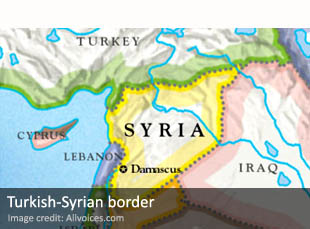
Turkish-Syrian borderBy JOSEPH FITSANAKIS | intelNews.org |
A growing team of United States Central Intelligence Agency personnel is currently in Turkey overseeing a multinational effort to secretly deliver weapons to Syrian anti-government rebels, according to The New York Times. Quoting “American officials and Arab intelligence officers”, the paper said last week that the weapons are being smuggled into Syria primarily through the Turkish border. The financial cost of smuggling into Syria such weapons as antitank explosives, rocket-propelled grenades, and automatic rifles, has so far been covered by the governments of Turkey, Qatar and Saudi Arabia, according to the article. The funds are partly required to bribe members of what The Times describes as “a shadowy network of intermediaries”, which reportedly includes forces loyal to the Syrian Muslim Brotherhood. The latter is a Sunni group that is widely viewed as the most dominant of the anti-government factions that make up the rebel side in the ongoing Syrian uprising. The paper quotes an “Arab intelligence official”, who says the CIA contingent in Turkey “is trying to make new sources and recruit people” along the porous Turkish-Syrian border. But its presence in the volatile region, which has been constant for “several weeks”, according to The Times, is also aimed at keeping the smuggled weapons out of the reach of Syrian anti-government forces that are allied with militant Islamist groups, including al-Qaeda. The article notes that American support for the Syrian rebels has been minimal, when compared with that in Libya in 2011, mostly because of staunch Russian support for the government forces of Syrian president Bashar al-Assad. Read more of this post

US and Israel behind computer virus that hit Iran, say sources

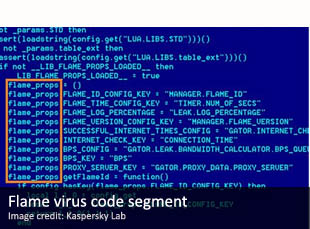
Flame virus code segmentBy JOSEPH FITSANAKIS | intelNews.org |
Flame, a sophisticated computer malware that was detected last month in computers belonging to the Iranian National Oil Company and Iran’s Ministry of Petroleum, was created by Israel and the United States, according to a leading American newspaper. Quoting “officials familiar with US cyber-operations”, The Washington Post reported on Wednesday that the malware, which is said to be “massive in size”, is part of a wider covert program codenamed OLYMPIC GAMES. The paper said that the US portion of the program is spearheaded by the National Security Agency, which specializes in cyberespionage, and the CIA’s Information Operations Center. The Post further claims that OLYMPIC GAMES has a three-fold mission: to delay the development of the Iranian nuclear program; to discourage Israeli and American officials from resorting to a conventional military attack on Iran; and to buy time for those officials who favor addressing the Iranian nuclear stalemate with diplomatic pressures coupled with sanctions. According to one “former intelligence official” quoted in The Post, the scale of OLYMPIC GAMES “is proportionate to the problem that’s trying to be resolved”. Russian antivirus company Kaspersky Lab, which first spotted the Flame virus in May, said that it is “one of the most complex threats ever discovered”. It is over 20 megabytes in size, consisting of 650,000 lines of code. In comparison, Stuxnet, a computer super-virus that was detected by experts in 2010, and caused unprecedented waves of panic among Iranian cybersecurity experts, was 500 kilobytes in size. Read more of this post

Russian professors jailed for passing military secrets to China

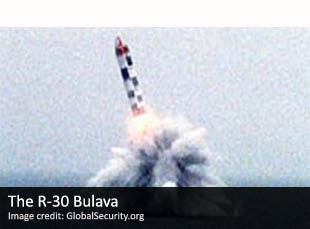
The R-30 BulavaBy IAN ALLEN | intelNews.org |
Two Russian professors were convicted yesterday of handing over to Chinese government agents highly classified technical details about one of Russia’s most secretive military projects. Svyatoslav Bobyshev and Yevgeny Afanasyev, both employees of the military-affiliated Baltic State Technological University in St. Petersburg, had been arrested in March 2010 on suspicion of spying for a foreign government. The two have now been sentenced by the St. Petersburg City Court to 12 and 12 ½ years in prison respectively, after having been found guilty of treason. According to the court documents, Bobyshev and Afanasyev traveled to China in 2009, where they passed on to Chinese military intelligence officers highly secret technical details about Russia’s R-30 Bulava ballistic missile. Specifically, the two professors are accused of sharing information relating to Bulava’s underwater launch specifications. Additionally, the Russian government prosecutor said that the two were preparing to provide the Chinese with information about two of Russia’s land-based missile systems, the Topol-M and Iskander. The R-30 Bulava (the Russian word for “mace”) is the name for Moscow’s latest-generation submarine-based ballistic missile technology. It is widely considered to be one of the future cornerstones of Russia’s nuclear weapons capability, and is thought to be the most expensive weapons project currently being developed in the country. The missile was approved for production last year, and is expected to come to service this coming October, when it will begin to replace Russia’s Soviet-era stock of submarine-launched nuclear missiles. Read more of this post

Western spy agencies ‘sharing intelligence’ with Syrian rebels

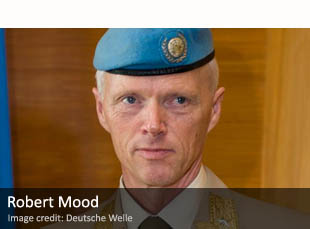
Robert MoodBy JOSEPH FITSANAKIS | intelNews.org |
A British newspaper has cited defense sources claiming that British and American intelligence agencies are passing vital information to Syrian rebels fighting to overthrow the country’s government. British tabloid The Daily Star quoted “a British defense source” who said that most of the raw intelligence on Syria is picked up by sophisticated British and American satellites monitoring Syrian communications. Once gathered and assessed by intelligence analysts in Washington and London, the information is passed on to operatives of the United States Central Intelligence Agency and Britain’s MI6, who are allegedly operating on the ground in Syria. They in turn communicate actionable intelligence to rebel leaders in Syria, who are fighting the government of Syrian President Bashar al-Assad. According to the British tabloid, information passed on to rebel leaders includes detailed satellite imagery of Syrian pro-government troop movements around the country, as well as the contents of intercepted communications between senior Syrian military commanders and their subordinates in the field. The Star quotes one unnamed British government source who claims that the satellites are so sophisticated that they allow British and American eavesdroppers to identify the individuals whose voices are heard in the intercepted communications, with the aid of advanced voice recognition systems. The intelligence has reportedly enabled rebel commanders to evacuate locations targeted by government forces, and may also have allowed the rebels to organize successful counterstrikes in response to offensives conducted by troops loyal to Damascus. Washington-based publication The Hill contacted the CIA and the White House but their spokespersons refused to comment on what they called “an ongoing intelligence operation” in Syria. A spokesman from the British Foreign and Commonwealth Office would only tell The Star that “all actions remain on the table”.   Read more of this post

Founder of Polish special forces unit found shot dead in Warsaw

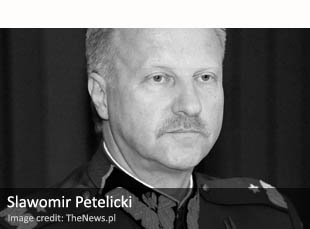
Slawomir PetelickiBy JOSEPH FITSANAKIS | intelNews.org |
Polish authorities have launched an official investigation into the death of a senior retired military intelligence officer who founded Poland’s best-known special forces unit. The body of Brigadier General Slawomir Petelicki, who held senior intelligence positions in both communist and post-communist Poland, was discovered by his wife on Saturday. It was reportedly lying on a pool of blood on the floor of the garage located under his apartment in the Mokotow district of Polish capital Warsaw. Polish media said on Monday that Petelicki’s body carried a single gunshot wound to the head and that a gun was found at the site. Petelicki, 66, had joined Poland’s Ministry of Internal Affairs in 1969 and was soon afterwards posted as a “Military Attaché” at the Polish consulate in New York. He later served in a similar capacity at the Polish embassy in Stockholm, Sweden, as well as in China and North Vietnam, among other countries. He managed to survive the post-communist purges in Poland’s intelligence community, and in 1990 he was assigned to a brand new special forces unit codenamed JW 2305. Through his leadership, the obscure unit was eventually transformed into the GROM (meaning ‘thunder’ in Polish) Special Forces regiment, which he led from 1990 until 1995. Initially, the existence of GROM was kept secret and was not openly acknowledged by the Polish government until 1994. Polish authorities said on Monday that they were treating Petelicki’s death as a case of suspected suicide. But many of the late intelligence officer’s colleagues and friends have voiced skepticism about the alleged suicide, claiming that the Brigadier General had not seemed depressed, and that he was not the kind of person who would contemplate taking his own life. Read more of this post

CIA ‘seriously damaged’ China’s overseas spy network, sources say

Ministry of State Security branch office in Hubei Province, ChinaBy JOSEPH FITSANAKIS | intelNews.org |
A high-level Chinese security official, who was arrested earlier this year in China for spying for the United States, compromised several Chinese agents operating on American soil, according to sources. Reuters news agency, which broke the initial story of the Chinese official’s arrest earlier this month, published last week a lengthy update on the spy affair. The article quoted “two sources with direct knowledge on the matter”, who claimed the issue was considered serious enough in Beijing to prompt the personal intervention of Chinese President Hu Jintao. Jintao, who is also General Secretary of the Communist Party of China, personally ordered an investigation into the case, said Reuters. The investigation focused on China’s Ministry of State Security (MSS), China’s primary intelligence agency, where the accused spy was reportedly working at the time of his arrest. Although Chinese media have remained silent on the issue, the arrested official is said to have worked as a senior aide to MSS Vice Minister Lu Zhongwei. The Reuters article alleges that the investigation, which is said to be continuing, has concluded that the aide had been a paid informant of the US Central Intelligence Agency, and that the information he provided to the CIA included “political, economic and strategic intelligence”. But the sources also told Reuters that some of the government secrets that the MSS aide gave the CIA related to China’s network of spies operating on American soil. The latest Reuters article strengthens the widespread view that the latest espionage scandal caused serious damage to China’s espionage network in the US. Some observers now argue that this represents China’s most damaging espionage scandal since 1985, when Yu Qiangsheng, a senior Chinese intelligence official, defected to the United States. Read more of this post
South African intel officials faked threats to increase spy budget

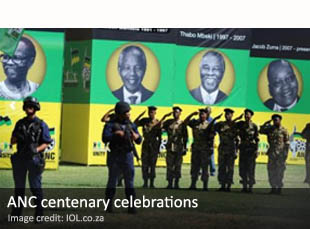
ANC centenary celebrationsBy JOSEPH FITSANAKIS | intelNews.org |
The tendency of some spy agencies to overstate security threats in order to secure governmental funds is hardly novel. But officials in the South African Secret Service appear to have gone a step further: they allegedly paid some of their informants to make bogus threats against the government, in order to prompt an increase in counterterrorist funding. According to Pretoria News, which is owned by The Independent, South Africa’s largest newspaper consortium, the bogus threats were aimed at creating “a false impression of imminent, unprecedented attacks on black people and African National Congress (ANC) members”. The ultimate goal of the perpetrators, says the paper, was to benefit personally from an increase in counterterrorist funding, which is said to run at around R600 million (US$72 million) per year. The plan was carefully designed to coincide with the run-up to the ANC’s centennial celebrations, which took place in January of this year. In one case, an informant was paid by Secret Service officials to record a video message threatening an uprising by whites against the country’s black-majority government, unless the latter put an end to the occupation of white-owned farmland by landless peasants. One video, which made “chilling threats” against black Africans and members of the ANC, was made publicly available on YouTube, causing widespread concern and prompting the government to beef up security measures around ANC facilities in several areas of the country. The threats also led to an extensive government investigation. Read more of this post

‘Massive expansion’ in US covert operations in Africa

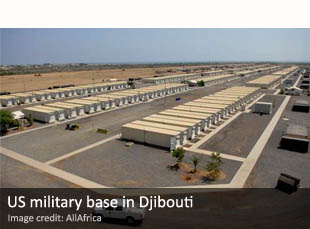
US military base in DjiboutiBy JOSEPH FITSANAKIS | intelNews.org |
The United States administration of President Barack Obama is implementing a near-unprecedented expansion of covert operations by American military forces throughout Africa, aimed at a host of armed groups deemed extremist by Washington. A lead article published yesterday in The Washington Post quotes over a dozen unnamed American and African officials, as well as military contractors, who refer to the US military-led effort as Project CREEKSAND. It allegedly involves secret operations in several African countries, conducted out of a large network of small air bases located in strategic locations around the continent. According to The Post, most of the airplanes used in Project CREEKSAND are small, unarmed, disguised to look like private aircraft, and bear no military markings or government insignia. In reality, however, they carry sophisticated electronic equipment designed to collect signals intelligence, while some are used to transport US Special Forces troops during capture or kill missions. The paper quotes an unnamed “former senior US commander […] involved in setting up the [air bases] network”, who alleges that the US government has built about a dozen such bases throughout Africa since 2007. These secret air bases are located in countries such as Mauritania, Burkina Faso, Ethiopia, Djibouti, Uganda, South Sudan, Kenya, and Seychelles. Most of the US personnel involved in Project CREEKSAND consists of Special Operations forces tasked with “training foreign security forces [and] performing aid missions”. However, The Post alleges that there are also small teams of US operatives who are “dedicated to tracking and killing suspected terrorists”. Read more of this post