Does Iran have access to satellite jamming technology?
December 20, 2011 5 Comments
 By JOSEPH FITSANAKIS | intelNews.org |
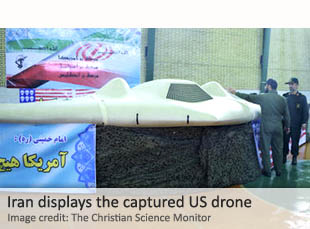
A European intelligence official has said that Iran downed an unmanned American surveillance aircraft earlier this month by remotely sabotaging its satellite navigation system. The official, who has not been named, told The Christian Science Monitor that the Iranians used a state-of-the-art laser system to effectively “blind” the American spy satellite that guided the drone’s global positioning system (GPS). In doing this, Iran’s military was able to remotely skyjack the aircraft and assume control over its navigational system. The paper also published an exclusive interview with an Iranian electronic warfare specialist, who claimed he was part of a team that hacked into the drone’s communication frequency and reprogrammed its GPS data. Eventually, the Iranian specialists managed to cause the unmanned aircraft to switch into autopilot mode, and guided it to land relatively smoothly on Iranian territory, where it was eventually captured intact by Iranian authorities. If this is true, it will mark the first-ever indication that the Iranian state is in possession of sophisticated satellite jamming technology. In an important development, Iran’s Minister of Foreign Affairs, Ali Akbar Salehi, told Iran’s government-run IRNA news agency on Saturday that the American drone was brought down by Iranian armed forces, without any foreign assistance. If this is so, then does it mean that the Iranians developed the state-of-the-art jamming system themselves? Read more of this post
 By JOSEPH FITSANAKIS* | intelNews.org |
















Announcement: intelNews gets down with social networking
December 20, 2011 Leave a comment
This blog first boarded the social-networking train by joining Twitter, in June of 2009. Back then Leon Panetta was in the hot seat at the CIA, US troops (of the non-mercenary kind) were still in Iraq, Osama bin Laden was living the high life in exotic Abbottabad, and South Korean intelligence were trying to kill the North’s “dear leader”, Kim Jong-Il. We’ve since managed to post over 1,200 Tweets, and have attracted a microblogging community numbering a moderately respectable 600 members. If you haven’t signed up, you can do so, here. Today we’d also like to invite you to join our newest adventure in the land of social networking, by signing onto Facebook and becoming a member of our new breathtaking, awe-inspiring page, which is located here. Our grand plan is to use the new page as a way to interact with our readers on a more frequent basis, and to invite further feedback and discussion on issues of concern to intelNews readers. Check us out, and let us know of your thoughts. We also have a hip new channel on YouTube, where we post audiovisual content relating to our work, including our research and periodic media appearances. You can find the YouTube channel here. In case you didn’t know, you can also share or bookmark articles that appear on intelNews, you can subscribe to read intelNews in one of the popular readers out there, you can get intelNews articles on your email, and you can even place our headlines on your website or blog. So there. I think we’ve covered everything. Or, have we? If you have any suggestions or advice for our growing social-networking empire, get in touch.
Filed under Expert news and commentary on intelligence, espionage, spies and spying Tagged with announcements, social networking